People
Rakyat Pasti Menang (The People United Will Never Be Defeated): Interview with Taring Padi, Part III
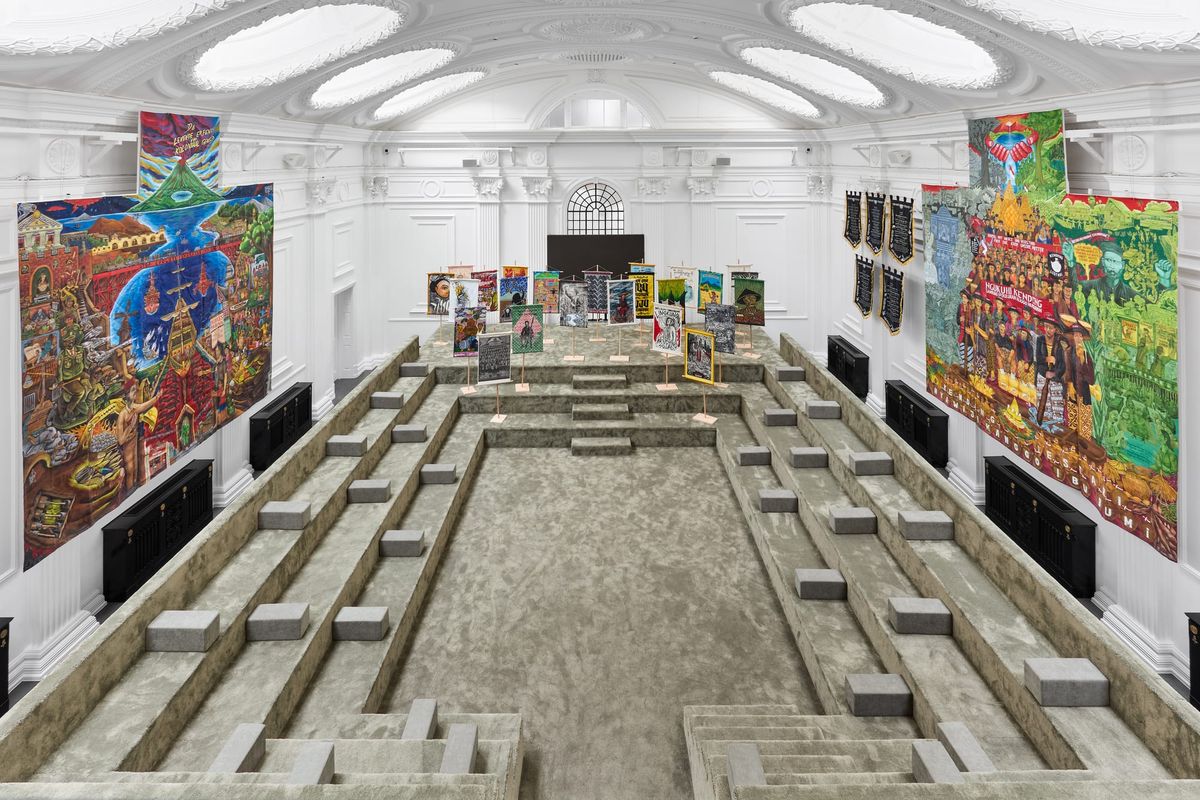
After Documenta 15, Taring Padi’s newfound prominence led them to engage in broader solidarity efforts around global issues such as colonialism and the Palestinian struggle. Part III of our interview series discusses the Indonesian collective’s recent works in their third and final chapter of “Rakyat Pasti Menang” at Ibraaz London, which closes on November 22.
The interview was conducted with Alexander Supartono, a first-generation member of Taring Padi and an associate professor at Edinburgh Napier University. Follow the links for Part I and Part II to read the full conversation.
The centerpieces of this final chapter of “Rakyat Pasti Menang” are two massive banners, the fourth and fifth in the People’s Justice series (2023–26). This series grew out of your experience with your 2002 banner of the same name that was shown at Documenta 15 in 2022. You’ve said that Documenta was a turning point, after which Taring Padi was “no longer an outsider” in the art world. How did that experience inform Taring Padi’s practice in terms of the subsequent issues you chose to focus on, your artistic language, and your collaborators?
Our artistic language, in terms of realist style, details, and the use of text, hasn’t changed. But the scope and scale of our operational field have expanded beyond our expectations. We participated in Documenta 15 to broaden our solidarity works, to connect with different movements across the Global South, and to utilize this well-known contemporary art event as a platform for our political projects. Our presentation there was titled “Flame of Solidarity.”
The People’s Justice series is only possible because of widespread support following the controversy around that original People’s Justice banner from 2002. Our subsequent international collaborations were and still are part of solidarity acts initiated by our friends and comrades whom we met in Kassel and beyond. We also had the backing of established art institutions—museums, biennales, and festivals—which thrust Taring Padi into the very center of the contemporary art ecosystem. Having said that, we continue to collaborate with comrades outside the conventional art circuit. Our collaborations with trade unions, for example, have intensified in the past two years.
The People’s Justice series features nine monumental banners that address different subjects but share similar tripartite compositions. There’s usually a literal explosion at the top, followed by a flood of demonstrating citizens or villagers down the center. This repeated form brings to mind Antonio Gramsci’s concept of the interregnum, where “the old is dying and the new cannot be born; in this interregnum a great variety of morbid symptoms appear.” How did you decide on this particular structure and visual language to represent the many crises in the world today?
The majority of our large-scale banners follow this compositional structure: the baddies on the left side, the goodies on the right, and the middle occupied by the main message or topic. We deliberately choose this classic binary distinction between heroes and villains because it serves the main objective of the banner as a propaganda tool: informative, simple, and to the point, with minimal room for ambiguity. In terms of art history, the composition recalls Diego Rivera’s schematism, and our inspirations—particularly for zoomorphized characters—are equally drawn from Hieronymus Bosch and George Grosz, as well as from Indonesian folk traditions and Javanese shadow puppet figuration. I think we take Gramsci’s “interregnum” concept further by offering solutions for a new world order. For example, the original People’s Justice no. 1 proposed the “people’s tribunal,” and People’s Justice no. 9, which is about the Palestinian struggle, envisions the rightful establishment of Palestinian autonomy.
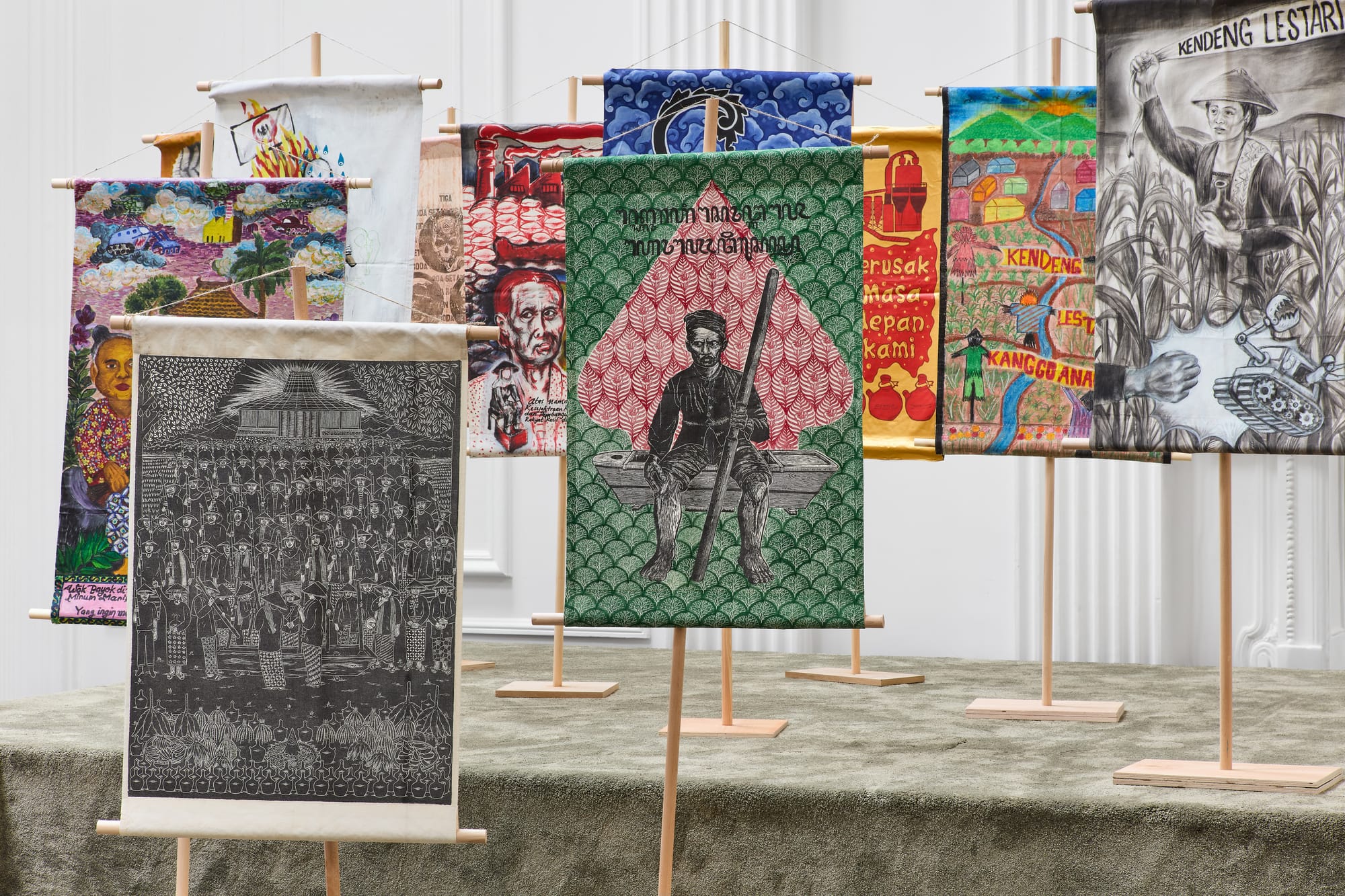
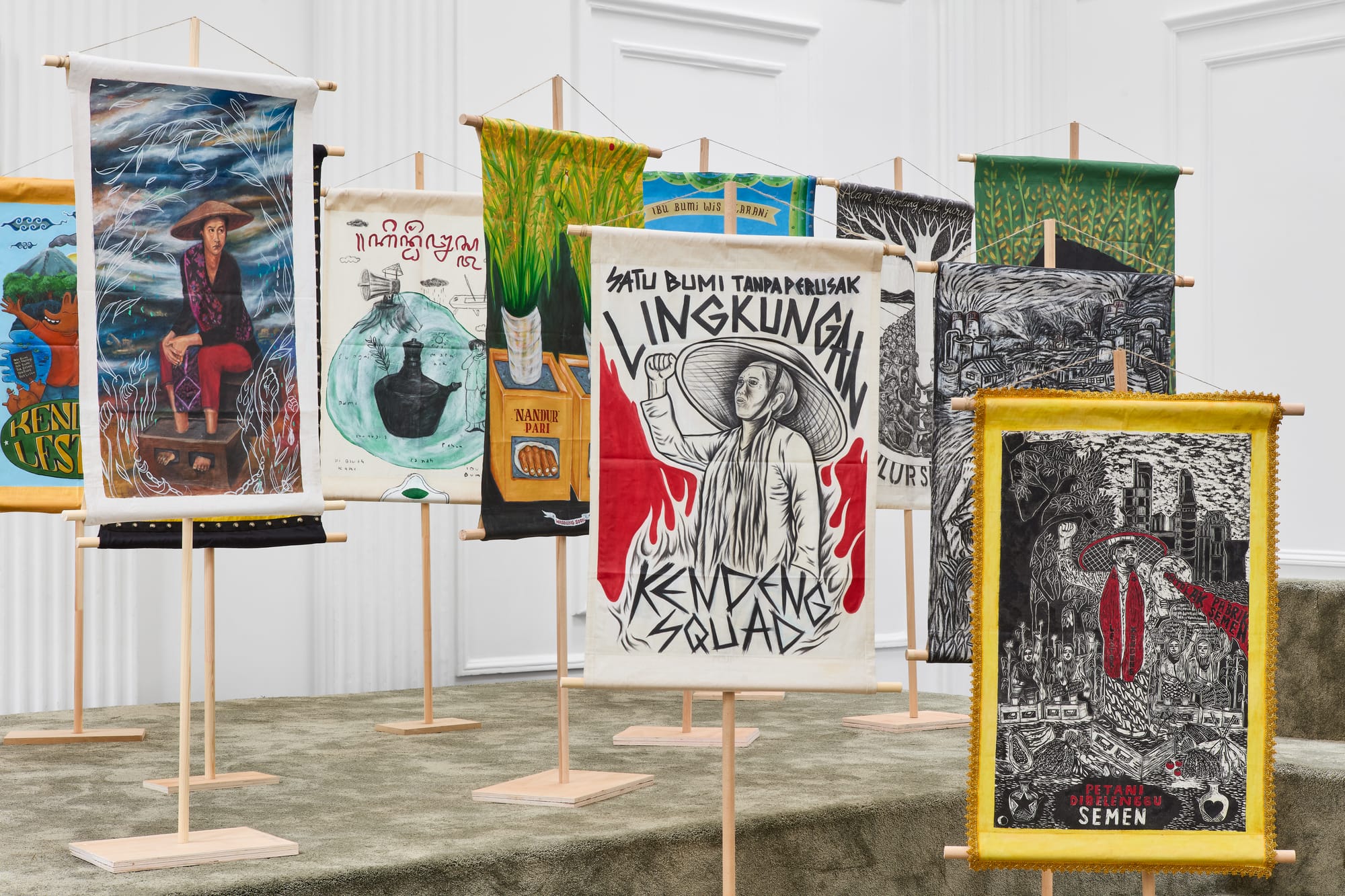
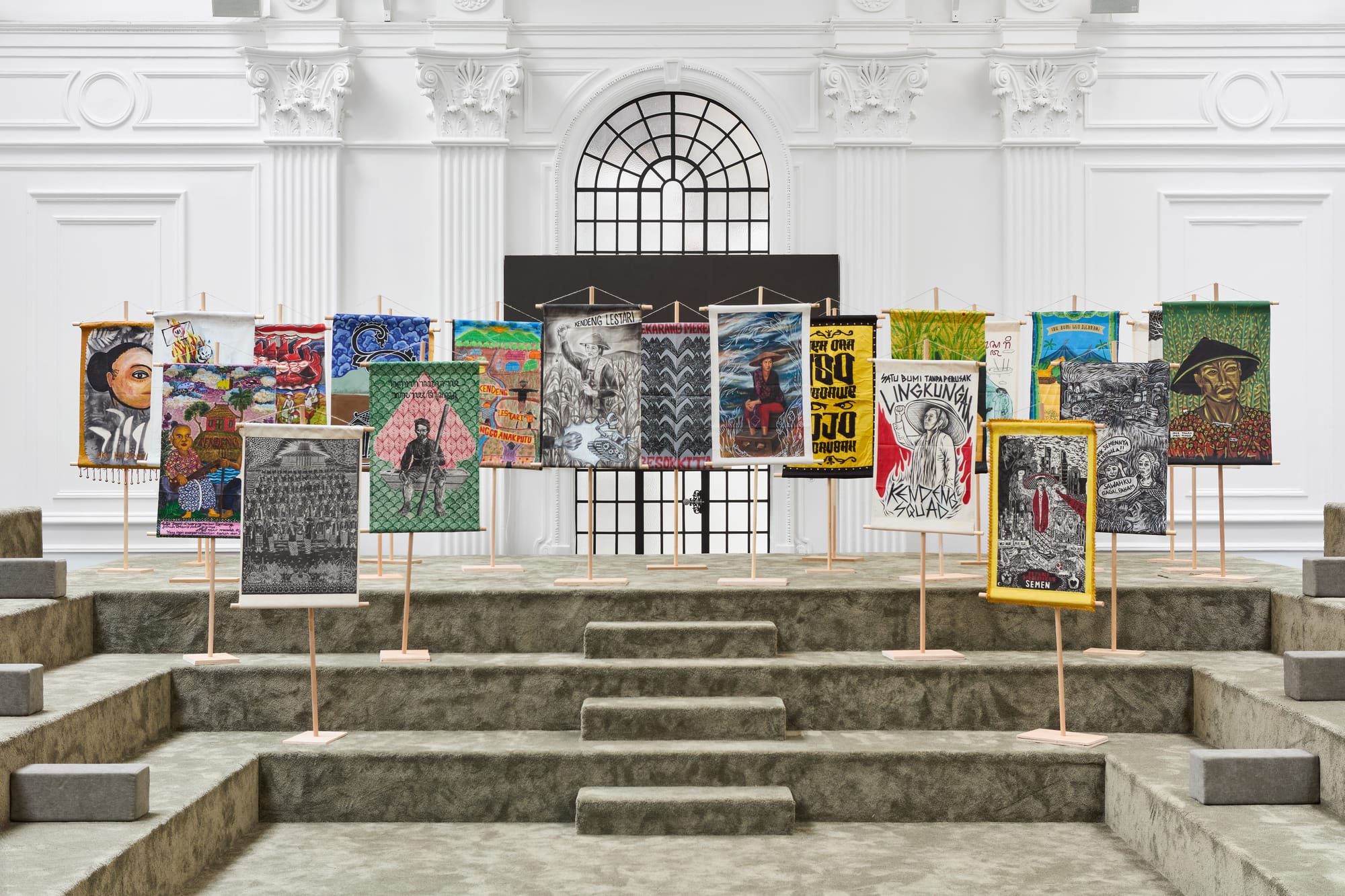
Detailed installation views of TARING PADI’s “Rakyat Pasti Menang” at Ibraaz, London, 2026. Photos by Ollie Hammick. Courtesy the artists and Ibraaz.
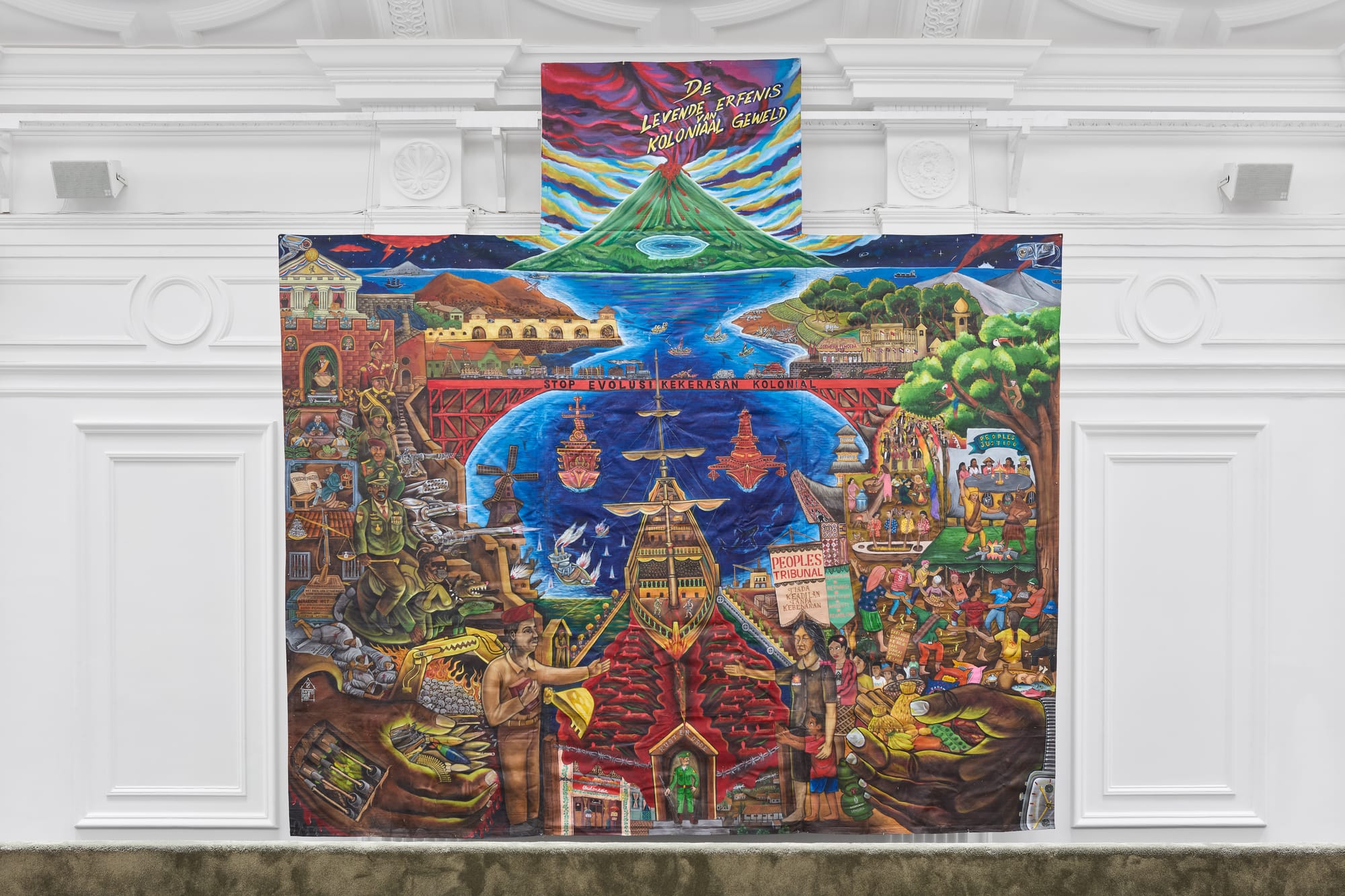
De Levende Erfenis van Koloniaal Geweld, made for your 2023 exhibition at Amsterdam’s Framer Framed, affirms that neo-colonialism is alive and well almost 80 years after the Dutch withdrawal from Indonesia. Could you tell us more about this scene, and how you decided on this banner’s composition and visual language?
When we started preparing the Amsterdam exhibition, we realized that we had never directly addressed our own colonial history in our works. Our very first show in the country of our former colonizer triggered our banner on this long-overdue topic. As our works over the years testify, the genocide of Indonesian communists is one of Taring Padi’s main topics. The Amsterdam exhibition provided an opportunity to get in touch with the Indonesian community-in-exile from 1965, to listen to their stories, and contextualize them within the continuous legacy of European colonial violence since Dutch ships arrived in the archipelago in the late 16th century.
We translated this into the three figures in the foreground standing on either side of the bloodied cemetery-river. They represent one of many families separated during the 1965 Indonesian genocide in which the Netherlands was part of the Western coalition supporting the communist pogrom. The father became a political exile, ironically, in the Netherlands—the very country he had fought against during the revolution for independence—while his wife and son were left behind in Indonesia. Through this family chronicle, the banner highlights the devastating impact of the evolution of colonial violence. More importantly, it also offers solutions as the three small banners carried by protesters behind the wife demand: “People Tribunal is a must because there is no justice without truth, and it should deliver reconciliation, reparation, restitution, amnesty, and rehabilitation across the whole archipelago, from downstream to upstream, from the river to the sea.”
The other large banner, Kendeng Lestari, Nyawiji Kanggo Ibu Bumi (2023) depicts members of the Sedulur Sikep, a Central Java community, protesting against multinational corporations’ plans to build a cement factory on their agricultural land. However, as we know, the conversation around progress is not always clearcut. In the Kendeng case, some villagers wanted to accept the buyout, and often people see participation in capitalist activity as a necessary step toward better living standards. Please tell us about Taring Padi’s long-term work with the Sedulur Sikep community and the role of art in unpacking and mediating these issues.
This banner is dedicated to the lifelong mission of the Sedulur Sikep community, with whom Taring Padi has been working over the past two decades. Specifically, it addresses their fight against the development of a state-owned cement factory in their karst-rich area along Kendeng mountain that stretches across East and Central Java. The banner also exemplifies Taring Padi’s operational principles: learning and working together in a long-term collaboration in order to establish progressive alliances. We got in touch with them for the first time in 2006 through one of our members from the area; personal connection is often significant in our collaborations. We printed the Farmers Give Life to All banner for their demonstration, which they still have to this day!
Our collaboration intensified when nine peasants were arrested during a 2009 demonstration opposing the development of a cement factory in Pati, which was followed by a long court battle. Taring Padi produced five woodcut prints to support this campaign. We won! The nine peasants were released and the factory development was canceled. In 2012, the factory changed its name and moved the development to Rembang with full support from the local government and military. We continued our fight, which led to the 2016 silent sit-in protest in front of the Presidential Palace in Jakarta, where the peasants cemented their feet in wooden boxes for days.
This action became a national inspiration and the focal point of the banner. During this long ordeal, we formed different alliances, including the Community Network Concerned for the Kendeng Mountains (JM-PPK), of which Taring Padi is a member. This alliance maintains and nurtures the struggle beyond the fight against the factory. The principle of “Sambang, Sambung, Sumbang (to visit, to connect, to contribute)” is embedded within our collective and guides us when we establish new alliances.
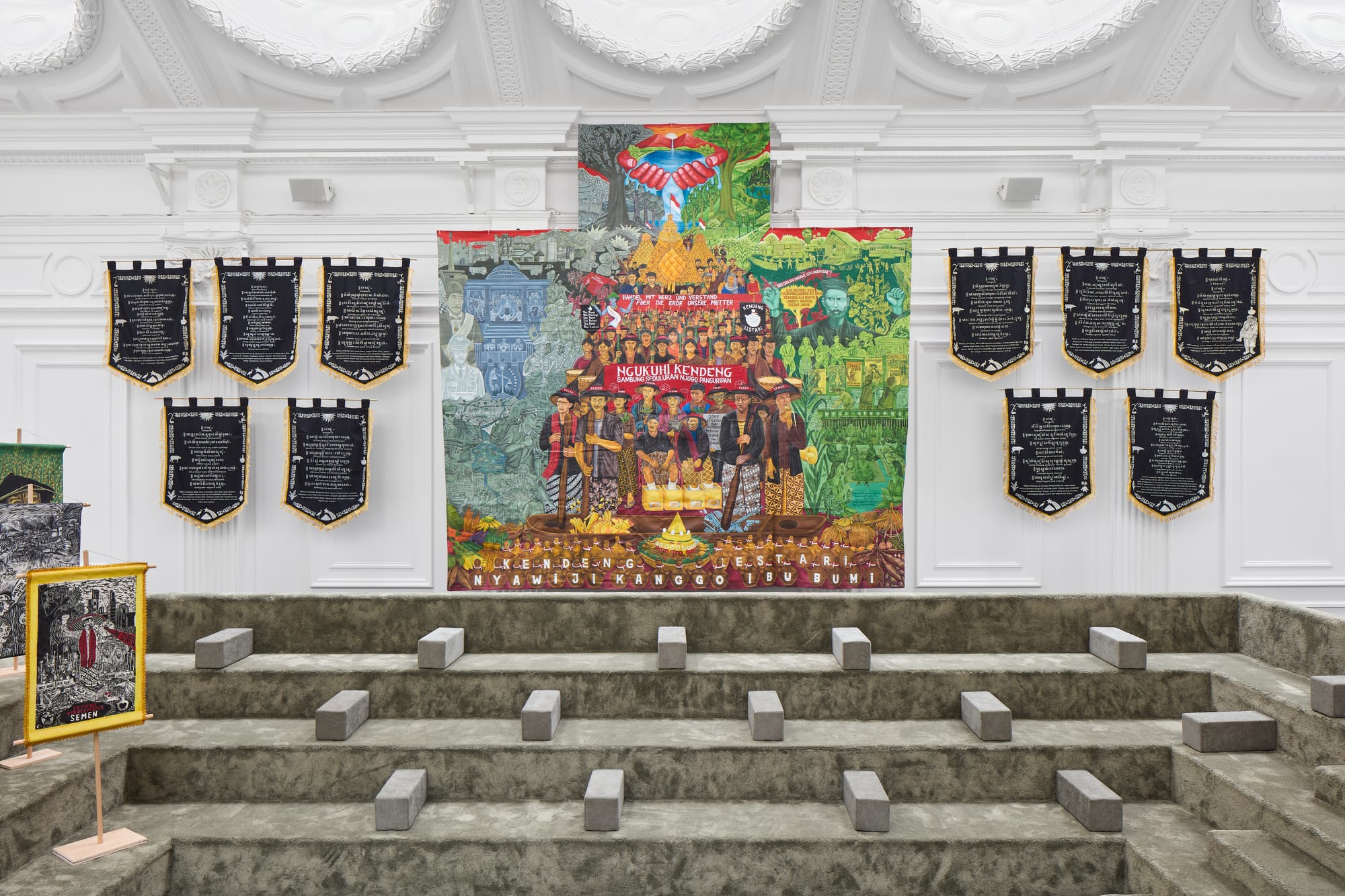
The factory was eventually built in Rembang in 2017, which is what you referred to with your comment that some villagers wanted to accept the buyout. We neither judge their decisions nor intend to mediate; this is beyond our scope and capacity as a collective of art workers. What we can do is be an active member of the JM-PPK alliance, whose members are still resisting. This is the most valuable learning point for Taring Padi: never boycott or even cancel those who are fighting by your side, and always look at the bigger picture of collective struggle. One of the villagers’ songs, Ibu bumi wis maringi, Ibu bumi dilarani, Ibu bumi kang ngadili (translated from Javanese: “Mother Earth provides, Mother Earth is being hurt, Mother Earth will deliver judgment”) inspired many of our works. We embrace the spirit of their protests that are often embedded in rituals such as lamporan—night marching with torches in a pilgrimage to spring waters and rice fields to remove bad omens. Their militant, creative, non-violent and ritual-based protests are sources of inspiration and power for our common struggles.
The ongoing forest fires in Indonesia similarly show that extractive capitalism causes great harm to nature, indigenous wildlife, and local communities on multiple levels. Has Taring Padi been involved in any actions related to this matter?
We have joined protests in Yogyakarta related to the burning of tropical forests in Kalimantan and West Papua by palm oil agro-industries. Our involvement there is not as hands-on as with, for example, the Kendeng struggle. As there is no way we can be actively involved in all struggles, sometimes we just “contribute” with our works. Three years ago, we were invited to contribute to the campaign of Rainforest Action Network (RAN) and Justseeds. RAN works in solidarity with Indigenous and local communities to resist forest destruction in Indonesia and beyond. Justseeds, an artist cooperative, contributes visual materials to grassroots movements for justice. We produced Jungle of Hope (2023), a woodcut triptych that addressing urgent concerns and calls for action and solidarity around environmental justice and Indigenous land rights.
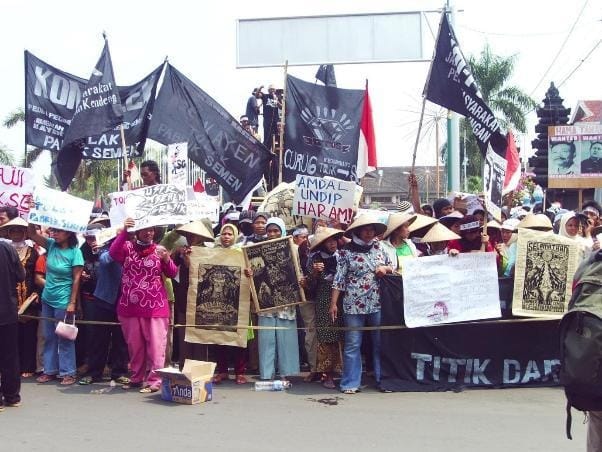
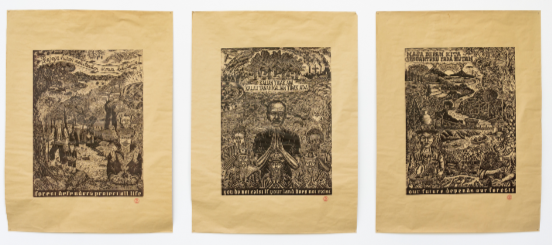
Photograph of TARING PADI’s woodcut prints in a protest during a court battle against the development of Gresik cement factory in Pati, Central Java, 2009 (left); and TARING PADI, Jungle of Hope, 2023, woodcut on paper, series of three, 120 x 80 cm (right). Courtesy the artists.
The People’s Justice series at Sale Docks this summer was a highlight of the 61st Venice Biennale’s collateral events, particularly amid the extraordinary pro-Palestinian rallies. How has the conversation around Taring Padi’s work—as a barometer of American and European acknowledgment of responsibility for ongoing colonial violence—changed or evolved since October 7, 2023? Has the UK’s unremitting crackdown on pro-Palestinian speech been a factor in deciding what works to exhibit at Ibraaz?
The current conversation around our works has been very positive, the exact opposite of our experience with the media—mainly German outlets—during Documenta 15. Our works are significantly more visible and have been reviewed by established media such as ArtReview, Art Monthly, ARTnews, and Artribune. You’re conducting a three-part interview with us about our exhibition at Ibraaz. So we have nothing to complain about. At the same time, we keep reminding ourselves about the bigger picture—about our struggle and the underlying objectives of our artistic practice—which is clearly never just about art in itself.
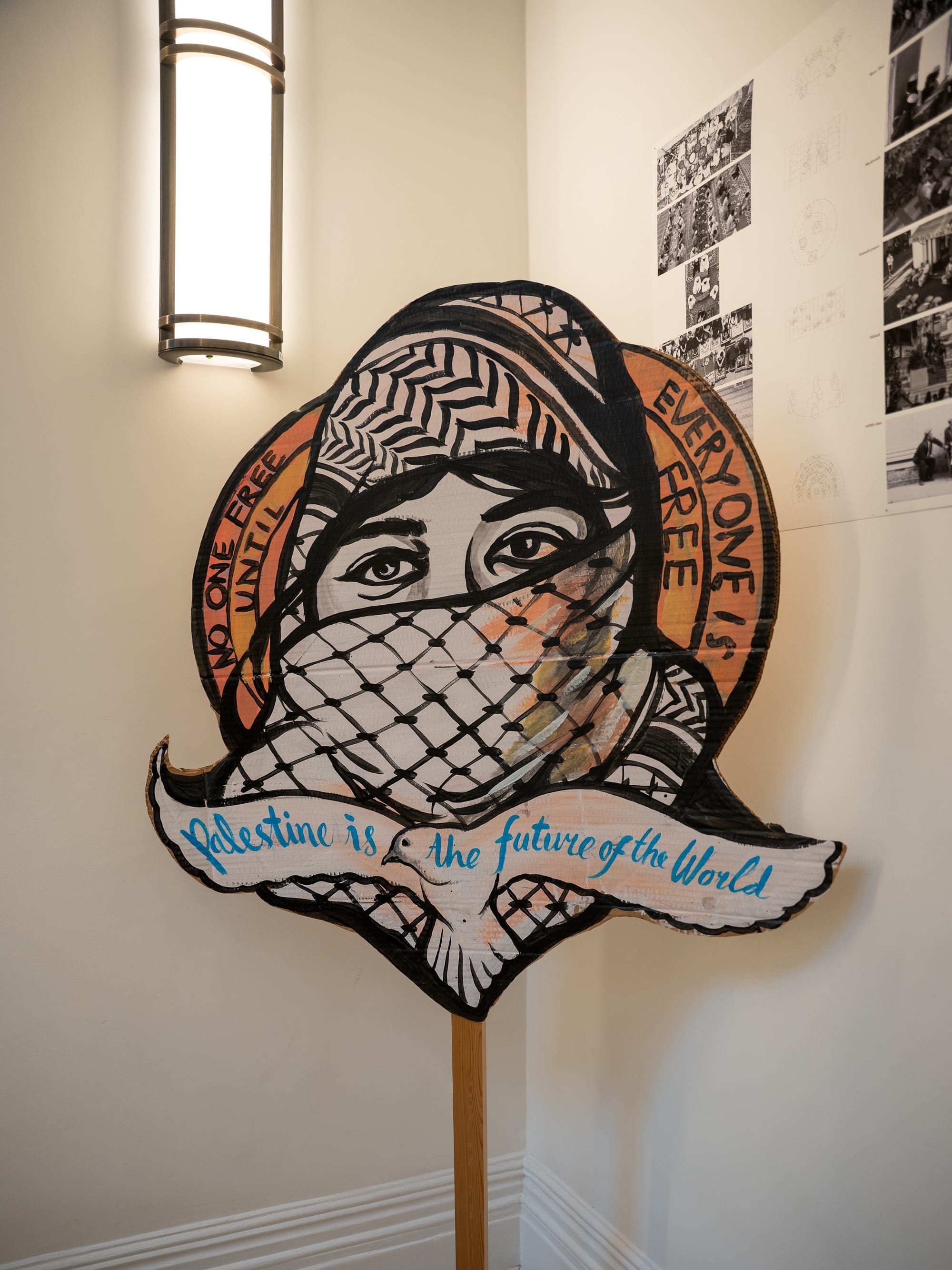
Since the summer of 2022, Taring Padi has become more and more involved in Palestinian struggles, and this intensified after October 7, 2023. It’s not enough for us to collaborate. We need to establish progressive alliances and one of our guiding principles in selecting collaborators is their stance on the Palestinian struggle. We agreed to show our work at Ibraaz because of their position on the Palestinian issue in the UK and in the world. The cardboard puppets we produced for this exhibition directly respond to the UK’s crackdowns on pro-Palestinian speech.
You’ve said that this exhibition is an opportunity for Taring Padi to work on more in-depth archiving and documentation. Can you share more about Taring Padi’s plans for such archiving—particularly regarding the works’ collective production—and their activist function and social impact, which are more elusive metrics but certainly central to your artistic ethos? Is there any change in how you preserve your works, especially the smaller rontek and panji-panji, in light of future exhibitions?
While preparing the show, we rediscovered the Marsinah banner (1997–98) which was part of the second chapter of this exhibition. The Ibraaz show gave us the opportunity to properly register our works because we needed to make selections. In our previous three solo shows we simply displayed everything! This is a milestone achievement in archiving for us. But we also archive works based on their potential use value in the near future. For example, the Kendeng banner together with the smaller ronteks and panji-panjis will travel back to Yogyakarta because they will be more useful there. The Palestinian banner will stay in Europe because it will be more needed here. De Levende Erfenis van Koloniaal Geweld will travel to Rome for a group show at the Museum of Civilisations. We don’t need to centralize our works in one place; instead, we store them wherever the latest activity took place, and they will then travel on to the next stop.
Your profile is highly unique as an artist collective based in Yogyakarta, with some key members such as yourself based overseas, and projects all over the world. How do you manage practical issues of internal communication and decision-making?
We spend a ridiculous amount of time in Zoom meetings! We avoid voting to make decisions and instead do things through consensus. As a consequence, we talk a lot! As I mentioned earlier we have guiding principles for collaboration, which include consulting a “toxic philanthropy” list. Sometimes we simply substitute a potentially long discussion with a question: “Are they comrades?”
Chin-chin Yap is a Singaporean writer and filmmaker based in Lisbon, and a contributing editor for ArtAsiaPacific.