People
Making Space for Uncertainty: Han Nefkens Moving Image Commission

In 2021, the Han Nefkens Foundation joined forces with the Singapore Art Museum (SAM), the Mori Art Museum (MAM) in Tokyo, and M+ in Hong Kong to establish the Moving Image Commission, a USD 100,000 award supporting a new screen-based work. Unlike many large-scale prizes that emphasize spectacle and established names, the commission was ambitious yet deliberately modest, giving a midcareer artist from Asia the time and means to create a new work that would be exhibited and enter the permanent collections of all three institutions.
The inaugural recipient was Vietnamese artist Nguyễn Trinh Thi. In 2023, the second commission went to Hao Jingban. Born in 1985 in Shanxi province and based between Yunnan province in China and Berlin, Germany, Hao is known for her research-driven films that excavate overlooked moments in contemporary Chinese history.
Five years after its launch, the partnership has evolved from an experimental co-commission initiative into a sustained framework for collection-building and cross-institutional dialogue. In this conversation with Elaine W. Ng of ArtAsiaPacific, Han Nefkens (HN), the founder of the Barcelona-based foundation; Eugene Tan (ET), the director of SAM; Shabbir Hussain Mustafa (SHM), chief curator of SAM; and Hao Jingban (HJB) together reflect on the quiet origins of the initiative, its impact, and how the model has grown and continues to feel necessary.
When did you and Han first meet, and when did you begin discussing the Moving Image Commission? Did the idea emerge immediately, or did it develop as you got to know each other’s organizations better?
ET: Han, Hilde, and I had known each other for a while. They were members of the juries I participated on for the Southeast Asian Prize in 2014, for the Bangkok Art and Culture Centre (BACC). That was the first time I met Han, and we stayed in touch over the years. But then in early 2020, just before COVID got really serious, Hilde was in Singapore; that’s when we started talking about this new initiative. I suggested collaborating with M+ and MAM, so that the artists would get more opportunities to show and have their works enter more museum collections. Mami very kindly agreed, and so did Suhanya.
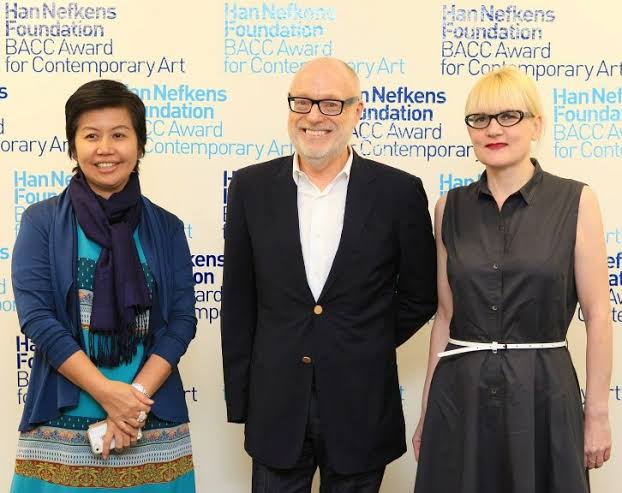
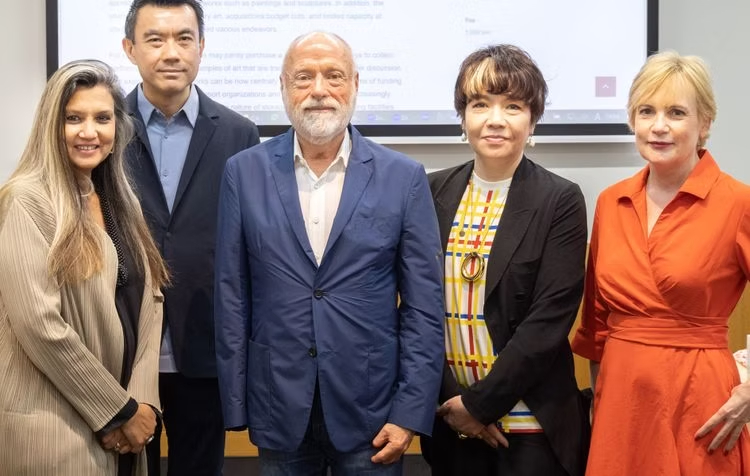
Portrait of (left to right) LUCKANA KUNAVICHAYANONT, HAN NEFKENS, and HILDE TEERLINCK, at the Bangkok Art and Culture Centre (BACC), 2013; and portrait of (left to right) SUHANYA RAFFEL, EUGENE TAN, HAN NEFKENS, MAMI KATAOKA, and HILDE TEERLINCK at the jury meeting of the Han Nefkens Foundation, the Mori Art Museum (MAM), M+, and the Singapore Art Museum – Moving Image Commission 2023, at MAM, Tokyo. Courtesy the Han Nefkens Foundation.
So the idea grew out of that relationship rather than happening immediately?
ET: It’s very much Han’s way of working in a collaborative manner. Hilde said, “We want to work with you on the commission.” They were open to what form it would take, so we talked, and that’s when this came about.
Why M+ and MAM? What did you hope they would bring to the project?
ET: At the time, these two museums were doing very interesting things in Asia and were among the more important institutions in the region. We knew each other well, but we hadn’t yet worked on anything together.
HN: One of the unique parts of this commission is that museums work together not only to produce, but also to keep a work: this is the first initiative where museums each keep a copy for their collection.
Was this the foundation’s first initiative of this kind in Asia, and how did the model develop? Did you begin with a concrete framework in mind?
HN: We have grants in Asia, but this was the first initiative with museums, and the first time museums would each collect a copy. It was also, at the time, our biggest commission, at USD 100,000. The museums contribute USD 20,000 each and the foundation contributes USD 40,000. It is not only about what they will collect and show, but where they invest their funds.
We didn’t have a concrete idea for this model. We never do. We developed it through discussions and conversations with partners. It has to come from the whole group. The geographic location also came up through those discussions.
ET: It was up to the three museums to decide how we defined Asia. Asia is a big part of the world, so we included artists from Central Asia.
What does the selection process look like?
HN: The directors and curators of the three museums agree on a group of scouts. That’s the first filter. There are nine scouts (three for each museum) that nominate 18 artists (two for each scout) The museums then develop a longlist and a shortlist. From the shortlist, usually three or four finalists are asked to make a proposal. They have about a month to develop it, and the final artist is selected at the jury meeting.
ET: Han and Hilde are present throughout, but they have no say in the selection. The first jury meeting was in Tokyo, in May 2022.
HN: We initially committed to three rounds, with one commission every two years, and now we find ourselves in the fourth round!
What makes the collaboration work institutionally?
HN: With these three museums, the entire curatorial staff participates in the meetings. In many museums, only the director is involved. Here, decisions are shared and made together rather than top-down.
The curators bring information about the artists, their practices, and their ideas. They also learn from one another about how each institution commissions, acquires, and develops work, and how those processes fit within different institutional contexts. Every stage is collaborative because I’m convinced that the only way to set up something sustainable is when everybody is involved in the decision-making process.
ET: At SAM, we have very open, robust discussions about the proposals we support. After an artist is selected, they work closely with the curators from each institution. Each museum assigns a curator, and we have constant conversations about the work and its development. The artist has about 18 months to make it.
HN: When a decision is made, we immediately contact the artist who has been selected for the commission and write to the others who were not selected.
How has this become a model for the foundation beyond this Commission, and what was distinctive about choosing museums rather than an organization such as BACC?
ET: They had to be museums that collect; BACC is not a collecting institution. At the commission’s inception, it was also important to work with directors whom I knew—Mami and Suhanya—and whom I could convince to take a chance on an unusual project.
HN: It had to start through personal contacts. Now we have four commissions and five grants. We started with grants to different art institutions, but not usually with museums.
ET: I’m pleased that the model has mushroomed. There are now many commissions involving multiple museums beyond SAM, MAM, and M+.
We also have an international commission with the Walker Art Center and the Museo Nacional Centro de Arte Reina Sofía. That one is open to artists from anywhere in the world. The artist who was selected for the first round was Saodat Ismailova.
HN: The Eurasia Moving Image Commission has four partners: the Museum of Contemporary Art Antwerp; the Museum of Contemporary Art Kiasma, Helsinki; Art Sonje Center, Seoul; and the New Taipei City Art Museum. It is USD 120,000, and they selected Tekla Ashlanishvili, who is from Georgia, as the inaugural recipient. She had previously received one of our grants.
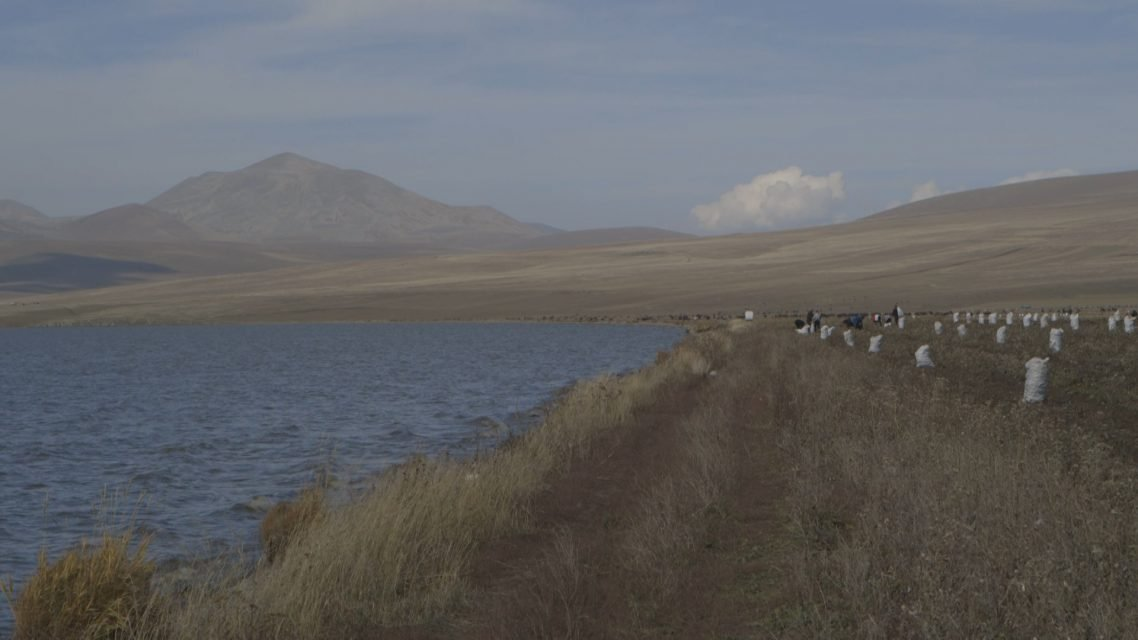
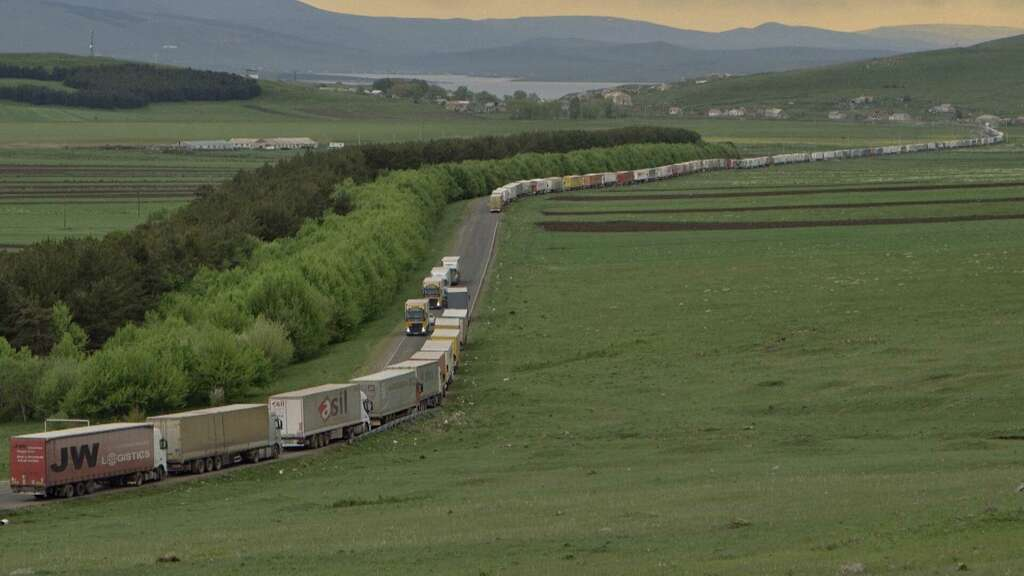
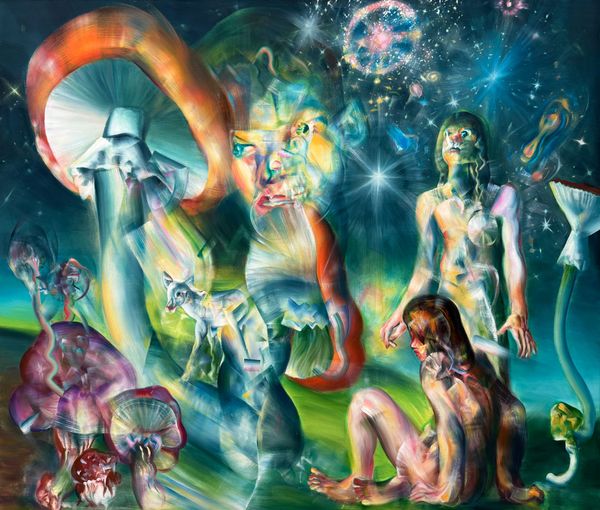
Video stills from TEKLA ASLANISHVILI’s A State in a state, 2022, color, black and white, AVCHD digital film. archival and found footage, sound, 47 min. Commissioned by the Han Nefkens Foundation – Fundació Antoni Tàpies Video Art Production Award. Courtesy the artist.
Are there restrictions on the content artists could propose?
ET: There is no restriction on content. The first commission was kept quite loose. Since many moving-image artists are now working with expanded cinema, we changed the framework slightly so that artists must also produce a single-channel video. That makes it easier for museums to show the work. They can make an expanded version as well, but there should be a single-channel version.
HN: The commission gives artists space to try something different from what they usually do, knowing that the work is already being collected.
ET: For us, it is about learning to trust and giving artists space. Museums usually have many constraints, but this is an opportunity to enable artists to do what they want. Because we are working with other partners, everyone has to believe in the work and go along with it.
HN: That trust is important for artists. They are told, based on their previous work, that we trust them to make a good work that will become part of our collections. That can be a real boost.
How is that different from a normal museum acquisition?
ET: When SAM commissions a work for an exhibition, we do not commit to acquiring it. We have the first right of refusal, but we wait to see what the work is like. This commission is the exception. We acquire the work without knowing what it is.
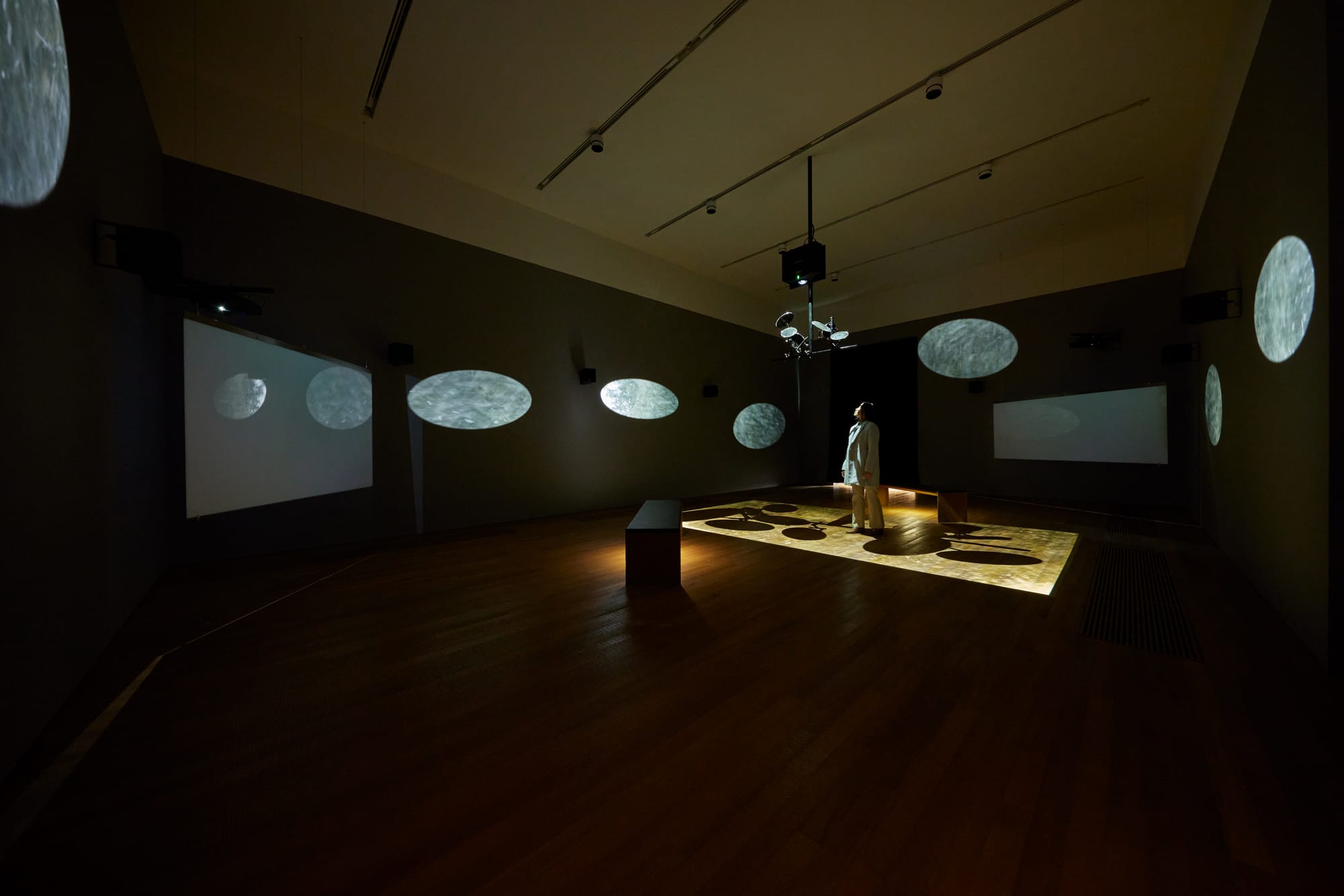
The first artist was Nguyễn Trinh Thi, the second Hao Jingban, and the third artists were John Torres and Shireen Seno from the Philippines. The 2023 commission by Hao Jingban is now on view at SAM and has already been shown at MAM. Jingban, what did receiving this commission enable you to do that might have been difficult or impossible otherwise?
HJ: When I was selected as a finalist, I was in the late stages of pregnancy. I was informed that I had received the commission three or four months after having my baby. I wondered whether I had the time, or even wanted, to begin working so soon. I spoke with Hilde, and the process felt flexible and spontaneous. The production period was long compared with other commissions, almost two years, so I could begin when I was ready.
The USD 100,000 changed how I could work. When you do not have much money, you have to plan everything in advance and make sure nothing goes wrong. You cannot leave much room for mistakes. With this commission, I had the opportunity to let accidents happen and to practice making decisions when things slipped away. It gave me more freedom in the production process. My proposal was conceptual and abstract, and I did not know exactly what the work would become. The commission gave me space to develop it while making it.
HN: This is why trust is so important. There is trust in the artist, trust among the museums, and trust from the foundation. The outcome of that trust is Hao’s video. It shows that the trust was warranted.
What was the central idea or question you were exploring in the work realized through the commission?
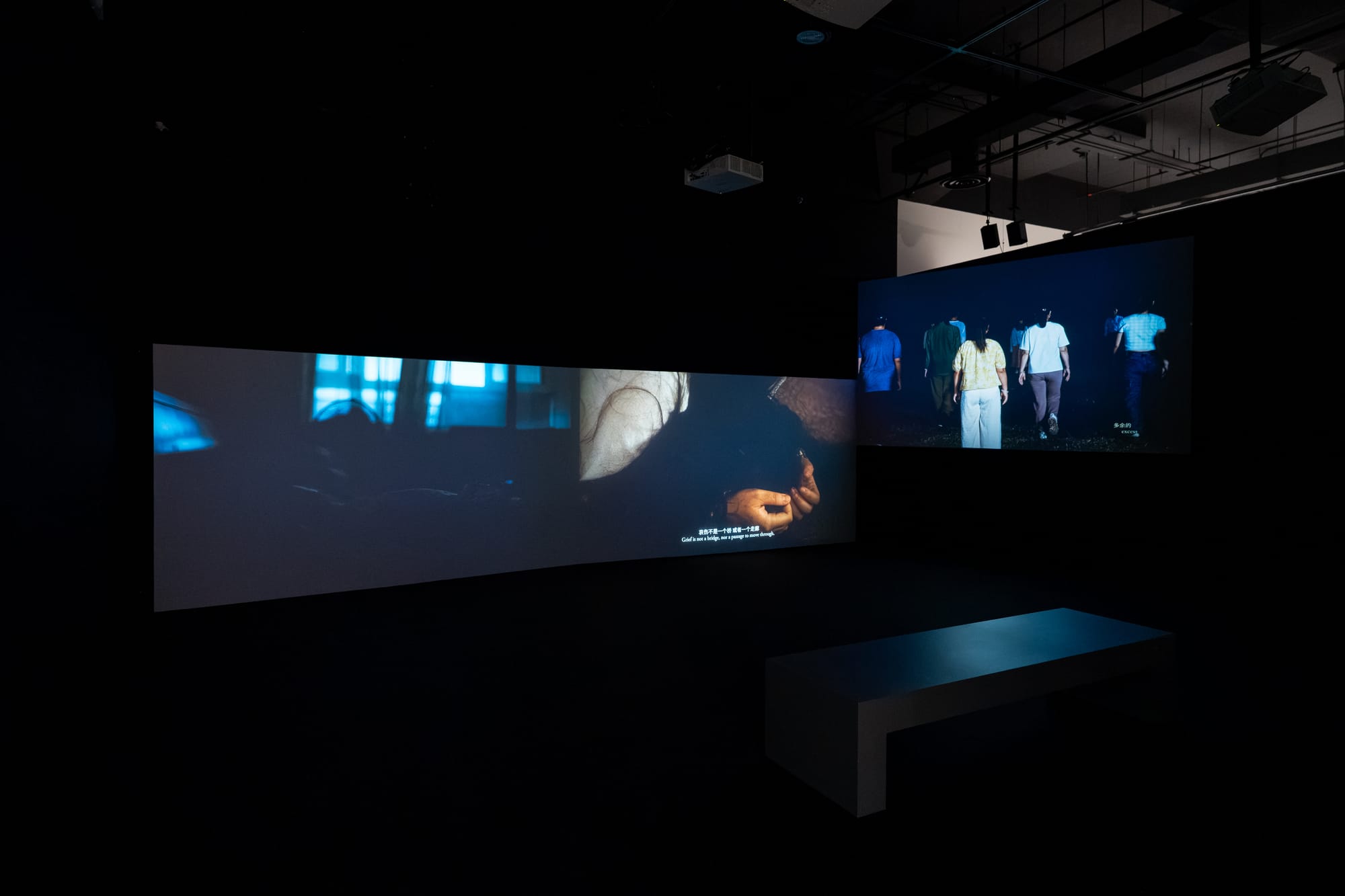
HJ: The work is I Witness (2025), and it is about grief. It began with two moments in China during the pandemic. At the beginning, there was widespread mourning for a doctor who had tried to warn people about the outbreak, but was disciplined by his hospital and later died of COVID. The other was near the end of the pandemic; an apartment fire killed around 10 Uyghur people. Their exit was reportedly changed because of the lockdown policy. Many people saw that as a sign that the COVID period was coming to an end, although there was never a clear ending.
News and stories of death and loss were circulating. There was anger, sympathy, and, for a brief moment, a deeper questioning of why these things were happening. The lockdown was brutal and absurd. During that period, other people’s losses felt like our own. You could imagine being on a quarantine bus that crashed and killed 27 people, or being a parent trying to take a sick child out of a locked-down neighborhood and reaching the hospital too late.
When the restrictions were suddenly lifted, life seemed to resume as if nothing had happened. I understood why people needed to move on, but I found it difficult. Gradually, I realized that many people were in a similar place, for different reasons. The people in the work lost someone close during COVID. For some of them, it felt impossible to walk away from their grief.
Their grief embodied a larger social trauma, but I was careful not to use their personal pain simply as a means of social critique. That could become an invasion of their suffering. Each person’s grief was intense and particular, and I felt I should resist adding something to it or making it stand for something broader.
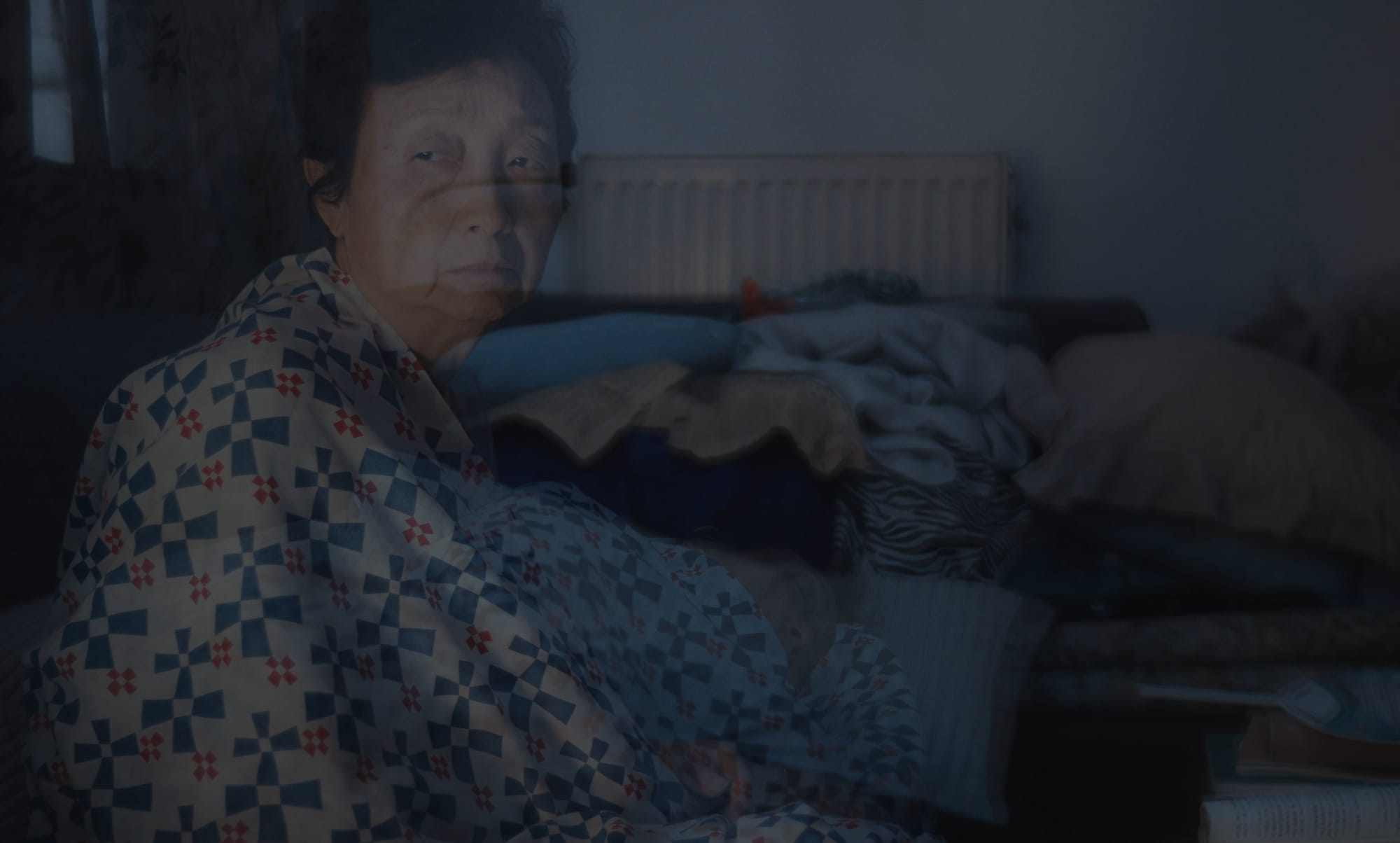
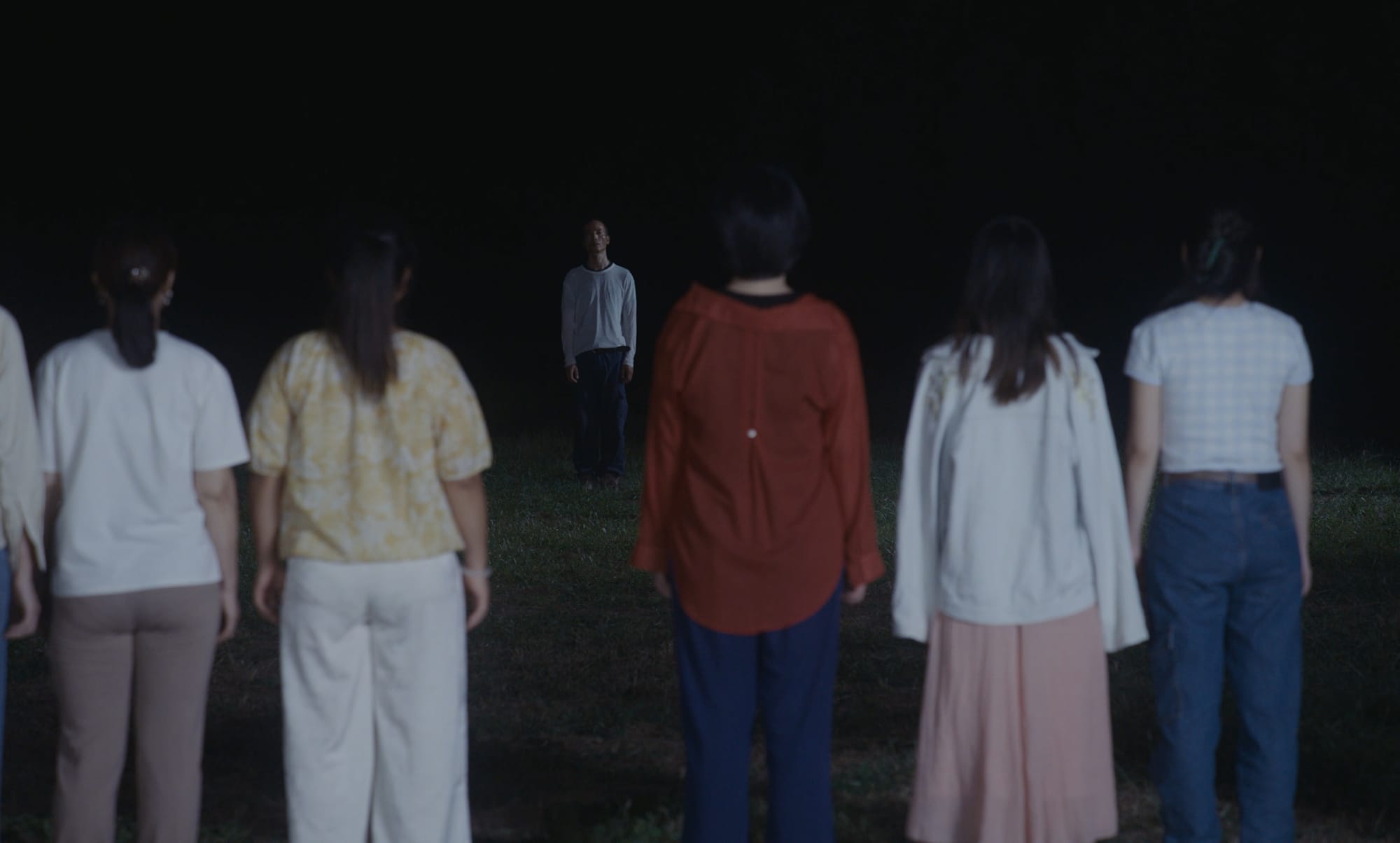
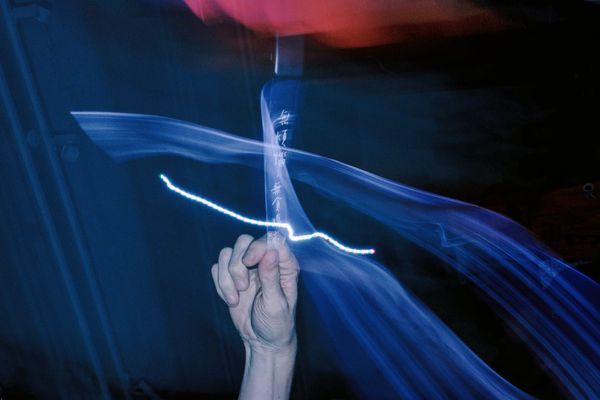
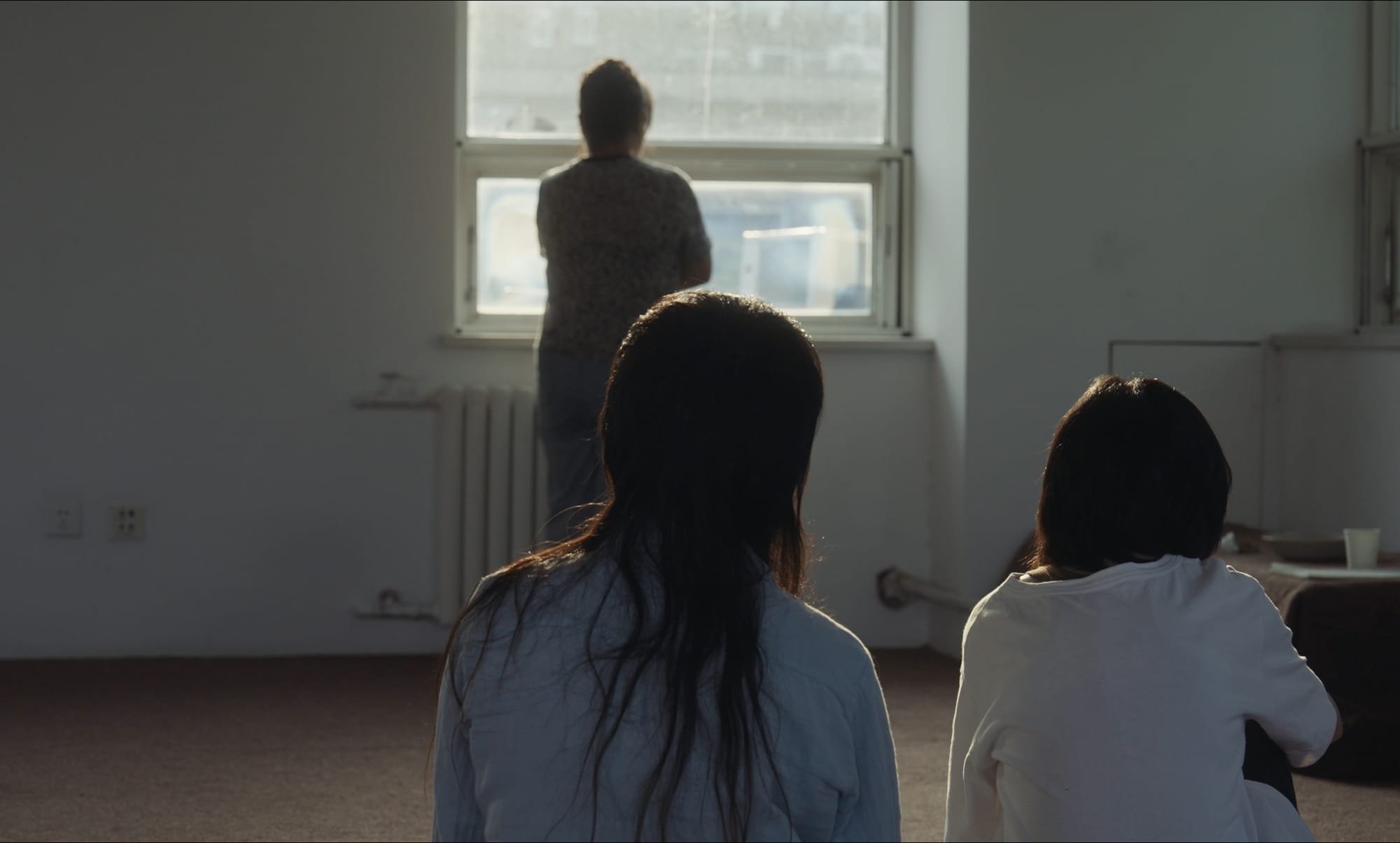
HAO JINGBAN, I Witness, 2025, three-channel video installation: 54 min 41 sec, edition of six + 2AP. Commissioned by the Han Nefkens Foundation, the Mori Art Museum, M+, and the Singapore Art Museum. Courtesy the artist and Blindspot Gallery, Hong Kong.
One woman told me that it was difficult to describe her grief because sometimes, before she had begun to speak, the person listening had already started to cry. There was no space left for her to express her own feelings. I could relate to that during the whole process.
I am not sure the COVID period is part of public history in the way it happened. There has been an effort to erase it from the collective memory. That is one reason for the title, I Witness. I began to ask what it means to witness something that is forgotten or obscured, and how to witness oneself and what happened to an entire society.
I understand that the proposal and the finished work were radically different. What changed?
HJ: The idea of mourning, the COVID period, public trauma, and forgotten things remained. But when I was asked during one of the jury meetings what the image would be, I had to invent an answer because I did not know. I knew my thoughts would not stay the same. The image came to me near the end of the production. That was good for me. I realized that the work could change while I was making it.
The commission also changed my working methods. I had recently lost someone during COVID and become a mother; many things in my life were changing. I began to trust my intuition more and to ask what was important in my life, relying less on pure research and rationality. I wanted to make something that not only interested me but touched me.
I had previously worked with archives and histories, which are already there for you to investigate and develop. This work was about the present, with everything happening at the same time in society and in the lives of the people involved. I needed a new way of working with them.
The commission also gave me the freedom to decide how to use the money. This was perhaps the first time I was able to pay everyone involved, including the production crew, which was important to me. I had previously avoided working with people because I found it stressful, so this brought a sense of ease to the process and allowed me to work differently.
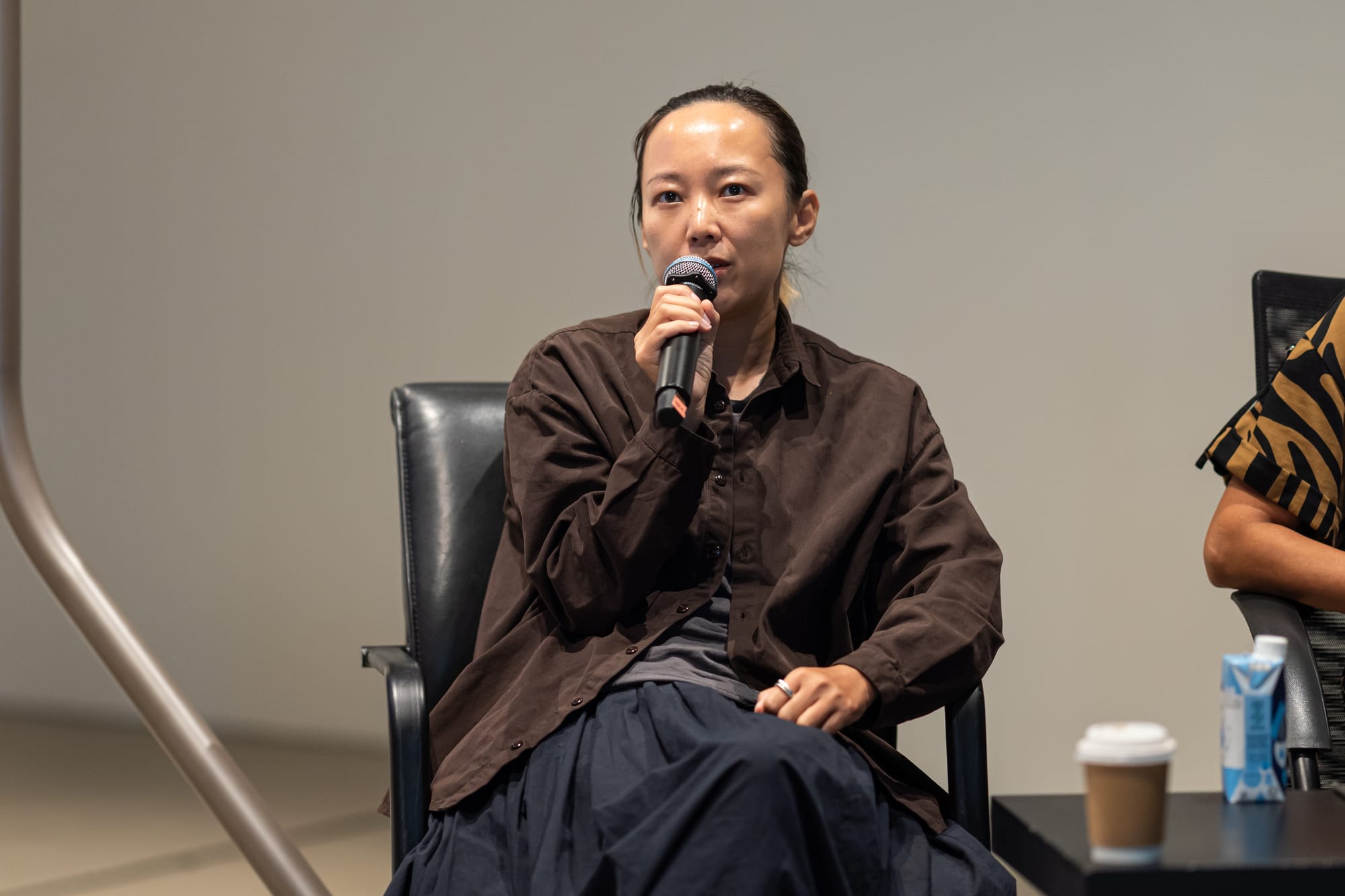
How did the three museums respond to the proposal about mourning and COVID, and how did you understand the work as it developed?
SHM: There was a shared sense that this was something we had to speak about, but there was no way to arrive at the final work through an interview alone. We had to trust the artist and allow the process of making to take us there. The act of making is essential.
ET: The work came out of COVID, which was a shared experience that the whole world went through, so I think it will resonate deeply with audiences. Our bodies, actions, and behaviors are important to the work. They are a way of dealing with things and a way to communicate.
How does the work change as it travels between institutions?
ET: The context differs in each museum. At MAM, Hao’s work was shown in its own gallery. At SAM, we show it as part of the collection. Ideally, it should be shown by itself, but exhibitions always involve constraints. Showing it with other works can also create different readings.
HN: The work will be perceived differently in Tokyo, Hong Kong, and Singapore. That is part of the value of co-commissioning and collecting: audiences encounter the work through different contexts.
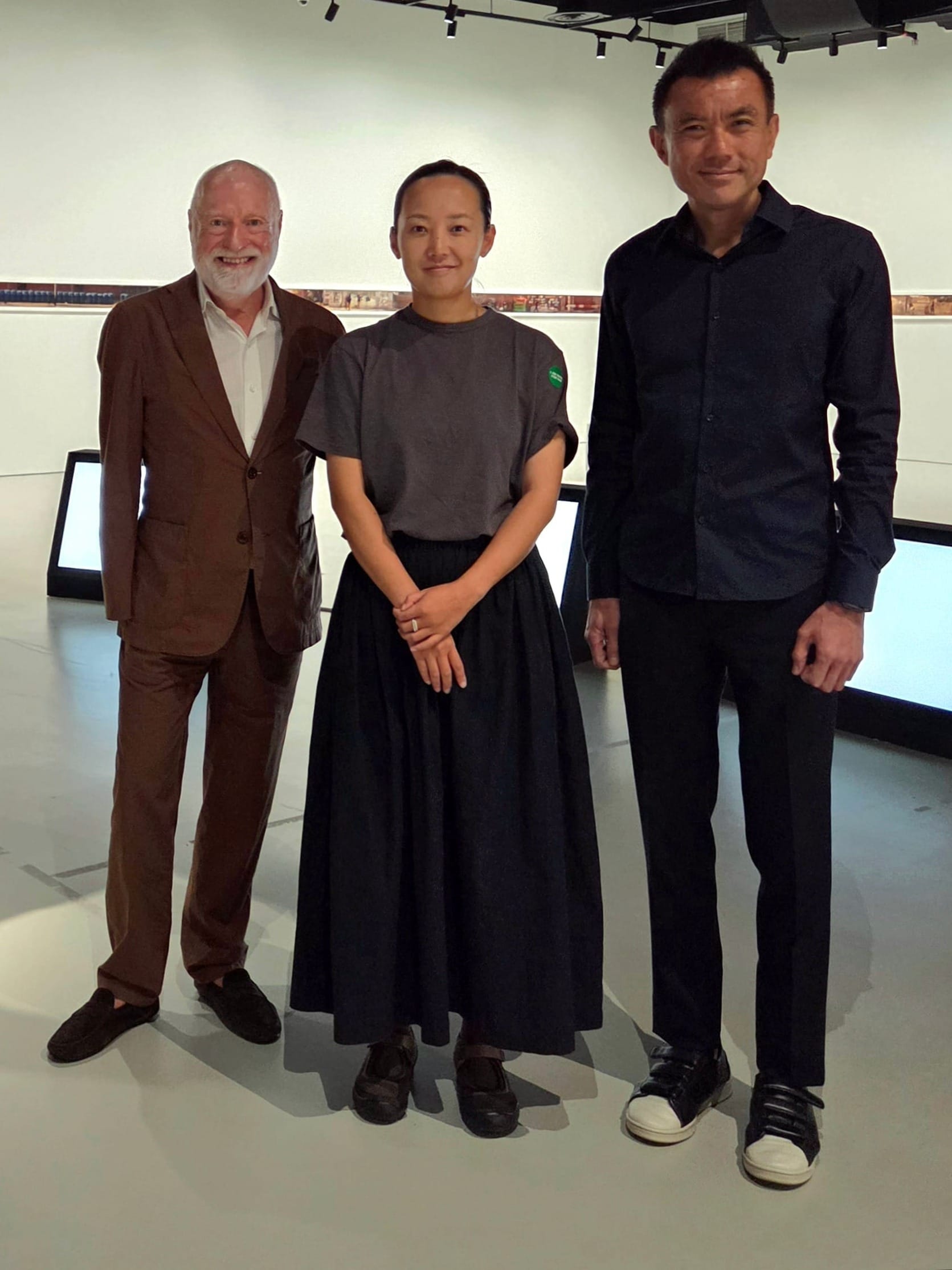
Through the partnership with SAM, how has the foundation’s relationship with Asia developed?
HN: The contact with SAM, M+, and MAM was very important because it allowed us to work with museums at the top level. It was important for our credibility and helped us with other commissions and grants. Working with these institutions gave us confidence and opened doors.
Has the collaboration had a domino effect?
HN: Yes. When we meet people and they hear about the work, they say they would like to be part of it. The methodology is similar, but the personality of each collaboration depends on the people involved.
ET: For SAM, working with the Walker Art Center and Reina Sofía is also about getting to know colleagues from outside of Asia, and understanding their institutional practices.
HN: Reina Sofía particularly wanted to collaborate with SAM because they wanted to be more involved in Asia. Not all partnerships are obvious, but the less obvious partners can get together and stick it out for quite a while.
Is SAM the only institution in Asia working with the foundation both regionally and internationally, and how has that relationship developed?
HN: SAM is the only museum with two commissions. We have a special relationship with Eugene because we have known each other for such a long time. He helped with the Moving Image Commission from the outset, and the collaboration has always been very pleasant. We feel at home.
ET: Han has also donated pieces from his personal collection to SAM, including works by Bill Viola, Pipilotti Rist, Tony Oursler, and Shirin Neshat.
Has the collaboration changed the way SAM thinks about collecting and working with other institutions?
ET: We have not done anything similar since, partly because of restrictions in our collection policies. But this model allowed us to break out of those restrictions, and I can see us using it more in the future. Co-owning moving-image works is easier because there can be several copies, while co-ownership of other works, such as painting or installations, is more challenging.
The showing was part of the grant framework, but I also wanted SAM to grow its collection. Why not create an edition for each of three museums? We all contribute, and the artist has a major work supported, shown and collected by three institutions.
What do you hope this long-term collaboration will continue to produce?
HN: Over the years of working together with Eugene we have learned that collaboration and trust are what make a project sustainable. I have also observed the huge leaps that video art has made in this time: not only on a technical level but also content-wise. The videos we see now are multilayered yet focused, highly sophisticated, and very surprising! I hope to see more such developments in the future.
ET: The model creates opportunities for artists, helps institutions learn from one another, and grows the ecology around moving-image work. That is why the relationship with Han and the foundation has been so valuable to SAM.
Elaine W. Ng is editor and publisher of ArtAsiaPacific.