People
New Currents: Zigsen Liu’s Cybernetic Ecologies
In his 1982 short story Burning Chrome, William Gibson coined the term “cyberspace,” referring to the “consensual hallucination experienced daily by legitimate operators, in every nation. . . . A graphic representation of data abstracted from the banks of every computer in the human system.” Although Gibson knew little about computers at the time, he described the condition of virtualization as we know it today: the sense of another realm, an electronic vastness that is at once unnerving and utterly engrossing.
Zigsen Liu reifies this perceptual complexity in his luminous paintings. Born in 1992 in Anhui, he is part of China’s “Post-90s generation,” which grew up at the dawn of the Internet age. The nascent days of the World Wide Web—with its spectacular promises and radical, if still rudimentary, capabilities—sparked his interest in how technology might evolve and alter our understanding of time, space, and memory.
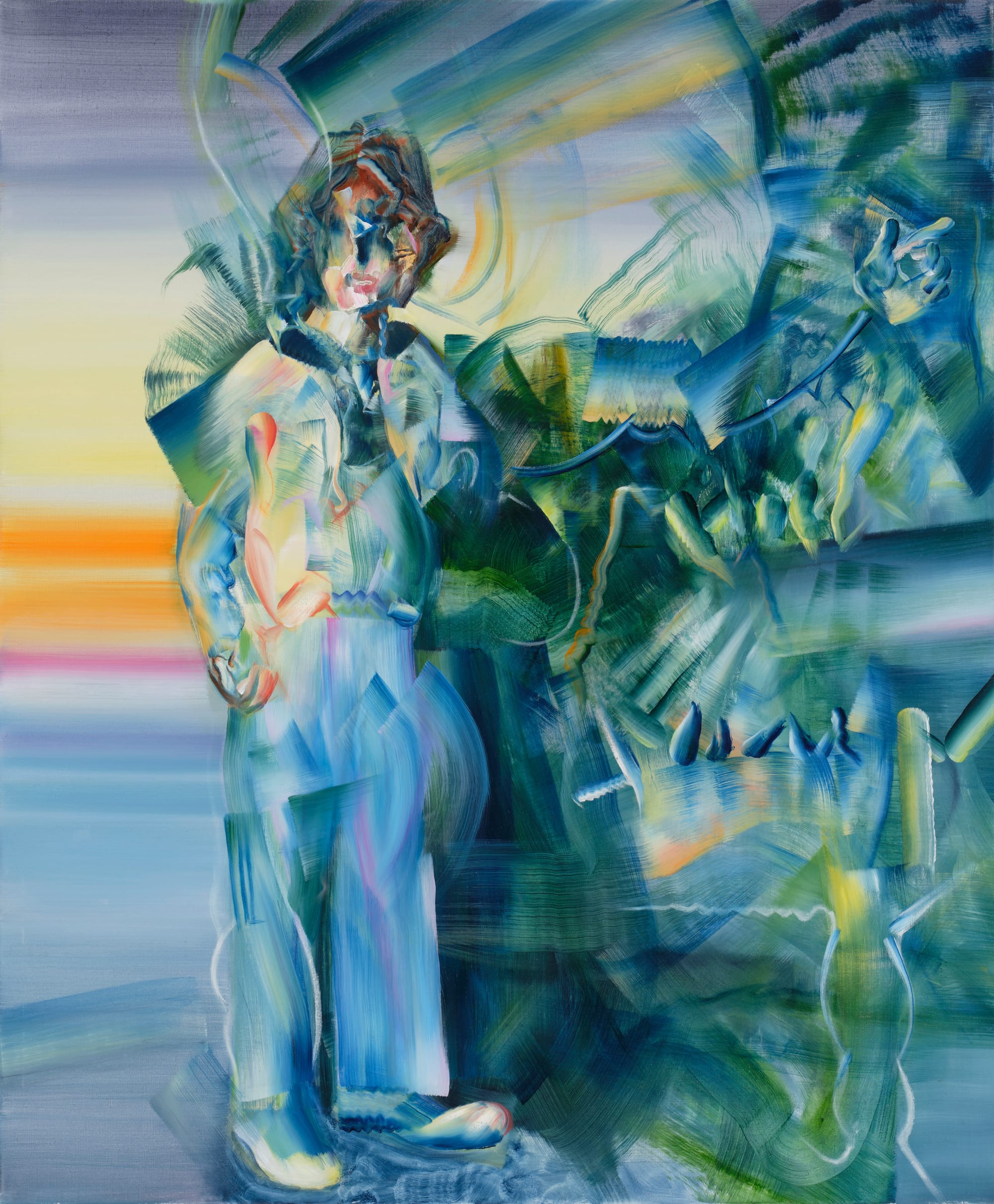
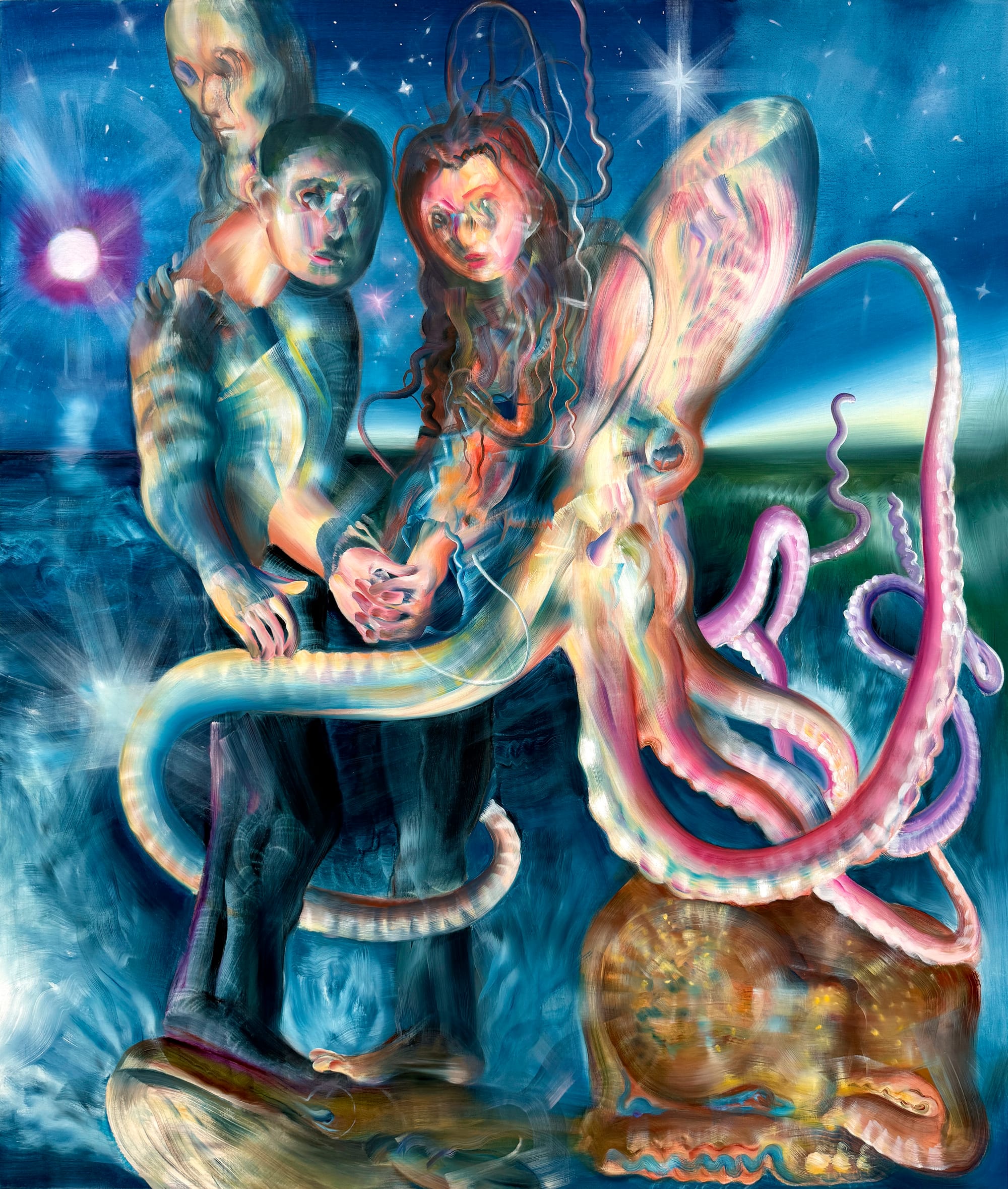
ZIGSEN LIU, Youth, 2025, oil on canvas, 120 x 100 x 4 cm, unframed (left); and Children of the Sea, 2026, oil on canvas, 200 x 170 x 5 cm, unframed (right). Copyright the artist. Courtesy NANZUKA, Tokyo.
Liu’s tableaux often depict human figures within surreal, digitally mediated mindscapes, their forms half absorbed by glimmering atmospheres. Take Youth (2025), the latest addition to his New Boy series (2020– ), which NANZUKA showed at the fourth edition of Tokyo Gendai 2026 this September. The oil-on-canvas features a lone protagonist amid an endless, brightly-hued expanse, its saturated blue-and-green palette recalling early desktop designs. Wide, almost frenetic brushstrokes render the subject in fluid contours; his face is turned toward the viewer, featureless apart from the faint slit of a mouth, while one side of his frame dissolves into smears and streaks. In the upper right, a disembodied hand emerges from the torrent, as if reaching for something in the ether. Youth conveys not only the alienation of the tech-driven age but also its immersive pull: just as the phantom-like individual dematerializes into a turbulent unknown, so too have we become enmeshed in a computerized terrain, our minds and bodies yielding to simulation. There is also an impression of motion, velocity, and perhaps inevitability, pointing to accelerated automation and the relentless encroachment of AI on contemporary life. “Sometimes it feels like the pages of a book are being turned faster and faster,” Liu tells me. “Before we have understood one page, we’re already entering the next chapter.”
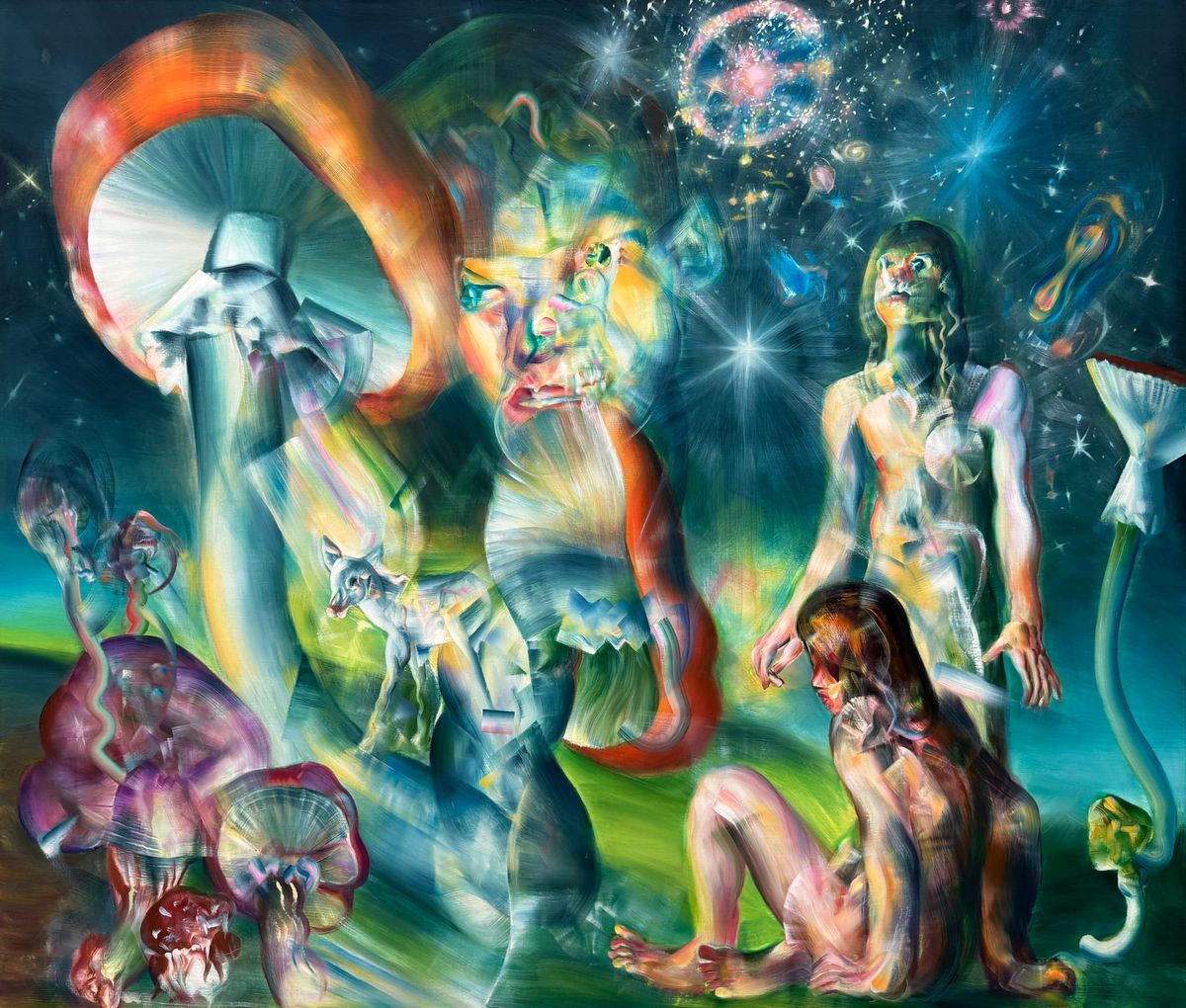
Large-scale projects like Children of the Sea and The Rising Stars (both 2026) take a more speculative tone, harnessing the numinous quality of a digital zeitgeist. Here, earthly beings, rendered more concretely, inhabit fantastical environments that conjure the immensity of Gibson’s “cyberspace.” In Children of the Sea, a couple perches on a whale above the ocean, holding hands, as a gaunt, hollow-eyed figure looms behind the man and a giant pink-tentacled octopus sidles up against the woman. The Rising Stars is similarly psychedelic, with human characters dwelling on a strange planet in a distant galaxy, surrounded by massive fungal growth. The dreamlike scenery evokes what British anthropologist Alfred Gell called the “enchantment of technology”: the more esoteric an innovation, the greater our awe. Liu applies this phenomenon to paintings that compel and entrap the gaze as they imagine a future in which spatiotemporal logic and organic matter collapse into a new, cybernetic ecology.
Annette Meier is an assistant editor at ArtAsiaPacific.