People
Shi Guowei: After the Festival
Shi Guowei sets down a box of cookies—a modest gift I had brought to Beijing from Hong Kong—and adds a platter of nuts and seeds, mugs for tea, bottles of Perrier. The spread is humble yet rich with quiet hospitality. I take a sip of water and prepare to record; beside me, an old harlequin cat, fur scruffy with age, climbs onto an empty chair and settles in for the conversation.
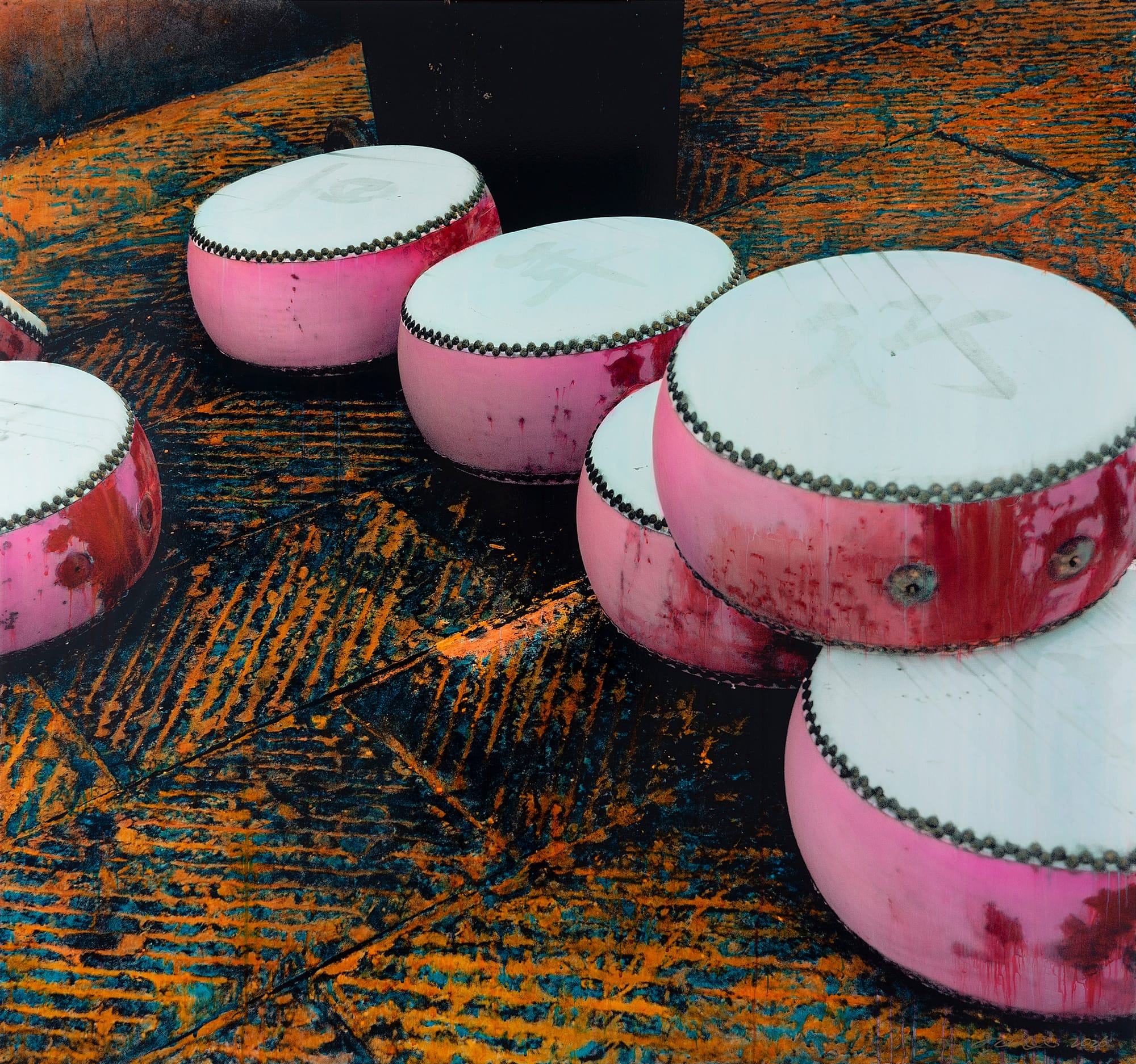
On the wall opposite hangs a large tableau, Drum (2026), from a new body of work soon to debut at Fotografiska Shenzhen this October. A constellation of red ceremonial drums sits on a nondescript floor, the base of an equally nondescript pillar visible in the composition’s upper register. The vantage is tilted downward, feeling accidental, except it isn’t—the instruments, scattered in derelict disorder, carry a disquieting, almost sentient charge.
“They were perhaps being played just moments ago,” says Shi, “then cast aside while people moved on to other festivities.” Shi’s method begins with a black-and-white photograph, which he paints over with water-based pigment in exacting, painstaking layers, in pursuit of what he calls an “authentic illusion.” Hand-coloring is a rigorous, largely obsolete technique, one that predates photography’s capacity for color. Trained as a photographer at Tsinghua University’s Academy of Arts & Design and later at the Fachhochschule Dortmund, Shi revives and redirects the age-old method—not toward verisimilitude, but toward displacing recorded fact for a particular emotional intensity, or what he terms “felt truth.” Here, the grooves in the grubby floor flare with scorched terracotta. The drums’ gilding has dulled with rust, their maroon lacquer worn and mottled by wear and stains. Yet their faces remain a stark, incongruous snow white, the characters 百年行 (“a hundred-year journey”) discernible atop.
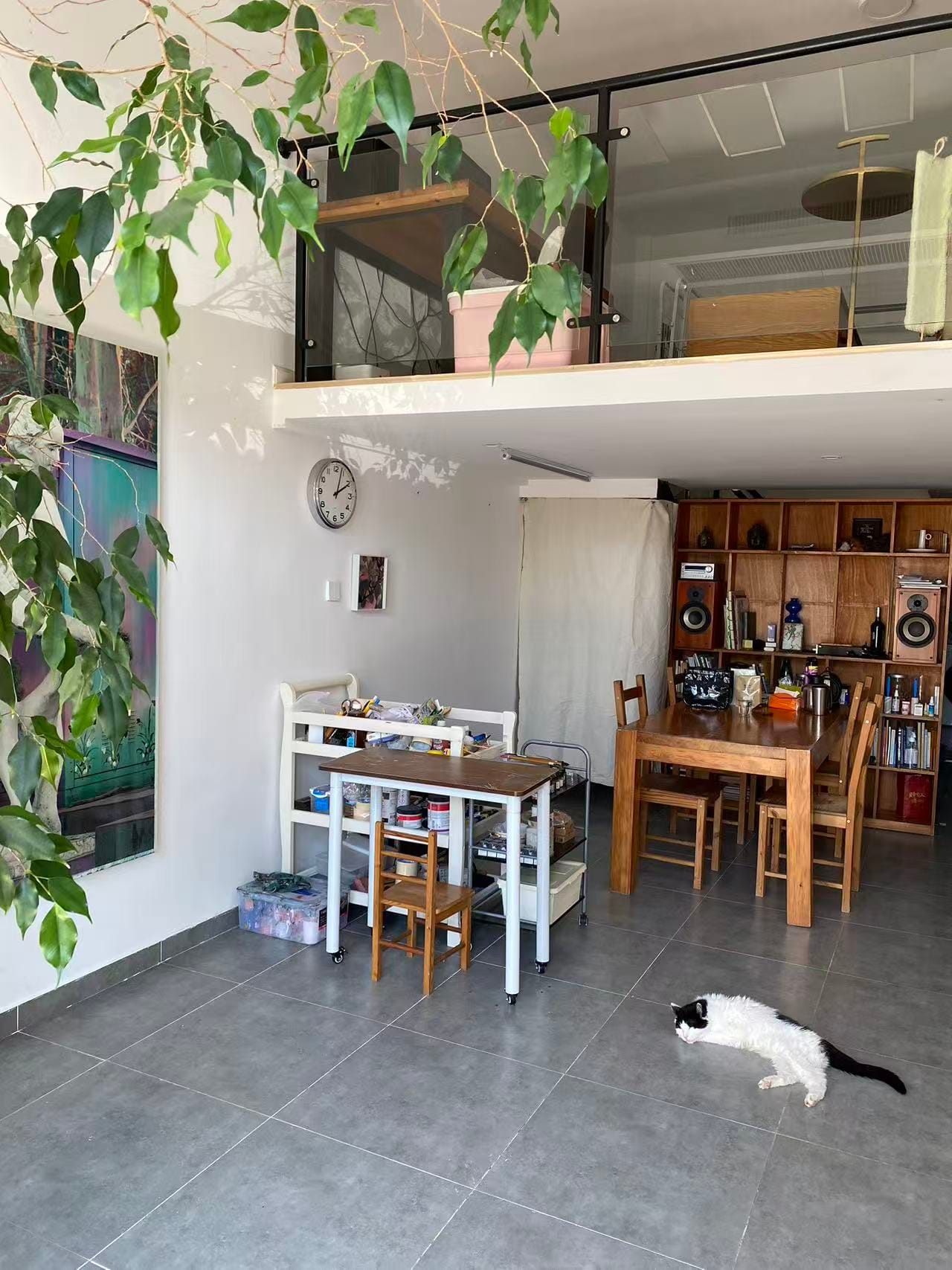
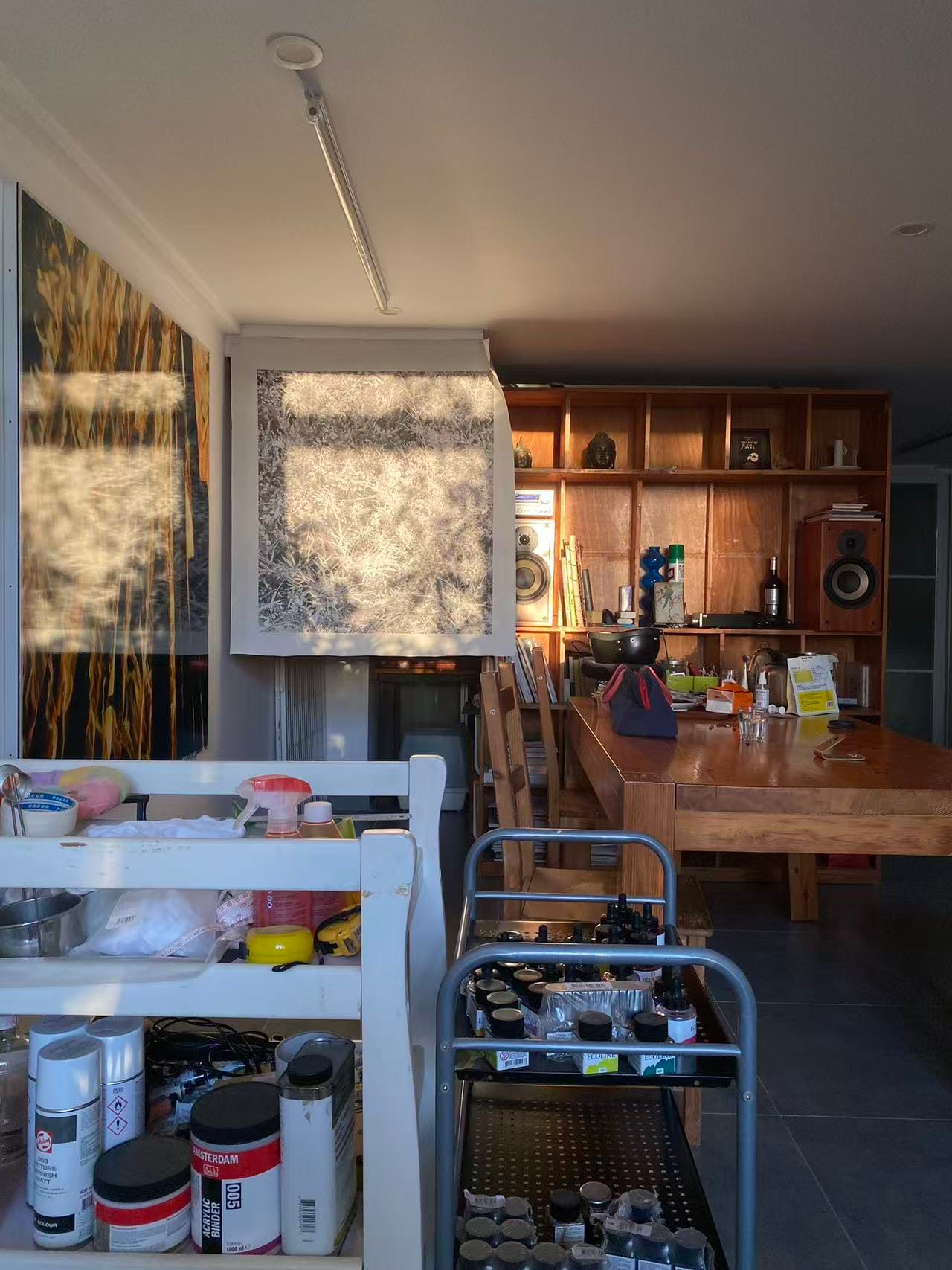
Views of SHI GUOWEI’s studio in Beijing. Courtesy the artist and Magician Space, Beijing.
“For some time I have found myself drawn to festivals,” Shi tells me, “but not their pageantry. What holds me is a quality I encounter around them, or after them.” His recent work marks a departure: after a decade spent rendering verdure, rock, and flora, he has turned his focus to the remnants of human celebration—its overflow, its sediment, its afterglow. In moments of isolation from crowds or in emptied corners of a carnival ground, Shi locates something resembling melancholy but stranger—subtler, yet somehow sharper. In Drum, it percolates most intensely in the barrels’ precisely calibrated plum-toned burgundy, faded through use yet all the more potent. That hue is echoed in a much smaller square study hung adjacent: a close-up of rock texture, the subject for which Shi is—for now, at least—best known. The stone, too, takes on a vital vermilion flush, its marbling rippling like sinew in raw flesh.
We walk over to another new work, Bridge (2026). Here the operant palette is green: a procession of round, scalloped cement forms appear to float on a pond, cast to resemble lotus leaves. The algae-filmed cement dons a jade cast while the water glimmers deep turquoise; upper left, brilliant chartreuse wavelets breach the serenity, lending the scene something at once magical and unsettling. The disturbance is produced by artificial light reflected from festivities nearby, just off-camera. “It was a tremendously crowded day,” Shi recounts. “I had to wait hours to capture this view without people.” The intrusion of yellow is deliberate: “On an ordinary day, the water would simply mirror a blue sky. But here there is something invasive. A quiet space has been forcibly entered. I wanted to convey that uneasy contrast.”
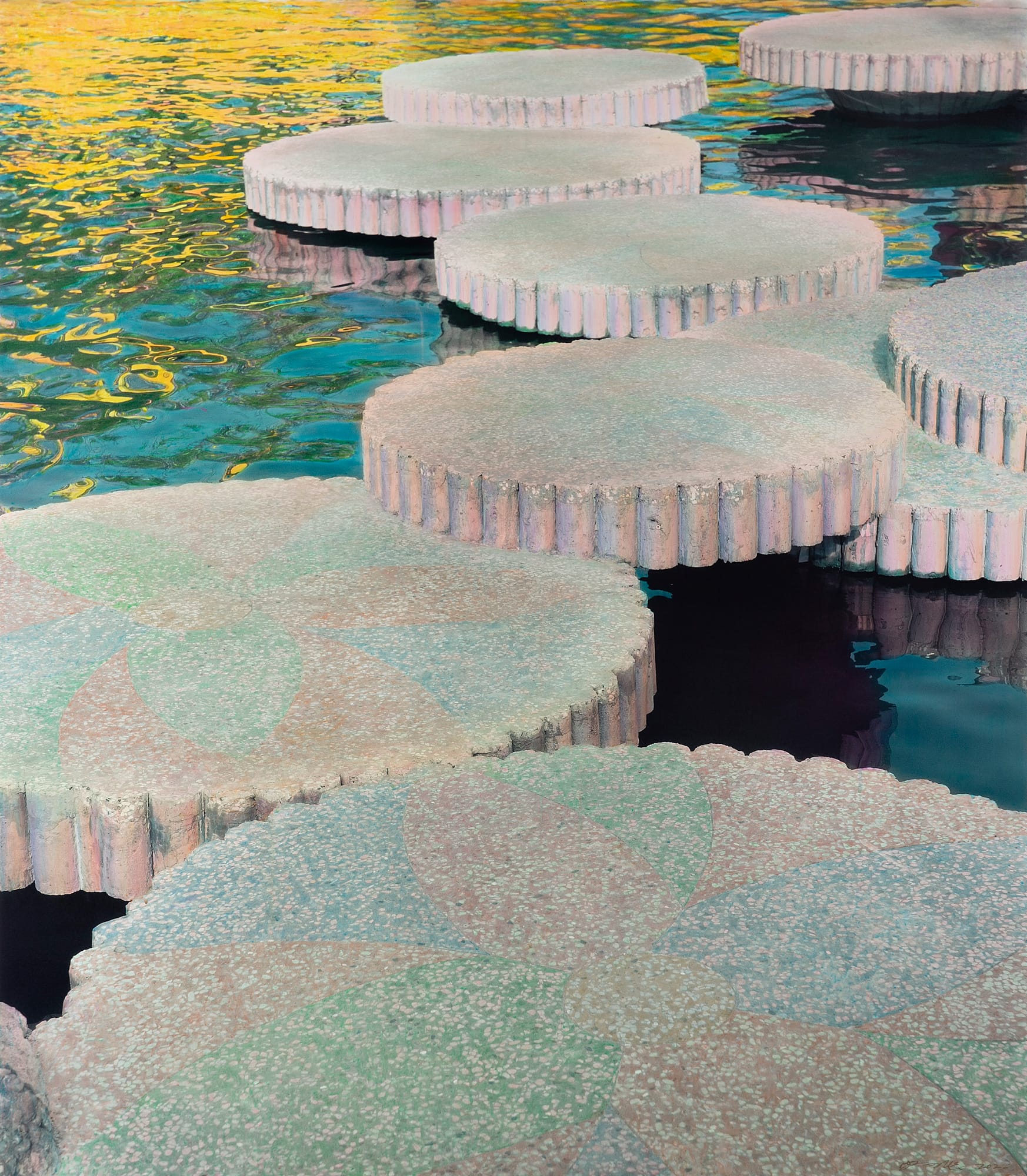
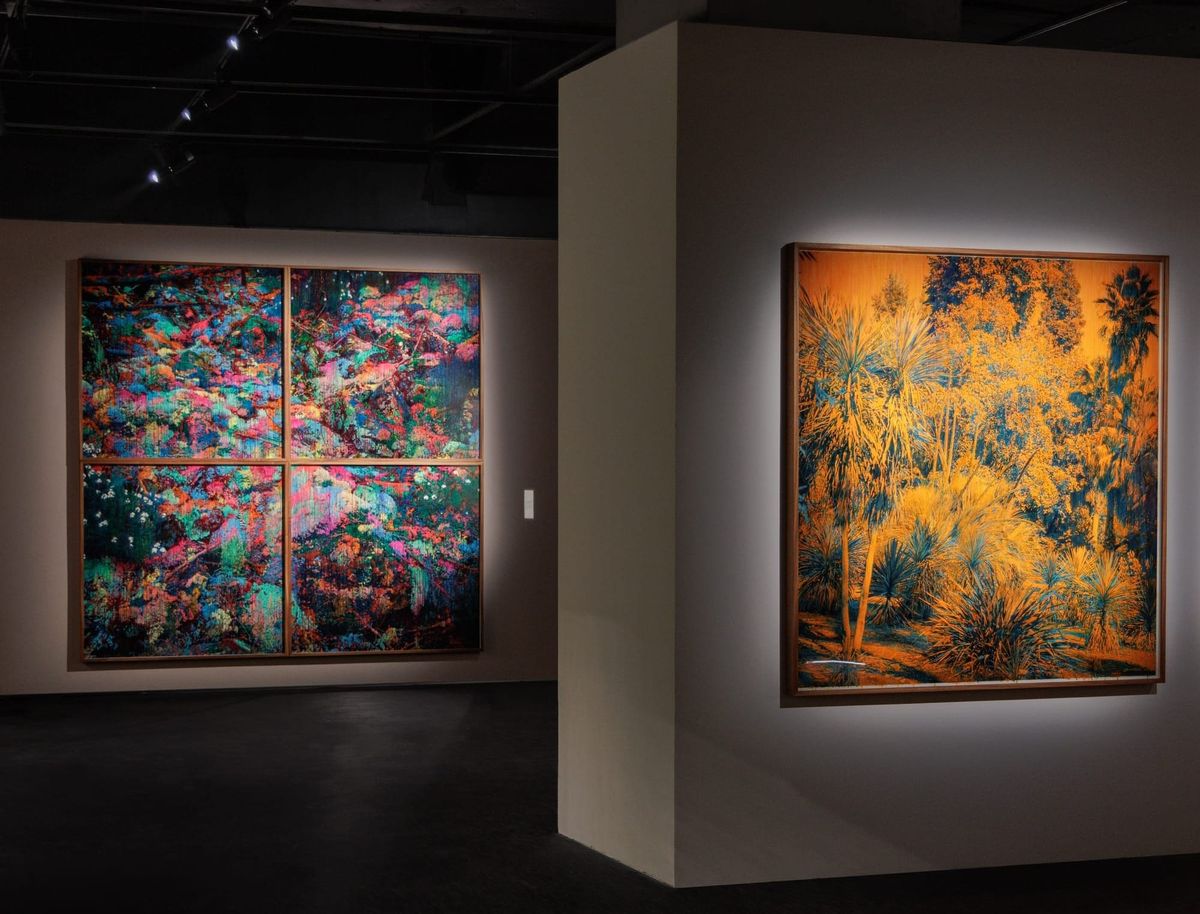
SHI GUOWEI, Drum, 2026, C-print and color ink, 126 x 135 cm (left); and Bridge, 2026, C-print and color ink, 145 x 126 cm (right). Courtesy the artist, Magician Space, Beijing, and Fotografiska Shenzhen.
Festivals divide time by returning. Each recurrence calls for celebration but measures all that passes in the interim—an illusion of progress and permanence undercut by an invisible accounting of absence and loss. A year, an anniversary, another gathering beneath lights—the shadows of which Shi inhabits. “Festivals are understood as collective occasions of happiness and hope,” he says. “But I am interested in what an individual experiences. Private feelings can diverge greatly from the noise and commotion. I want to ask what joy actually is.”
For years, Shi remained faithful to a vocabulary of motifs drawn from the natural world, accumulated largely during solitary walks in the mountains. I leaf through a catalog of earlier works: verdant shrubbery articulated in minute detail, severe faces of craggy cliffs, succulents alive and acerbic in saturated pastel tones. Their apparent stillness belies the peculiar temporality of their making. A photograph compresses an encounter into an instant; Shi reverses the process, re-inserting that isolated instant into the wayward currents of felt time. Over months, he revisits a single exposure through color and the repeated touch of his brush. There is something almost punitive in this sustained return, but also something relished: an obligation to look again, and feel again. The process amounts to a retrospective encounter, which chromatically loosens the image from the shutter’s grip; color stops being information and becomes qualitative, lived duration. Against an image culture organized around immediate edits and filters, Shi makes the almost foolish proposition that “some things require time.”
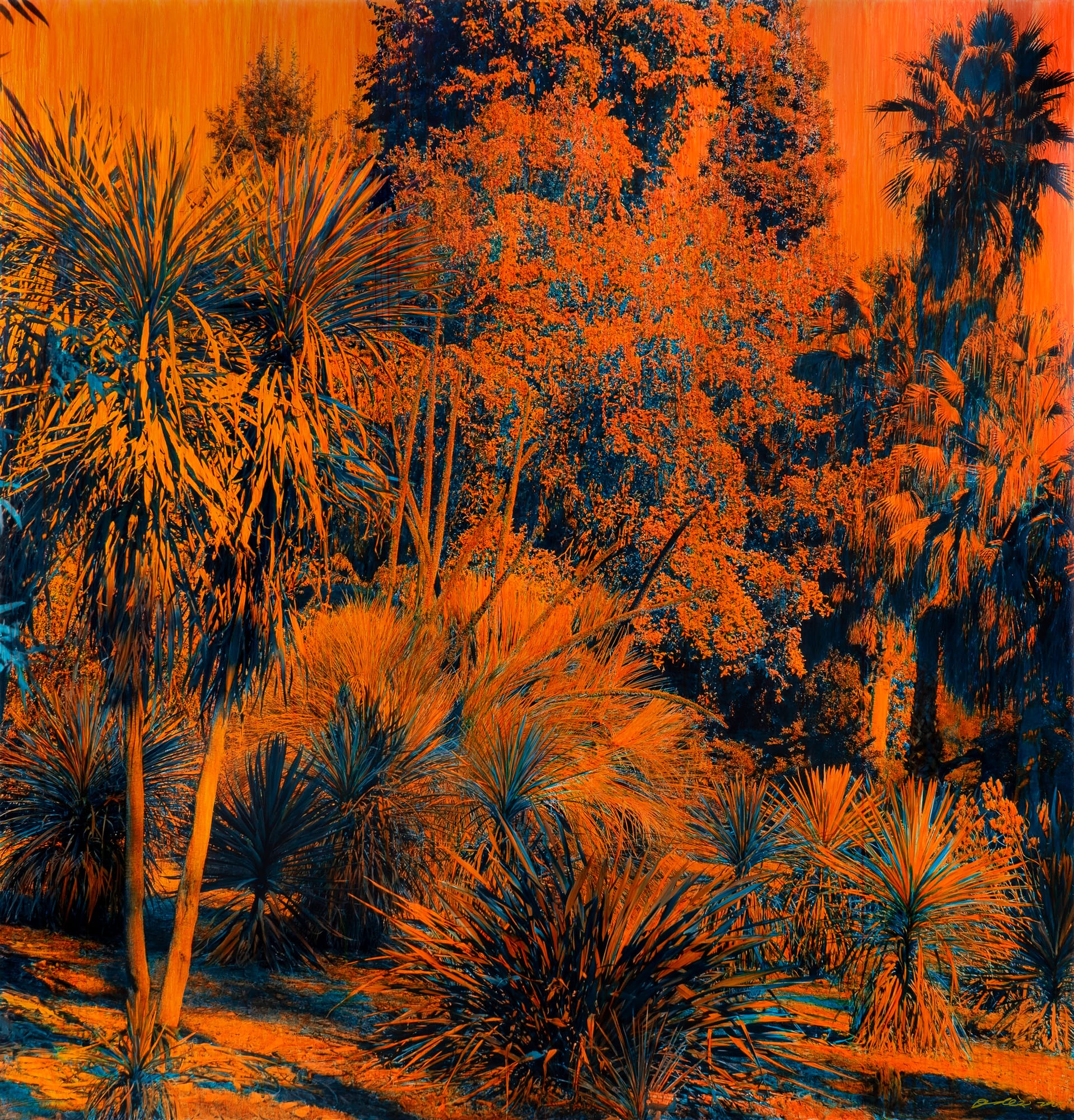
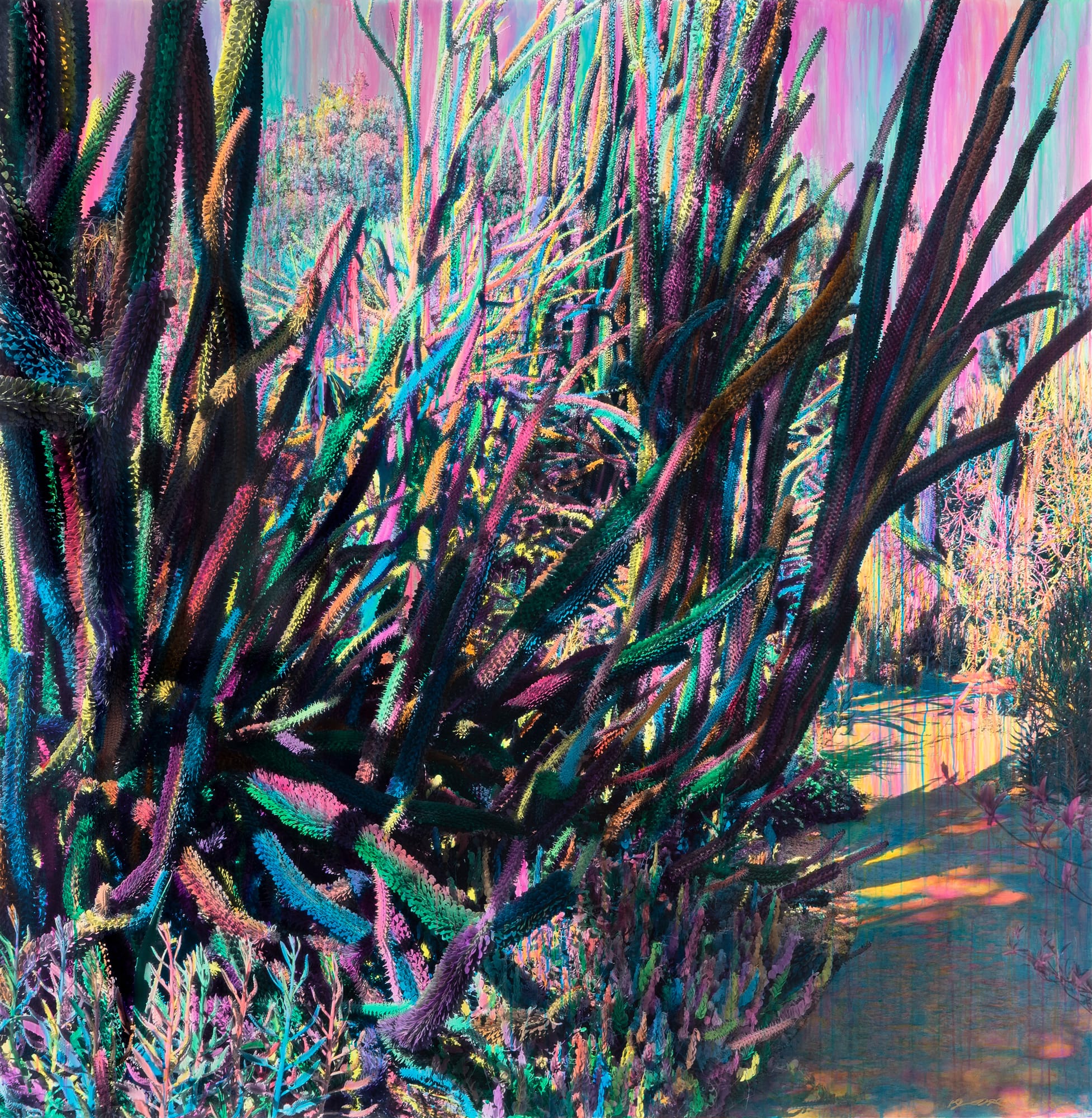
SHI GUOWEI, Fireworks II, 2025, C-print and color ink (left); and Garden II, 2024, C-print and color ink (right). Courtesy the artist, Magician Space, Beijing, and Fotografiska Shenzhen.
As I continue through the monograph, an instinctive recoil propels me past a page; catching myself, I double back. The image is an apparently innocuous close-up of a roadside thicket; beyond clusters of oleander in the foreground burns a scarlet horizon—muted yet feverish, almost malign. A brief silence passes, then the artist begins. “Some years ago, a puppy started appearing at my studio door every day,” he says. “I couldn’t afford to keep him, but I fed him and played with him. We went for walks. It was during Covid, and I was at a very low place. Watching him frolic in the fields became a kind of lifeline for me. His coat was entirely black, and when he sprinted into the distance, he blurred into a flash of black lightning.”
“Then one day he stopped coming,” Shi continues, his tone still stoic and even, but his countenance tightening. “At first I thought he would show up again, perhaps after a few days, but he never did. I searched the surrounding areas but never found him. It took me a long time to recover. It was a period when everything felt beyond my control, and there was nothing I could do.”
Eyes welling, I avert my gaze, fixing it back on the page. The lucent red behind the poisonous clouds of white oleander intensifies under scrutiny. It is a red before language, before thought or even consciousness. The same quality of red, in various shades and gradations, courses through Shi’s bushes, branches, and stones; beneath his pigments, their obdurate surfaces swell and soften—brittle as bone at times, tender and fragile as skin and vein at others. This slippage between mineral and animal matter goes beyond formal semblance into a Merleau-Pontian entanglement with the primordial flesh of the world. While traveling with itinerant herding communities in northeastern China, Shi once watched a rancher dissect a dead deer, its organs swiftly and surgically arranged and examined to determine the cause of death—disease, poison, or some other threat to human or flock. Shi was struck by the herdsman’s composure: here was a bond between man, animal, and land so profound yet so unsentimental—an intimacy forged by survival, capable of opening a body without ceremony.
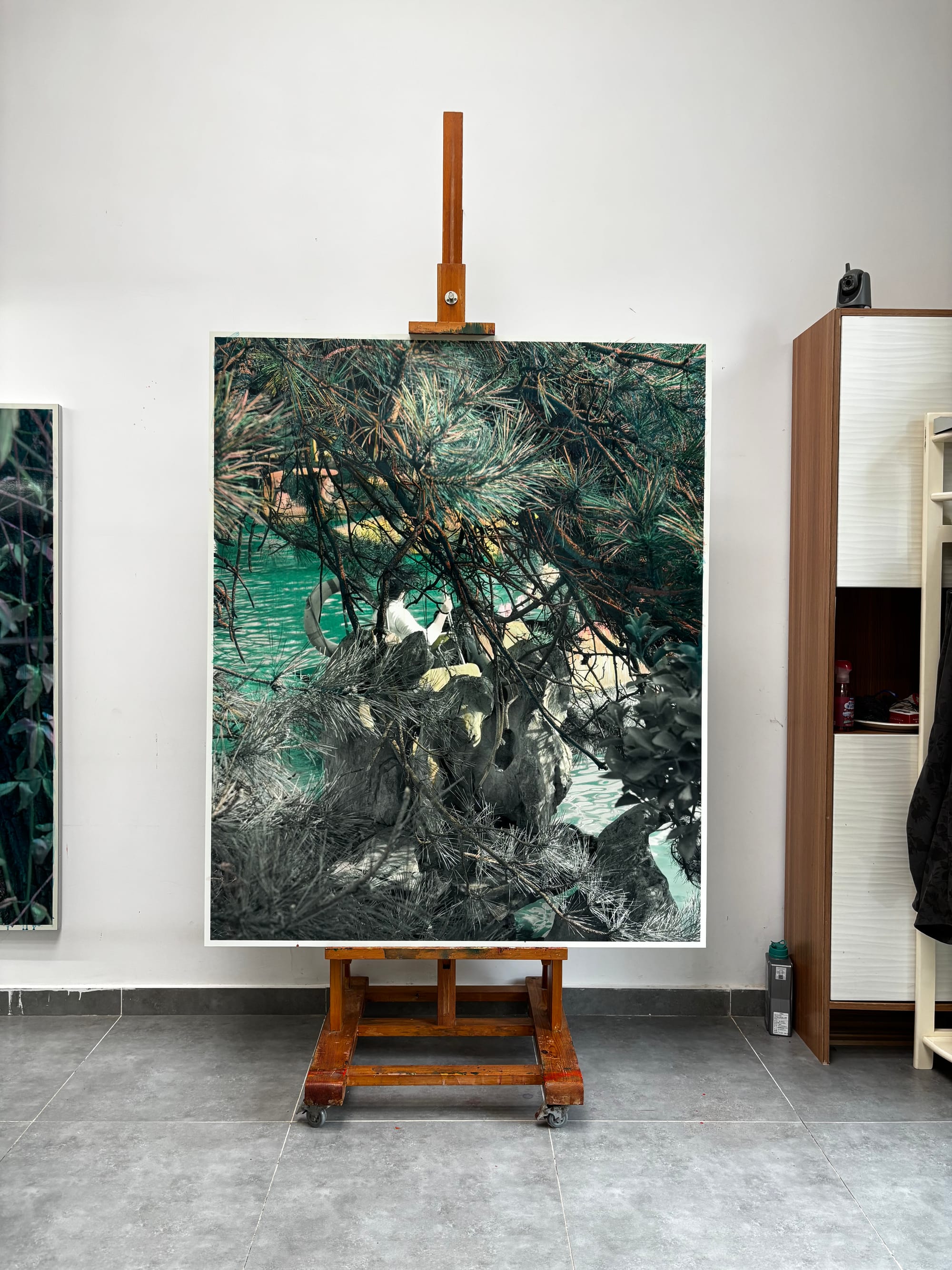
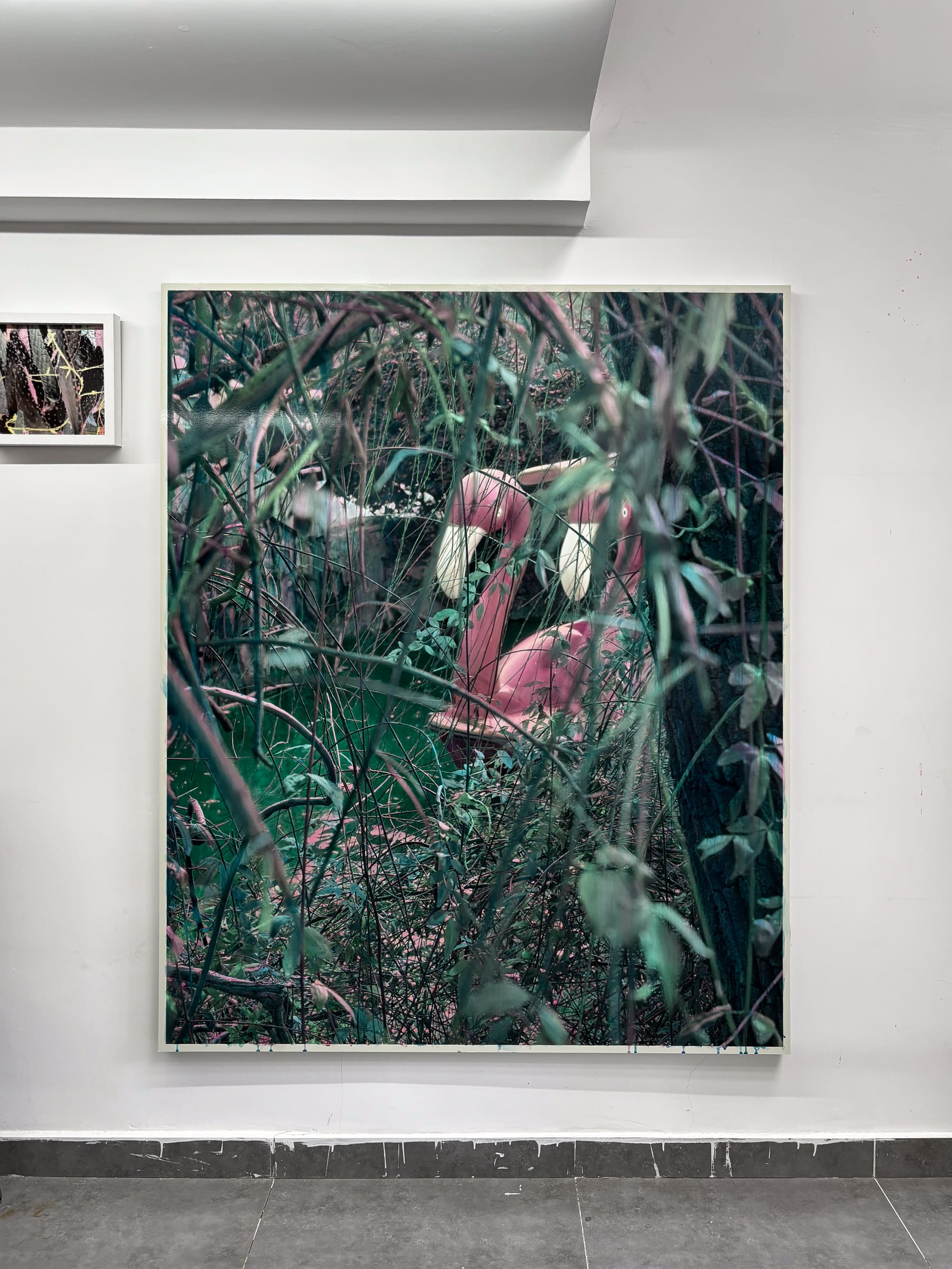
Views of works-in-progress at SHI GUOWEI’s studio in Beijing. Courtesy the artist and Magician Space, Beijing.
We rise again to examine two unfinished works. In one, a flamingo boat emerges half concealed by riverside shrubbery. The festive prop is at once ludicrous and regal—a majestic creature at rest, its curved neck maintaining its stately composure even while in repose. Its acidic pink bleeds into surrounding vegetation, folding boat, foliage, and beholder into a single sensory continuum; one imagines a child wandering from a picnic party, parting some leaves to come face to face with an enchanting creature. Nearby, another work-in-progress rests on an easel: visible through a curtain of trees is a couple on a canopied boat on the water. The perspective keeps us onshore, peering into an intimacy we cannot enter, and one which is already receding. The half-completed piece, part colored and part grayscale, recalls the Deleuzian crystal-image, in which the present co-exists with the virtual past it is already becoming. Shi’s camera records the first encounter; his colors enact the second; and the viewer arrives later still. Through perception, memory, and reception, the image continually accrues its distance.
Festivals promise that time will return, but no return is exact: the crowd changes, childhood ends, a beloved animal disappears. Shi’s color occupies that lapse between recurrence and loss: he does not paint the world as it is, but the interval between what once was and what passes beyond recovery.
Michele Chan is managing editor at ArtAsiaPacific.