People
Rakyat Pasti Menang (The People United Will Never Be Defeated): Interview with Taring Padi, Part I
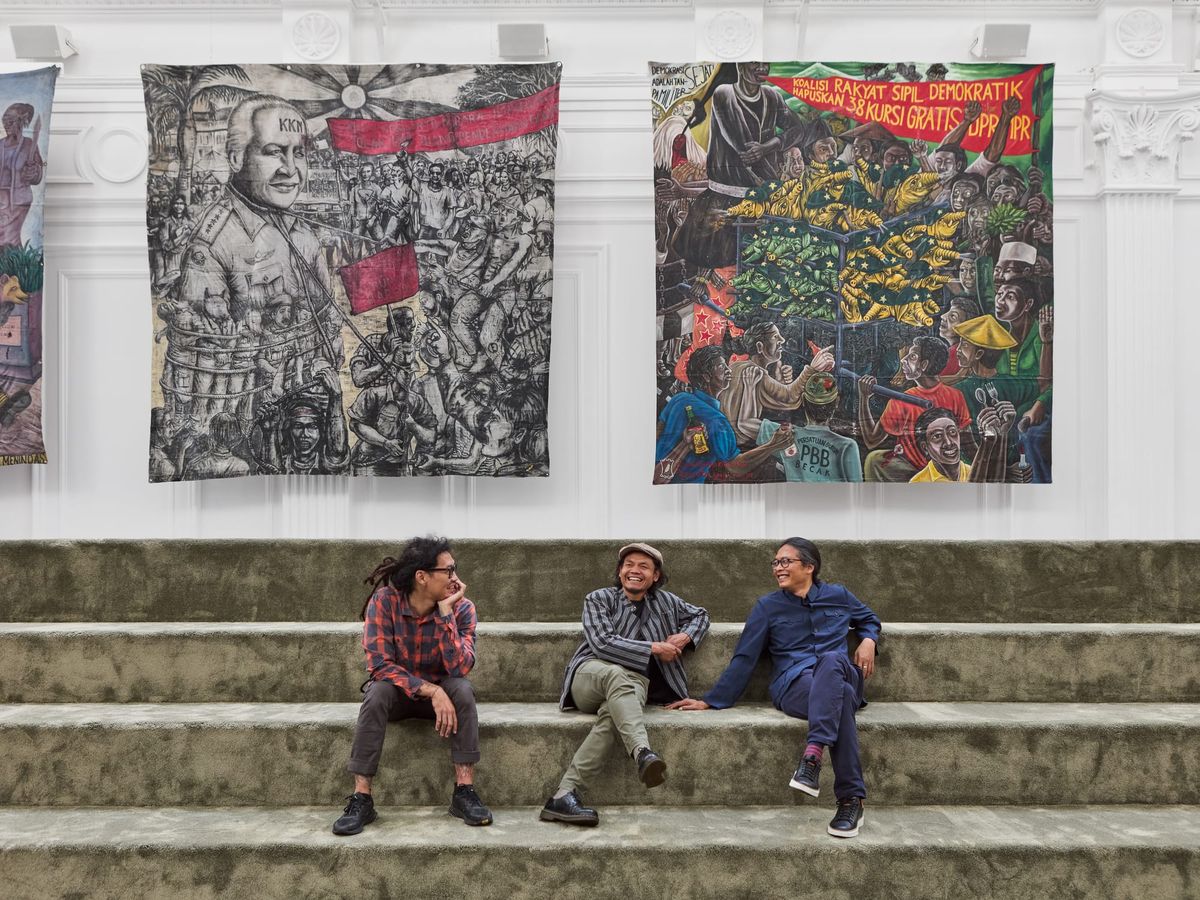
“Rakyat Pasti Menang (The People United Will Never Be Defeated)” opened at Ibraaz on July 8, marking Taring Padi’s London debut. Curated by Odessa Warren, it consists of three chapters. The first chapter, currently on view, is a rare display of the Indonesian art workers collective’s early banners protesting the Suharto dictatorship from the late 1990s to early 2000s. This September, the second chapter will exhibit Taring Padi’s projects addressing workers’ rights and land struggles, while the final chapter, which is slated for October, will present Taring Padi’s recent collaborations with other international progressive alliances post-Documenta 15.
This interview about the first chapter of “Rakyat Pasti Menang” was conducted with Alexander Supartono, a first-generation member of Taring Padi and an associate professor at Edinburgh Napier University. Subsequent interviews about the exhibition’s second and third chapters will follow in September and October.
Six of Taring Padi’s early banners from 1997 to 2000 are the centerpiece of “Rakyat Pasti Menang.” Almost 30 years after the beginning of the Reformasi period and the toppling of President Suharto’s regime in 1998, these banners now appear in a very different context within Ibraaz’s space.
When we started the conversation with Odessa, we reflected on how most people have only recently come to know of Taring Padi through Documenta 15 (2022). It was as if we hadn’t existed before that exhibition, although we had already been around for over 20 years at that point. So we wanted to closely examine what Taring Padi is about and where we began.
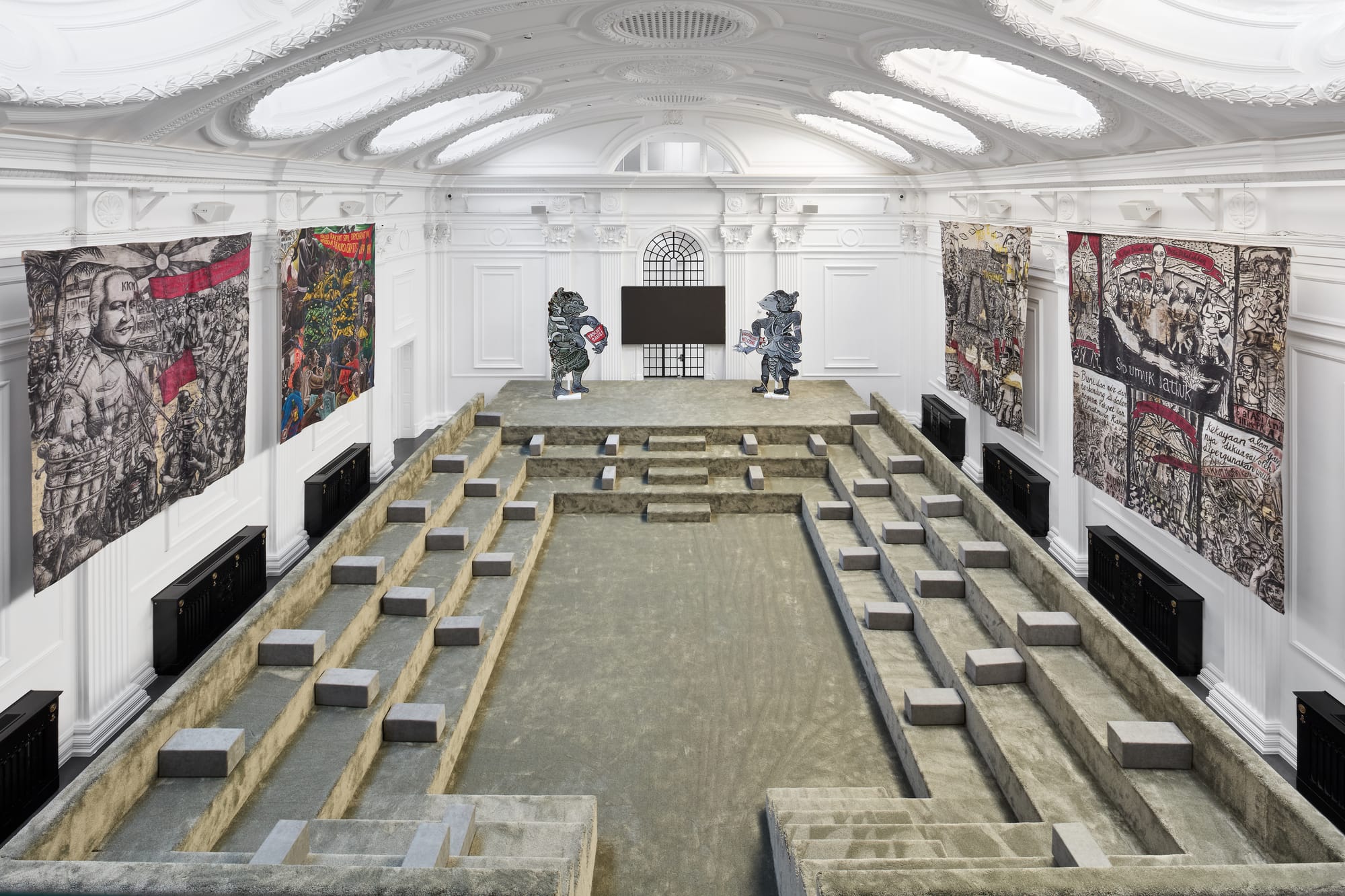
Installation view of TARING PADI’s “Rakyat Pasti Menang” at Ibraaz, London, 2026. Photo by Ollie Hammick. Courtesy the artists and Ibraaz.
Ibraaz is run by people with strong academic backgrounds. Odessa, who previously worked at Tate Modern, approached our oeuvre with a rigorous academic and curatorial approach, probing not only its subject matter but also its aesthetics, structure, and use of color. Her curation allowed us to contemplate our early works from an art historical perspective without passing over their sociopolitical elements. That felt strange to us, but in a good way.
We learned a lot through this process. Rather than making art in the conventional sense, we produce art that serves specific sociopolitical purposes. This show definitely helped us to move forward, and Taring Padi has become much more active in the international art ecosystem—one battleground for our political agenda—since Documenta 15.
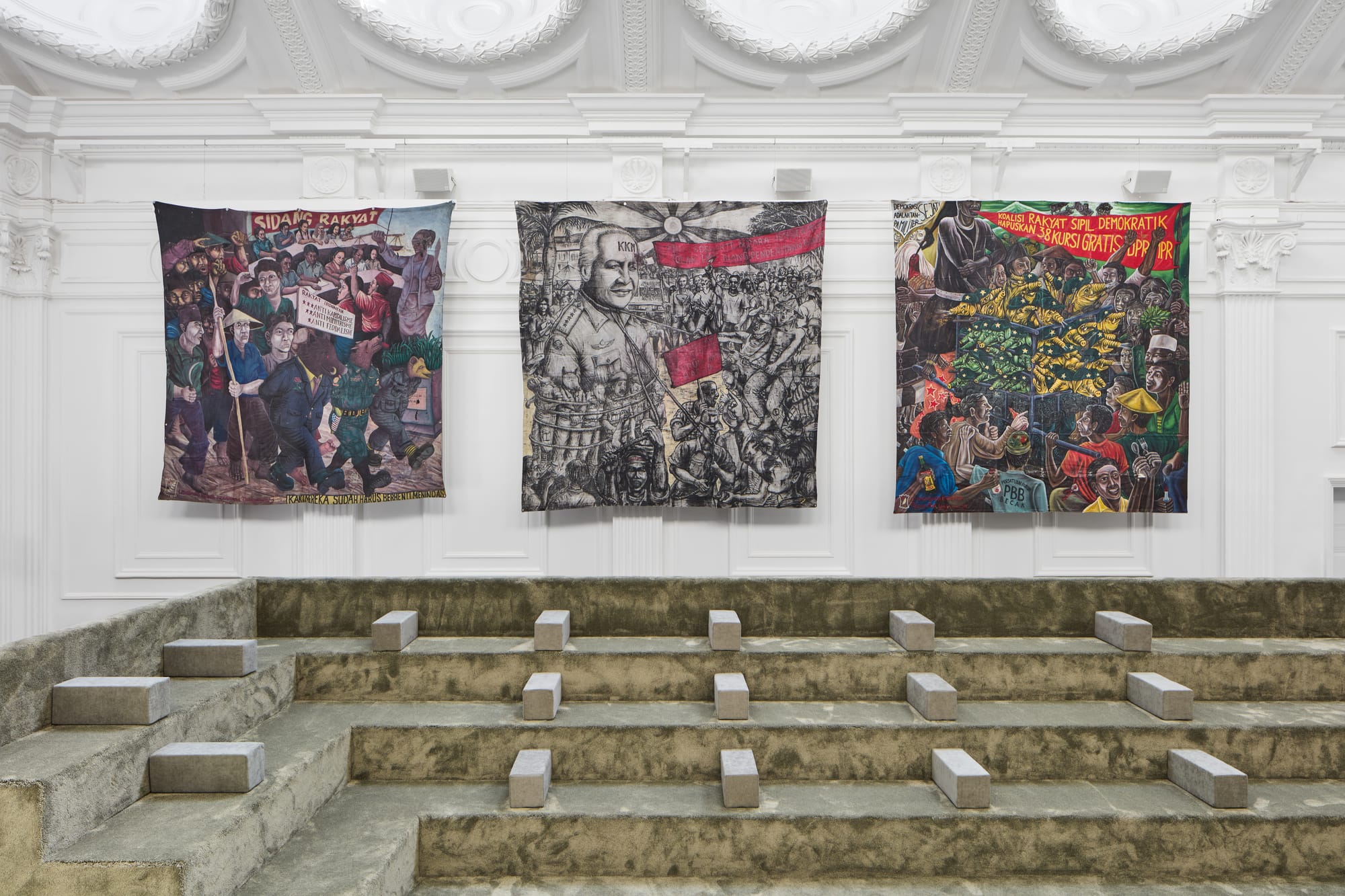
In this exhibition, for example, tiered seating structures are prominently situated in the middle of the space, to simulate an amphitheater. Our work is not the center of interest, but the backdrop against which conversations happen.
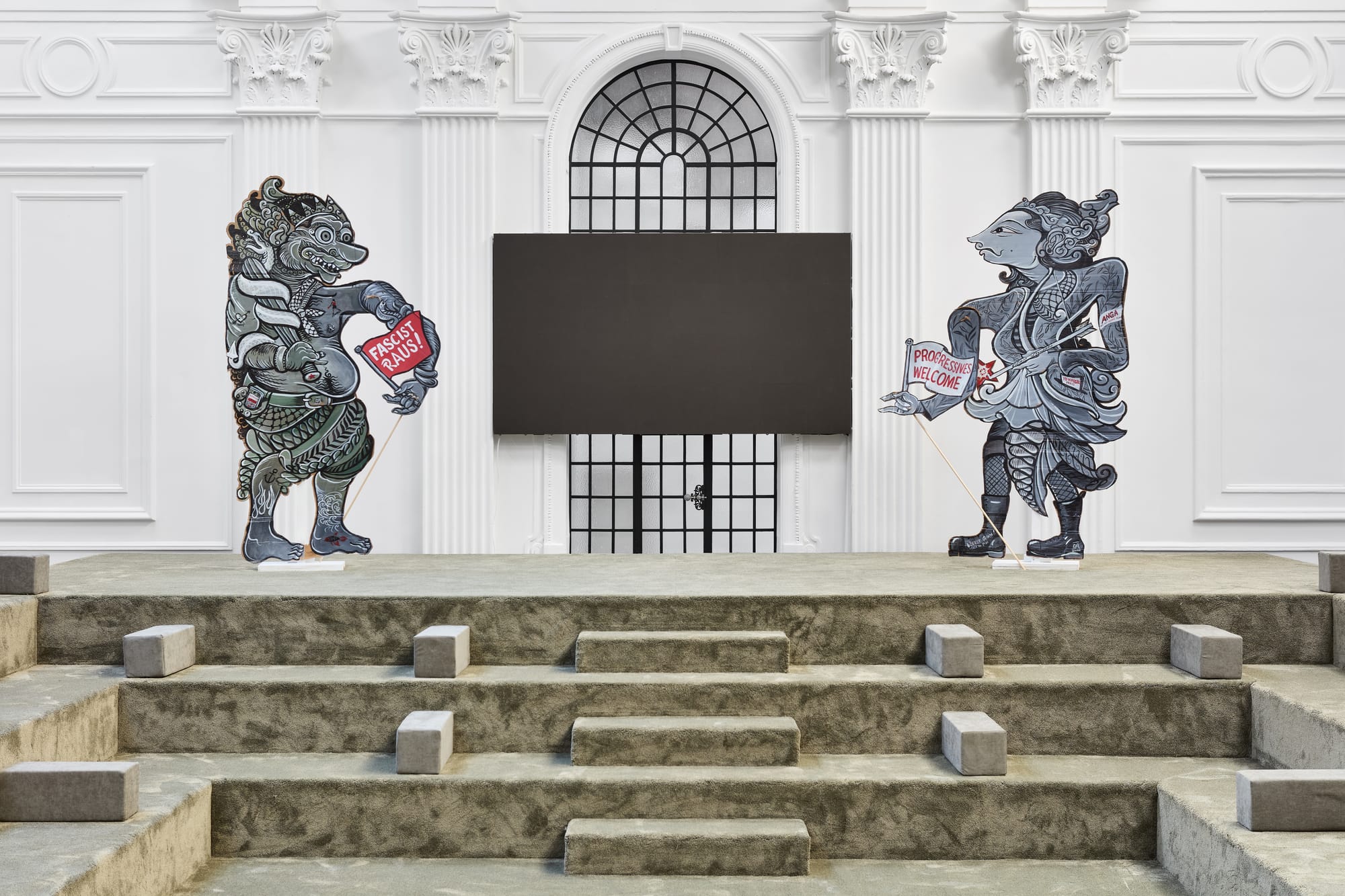
In addition to these early banners in the main gallery, more recent wayang kardus (cardboard puppets) materialize in doorways, corners, and stairwells. Could you tell us about these?
The first figure you encounter is a farmer with a shirt that says Sadumuk bathuk senyari bumi ditohi pati. It’s a Javanese saying—most of the members of Taring Padi come from Java—that means: “Even if it is just a touch on the forehead or a single inch of land, we will defend our dignity with our lives.”
These cardboard puppets—like the ones bearing “Fascists Raus” and “Progressives Welcome” signs—were all made at Ibraaz, responding specifically to the space and its location. They’re made from used cardboard and aren’t supposed to last. After the show, we’ll dispose of them, or some people may keep them. If you go around the building, you’ll see puppets in the bookshop, the café, even in the office. We tried to somehow occupy this neoclassical building—a listed building, so sterile and beautiful— and conquer it with our used cardboard puppets.
Do you remember specifically when these banners were used in Indonesia? How did these early works influence the course of political events and the development of the public’s social consciousness?
We used early banners in Yogyakarta, where they were very popular. Many organizations borrowed them for their events and some were never returned. Less than a year after we started to display them, Komnas Perempuan, the National Commission on Violence Against Women in Jakarta, commissioned us to produce a large-scale banner in response to the refugee crisis in Aceh (North Sumatra) in 1999. For sure, our banners helped shape public awareness in this respect, but one might argue that the public is already engaged in social and political protests. As for the public’s reaction to seeing the banners, I can only say people appreciated them, observing the details closely and finding humor in them. We like to think, for example, that our banner 38 Kursi Gratis (38 Free Seats) (1999/2021), which called to abolish the 38 unelected parliamentary seats reserved for the military, contributed to subsequent reform and the actual removal of those seats. There’s no way to factually cross-reference that, but we strongly believe in the sociopolitical impact or function of artmaking.
While the majority of the big banners are in Yogyakarta, they eventually circulated further. It’s a good thing because they should be moving through the world instead of remaining in storage.
Given Taring Padi’s multiple members, what are your artistic methods or guiding principles for creating work? How has the collective’s artistic language developed as its members changed over three generations?
After more than 20 years, we have found a rhythm. Usually we decide on the team, then the slogan for the banner, its focal point and main image—whether a tree, a figure, or something else—before getting to the overall composition and structure. Once we have that, everyone starts to chip in. We call it mengisi (“to fill in”). The projects are always full of details. Sometimes we don’t know what is in our banners until the very end, because so many hands are involved. And there are no rules. While working together, we banter, joke, debate, and discuss. All of this—even the fights and disagreements—manifests in the final product.
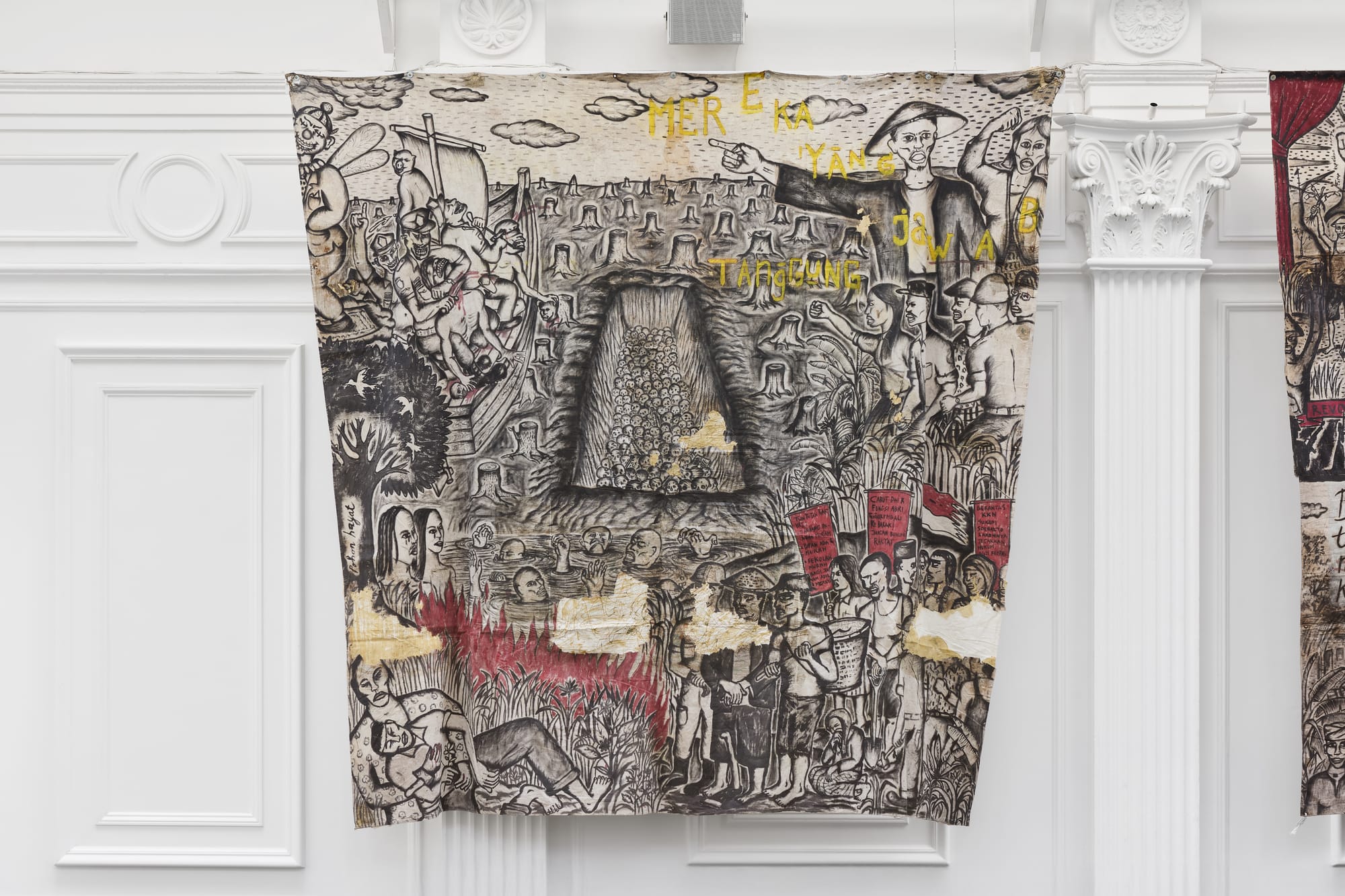
Installation view of TARING PADI’s “Rakyat Pasti Menang” at Ibraaz, London, 2026. Photo by Ollie Hammick. Courtesy the artists and Ibraaz.
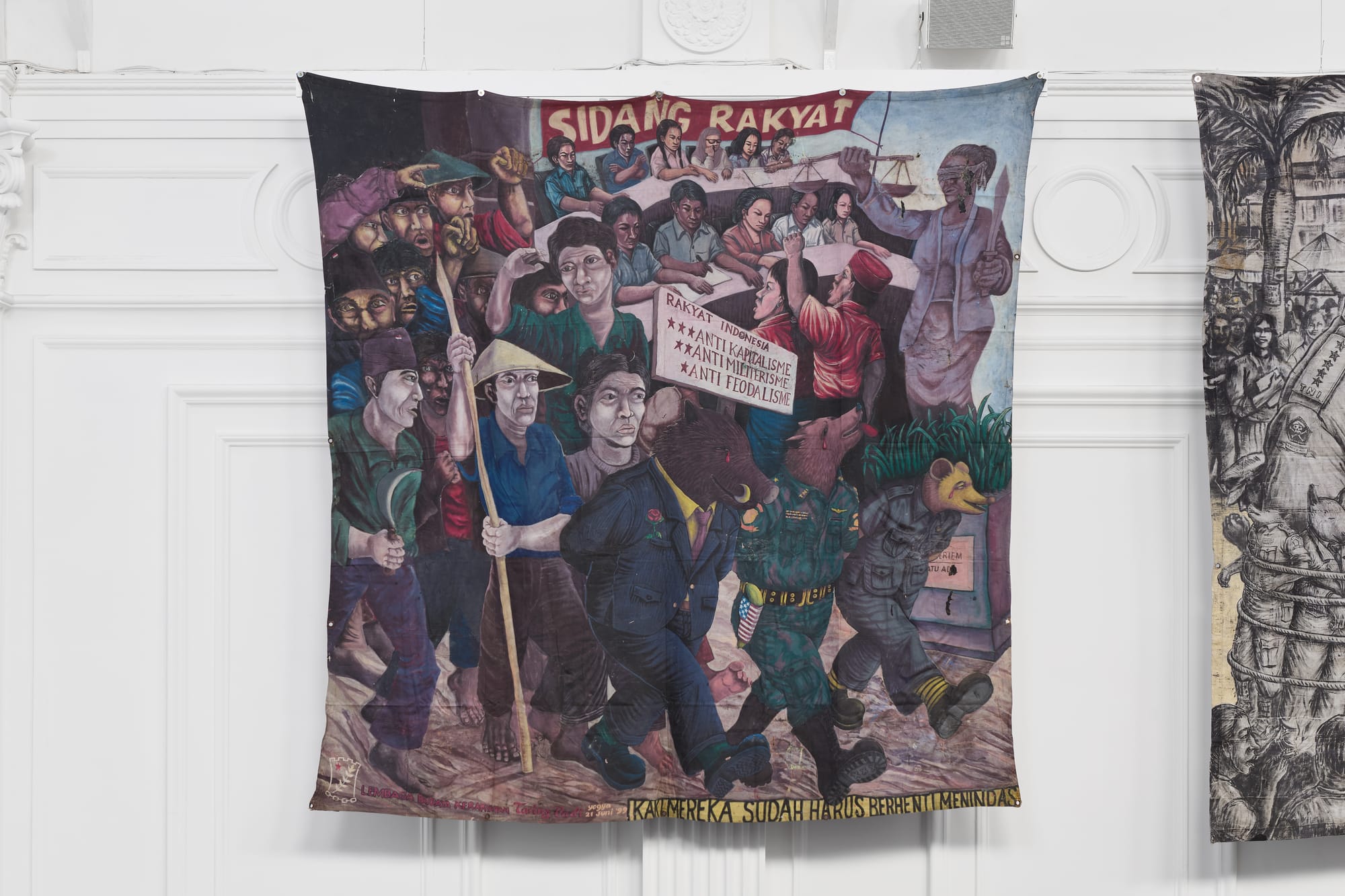
I don’t think our artistic style, which can be loosely categorized under social realism, has changed much over the years. Each member brings their own style to Taring Padi and vice versa. After almost three decades, this dynamic has given rise to Taring Padi’s signature commonplace pictorial language. There are slight changes here and there depending on who’s involved in each banner’s production, but only the insiders and very highly trained eyes can spot these changes. During the late 1990s, we developed our “realistic and concrete” visual characters, as Indonesian artist and academic Dolorosa Sinaga described them, moving on from the more naive style of banners that we had created prior to Taring Padi’s founding declaration in 1998 such as Mereka Yang Bertanggung Jawab (Those Who Are Responsible) (1997–98) and Rakyat Pasti Menang (People United Will Never Be Defeated) (1998). The post-declaration banners Sidang Rakyat (People’s Tribunal) (1999) and Adili Suharto dan Para Jendralnya (Bring Suharto and His Generals to Justice) (2000) adopt a more realistic style that communicates better.
Our banners are filled with symbols and wordplay. Take Adili Suharto dan Para Jendralnya (Bring Suharto and His Generals to Justice). In the background there’s an ordinary truck, the kind that usually has a cheesy painted sign saying “all my love to you” or something like that. So we have a truck with a sign saying Senyummu menusuk hatiku, which literally translates to “Your smile pierces my heart.” It’s a very sappy phrase, but here it refers to Suharto, who was known as the “smiling general” who orchestrated the 1965–66 communist purge and killed people while smiling.
People are talking about how Taring Padi challenged certain ideas in modern art, such as the concept of individual artistic genius. But we were originally guided by practical factors. We collectively produced large-scale banners because we needed them as soon as possible for scheduled demonstrations the next day. Even now, practicality continues to dictate the way we work.
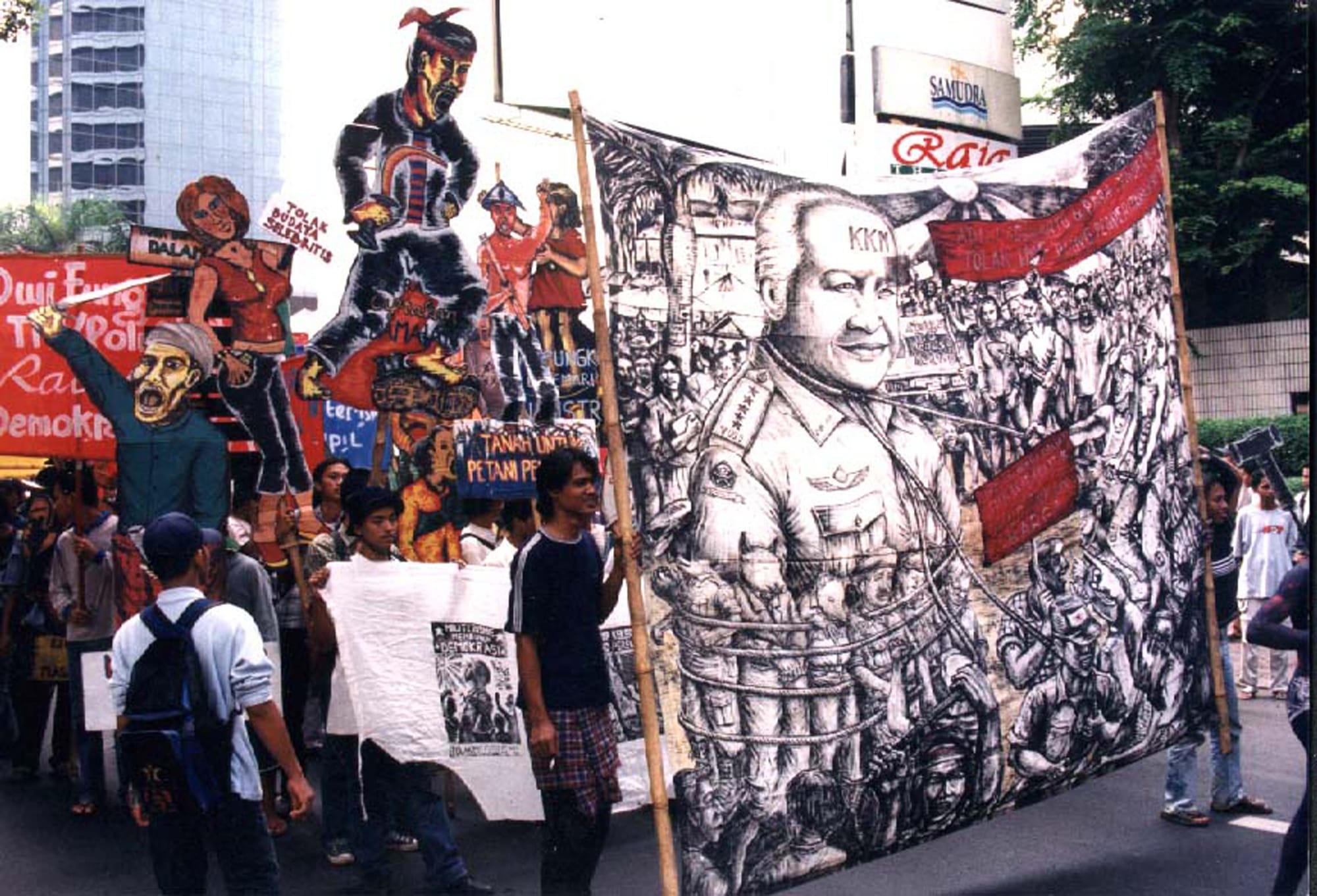
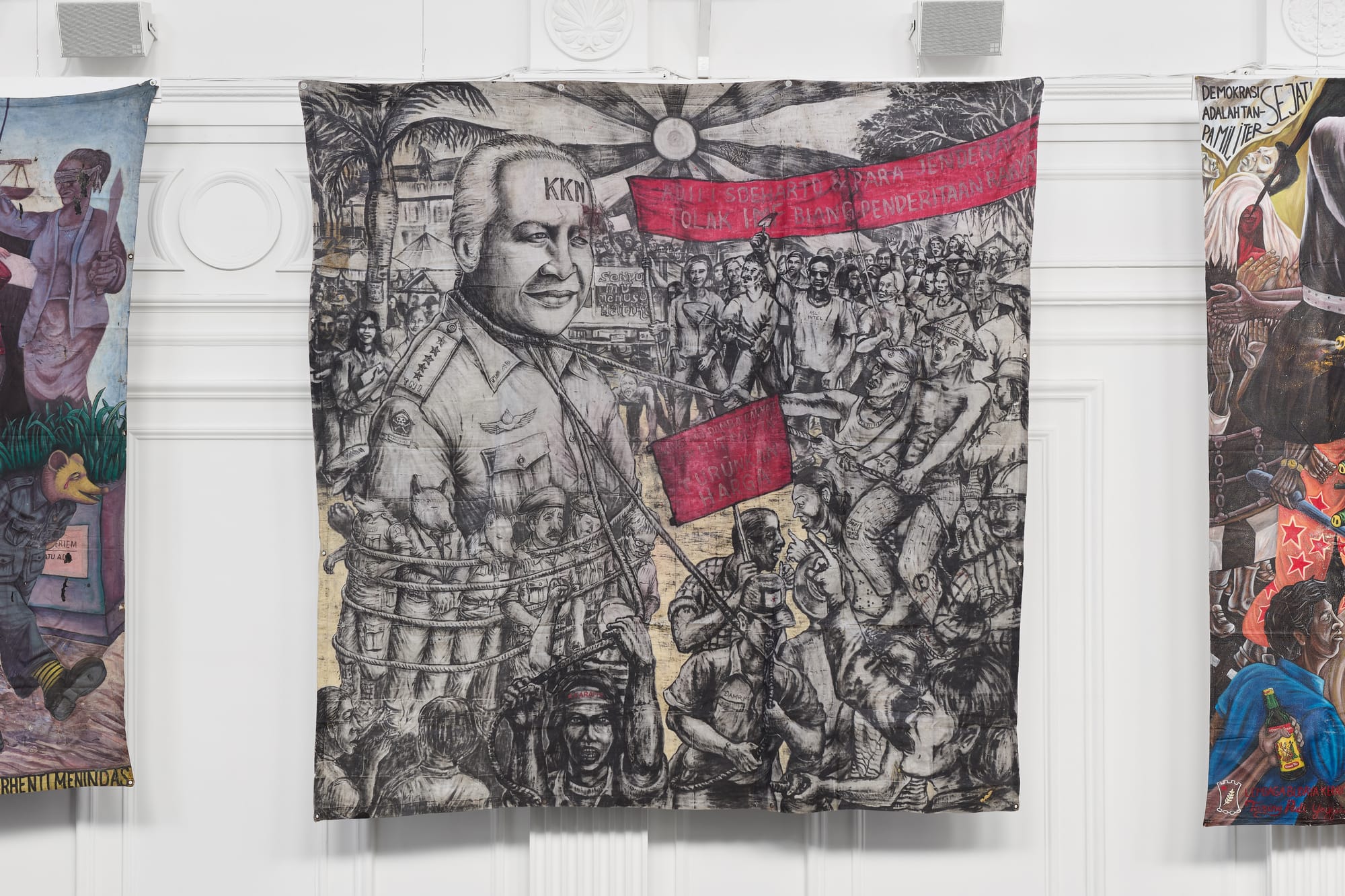
Detail from archival photograph of TARING PADI’s banner, Adili Suharto dan Para Jendralnya (Bring Suharto and His Generals to Justice), 2000, during the Karnaval Rakyat Anti Militerisme (KARAM/People’s Carnival Against Militarism), Jakarta, 2000 (left); and installation view of TARING PADI’s “Rakyat Pasti Menang” at Ibraaz, London, 2026. Photo by Ollie Hammick (right). Courtesy the artists and Ibraaz.
Which ideologies and groups were influential or formative in Taring Padi’s early years? Would they include Lekra and Sanggar Bumi Tarung, which were affiliated with the Partai Komunis Indonesia (Communist Party of Indonesia), or other internationalist or Global South movements?
It’s difficult to trace this partly because Lekra’s literature and leftist literature in general were hard to access during the Suharto era. The internet helped a lot. I remember in early 2000 I was working at the Goethe Institute’s Jakarta office as a freelancer, and I printed whatever leftist literature I could access online and distributed them among Taring Padi’s members. Taring Padi was certainly influenced by Lekra in terms of its leftist cultural ideology, but not in terms of visual reference. That we learned more from Diego Rivera and other Mexican muralists. We don’t draw any visual inspiration from Sanggar Bumi Tarung or their organizational structure. People like to connect our anarchist tendencies with Sanggar Bumi Tarung’s, but that’s inaccurate because our anarchist element comes from punk music tradition.
I’m very impressed by your ethical and artistic principles as a collective, but I also wonder how you conserve and document work while maintaining such an anti-consumerist stance.
We don’t conserve our works very well. In fact, we’ve lost many of them. They are political tools. When people come to us wanting to borrow our banners for their event, we can’t say no. Just last week, someone asked to borrow a banner to commemorate a journalist who was killed more than 30 years ago. It’s difficult to monitor where all these banners go. Oftentimes, we get someone saying, “Oh I’m sorry, I left the banners on the bus!” We accept that as part of how we work. The 38 Kursi Gratis banner, which is in this show, was folded up and somehow got stuck together, and we had to open it bit by bit using a clothes steamer that we bought from John Lewis next door.
We used to keep all the works in our Yogyakarta studio. During Documenta, we started to catalog and archive them; some are now in Venice, London, Perth.
It’s very timely that these works are now being exhibited in London in Ibraaz—an important new space “for the global majority” in the heart of British empire—during a moment of historic political change and social mobilization. How has the reception of your show been so far? From an activist or solidarity perspective, what is the significance of the show happening here and now?
The reception has been good. We were prepared for some backlash with this show but it hasn’t happened so far; maybe because our subjects are still focused on Southeast Asia, on Suharto and militarism in Indonesia. The exhibition will have three chapters. This was also a curatorial decision made together with Odessa, to show limited works in each chapter, and give people the time and space to reflect upon the pieces. The final chapter will be more interesting as we address more global topics there, such as the Palestinian issue and the rise of fascism around the world.
Chin-chin Yap is a Singaporean writer and filmmaker based in Lisbon, and a contributing editor for ArtAsiaPacific.