People
Anne Imhof on Discipline, Agency, and “House of Swans”
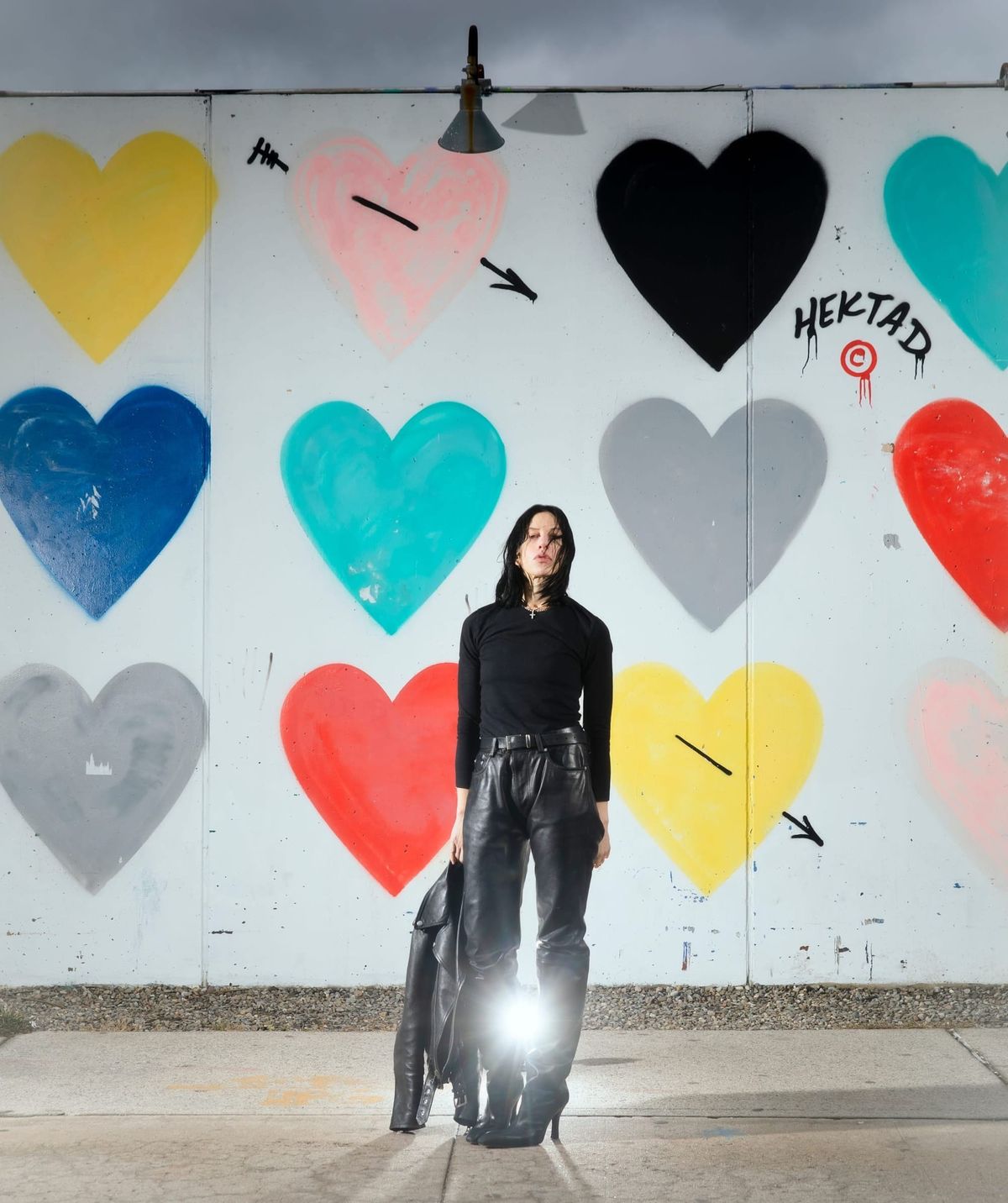
Discipline and desire, confinement and release, somatic control and unbridled grace—these are the tensions Anne Imhof creates in “House of Swans,” the German artist and choreographer’s exhibition at Hong Kong’s Tai Kwun Contemporary. Spanning several galleries, the show brings together sculpture, painting, and large-scale installation. At its center is the titular performance, a four-act story ballet realized with the dancers of the American Ballet Theatre (ABT) and the Hong Kong Ballet (HKB), which extends the preoccupations that have long run through Imhof’s practice, from her Golden Lion-winning Faust (2017) at the 57th Venice Biennale to her monumental DOOM: House of Hope in New York’s Park Avenue Armory last year. In this conversation, Imhof speaks about discipline as both constraint and freedom, the search for agency that drives her heroines, ballet as a universal language, and the world she built in “House of Swans.”
Across “House of Swans,” you bring together the bodies of the ballet dancers, whose bodies are trained to project an almost inhuman grace, and the architecture of confinement—crowd barriers, metal lockers, and cages. All of them are, in one way or another, forms of discipline. What draws you to this tension?
I’m drawn to ballet because of its form—it’s like a formula you can use to compose. House of Swans includes both contemporary dance and ballet, which are quite distinct from each other. I like that ballet forces me to work with its constraints. I used to think the opposite, but it actually gives me more freedom to express things. Ballet is a language that one can communicate in universally. That was one reason for using it again here, although it was always part of my practice. The movement language in DOOM (2025) was heavily infused with ballet. I worked with Devon Teuscher and other dancers of ABT in New York to present a whole act as a 20-minute ballet. For House of Swans at Tai Kwun, I had the chance to work with HKB dancers. I promised myself to involve the principals and corps in the creative process, and we did. We worked with the dancers in New York—Devon, Remy Young, and Toon Lobach—and then prepared the roles for Qingxin Wang, Gouta Seki, and Ryo Kato, developing their characters and choreography in the HKB studios.
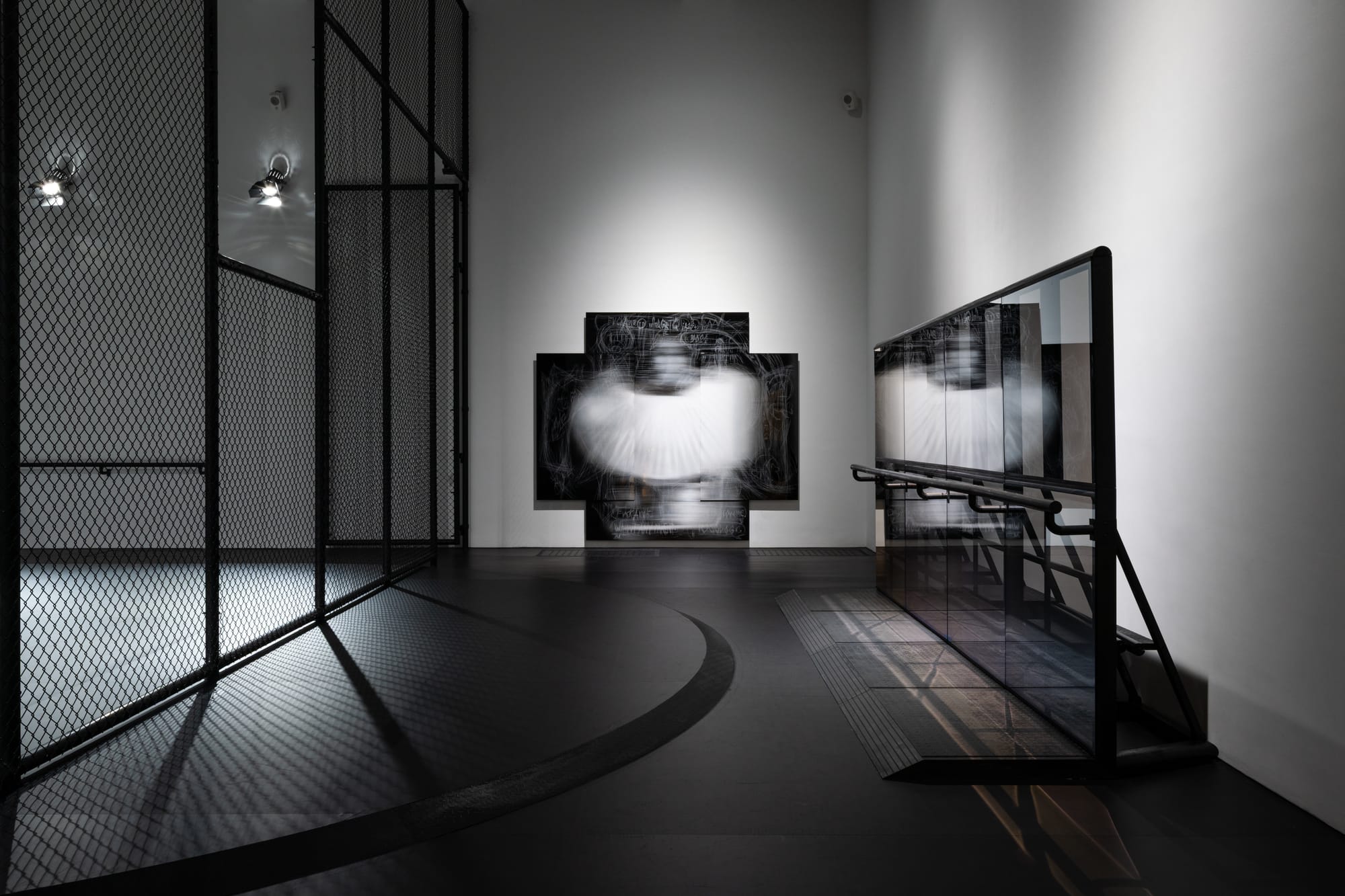
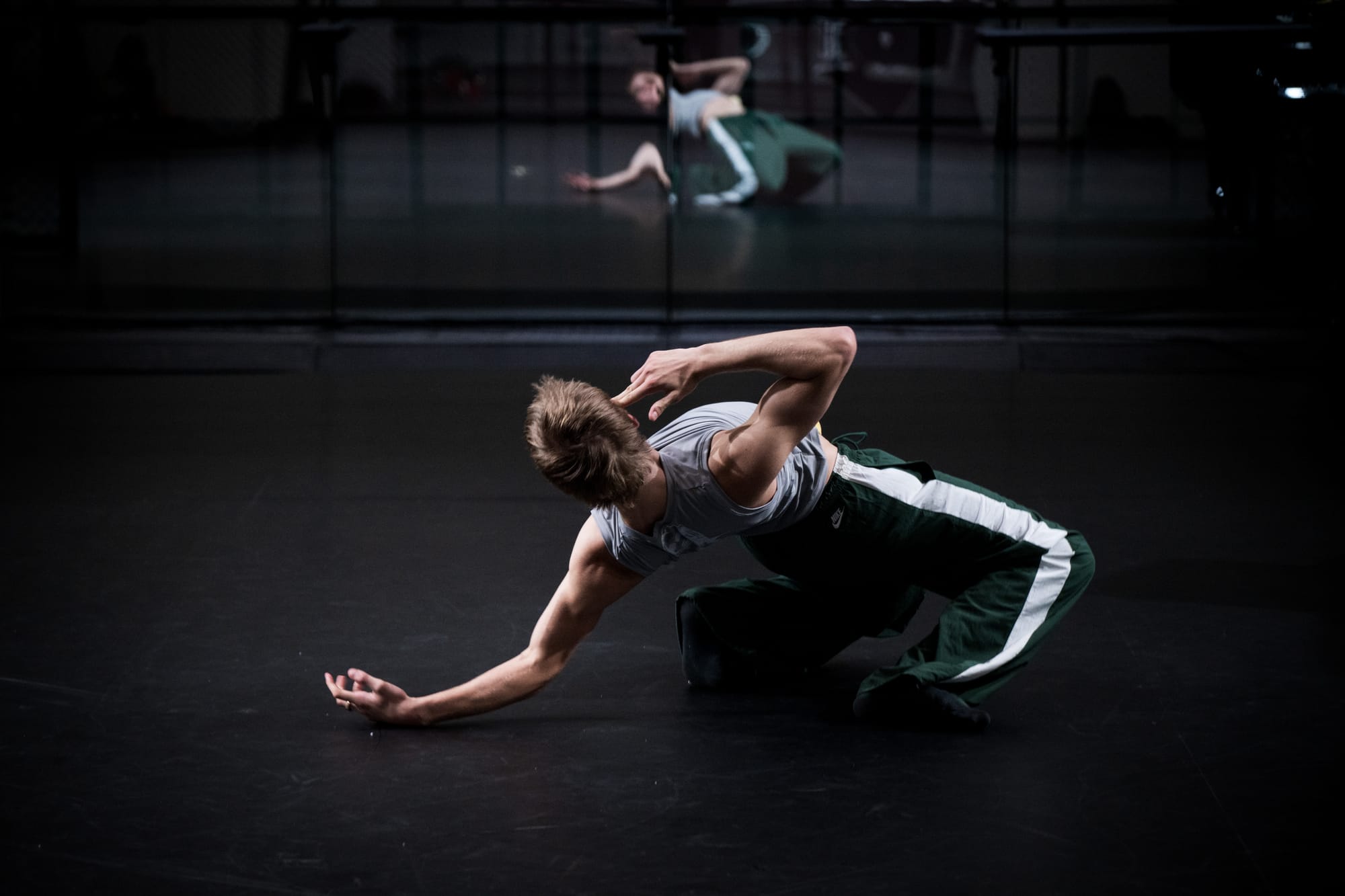
The sculptural elements of the mise-en-scène represent discipline from the outside of a space and a stage—something that is inherent in the material, in the steel, in the black matte of the marley flooring. The crowd barriers and chain links carry connotations of a sports field and a cage, of an urban outdoor space and a situation of control. As the audience enters and takes their place in a ring around the main stage, the whole thing becomes a sort of amphitheater in which the last thing you would expect to see is a four-act story ballet. It fuses the idea of a dance battle and ballet. Moreover, the crowd barriers are not the kind the police would use, but the ones you’d find at a concert. They have a dual function in that they are a disciplinary instrument but also, in a twisted way, serve as ballet barres for the dancers during the performance. The bars themselves are built to sit loose in the mirrored structures. It’s a strange, beautiful moment when the ballerinas take them out halfway through the show, carrying and moving with the long metal rods.
In one gallery, an installation of mirror panels forms a room, or a ballet studio. The aluminum and two-way mirrors make them appear clinical, and the absence of the dancer’s body becomes more visceral. The barriers become very sculptural. In the main performance room on the third floor, you encounter the ballerina—the representation of the purest, lightest, most graceful and ungraspable being—as depicted in classical ballets, right in front of you.
Dancers are high-functioning athletes—they undergo enormous amounts of physical training and practice endless discipline. Audiences are used to seeing ballet from only one vantage point—looking at the stage from a distance, and the illusion of the dancer in classical ballet is completely preserved. In House of Swans, the closeness breaks that illusion. There is a certain tension in between that really interests me. And to see ballet up close is fascinating and moving.
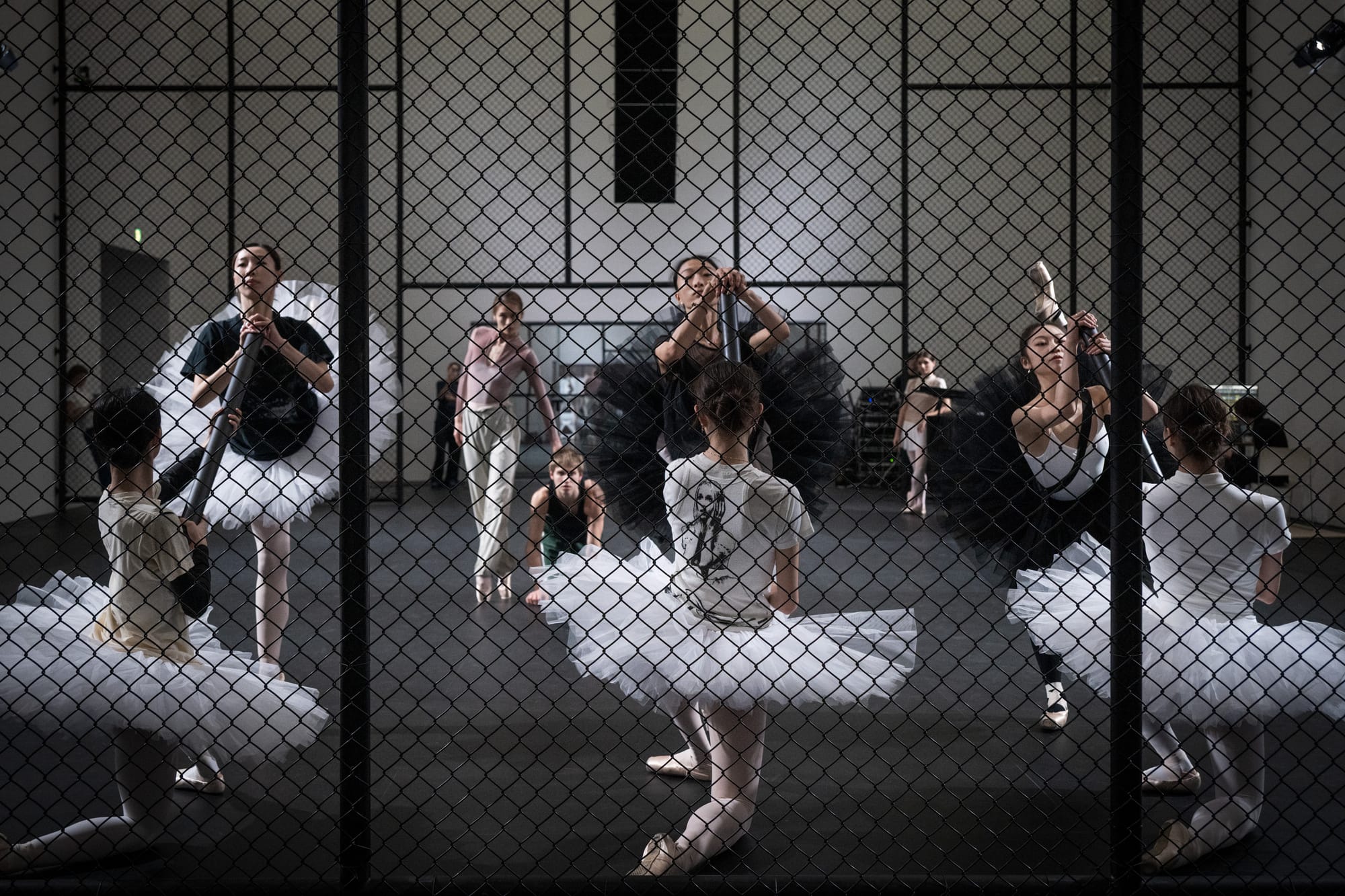
Before I even saw the exhibition, I was drawn to the title. Swans obviously evoke ballet, but “house” gave me the feeling of a secret society, and the word recurs throughout your recent works. During the performance at Tai Kwun, the dancers lounge on the floor between scenes, seemingly half in character and half themselves, recalling a community rather than a cast. You’ve spoken often about the collective as the grounding force of your practice. Is “house” your word for community, a structure of belonging?
I think you’re very right. The idea of a house comes, for example, from ballroom culture, from queer culture, where it describes a community and a safe space for expression. I wanted to take that principle and apply it to 19th-century classical ballets like Giselle and Swan Lake. In Giselle, you have the Wilis; in Swan Lake, it’s the swans. Both cohorts are ghostly creatures, communities of women who have been failed and betrayed. In our story, it becomes almost the opposite: it’s more about agency and control, the characters moving toward that.
I wanted to call it a house because the swans in Swan Lake are also a certain kind of society, led by a queen who stands in for them and protects them from Siegfried, a prince who wants to shoot them. As a classical image, that’s it. The Wilis have their queen Myrtha, who wakes them at night and drives them to kill men roaming through the forest. In DOOM, I started with two houses—the House of Wolves and the House of Tigers—which are loosely based on the Capulets and the Montagues in Romeo and Juliet (1597). And here we have the House of Swans, which was a little odd, because it was just the ballet—it didn’t derive from any story. An imagined society, a fantasy.
In House of Swans, I wanted to tell the origin story of the performance itself—on the one hand, it is a fantastical tale that tackles deep questions about human existence; on the other hand, it is a real-life account of us, as artists and as individuals, working together. The HKB dancers really became a part of it; I wanted them to bring their own personalities to the characters.
The performance centers on a young heroine, played by Devon, who is trying to reclaim her agency. It seems like she is searching for something abstract without fully knowing herself what it is. Where did she come from, and how much of your fictional characters are drawn from the dancers you worked with?
This is a fantastical story that could almost be an animated movie; that’s how it was in my head. All the dancers I collaborated with helped me shape their characters and the overall performance. The main protagonist is Amalia, a fictional character with traits of Devon Teuscher, and the character of Connie has traits of Qingxin Wang, who danced the role. The character of Hanno, meanwhile, was developed in New York with Michael de la Nuez of ABT and finalized here in Hong Kong with Seki. Lobach, who plays Vania, created the persona with me. Young is Juliet, and Kato is Angel—both of their characters represent people from the past, angels of some sort, moving between life and death, invisible to the others but visible to the audience.
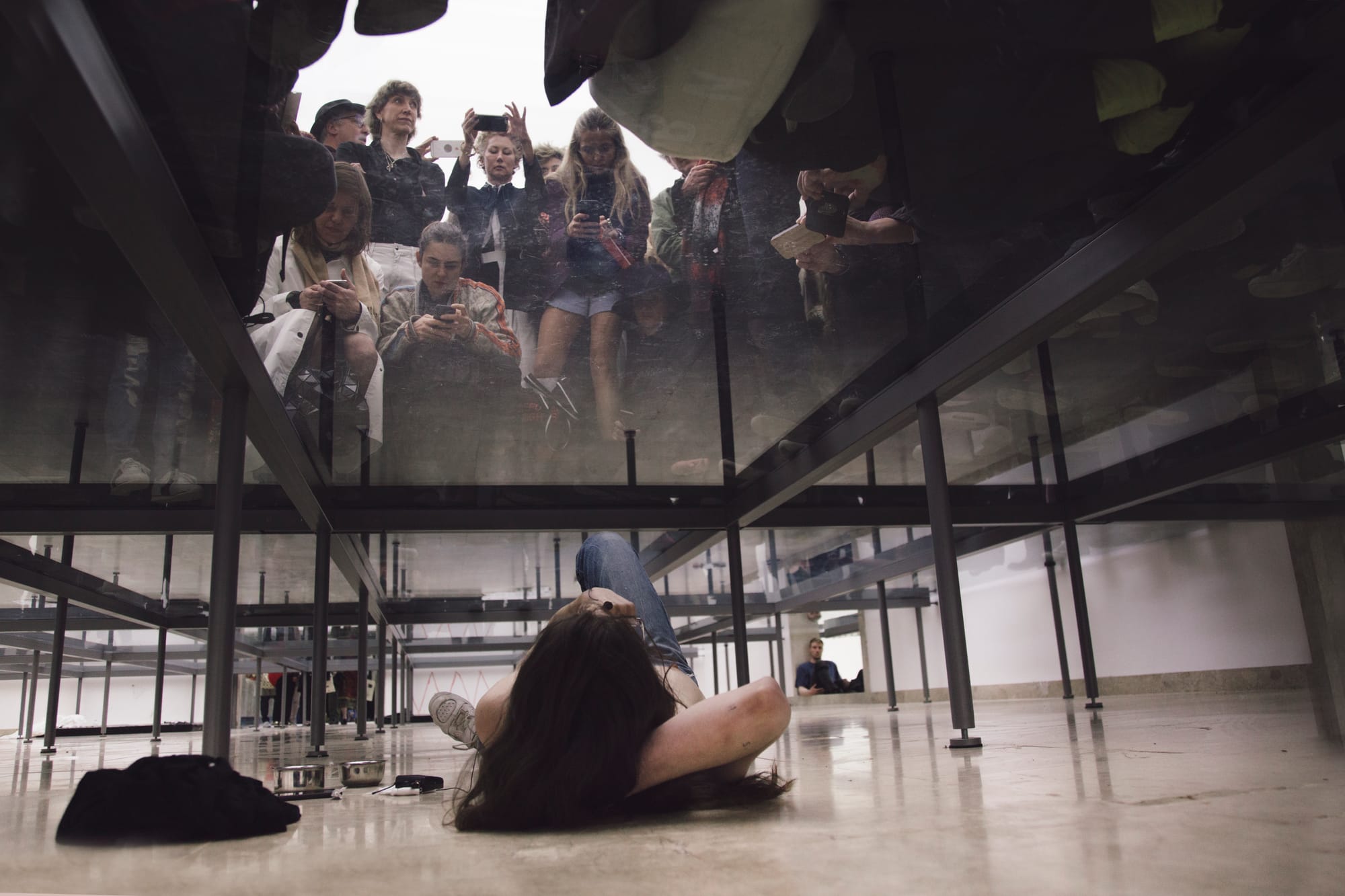
So much of your work keeps returning to love—love entangled with death, with rage. In Faust, it feels bound to isolation, whereby physical intimacy is almost disallowed; in DOOM, through referencing Romeo and Juliet, there is wrath and ruin; and here, it is something new. Is love something you’re actively thinking about right now? And has your thinking about it shifted over the course of these projects?
Yes. I wanted to tell a love story between two female characters in a ballet. It already started with Romeo and Juliet at the Park Avenue Armory, but it wasn’t as concrete or narrative-driven as in House of Swans. I have always been hooked on the theme of love, particularly in song lyrics. It fuses personal life and fiction, because it’s always infused by music and movement. I wrote the song For Real during DOOM. I asked Devon to dance to it, and we created that solo together. It’s the same with Levi Strasser. His lyrics are poetic—they’re his own. We fuse them with my words and lyrics quite intuitively; his world enters mine. Jacob Madden wrote the orchestral score. Iggor Cavalera did the drums. Ville Haimala pulled it all together and wrote pieces while Luke Hülsmann created the piercing synth lines. All the music is original and was written during the process of creating the choreography and the story of the ballet. So everything is connected, everything has to do with everything else, which is sometimes not simple to explain. But the audience always gets the essence of things.
The way I experience whom I love, my idea of love in the world, comes across in the interrelations of the figures. My work is in flux, but there is a thread going through it. Maybe House of Swans was more related to Angst (2016) and Faust. I had to risk something to get to the core of it.
Do you believe all love relationships are essentially power relationships? Watching the performance, I couldn’t help tracking who was jealous, who was angry, who was sad, and who loves whom more. Was that something you intended, or does it come through the form of ballet itself?
I was fascinated by the narratives of the classical ballets—Giselle, Swan Lake, Onegin. I wanted a story that doesn’t abandon the romantic story ballet but holds images specific to my world. And you’re right, the piece has a thread, a plot. It is a tragic love story. The story of House of Swans is told in four acts.
Amalia lives within a society where everyone performs the same exercises in the same order, their bodies disciplined and aligned. When she notices a stranger moving differently, a small deviation opens a breach in the world she knows. She follows it to Connie and Hanno, and encounters the Swans.
Amalia enters the abandoned hotel where the Swans live. Drawn into their world of freedom, desire and intimacy, she falls in love with the Swans and spends the night with Connie, whom she admires and adores, and develops deep feelings for Hanno. She discovers a part of herself she has never known. But she also learns that the Swans are planning an act of violence.
Amalia returns to the world of the Objectives, where her brother Egon stands at the center of the established order. Hanno confronts her with the life they might have shared, while Connie reveals her hidden identity and connection to the ruling order. Amalia is forced to confront the competing claims of love and family—and to find her own agency and power, choosing who she loves and what she believes in.
Amalia and Hanno struggle with what their choices have cost them. As the Swans and Objectives converge, Vania prepares to carry out the plan. Amalia intervenes to prevent the attack and protect those she loves. The ballet returns to the square where it began, with Amalia alone, changed by what she has experienced and chosen.
So the story is about love but also about power and agency. With the dancers, I worked on a movement language that infuses my choreographic vocabulary with classical ballet.
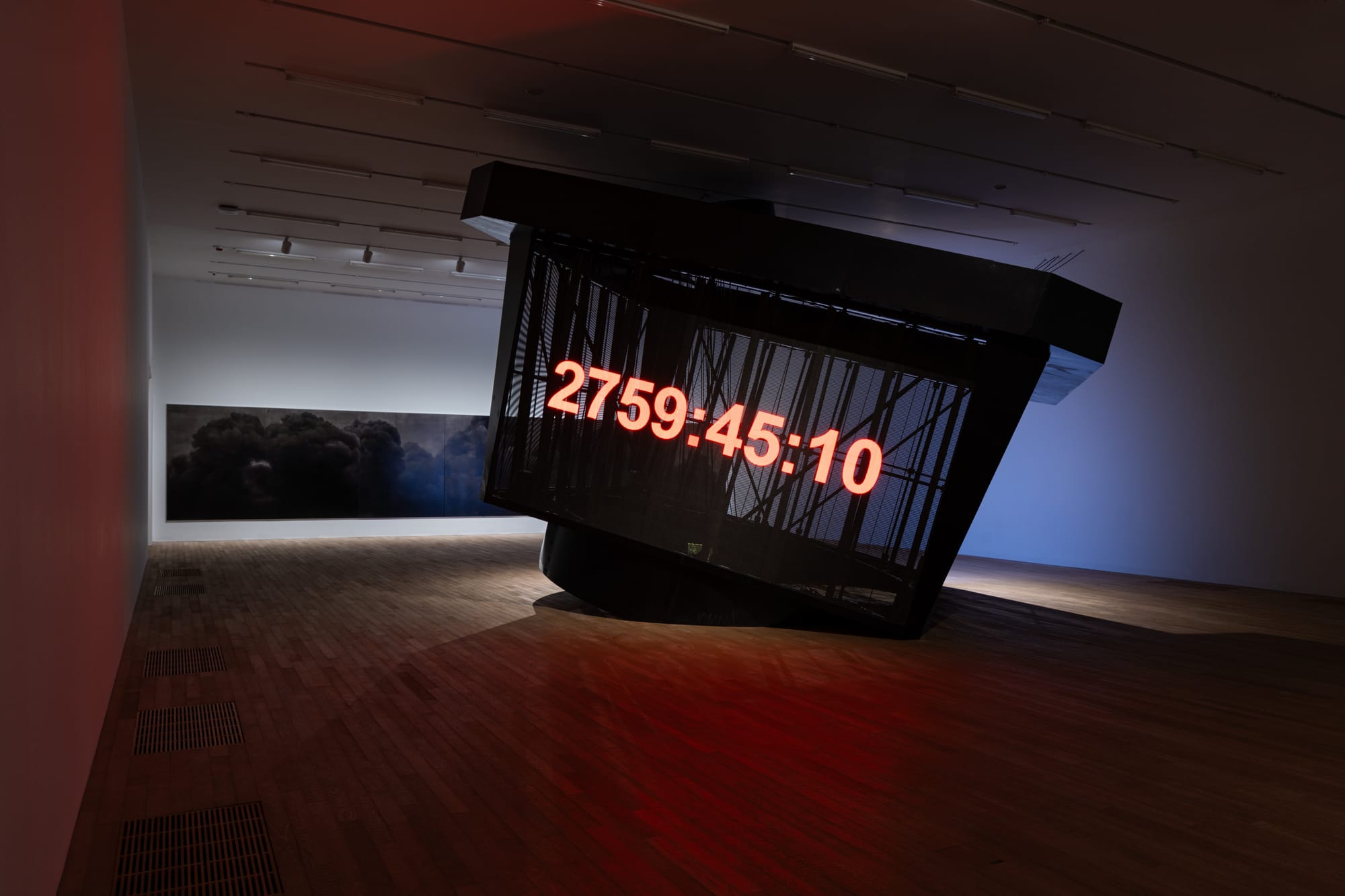
The crashed Jumbotron counting down to the exhibition’s end is one of the most arresting scenes in the show. I’m curious what it means to give an exhibition a countdown to its own death. It feels to me like a spectacle and a ruin at once—was that something you were thinking about?
That’s a good question. Something about the temporality of the art objects interested me, and the time they have to be seen in a museum, which is also a kind of capsule. The white cube has always had its cracks, but especially now it’s becoming more and more so—the collapse of the time of an exhibition, and the death of it. I wanted the whole thing to become a ruin. The crashed Jumbotron is the Western idea of popular culture, how things are broadcast, the idea of something happening right now—set against something you give a span, a beginning and an end. The ephemeral performance is the backbone of my practice, but then there are the bronzes, at the other end of the spectrum in terms of how long they exist. And yet, when you zoom out, even that is only a couple hundred years. It’s not so much, really. It shows how humans always want to command time. It is also the celebration of the moment when you say, okay, we come together to see a show.
There’s a sense of violence in the paintings. Dragging a blade across the oil like that seems physical, almost aggressive. What were you actually feeling when you made the works—was it rage, or something else?
I’ve already made the transition from the rage that’s in there, which was maybe the initial spark, to quite a tender idea of approaching a surface. When I stand in front of it, it’s almost purely conceptual, and then I let myself drift. I often listen to something that isn’t even music, because music is too much—whale sounds, something that takes me away. At Tai Kwun it was interesting: I started in silence, and then the monitors switched on on the other side, and it was the music of DOOM playing, and suddenly it gave the work a different atmosphere. I thought, ah, so that one composition shapes another.
It was such a huge work. Usually I photograph the piece and make sketches digitally, very fast, with my finger, which takes away the actual body movement, the uncertainty of the line, where more accidents happen. So I go in with an idea of a structure. This time that wasn’t possible. When I tried to make this composition, it was lost, so I just had to dive into it. It’s rare that I work like this, and it was quite a trip, I have to say. That work down there, it was a couple of nights. Quite a trip.
I also want to talk about the mirrored room. We are all so used to being watched now, and to watching ourselves being watched. Was that self-consciousness something you wanted people to feel in the room, and in the performance too?
Yes, that was the idea of this room. It holds the memory of a studio—a dance studio, a ballet studio—but also has the clinical quality of an observation room, almost an interrogation chamber. There’s an uncanniness to this sculpture, even though it’s a closed room, just because of the mirrors, the aluminum, the laminate. And then there is the beauty of the material, the lines, the form.
The libretto of the ballet says:
They asked us to prepare for Mars and we did, and they told us half of infinity was the same as all of it, and that our flaws were our superpowers; they read our diaries, the love books of love and hate, stillborn thoughts wrapped around a tree; in the end we stayed, we’re at home now, swans will never go to Mars, we love it down here.
It seems to resonate with the entire show.
Louis Lu is an associate editor at ArtAsiaPacific.