People
The Choreopolitics of Looking: Interview with Paul Pfeiffer

The linguistic associations that emerge from Paul Pfeiffer’s solo exhibition “Olympia,” on view at Perrotin Los Angeles through November 7, are inseparable from the city’s preparations to host the 2028 Olympic Games and the political and cultural significations such an event produces. Yet “Olympia” invokes something older and more metaphysical: Olympus, the mythological seat of the gods, and the summit as a site of transcendence, power, and spectacle. The Olympic “peak” becomes, in Pfeiffer’s work, entangled with the heights manufactured by media, capital, and collective desire. “Soft power is a polite way to describe something that is way more disturbing,” he tells me shortly after the exhibition’s opening.
It is tempting, then, to understand Pfeiffer’s work not simply as an interrogation of visual hierarchy and its ideological production of innocence, but as an attempt to excavate the occult structures beneath its surfaces: the interconnected systems through which image regimes and bodies acquire their seemingly natural authority. He traces part of this inquiry through the Italian neo-Marxist thinker Paolo Virno, whom he cites for his observation that artists access forms of knowledge that are ultimately made legible through institutions. Pfeiffer extends this framework to the athlete. Like the artist, the athlete has specialized capacities, occupying a peculiar position as an exceptional body whose singularity is converted into economic and cultural value.
Pfeiffer’s return to LA, following his 2023 retrospective at the Museum of Contemporary Art (MOCA), thus becomes a proposition for what he describes as a “bigger project,” further examining the narratives and economies of sport, machineries of representation, and their beguiling excess. In “Olympia,” the ascent toward the acme becomes a metaphor for cultural climax itself: a moment that is never simply reached, but staged, circulated, and consumed.
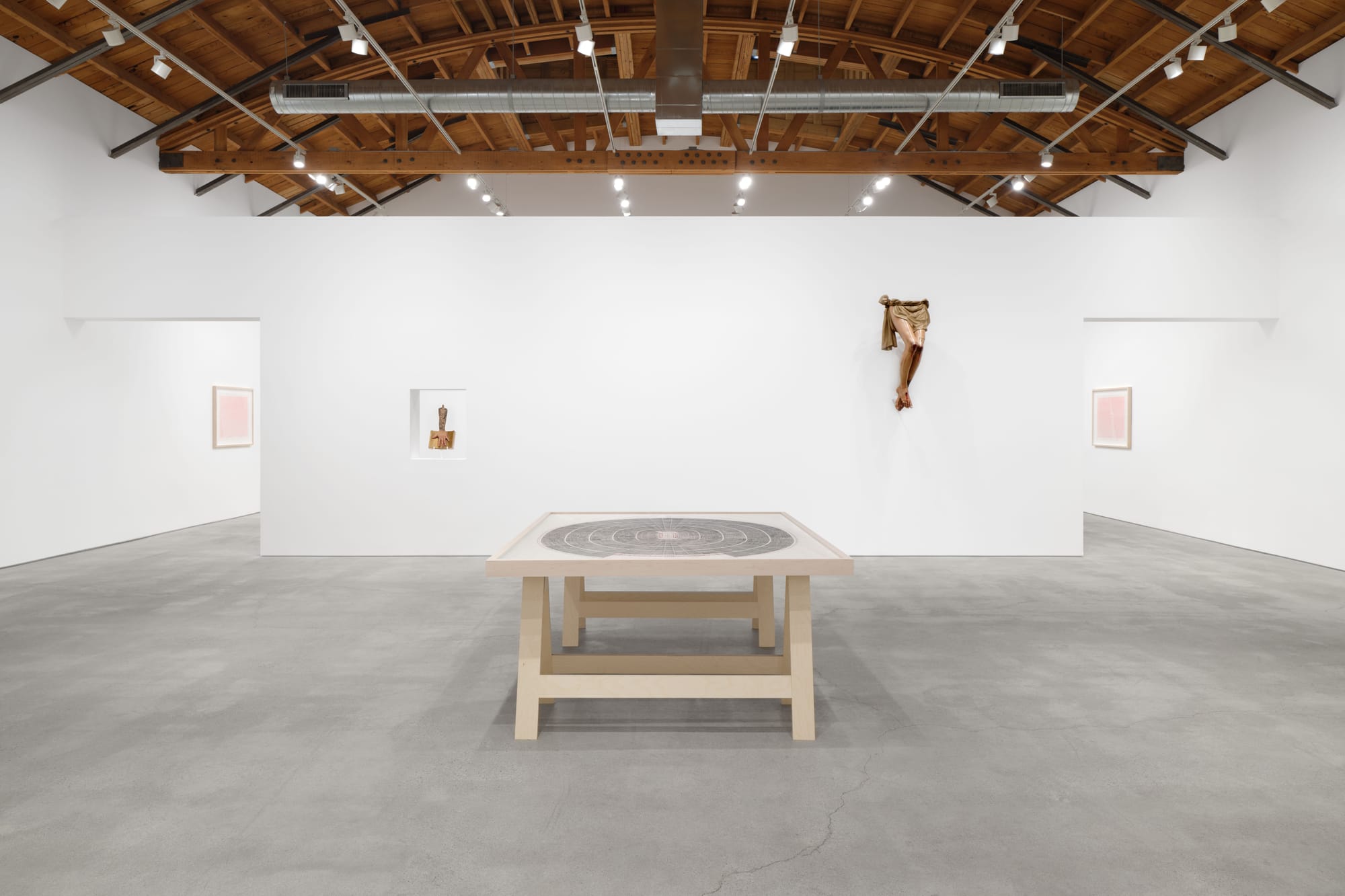
Installation view of PAUL PFEIFFER’s “Olympia” at Perrotin, Los Angeles, 2026. Photo by Paul Salveson. Courtesy the artist and Perrotin.
“Olympia” is staged like a focused iteration of your 2023 exhibition “Prologue to the Story of the Birth of Freedom” at MOCA. What arrivals and departures motivated this presentation?
The current exhibition at Perrotin really grew out of the MOCA show in a way that was unexpected to me. To some degree, the MOCA show revealed a depth of resonance that I knew was always there in my work, but to have it happen at one of the major institutions really brought it to relief. I mean, that show was 25 years of work. “Olympia” is my first chance to respond more consciously to the LA environment following “Prologue.”
The title, “Olympia,” is borrowed from the title of the 1938 film by Leni Riefenstahl covering the 1936 Olympics in Germany. (Riefenstahl notably claimed a non-political or apolitical status.) So, while this show may be a reduced version of the MOCA exhibition, it comes loaded with the legacy of visual production in its slippery relationship to politics.
I’m sure having the privilege of seeing the works here in that way allowed you to make connections that perhaps previously escaped intuition.
I’m coming to this contemporary scene—the moment, if you will—that we’re all coming to in a very intuitive way. And to me, it’s an occupation with sports and how sports intersect with what’s happened over the 25 past years, which is first the emergence of digital media and then the emergence of social media.
These are ideas that have, for the most part, informed your practice even before the emergence of social media as we know it. What makes this moment of particular interest?
Absolutely. It has been a major subtext of the work, intuitively speaking, since the beginning. We’ve gone through a major wormhole. And in some ways, to me, sports and entertainment have been a very powerful filter to understand where we’re at and what we’ve been through in the last couple of decades.
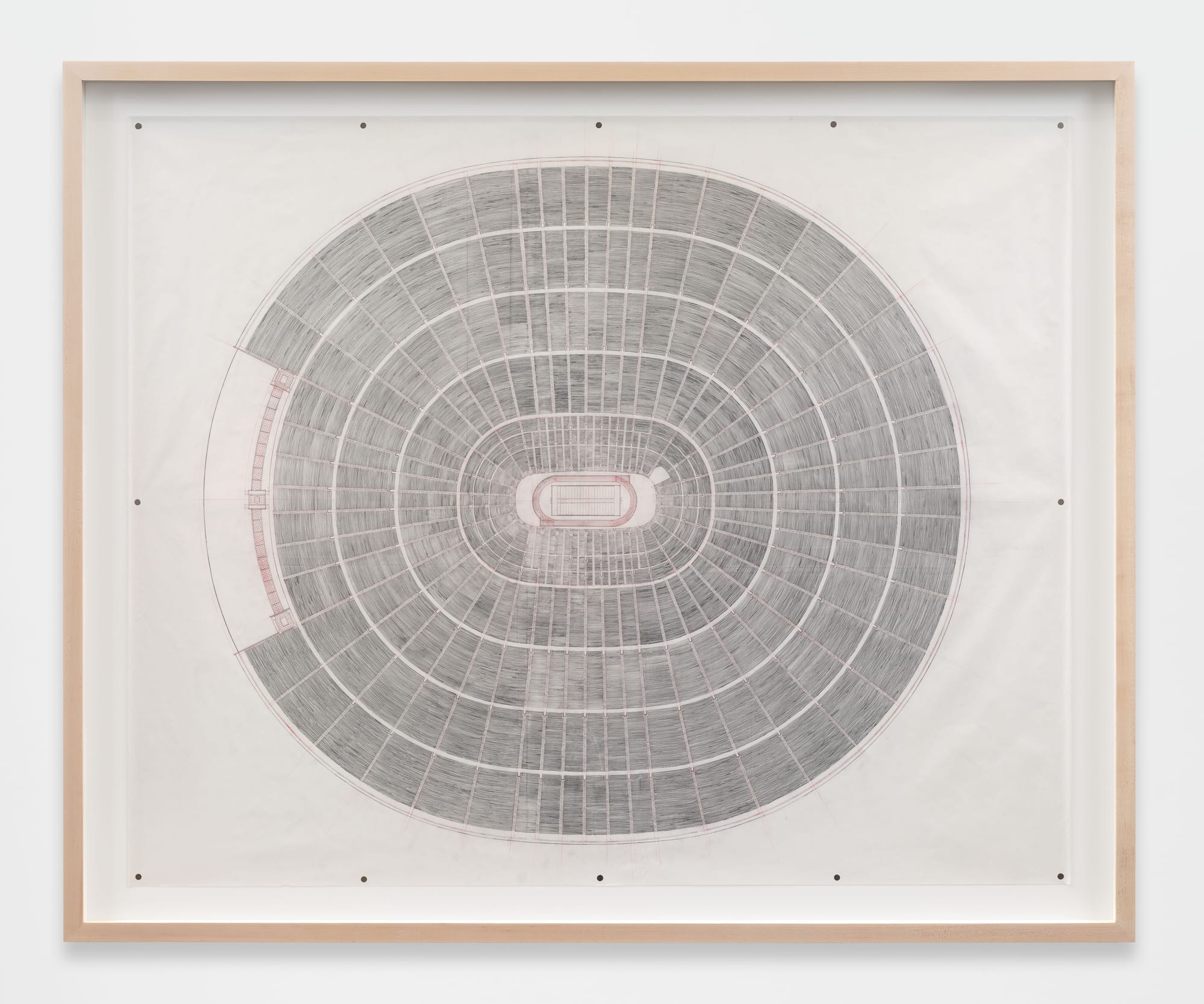
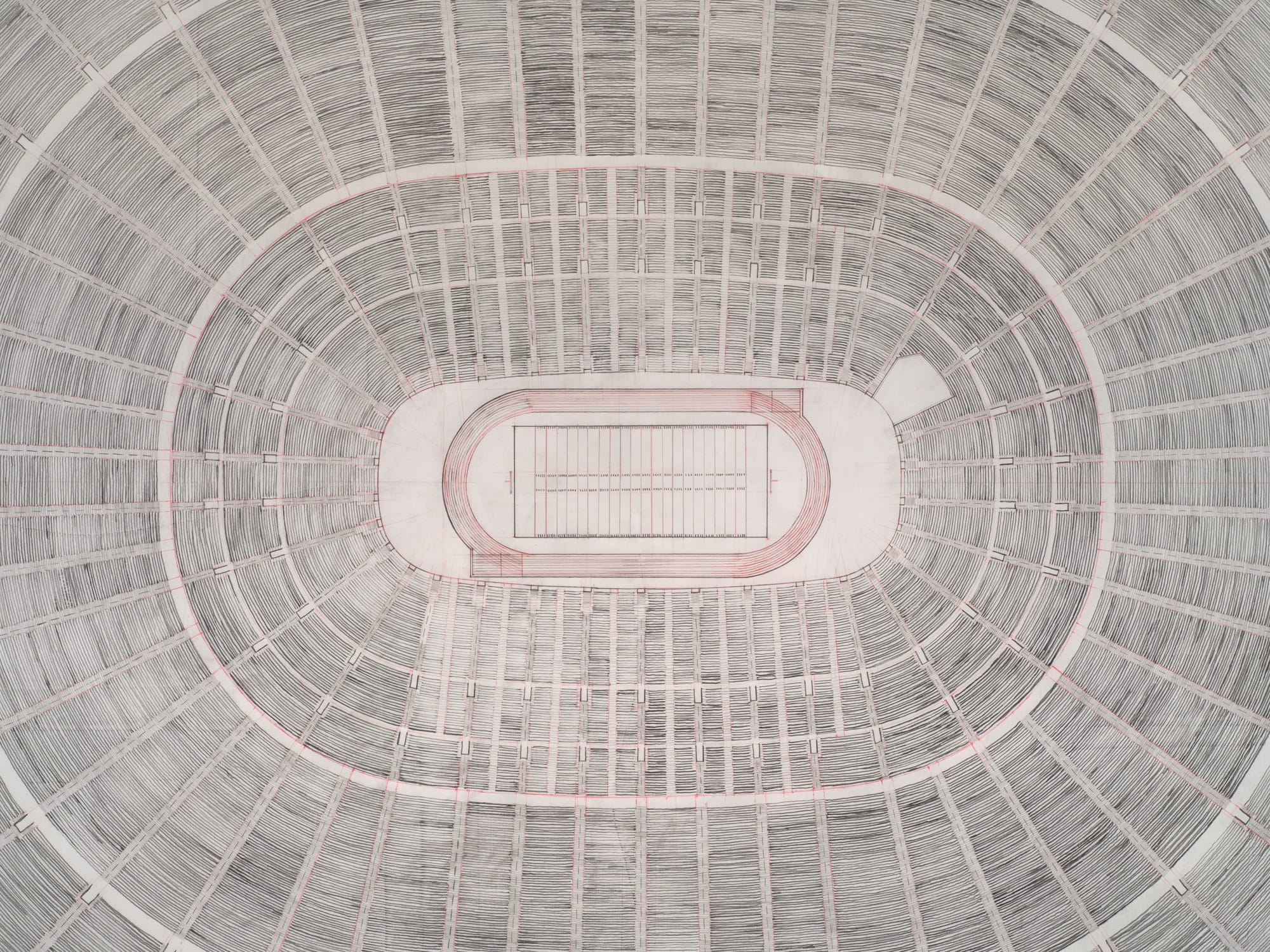
Details of PAUL PFEIFFER’s Vitruvian Figure (Los Angeles Memorial Coliseum: Ground Plan), 2026, black and red graphite on vellum, 169.5 x 205.74 x 7.6 cm, framed. Photos by Paul Salveson. Courtesy the artist and Perrotin, Los Angeles.
This show primarily centers on two works: the sculptural Vitruvian Figure (Los Angeles Memorial Coliseum) (2026) and its accompanying renderings, and a new installment of the Incarnator series (2018– ), which feature fragmented effigies of the popstar Justin Bieber fashioned in historical iconography of Christ. And while the frame of reference for understanding “Olympia” is the Debordian idea of spectacle, the condition that makes this conceit possible is the (re)production of capital. What interests me is how Bieber’s Christ-like representation can offer a simultaneous understanding of capital and images.
It’s funny. You’re making me think in terms of capitalism and democracy as a mythology or religion.
Much like the sacrifice of Christ comes to define the rubrics and metrics of God’s love and grace, Bieber’s challenges as a popstar, essentially a child worker, come to define the success of capitalism. In the same way that Carl Jung in his 1952 book Answer to Job discussed how each trial and tribulation that figures like Abraham, Job, and Jesus endure is a way for God to understand himself, each challenge faced by popstars like Bieber…
Michael Jackson.
Right. These are all ways for capitalism to understand itself. And the images that, in the Debordian sense, mediate social relations are all part of this process.
In fact, if you didn’t have the ups and downs in the process of individuation, it wouldn’t be capitalism, but something completely else. It would be communism. So, it’s interesting that we need the triumph of the individual over hardship for the story to be successful as a mythology that can sustain itself.
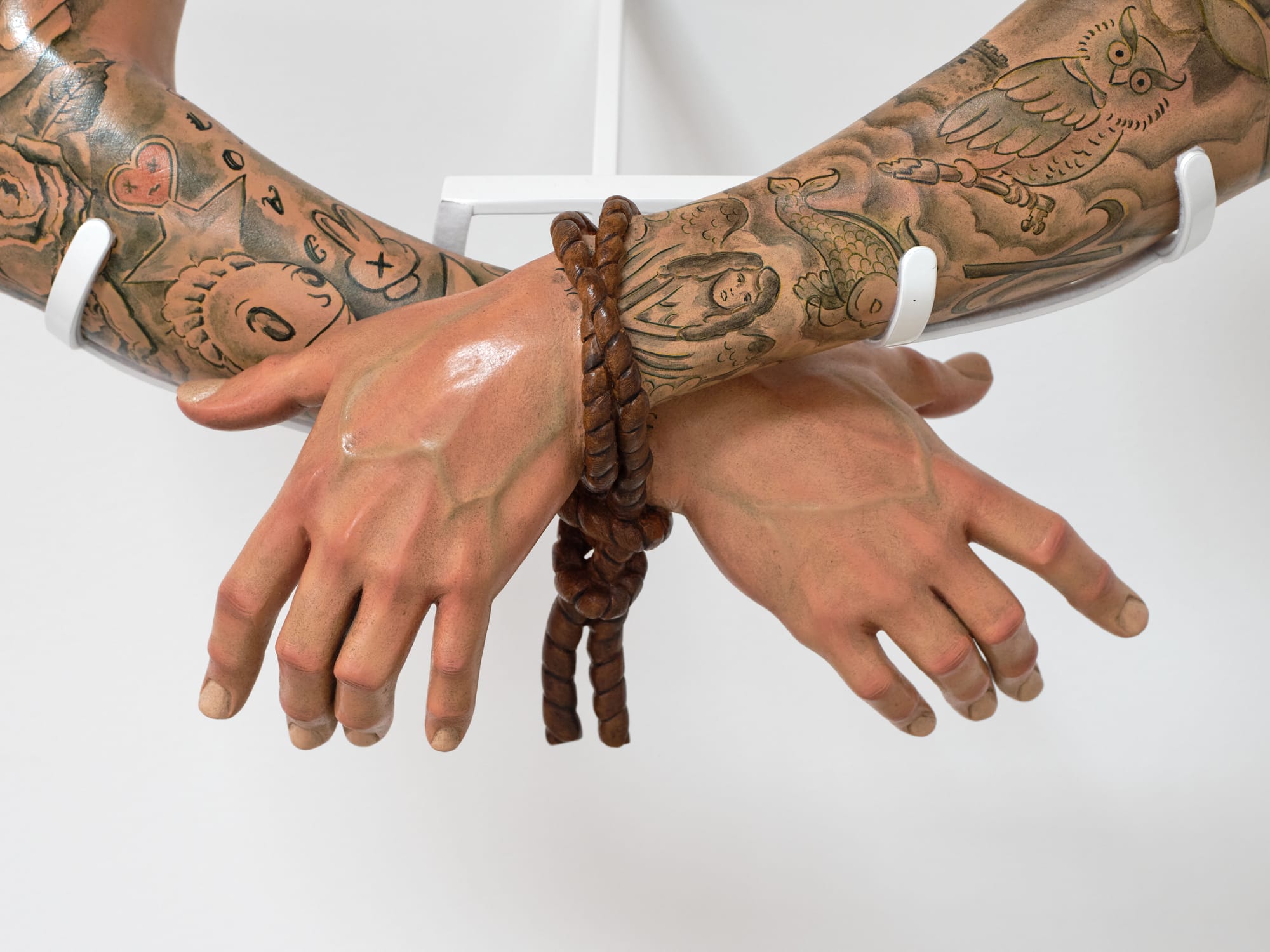
Detail of PAUL PFEIFFER’s Justin Bieber Ecce Homo I (Seville), 2026, cedar wood, paint, and metal armature, 38.1 x 55.8 x 20.3 cm. Photo by Paul Salveson. Courtesy the artist and Perrotin, Los Angeles.
In thinking through your work, I’ve been developing a theory about sports that moves beyond concerns of fandom and theatrics. Specifically, I find that what generates interest in any sport (even as far back as gladiators) is a performance of deception, structured and psychologically attenuated by an implicit social contract. This deception is non-nefarious and cannot be conflated with the trickster archetype, in that there isn’t an unethical withholding that takes place in the performance. There’s something here that seems to relate more directly with how we interact with social media content, and media in general.
I really love what you’re saying about the athlete and sleight of hand. One way that I would respond to your setup thinking about sports and deception is that I’ve been fascinated—especially after talking to professional athletes over the years—about the kinds of calculations around career or even just personal well-being. It has led me to believe that artists and athletes are connected in the ways both live out of their passions or their enthusiasm in a kind of hardcore system.
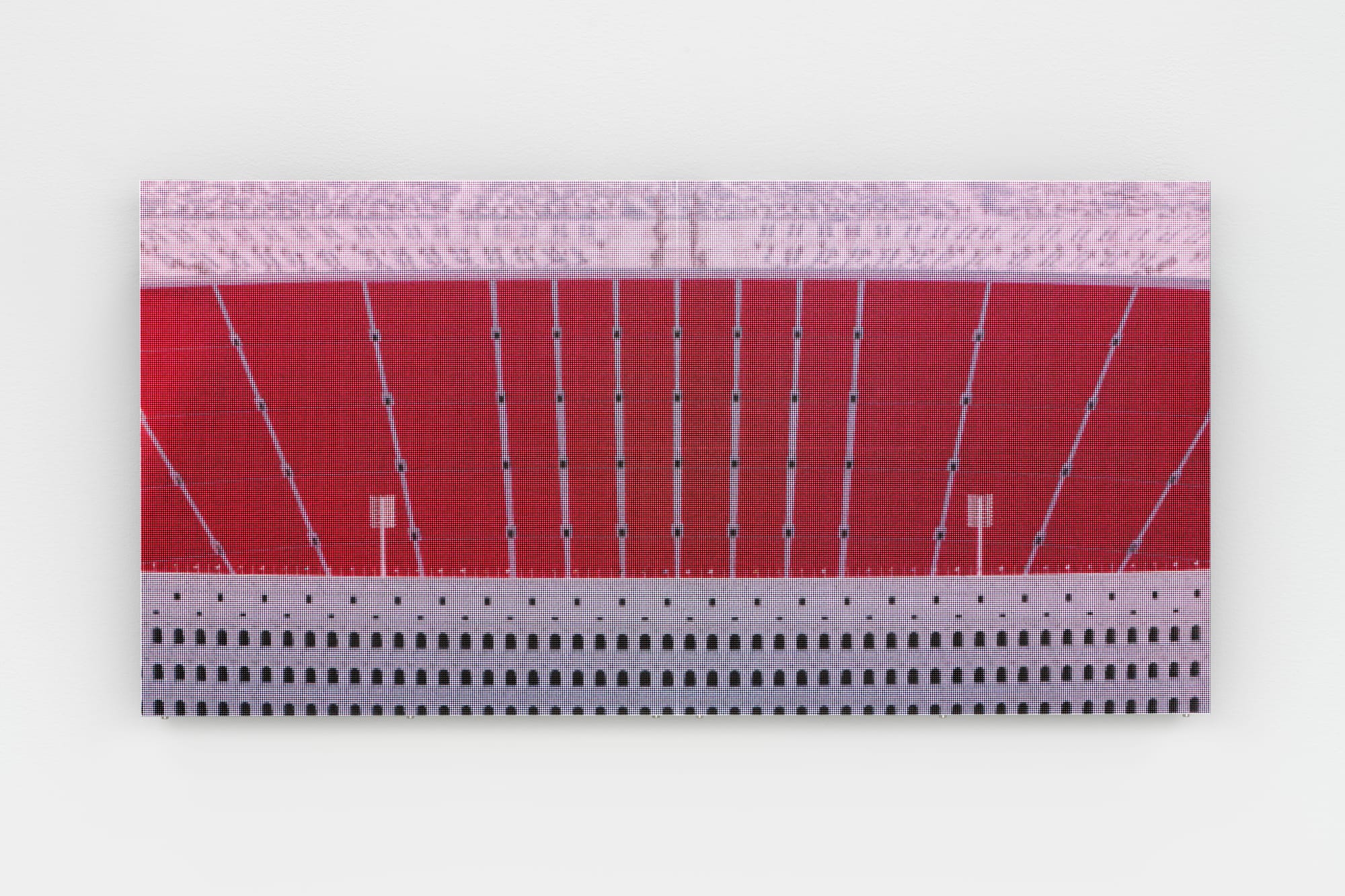
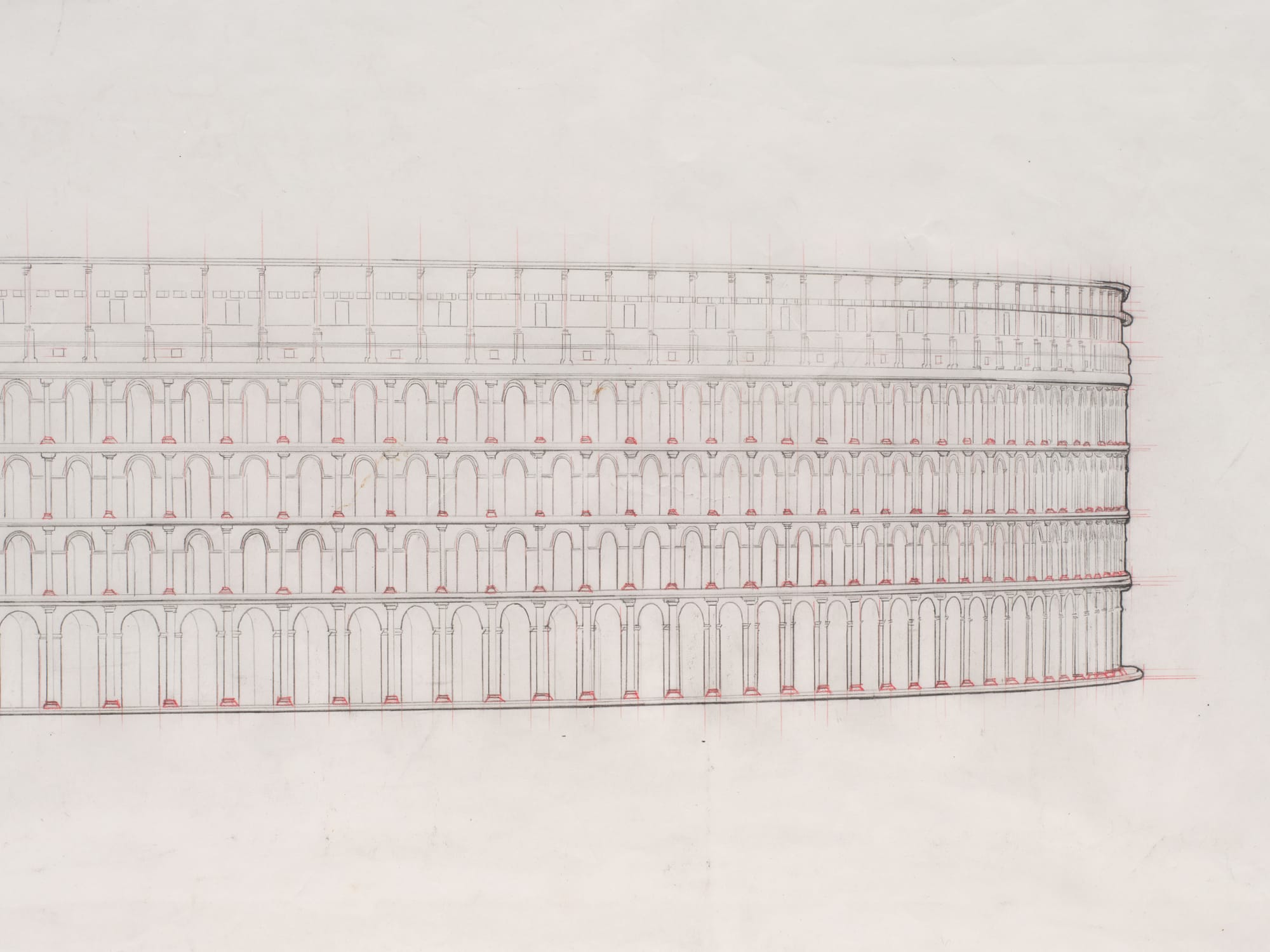
PAUL PFEIFFER, Vitruvian Figure (Los Angeles Memorial Coliseum), 2026, digital video (color, silent) and custom LED display, 48.26 x 96.5 cm (left); and detail of Vitruvian Figure (Los Angeles Memorial Coliseum: Elevations), 2026, black and red graphite on vellum, 169.5 x 205.7 x 7.6 cm, framed (right). Photos by Paul Salveson. Courtesy the artist and Perrotin, Los Angeles.
For sure. And, you know, I guess in a way the only separation here is that while artists operate in this nebulous zone, the athlete focuses more on the objective metrics that sustain their organization.
Although I will say, something that I noticed—from the times that I’ve had an opportunity to talk with younger professional athletes—is that they’re more attuned to the game of it all. Since they’re growing up in the age of social media.
True.
And the nature of communication and certain choices that you would have to make, in which your life could go one way or another.
This is a conversation that I keep hearing especially with the introduction of NILs (“name, image, likeness”), where the younger athletes have more stakes in and latitude with image rights. I can imagine things don’t get unilaterally easier with these new negotiation freedoms, but rather present updated surveillance features. I think this is where your Vitruvian Figure is implicated, for the athlete now must contend with perceptive possibilities that exceed the capabilities of their vantage point.
For starters, as digital media was emerging in the early 2000s, there was a thought that I was receptive to—this idea that the athlete is, in an existential sense, really a crystallization of the every-person situation in the advent of digital media. That something was about to happen, in which everything that already existed about our individual relationship being enmeshed in systems was about to be expanded.
Absolutely. But, in a way, athletes maybe have a little bit of privileged information toward that understanding.
To me, the image of the athlete in all of their physicality and performance, within the markings of the court, and under the intense lights of the arena, and with all the cameras watching—that, to me, just becomes the existential condition in a hypervisual form.
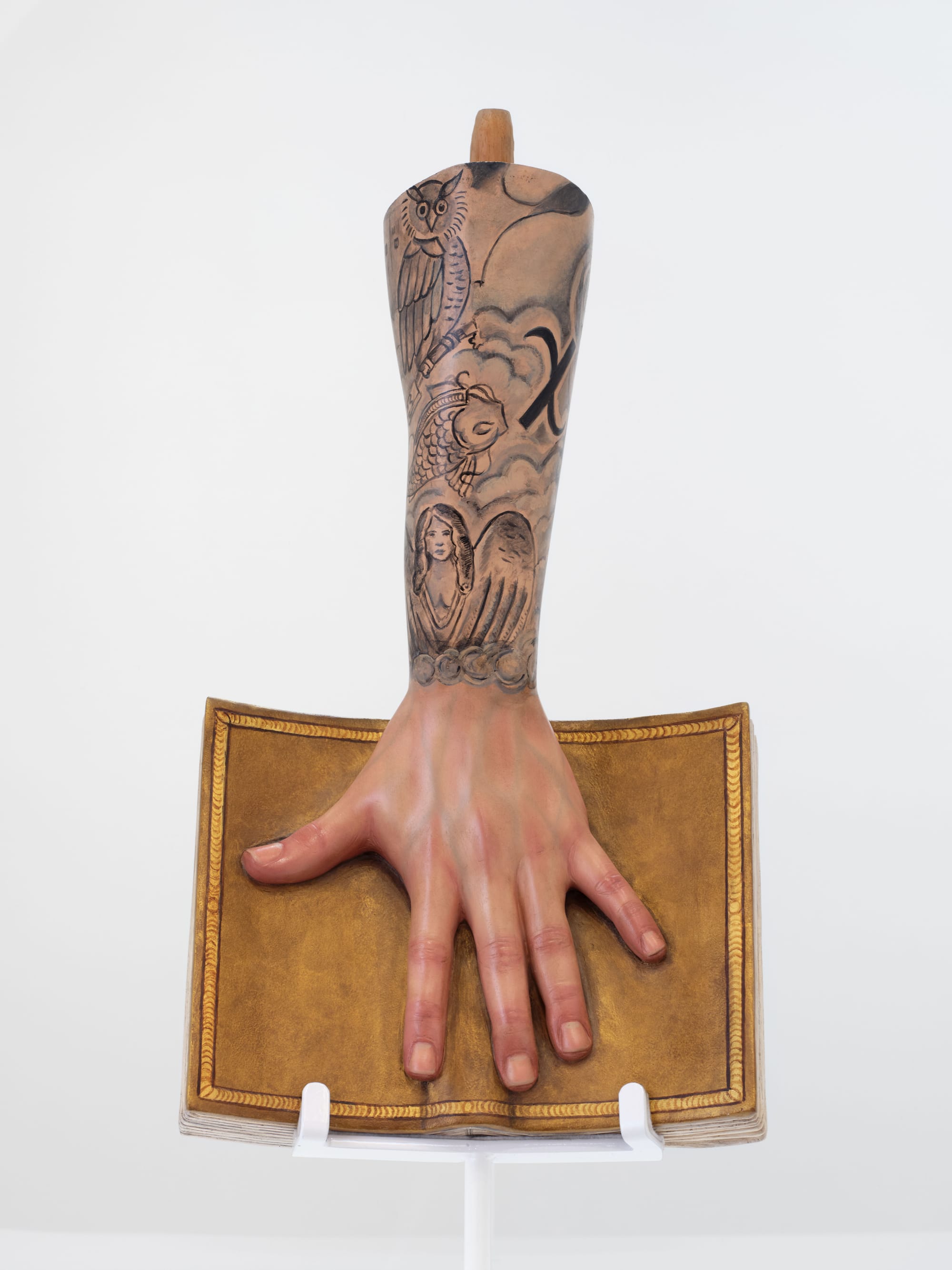
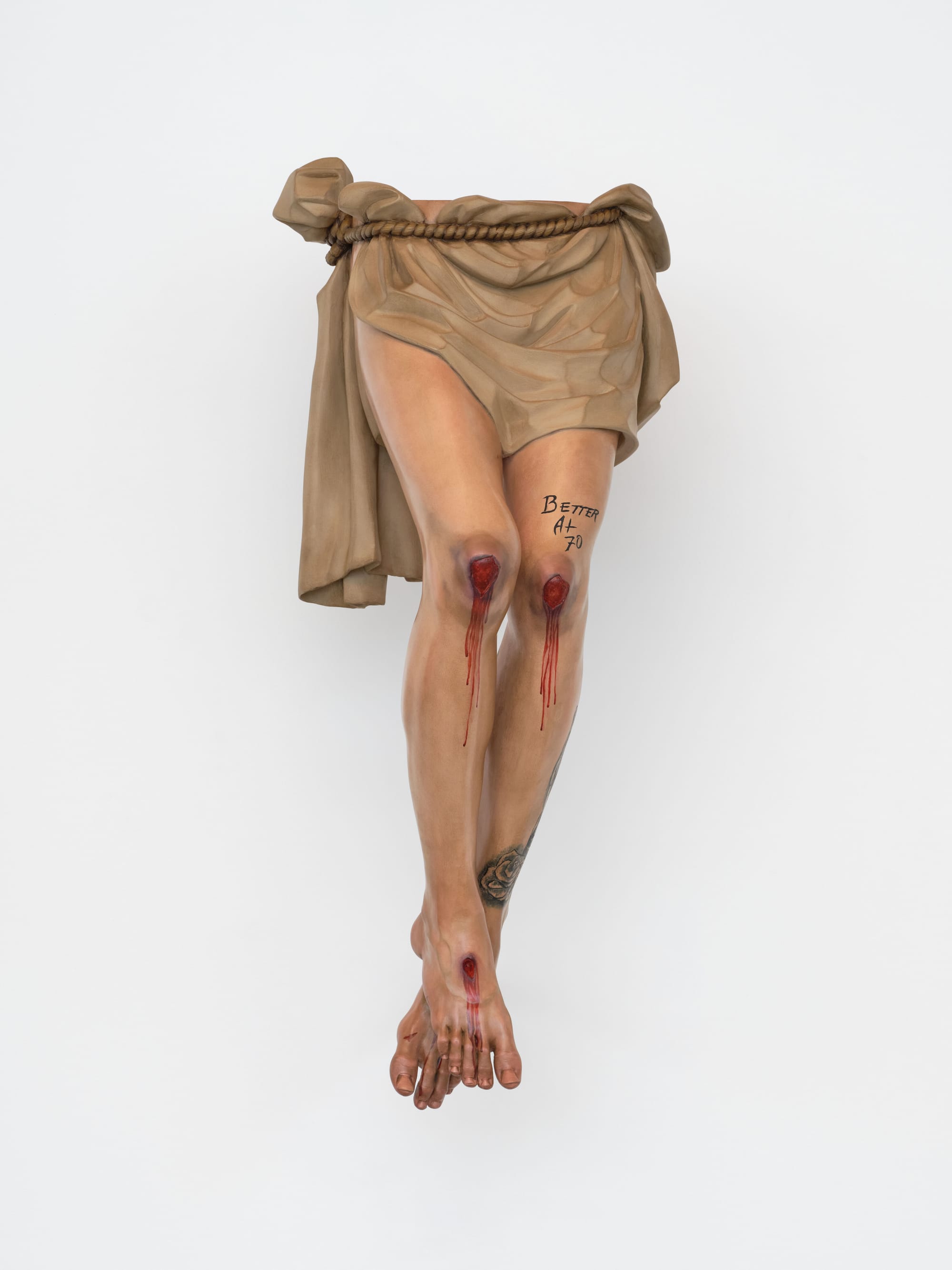
PAUL PFEIFFER, Justin Bieber San Juan de la Cruz (Seville), 2026, cedar wood, paint, and metal armature, 49.5 x 26.6 x 15.2 cm (left); and Justin Bieber Legs Crucified (Seville), 2026, cedar wood, paint, and metal armature, 118.1 x 50.8 x 45.7 cm (right). Photos by Paul Salveson. Courtesy the artist and Perrotin, Los Angeles.
It’s really the perfect marriage of physicality in its most intimate form, with mediation in its most hypermediated form.
And just to jump forward, it is, in a way, that thing we all intuit in Justin Bieber’s performance at Coachella earlier this year.
Interesting. How so?
We saw that hypermediation happening live in a way we hadn’t quite seen before. It crystallized so much so clearly, and so minimally. All the staging was removed, so that it was reduced just to the most fundamental formulation. It’s just the specificity of his body, with all the mediation that he’s reviewing from his own childhood.
I even registered that performance and his subsequent World Cup performance as a kind of refusal that revealed something deeply capacious within the context of him being a former child worker.
Yeah. What I loved about this part at Coachella is that he was going through all his favorite songs, but he wouldn’t finish any of them. He would cut it off halfway through. So, he would get the whole crowd singing and then stop it. It was almost like edging.
And to your point, his whole life has been live-streamed, and so he’s the perfect embodiment of someone who can look up their own YouTube videos and present them to the audience. And he’s now free of all other filters, to an extent. There’s something that’s like the opposite of innocence about doing that—a kind of a refusal of the insistence on innocence. I think this says a lot about being a citizen in the capitalist system: if we could only forgo this kind of crutch of supposed self-innocence, we might see the world in a different way.
Mark Pieterson is a Ghanaian American conceptual artist, independent curator, and writer based between Houston and Los Angeles. He is a recipient of the Andy Warhol Foundation Arts Writers Grant.