Shows
Who Gets to Be Human? Asian Artists at “New Humans” in New York
New Humans: Memories of the Future
The New Museum
New York
Mar 21–Aug 31, 2026
Where are the great Asian artists in the history of humanity? When the New Museum reopened in March following an over 5,000-square-meter expansion, its inaugural exhibition, “New Humans: Memories of the Future,” set out an ambitious premise: to trace how art, technology, science, and mythology have defined what it means to be human across the 20th and 21st centuries. Yet despite its global aspirations, the exhibition raises a more troubling question: whose humanity is being narrated, and whose remains partial, displaced, or excluded?
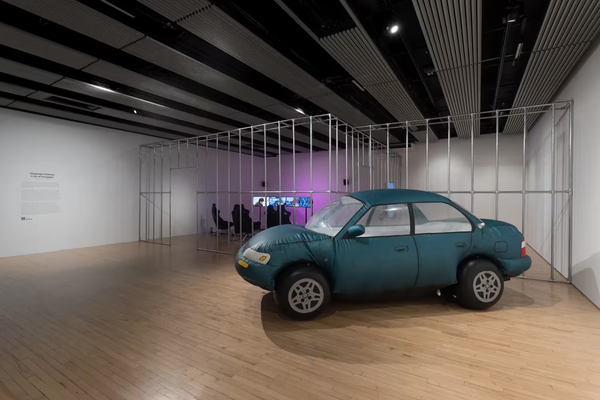
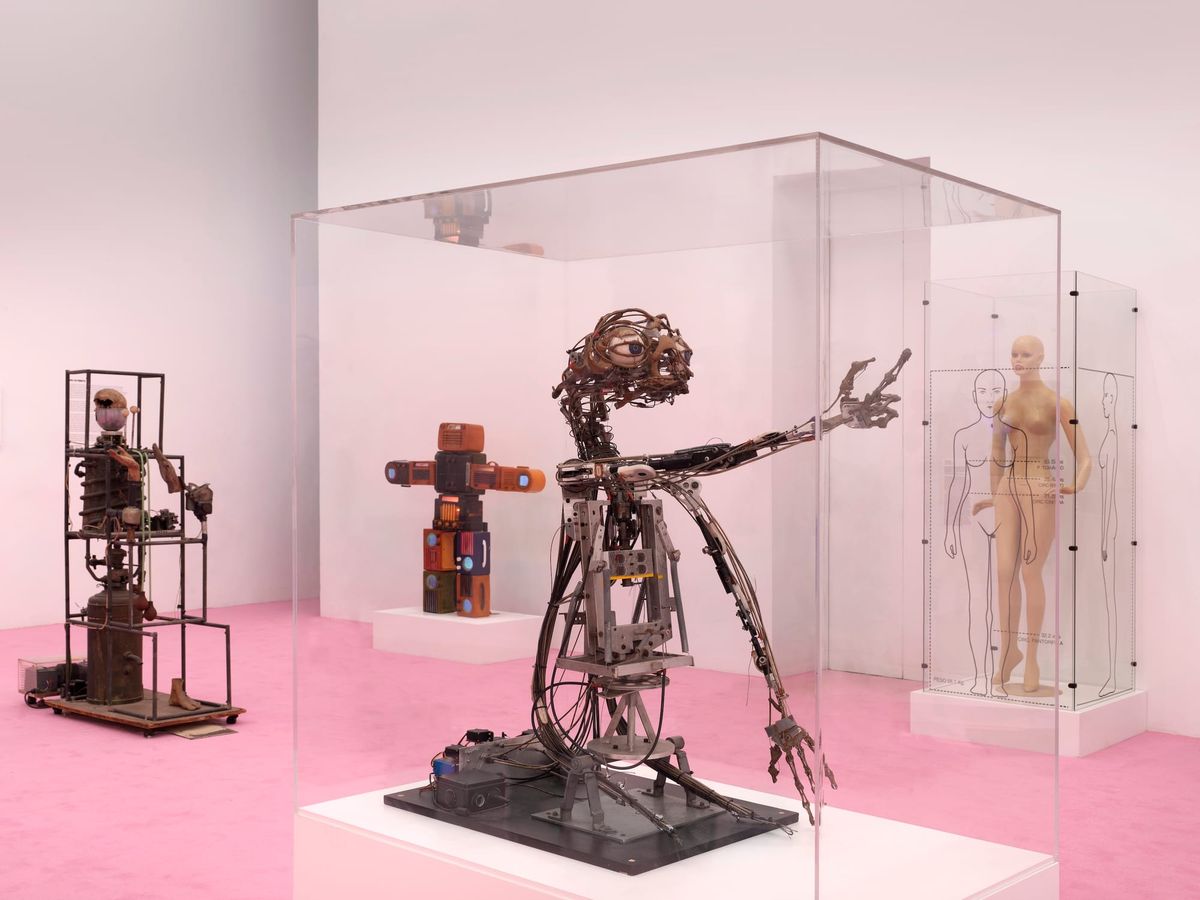
Bringing together more than 200 artists, the show presents an array of contemporary and historical works and artifacts—human-animal hybrids, cyborgs, alien bodies—in an environment that initially feels like an anthropological display curated by nonhuman observers. On the first floor, dense clusters of abstract images, machines, and biological models form a maze in which wall labels drift away from their objects. This disjunction mirrors a broader conceptual slippage: while the exhibition claims a planetary scope, its historical framework remains largely grounded in Western Enlightenment traditions of science and humanism, shaping both the selection and contextualization of Asian and other non-Western artists and their works.
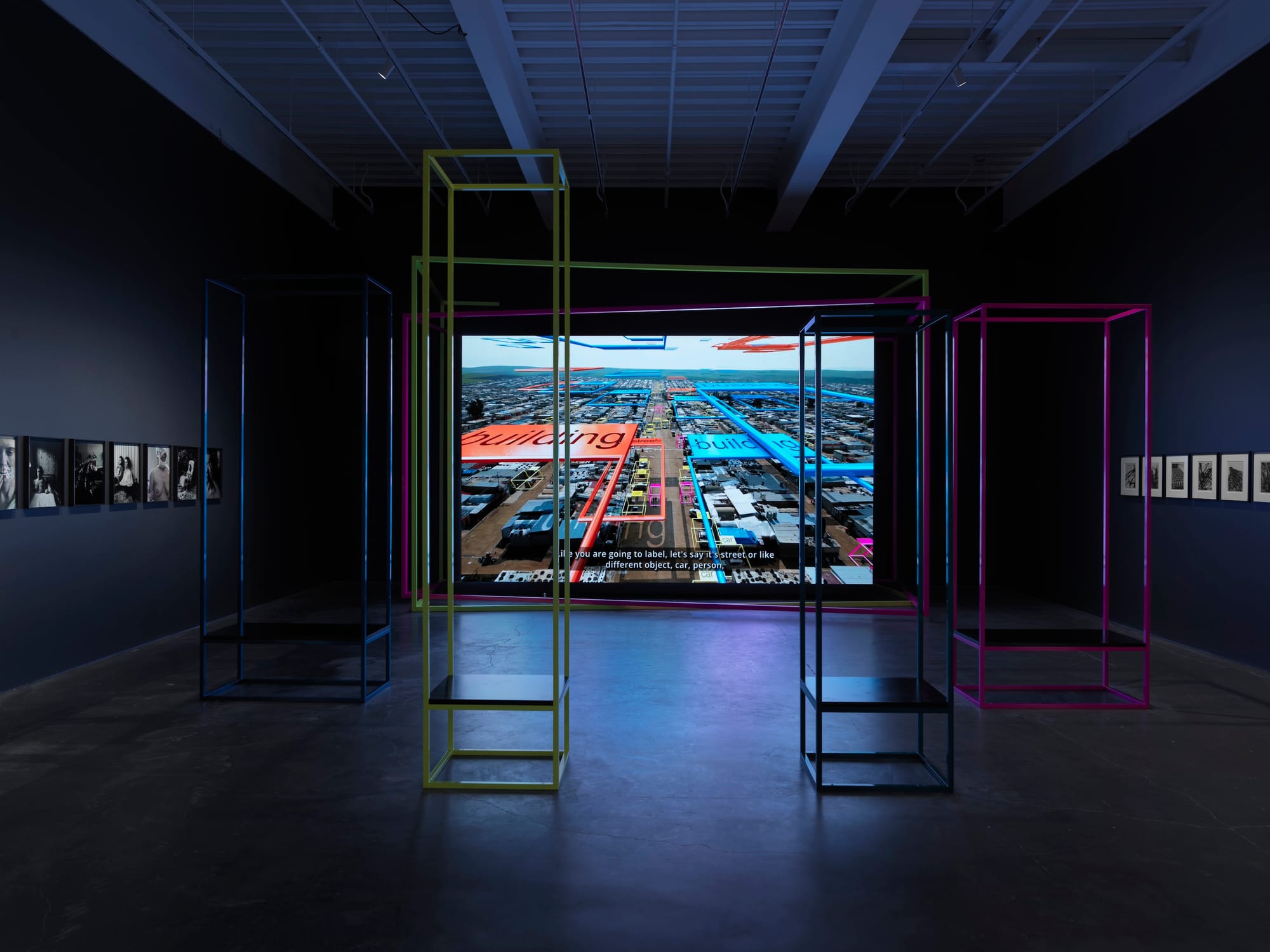
Among the most compelling works is Hito Steyerl’s Mechanical Kurds (2025), which revisits the 18th-century “Mechanical Turk”—the chess-playing automaton later revealed to be secretly operated by a human. Steyerl’s video installation exposes a contemporary analog: the hidden human labor underpinning artificial intelligence. Through interviews with Kurdish refugees employed as microworkers for AI companies, the work foregrounds the precarious conditions of those tasked with labeling images of streets, vehicles, objects, and people to train machine-learning systems. Documentary footage gradually dissolves into AI-generated imagery, producing a disorienting composite of geographies and visual regimes. A vehicle—variously identified as a self-driving motorcycle or an Indian tuk-tuk—mutates as its colors intensify; passengers dance, fight, then float, before the image erupts into archival footage of a drone strike.
Through this visual destabilization, Steyerl renders perceptible the alienation and exploitation in digital labor, recalling Marx’s account of the workers’ estrangement from both the product and the broader system they serve. “And the world is boxed, with many colors,” a Kurdish woman sings in the video—an observation that underscores the geographic displacement of globalized production. Even the workers themselves struggle to identify the locations they annotate, as companies withhold crucial contextual information. Installed within neon structures that draw a parallel with the classification boxes appearing throughout the video, Mechanical Kurds subjects viewers to the same logic of categorization, reminding us that so-called machine vision remains dependent on human perception structured by opaque systems of control.
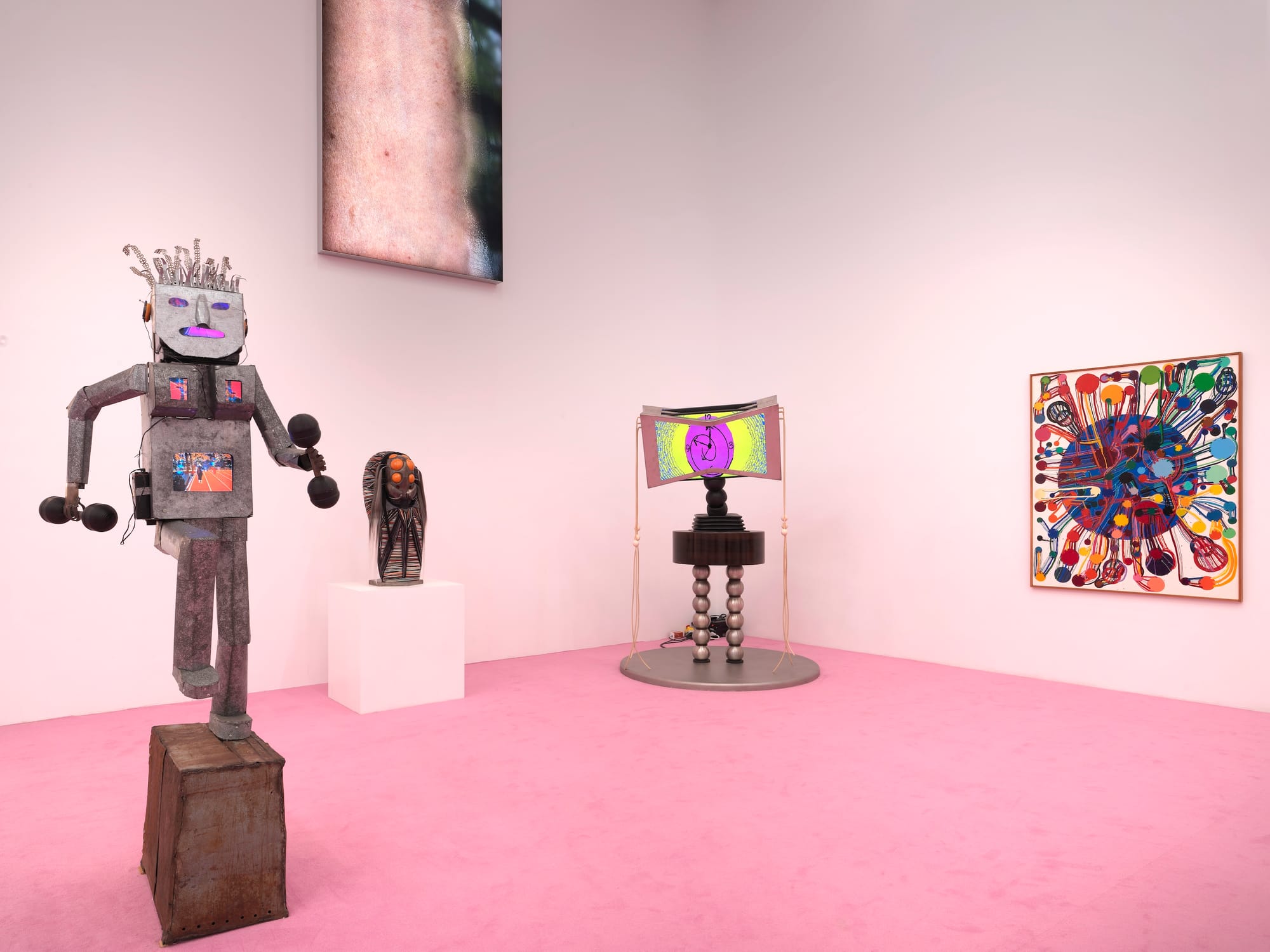
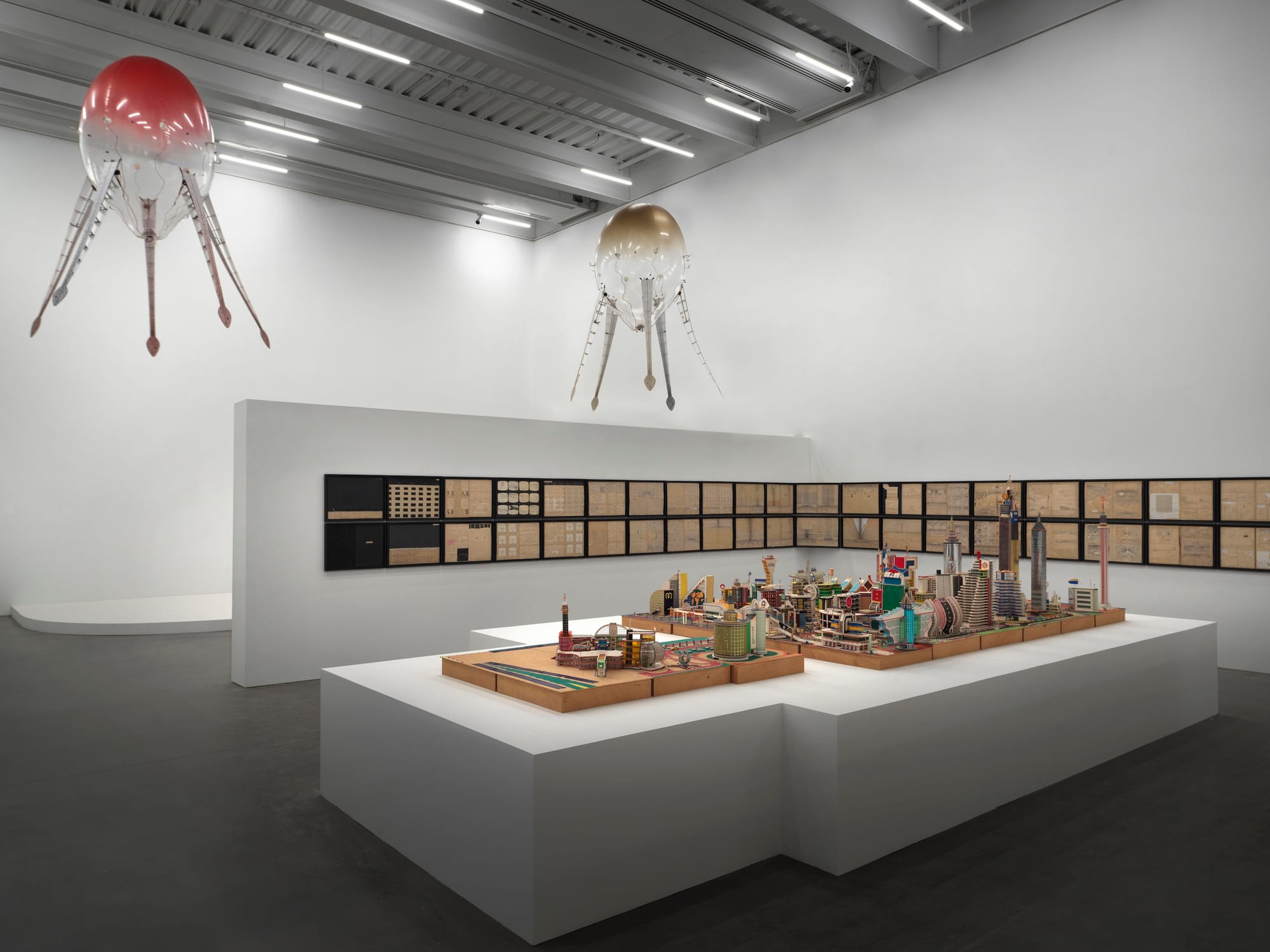
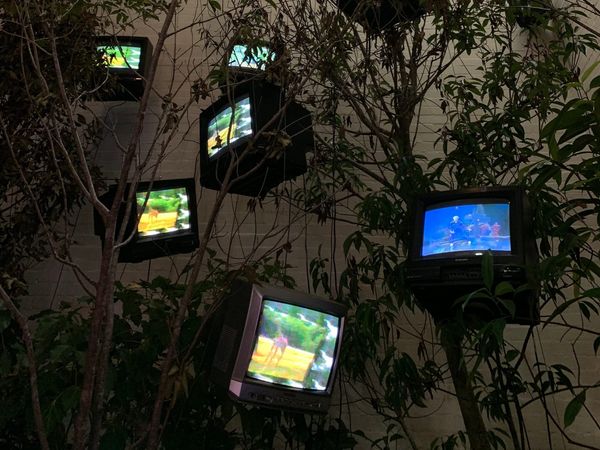
Yet Steyerl’s work, through its account of hidden labor and systems of legibility, unwittingly throws into focus the exhibition’s own uneven treatment of Asian artists, too often confined to tropes of robotic futures and posthuman bodies. On the exhibition’s third floor, the pink-carpeted “Hall of Robots” stages a dialogue between Shigeko Kubota and Nam June Paik, whose anthropomorphic video sculptures face one another to communicate technological exchange and the two artists’ lover-rival relationship in real life. Kubota’s Jogging Lady (1993), with its embedded monitors displaying scenes of a woman jogging through a park, alternating with excerpts from the artist’s earlier works, intertwines feminist concerns with media experimentation, reflecting on women’s labor and the negotiation of creative practice and caretaking responsibilities. Nearby, Anicka Yi’s In Love With the World (2021) introduces floating, jellyfish-like creatures that drift above visitors, rising and descending through the gallery. The work’s poetic title proposes forms of kinship that extend beyond the human, gesturing toward new ecosystems in which biological and technological life coexist.
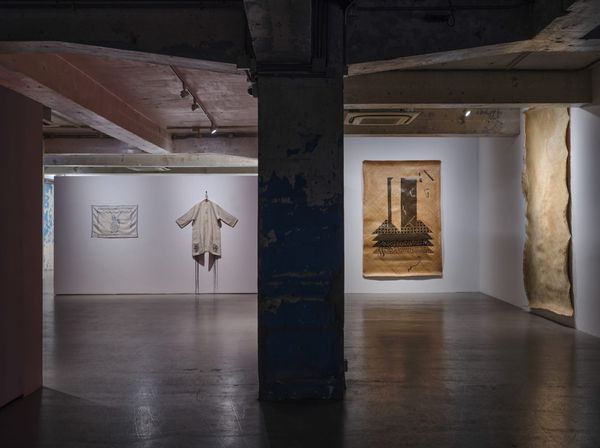
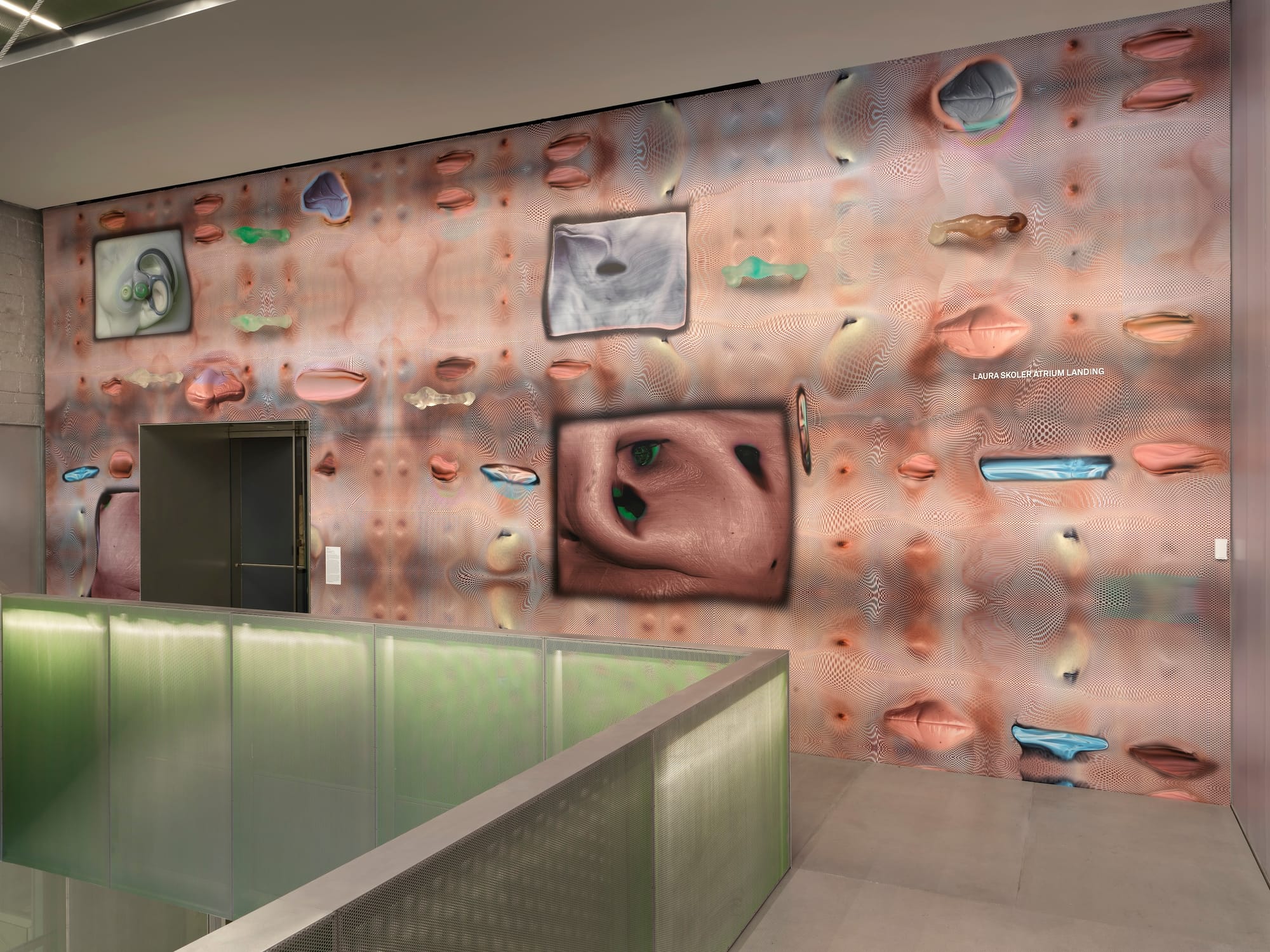
These speculative biological imaginaries are again evident in Tatsuo Ikeda’s surrealist drawings from the late 1960s to ’80s, which depict grotesque hybrid organisms born from the trauma and devastation of postwar Japan haunted by the atomic bomb. Illustrated in muted blacks, browns, and grays, Ikeda’s biomorphic forms merge geometric shapes with faces, eyes, and limbs, resembling embryos and cellular structures that appear simultaneously human and nonhuman. Drawing from both Surrealism and Reportage painting that emerged alongside Japan’s labor and anti-military protests of the 1950s, Ikeda’s works envision humanity as an exotic species undergoing constant mutation and transformation. Outside the galleries, Tishan Hsu’s flesh-toned wallpaper ears-screen-skin: New York (2025) fuses fragments of body parts resembling lips, ears, abscesses, orifices, plastic toys, and machine components into a Moiré-like field of glitching distortion, blurring the boundary between human and machine.
Yet even here, Asian artists are positioned less as participants in a shared historical continuum than as figures oscillating between aftermath and anticipation—either marked by past catastrophe or projected into speculative futures. By tracing the origins of video art through technologies such as the Sony Portapak and the CRT monitor, the exhibition situates Asia primarily within a historical narrative of technological emergence, with little attention to the region’s present centrality to consumer electronics, semiconductor, and mobile technology manufacturing. Asia thus appears less as an active force shaping today’s technological conditions than as either the site of technology’s past or the ground onto which Western-derived posthuman futures are projected.
By the exhibition’s conclusion, its central question—what it means to be human—has been displaced by another: from whose perspective is the human imagined, and through which historical and epistemological frameworks? For all its global ambition, “New Humans” ultimately reproduces a familiar asymmetry, in which non-Western perspectives are incorporated but not allowed to fully represent themselves.