Shows
Nam June Paik at the Watari Museum of Contemporary Art
Nam June Paik: The 20th anniversary of his passing
The Watari Museum of Contemporary Art
Tokyo
Jul 19–Nov 23, 2026
In a 1974 essay, Nam June Paik observed with startling prescience: “The mass entertainment TV as we see it now will be divided into, or rather gain many branches and tails of, differentiated video cultures, Picture-Phone, tele-facsimile. . . . They all will form a new nuclear energy in information and society-building.” His prediction might no longer impress today’s jaded netizens but remains a relevant diagnosis of our hyperdigital age: Paik recognized that this device would not only upgrade our communication networks, but establish a novel infrastructure of perception.
The South Korean artist, widely known as the “father of video art” for his experiments with electronics, passed away in 2006 before witnessing the full-scale realization of his prophecy. Two decades later, what does it mean to look at his work from within the conditions he foresaw? At Tokyo’s Watari Museum of Contemporary Art (Watari-um), a compact yet immersive three-floor retrospective surveys Paik’s practice through mixed-media installations, works on paper, and personal documents from the institution’s collection.
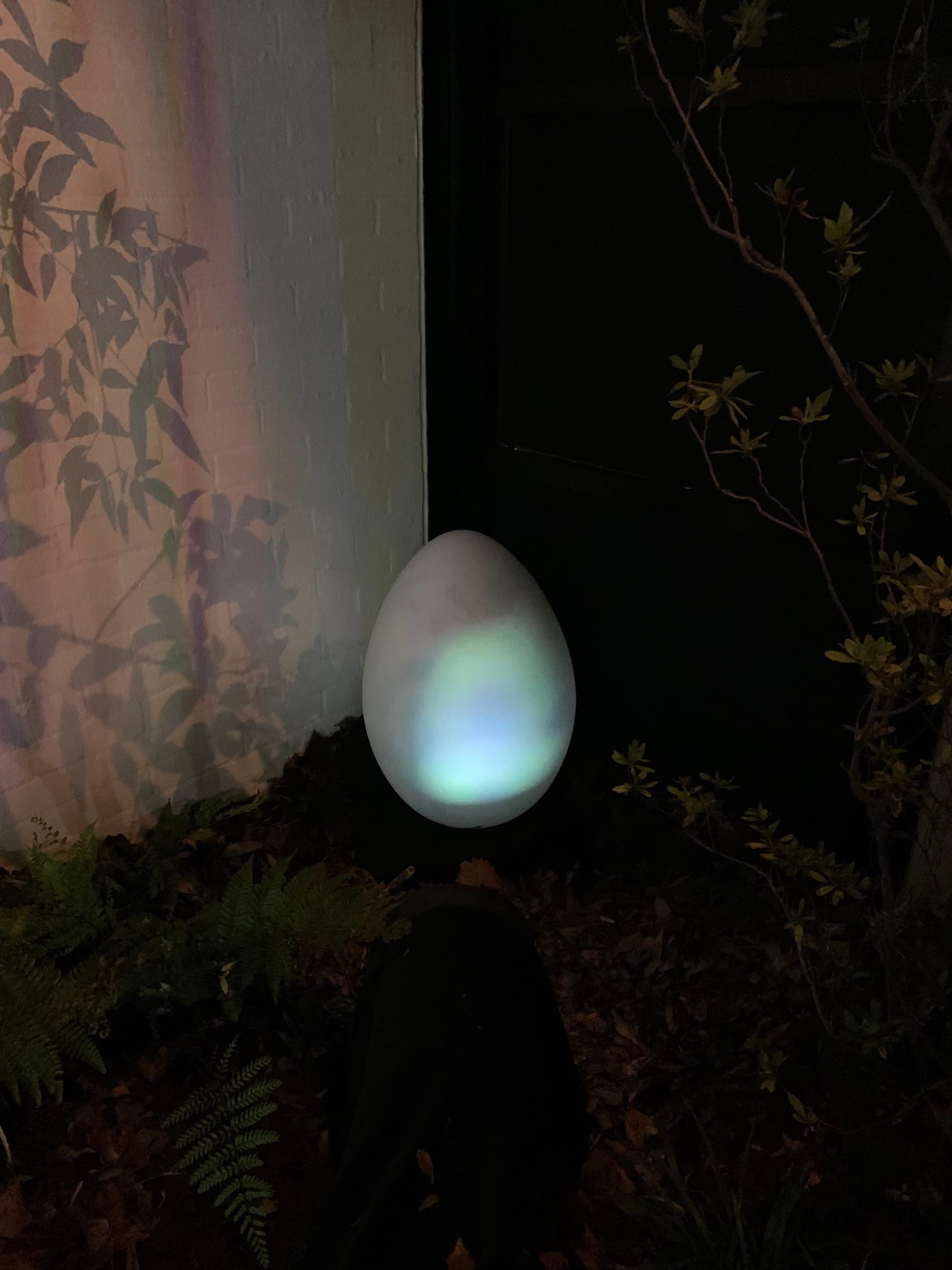
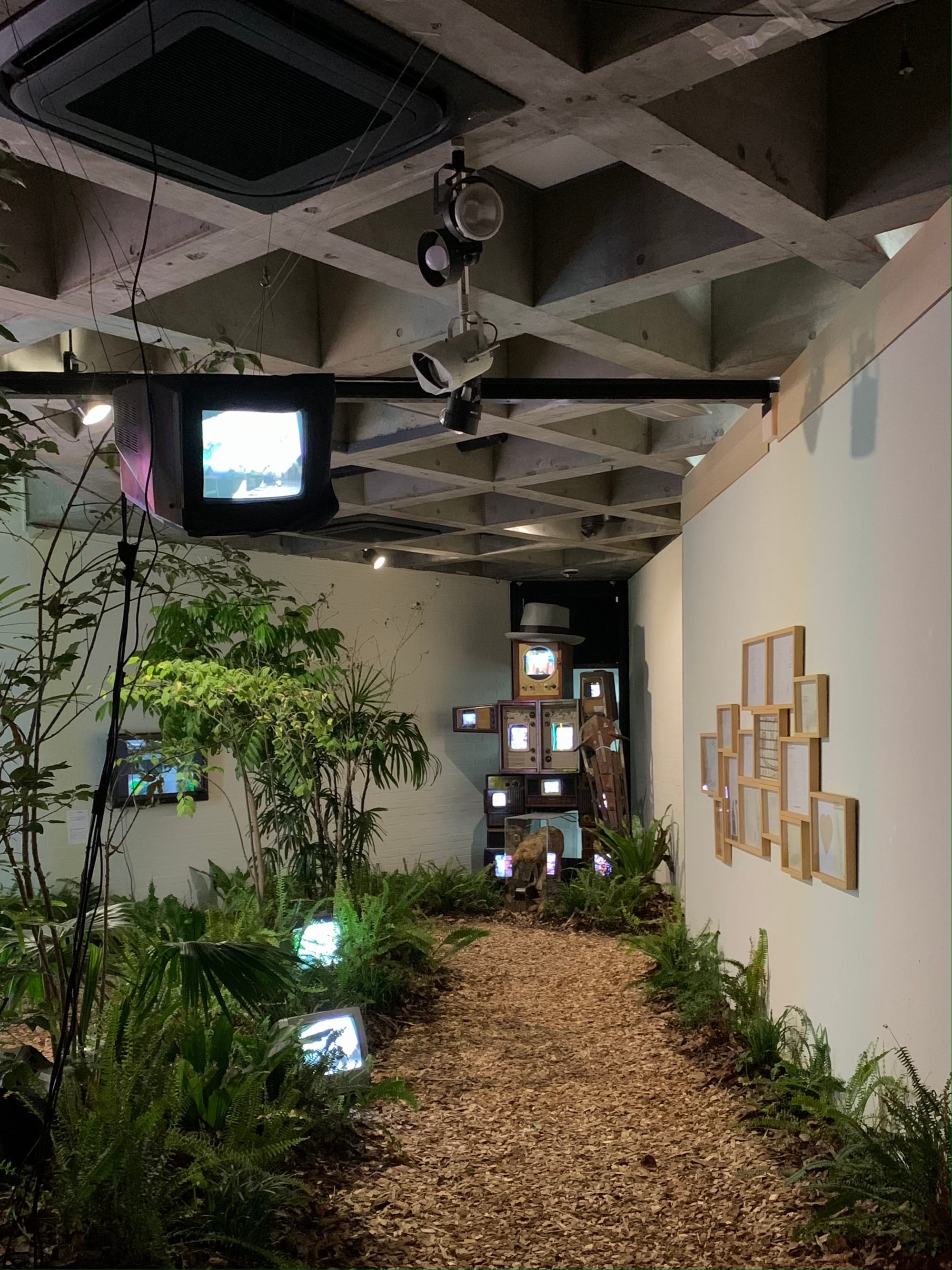
Installation views “Nam June Paik: The 20th anniversary of his passing,” Watari Museum of Contemporary Art, Tokyo, 2026. Photos by ArtAsiaPacific.
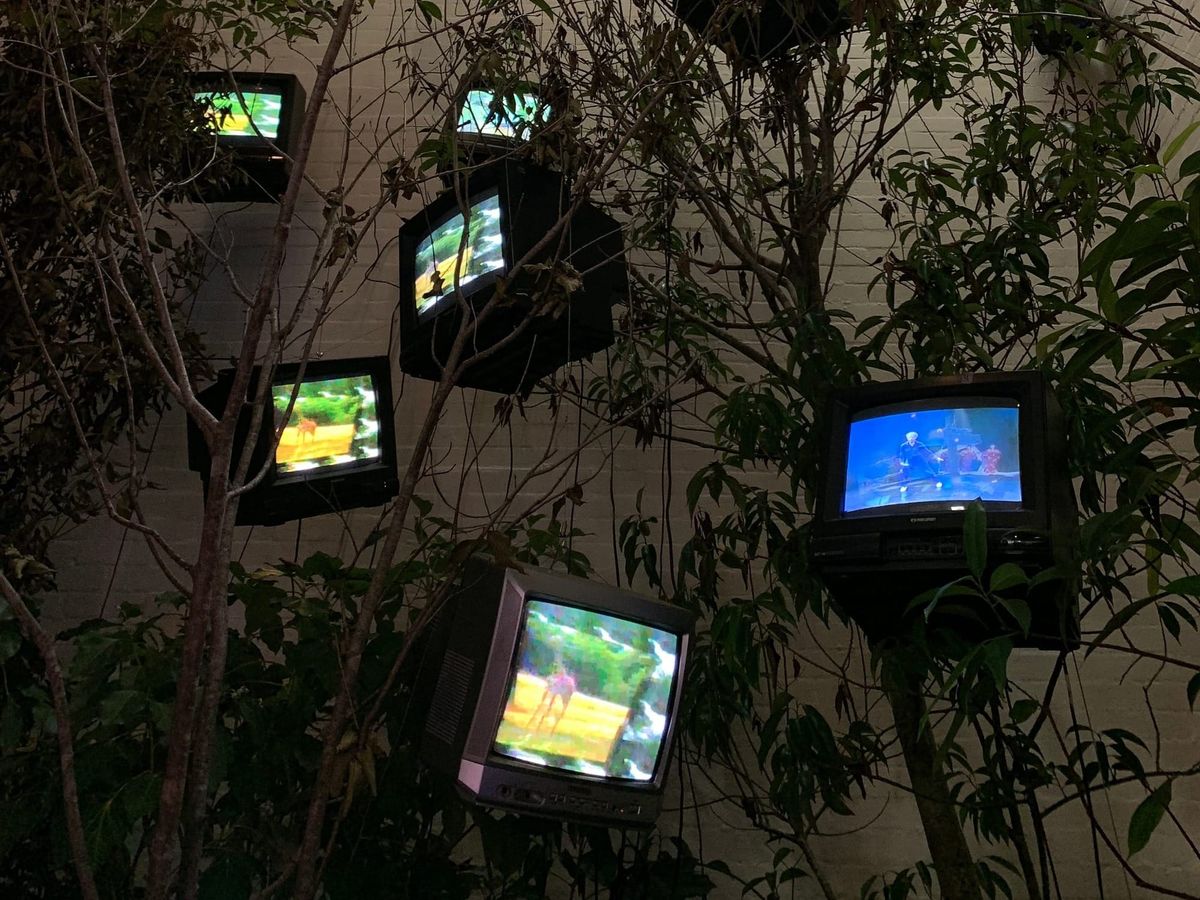
On the first level, visitors enter a dimly lit den, where a low thrum surges through the body before one’s vision adjusts to the darkness. The room situates somewhere between a lush forest and an abandoned broadcasting studio: wood debris litters the floor; tropical foliage unfurls throughout; and retro TV sets appear to sprout from branches and undergrowth. Near the entrance, TV Egg (1982) nestles on a pile of mulch surrounded by ferns, a cathode-ray tube projecting abstract moving images onto its glass surface. The illusively organic form denotes both cosmogenesis and false representation, reflecting the allure of technology as well as its deceptive potential.
Further inside, the ambient buzz intensifies into an all-surround sound field of Zen Buddhist chanting, zither notes, audience laughter, and static. Some monitors glow with black-and-white footage of Paik’s zany Fluxus performances from the early 1960s, others present surreal visual mélanges of monks meditating before dawn, their figures dissolving into hypnotic bursts of color. Despite the fuzzy archival recordings and now-outdated TV models, the video assemblages recall the fast-moving, addictive, and unstable logic of our current digital landscape.
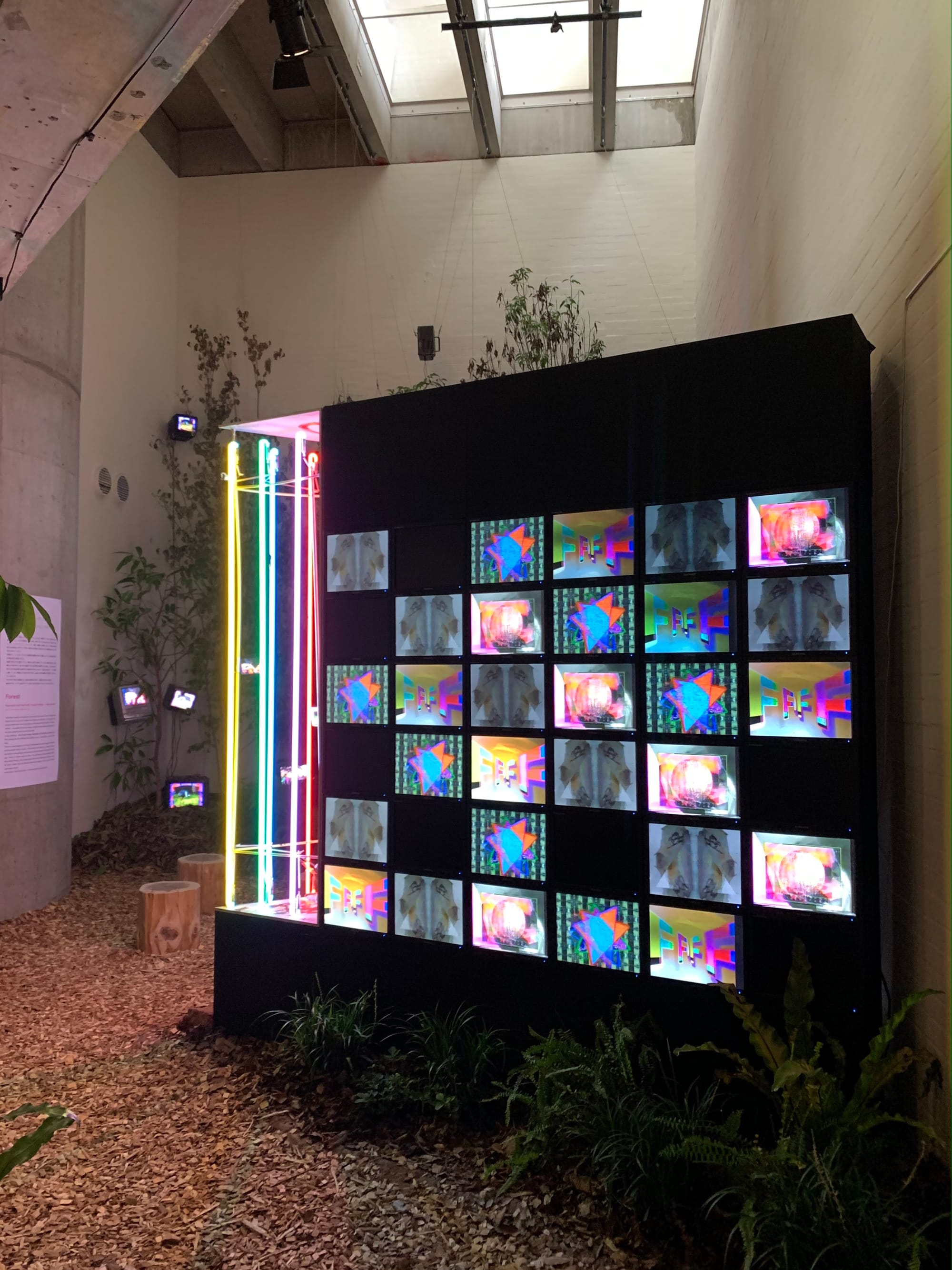
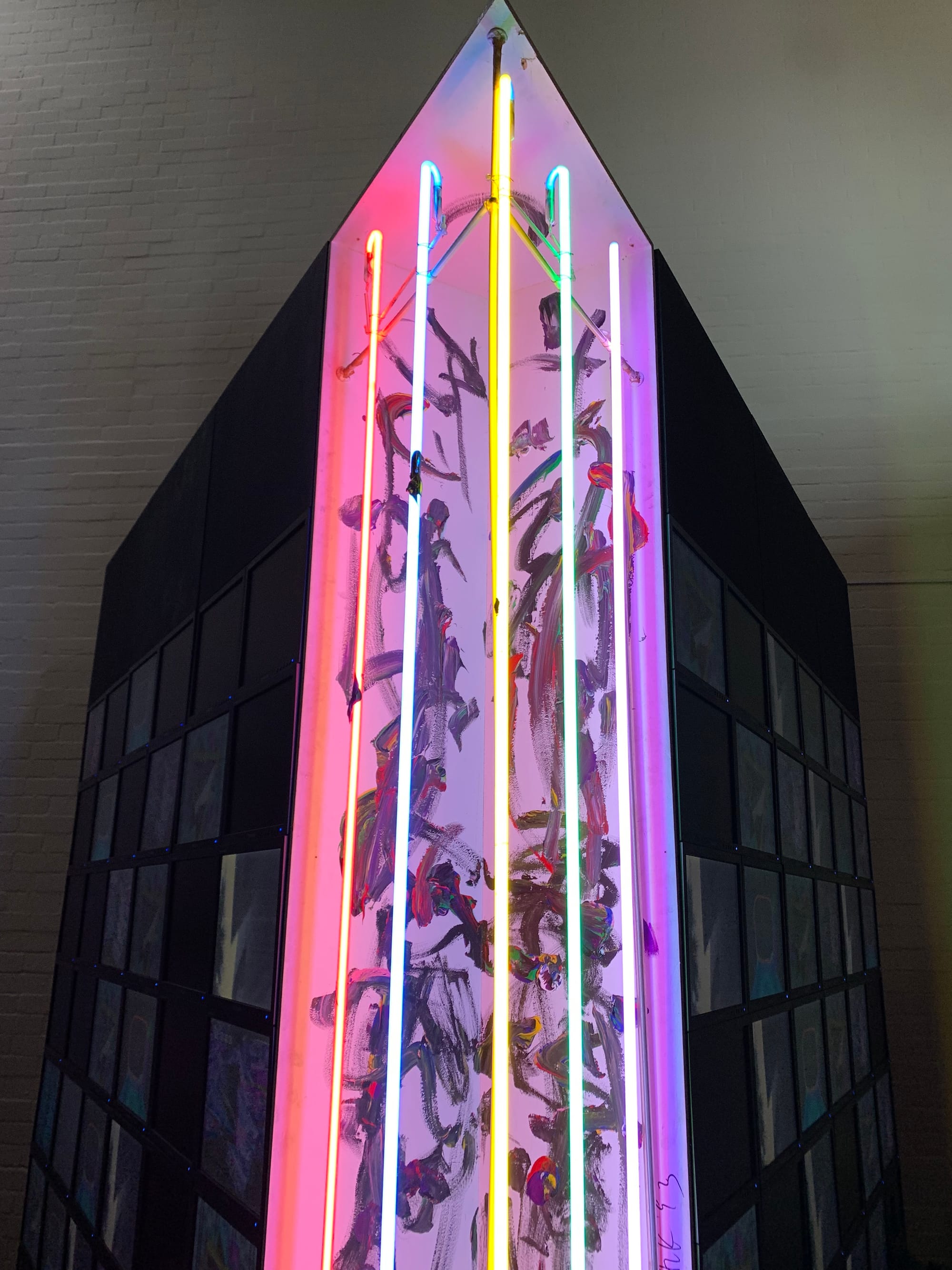
Detailed installation view of NAM JUNE PAIK’s Time in Triangular, 1993, at “Nam June Paik: The 20th anniversary of his passing,” Watari Museum of Contemporary Art, Tokyo, 2026. Photos by ArtAsiaPacific.
This conflux of nostalgia and contemporary resonance is pulled together by Time in Triangular and Forest of Cage / Revelation of the Forest (both 1993), created for Paik’s solo show at Watari-um that year. The former evokes both the museum’s own architecture and New York’s Flatiron Building; neon tubes illuminate its prow, while screens cover its walls, flashing clips from films and commercial TV distorted with a synthesizer. Forest of Cage, meanwhile, comprises 20-plus bulky TVs installed within a dense grove, each pulsing with kaleidoscopic imagery, forming a bizarre yet enchanting ecosystem in which nature and technology co-exist. A descendant of TV Garden (1974–77), the piece pays tribute to American composer John Cage (1912–1992), Paik’s friend and mentor. Just as Cage prioritized chance and sonic hesitation, Paik treated the glitch as both creative expression and political intervention, unsettling the corporate authority of telecommunication systems. He understood that the screen is not a neutral interface but a manipulable—indeed, “dictatorial”—medium whose subterfuge is concealed by its pervasiveness.
On the top floor, the exhibition turns to the afterlives of old appliances. Candle TV (1968) is a worn, hollowed-out Emerson TV sheltering a quietly burning candle. Conjuring the hush of a vigil, it mourns not only obsolete contraptions but the memories they contain. It also prompts a question: how does a world increasingly mediated by algorithms, cybernetic economies, and AI computing bear upon our collective psyche? Will human consciousness eventually succumb to the torrents of virtualization? Paik might not have lived these exact concerns, yet his work reminds us to stay attuned to the mechanisms of technology: to prod, tamper with, and disrupt the apparatus—if not to defeat it, then to at least preserve the human touch behind it.
Annette Meier is an assistant editor at ArtAsiaPacific.