Shows
Sculptures that Bewitch: “Unbound Forms” at the Hepworth Wakefield
Mrinalini Mukherjee: Unbound Forms—Women Sculptors of India and Bangladesh
Hepworth Wakefield
Wakefield
May 23–Nov 1, 2026
The 20th century was a time of mass upheaval across the Indian subcontinent. But, as the five women artists of “Unbound Forms” remind us, it was also a time of vivacity, of the revolutionary remaking of identities and visual languages. The quintet—Leela Mukherjee, Meera Mukherjee, Pilloo Pochkhanawala, Novera Ahmed, and Mrinalini Mukherjee—each played a part in the latter with their multimedia practices, which drew expansively from nature, local communities, traditional craft, European modernism, and myth. While the exhibition proposes compelling connections between the artists—only two of whom were in each other’s immediate spheres—its real joy is in how it fully showcases the dynamic, multifaceted character of their work, which befit their time.
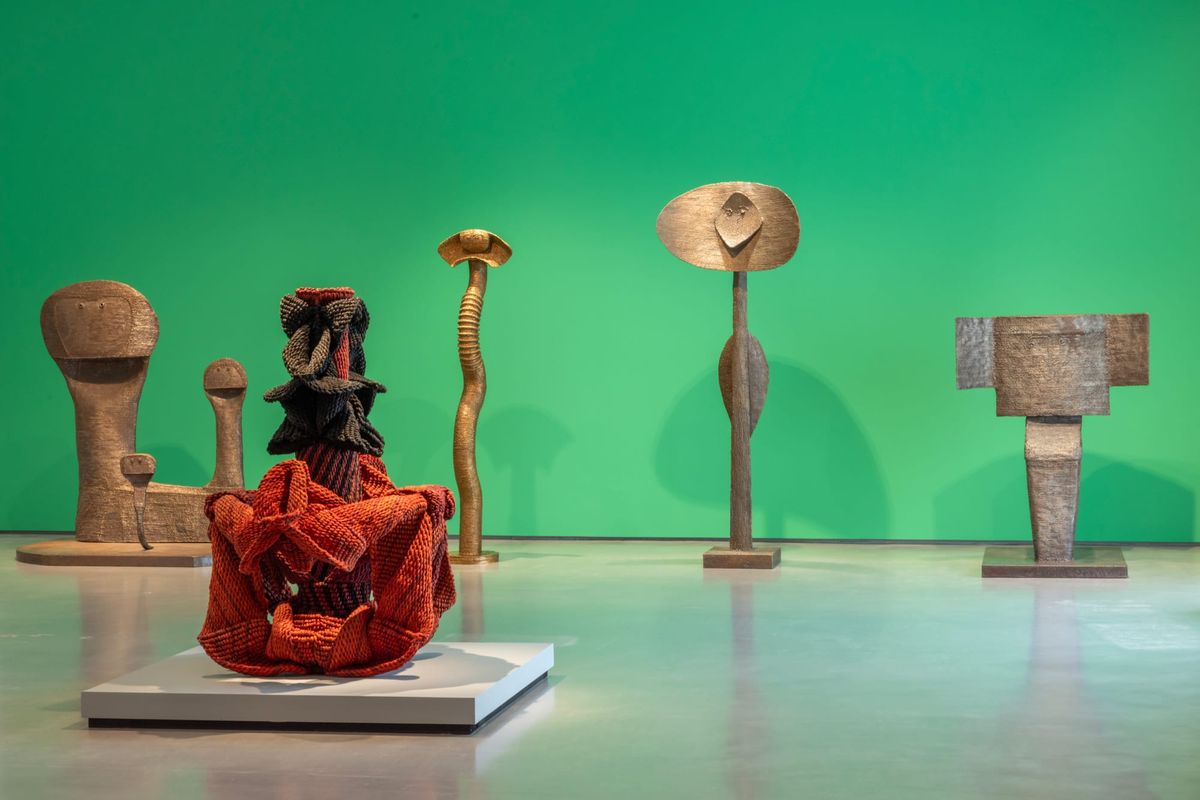
This is especially important for the artists who were in close dialogue with nature not just as a formal inspiration but as a living force. A motif that appears across the work of Ahmed and Mrinalini Mukherjee is the naga, a shapeshifting half-human, half-serpent spirit-guardian of water bodies. In Ahmed’s Snake painting (1973), it appears ready to strike, with human limbs sprouting from its fluorescent orange body, sharp fangs bared and forked tongue deployed. Contrastively, in Ahmed’s bronze sculpture Un serpent nommé désir (1972), the creature’s gently undulating body rises from the ground, its hooded head meeting viewers playfully around eye level. Between the two portrayals, Ahmed presents the mythical naga as both terrifying and loving. The threaded coils on the surface of Un serpent recall the bumpy textures of Mrinalini Mukherjee’s knotted hemp sculptures of the naga: Nag Devta II (1979) and Naag (1986). Symmetrical in composition, they appear like Rorschach tests, with their folds, bulges, and tubes rippling before one’s eyes into petals, gills, and stamen. Mrinalini Mukherjee’s ability to capture the enchanting aspects of nature is further evidenced in the sculptures Adi Pushp I and II (1997, 1998–99), which draw parallels between human and floral sexual organs. Adi Pushp II in particular features a towering shaft, crowned with fluid folds, thrusting upward from a scarred, fleshy crimson opening. Here the blooming of a flower is erotic, violent, and powerful—so beguiling one can’t look, nor look away.
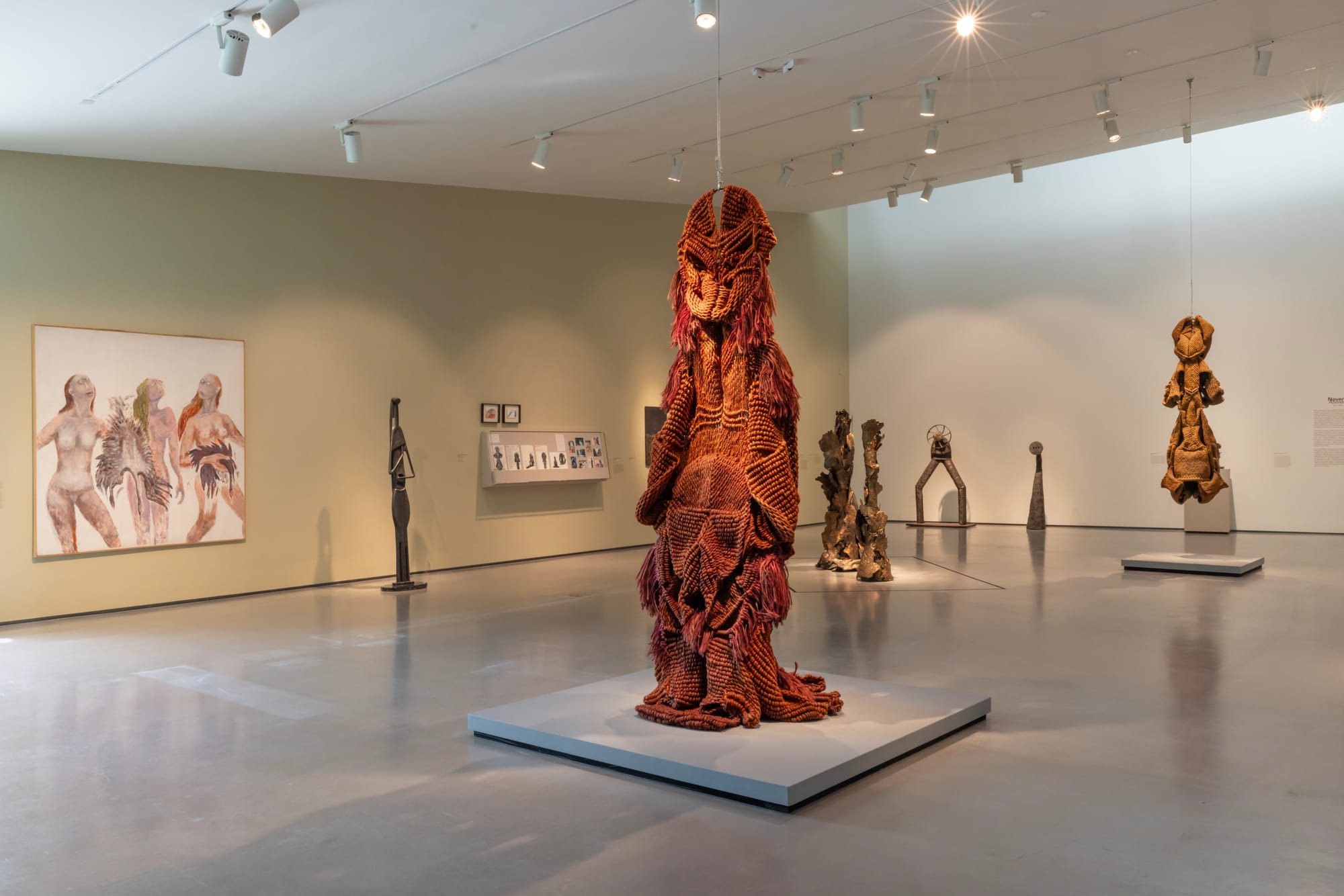
Adding to the sense of movement within the works are the multiple moments of time conflated within their compositions. Stacked atop each other in Mrinalini Mukherjee’s suspended macrame Pakshi (1985) are panels evoking pairs of wings alternately spreading and closing, like snapshots of a bird as it soars from floor to ceiling. Pochkhanawala’s Germination (1984) features a seed, with its rupture depicted in an aluminum stele behind it. As Pochkhanawala said, “A bloom already holds within it the germ of its decay.” Germination finds a counterpart in Mrinalini Mukherjee’s Earthbloom (1996), a bulbous ceramic form that resembles a genetically mutated gourd, caught simultaneously growing and atrophying. Besides flora and fauna, human performers are the subjects of works by several of the artists. Among them, Leela Mukherjee—Mrinalini’s mother—sculpted Dancers (1981–82) in bronze. The limbs and torsos of the two figures are equally thick and index the artists’ squeezes and pinches. As a result, they dance on the cusp of abstraction and figuration, coalescing as a duo executing an arabesque lift before dissolving into lines in space.
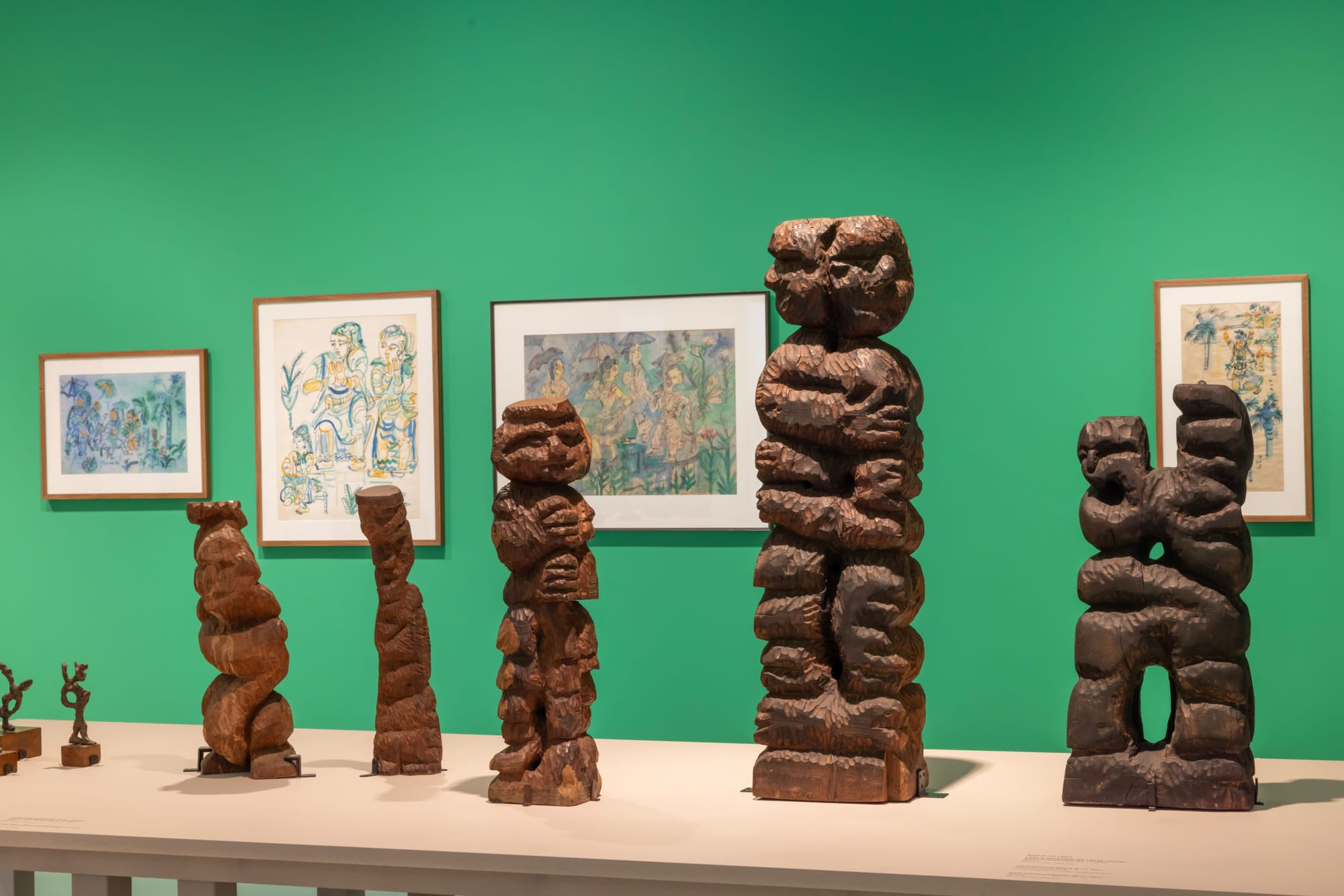
The works’ dynamism lends them to emotive views into the politics of the time. In Meera Mukherjee’s Violence (1972), the spindly bodies of three figures form dramatic loops and arches as they wrestle; at once distorted, tense, and perversely graceful, they allude to the 1971 Bangladesh Liberation War, in which Bengali nationalist forces fought against Pakistan with the support of India. Ahmed’s 1971 maquette proposes a monument dedicated to Bangladesh’s independence following that same conflict. Towering metal shards stand in for a celebratory crowd, their glimmering surfaces effusing jubilance. Captivating, surprising, and challenging viewers with the work of five bold women, “Unbound Forms” brims with life.
Chloe Chu is an art writer and editor based in London.