Issue
The Illusions of the Center-Periphery
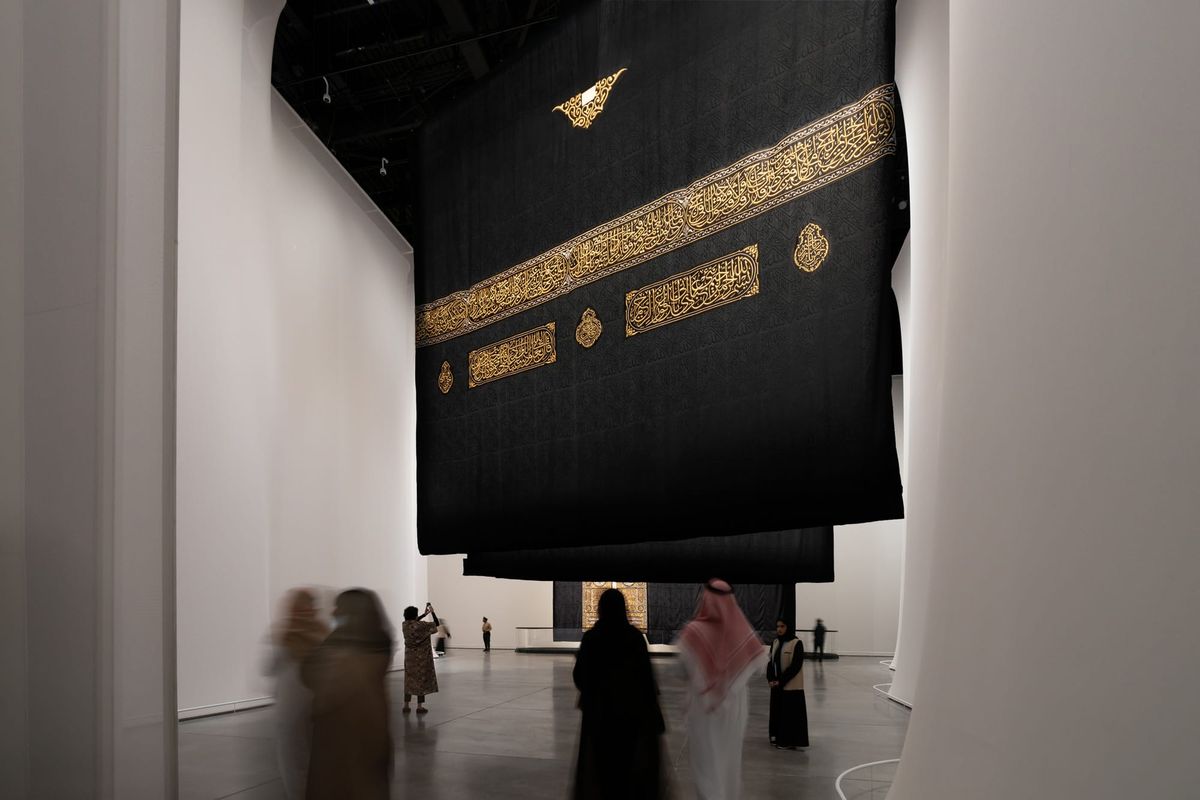
At the beginning of their journey through the 2025 Islamic Arts Biennale in Jeddah, visitors came across the kiswah of the Holy Kaʽbah, its black silk panels rising almost to the full height of the gallery space, gold embroidery catching the light. It is an object that, for centuries, has been encountered in Makkah, at the center of a particular relationship to place, ritual and devotion. Here, it was encountered differently, retaining its sacred significance within a milieu of other ways of seeing and making.
A few meters away, Abdelkader Benchamma’s Between Each Sky (2025) unfolded across the walls, its ink and charcoal forms animated by projections and organized around seven columns from Makkah. Nearby, Arcangelo Sassolino’s enormous steel disk, Memory of Becoming, turned slowly and almost imperceptibly, coated in industrial oil that shifted with its movement and gravity. As one work invoked geological strata and celestial expanses, the other made visible mass, instability, and transformation. The kiswah—situated in a dedicated hall between these installations—served not as a mere relic explaining or being explained by contemporary works, but as another singular presence within the conversation.
The scene captured something essential about the second edition of the Islamic Arts Biennale, which borrows its title from a recurring phrase in the Qur’an that references the heavens, Earth, “And All That Is In Between.” Its implication is expansive: rather than creating a binary between heaven and Earth, past and present, divine and worldly, it charts the vast field of creation that exists between such categories. The biennale drew on this proposition to explore how faith is experienced through feeling, thinking, and making. It is tempting to read such an exhibition in Saudi Arabia through the tired language of geopolitics: power shifting toward a more distributed, multipolar order, and the art world simply being downstream of everything else. New biennales in new cities, from this perspective, are the cultural correlates of new capitals in a G20 memo. Though it makes for a tidy story, it is neither a complete nor interesting one.
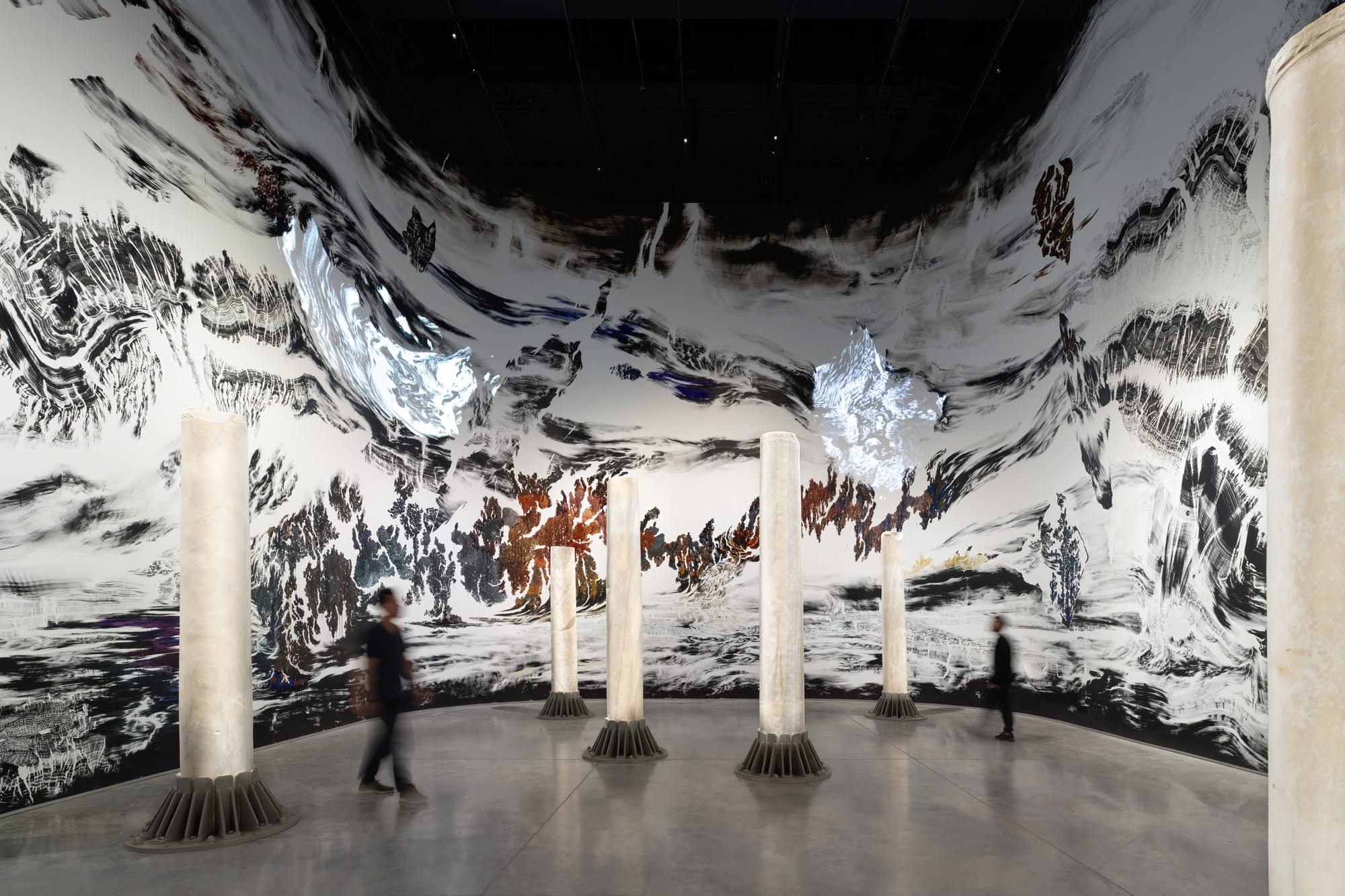
The more consequential change is not simply the relocation of art-world power to different coordinates on the same map, but the emergence of institutional models that were never trying to be peripheral versions of an existing template in the first place—models built out of distinct histories, distinct relationships between object and audience, distinct ideas of what and for whom an exhibition exists, and distinct ways of understanding how culture accumulates and is transmitted. This emergence runs parallel to a broader global reconfiguration already underway, whereby rising middle powers are exercising greater agency and forging corridors of exchange between the Gulf, Asia, and Africa. Cultural institutions are among the clearest expressions of this development, operating on terms they set themselves. These new centers, in other words, can introduce novel institutional logics: alternative modes of deciding what belongs in an exhibition, what constitutes a cultural encounter, and how relationships between places are built.