Issue
151 Dispatch: Abu Dhabi
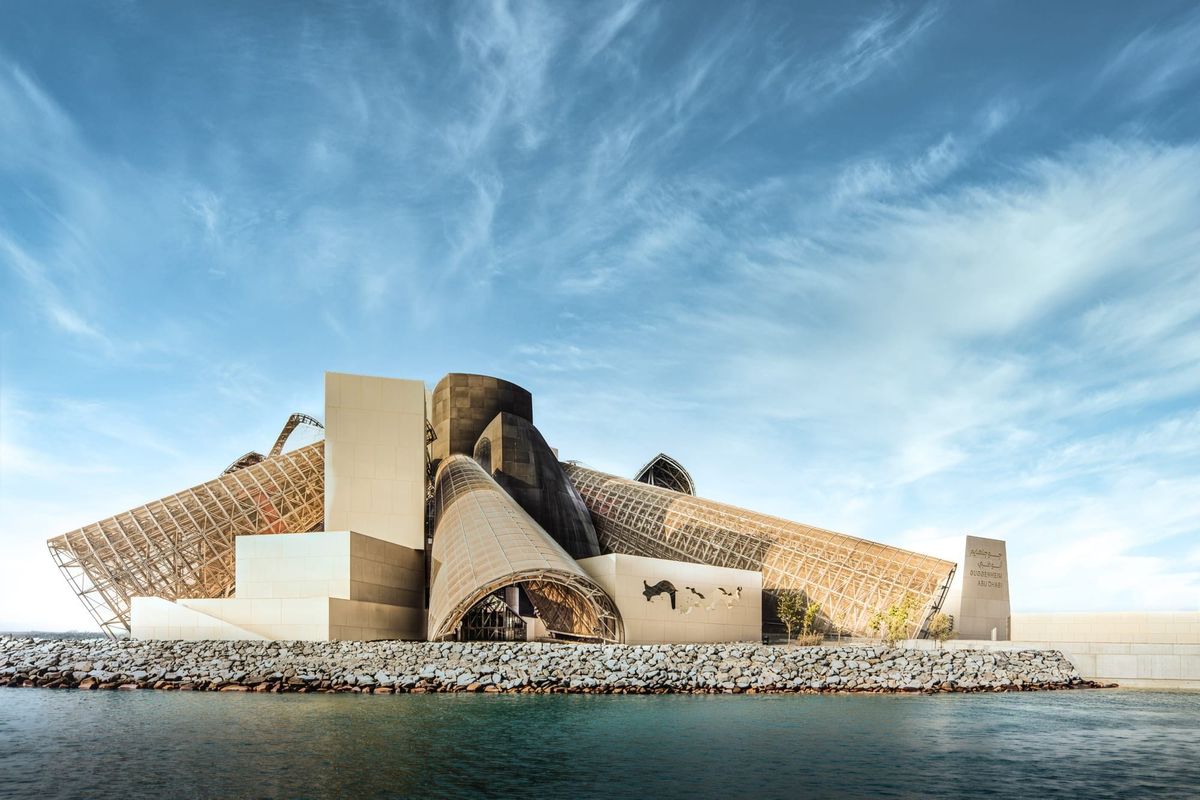
The master plan for Saadiyat Island, unveiled at the Emirates Palace in 2007, was presented in the form of a diorama spangled with statement pieces by some of the world’s most celebrated starchitects. Frank Gehry’s Guggenheim loomed with conical silvers and cubic golds. Beside it was Jean Nouvel’s metal dome design for the Louvre. Zaha Hadid had prepared a performing arts center that looked like an intergalactic vessel, neighboring Tadao Ando’s more restrained design for a maritime museum. Foreign press described it as a “cultural Xanadu,” alluding to Kublai Khan’s summer capital or, perhaps with a touch of condescension, to Samuel Taylor Coleridge’s poem of the city as a mythical, idyllic place.
The cynicism was perhaps defensible. On Abu Dhabi’s outskirts, Saadiyat was known for its Shaabiyat—a national initiative that distributed single-story houses to Emirati fishermen and their families, replacing the palm-frond huts they had lived in until the 1960s. The area had little more than a small police station, a schoolhouse, and a hospital equipped to administer only first aid.
The capital’s cultural software was also modest. In 2007, neighboring emirates had already entered the global conversation. Sharjah was hosting its eighth biennial with an established museum network. Dubai already had a dozen commercial galleries and was preparing to launch the Gulf Art Fair (later rebranded Art Dubai) and Alserkal Avenue, which overhauled a cluster of Al Quoz warehouses into gallery spaces. The year before, Christie’s had hosted its first Middle Eastern art auction in Dubai. In Abu Dhabi, however, the Cultural Foundation was practically the sole venue for art exhibitions—providing institutional visibility for local artists, but remaining a multipurpose venue.