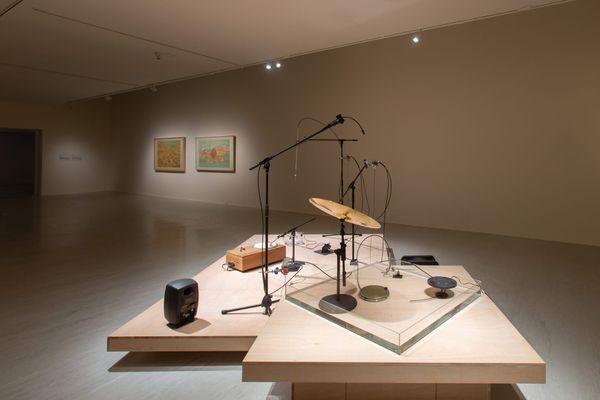
Shows
“Poetry goes no further than language” at Buxton Contemporary

Poetry goes no further than language: A historical moment of art becoming art again
Buxton Contemporary
Melbourne
May 1–Oct 3, 2026
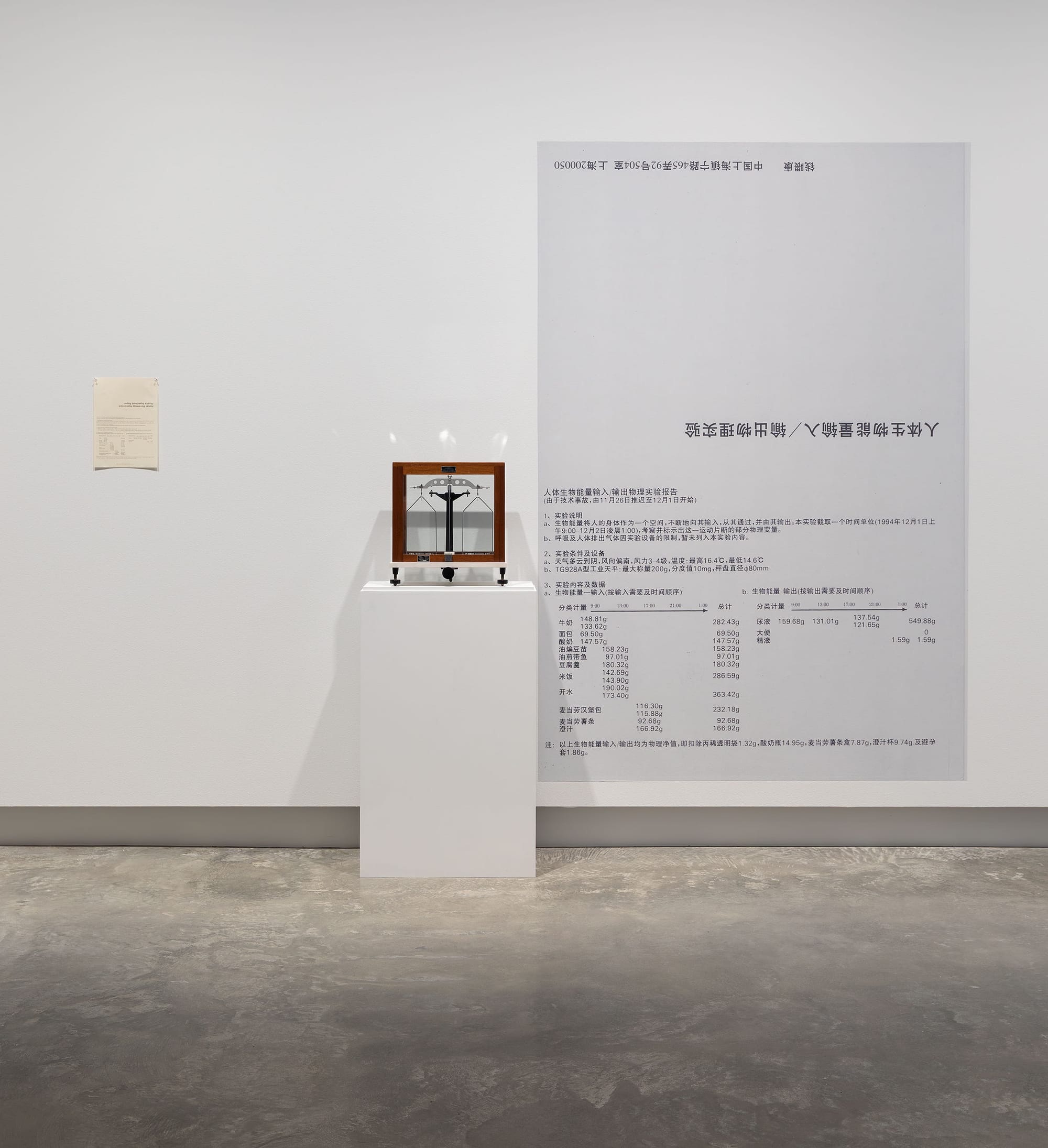
In Buxton Contemporary at the University of Melbourne, a document meticulously lists everything the artist Qian Weikang ingested and excreted on November 26, 1994. He ate bread and yoghurt for breakfast; stir-fried pea shoots, pan-fried beltfish, and tofu chowder for lunch; and a McDonald’s burger and fries for dinner. Out came 549.88g of urine, no faeces, and 1.59g of semen. Presented with the clinical detachment of a medical chart, this physiological ledger is no diagnostic record: it is an early example of conceptual art made in China.
That piece, Human Bio-energy Input/output Physics Experiment (1994), is a highlight of “Poetry goes no further than language: A historical moment of art becoming art again,” which examines the emergence of conceptualism in China in the late 1980s and 1990s. The exhibition focuses primarily on the work of Qian and the New Measurement Group, a Beijing collective that included, among others, Chen Shaoping, Gu Dexin, and Wang Luyan.
Today, these artists’ experiments are little known, partly due to their deliberate self-erasure. In 1996, the New Measurement Group disbanded and destroyed almost everything they had created together. That same year, Qian stopped making art and withdrew into anonymity. Any surviving evidence of their rigorous, often ephemeral interventions was largely left out of the dominant narratives of Chinese art in the 1990s, which favored movements like Cynical Realism and Political Pop that more neatly functioned as immediate visual allegories of the country’s political and economic changes.
Curators Carol Yinghua Lu, director of Beijing’s Inside-Out Art Museum, and her husband, the artist Liu Ding, are committed to rectifying this. The pair—recently appointed curators of the 2027 Istanbul Biennial—have spent years researching and tracking down these artists and their practices. Where originals no longer exist, they secured the artists’ permission to recreate pieces. Their efforts have reunited the complete experimental output of the New Measurement Group alongside reconstructions of key works by Qian.
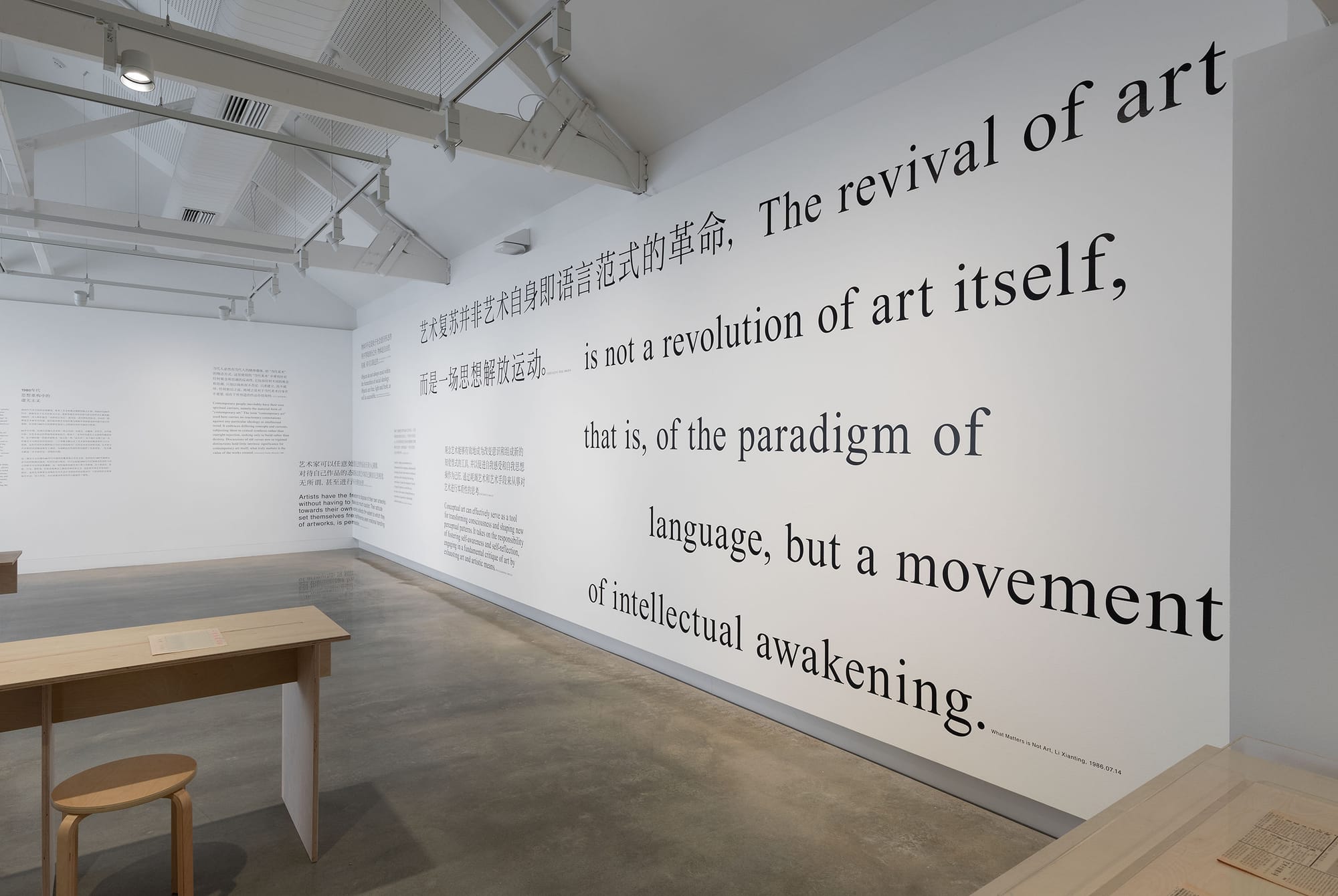
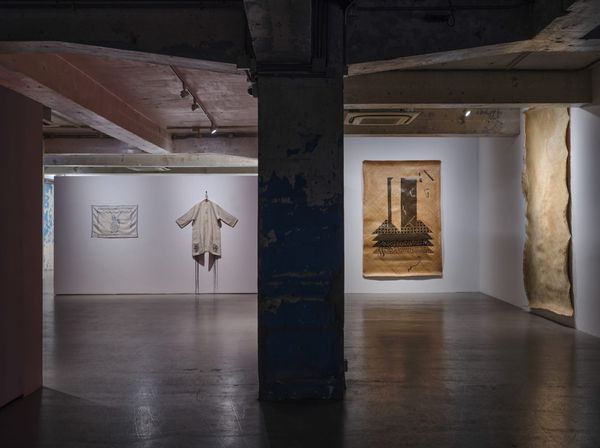
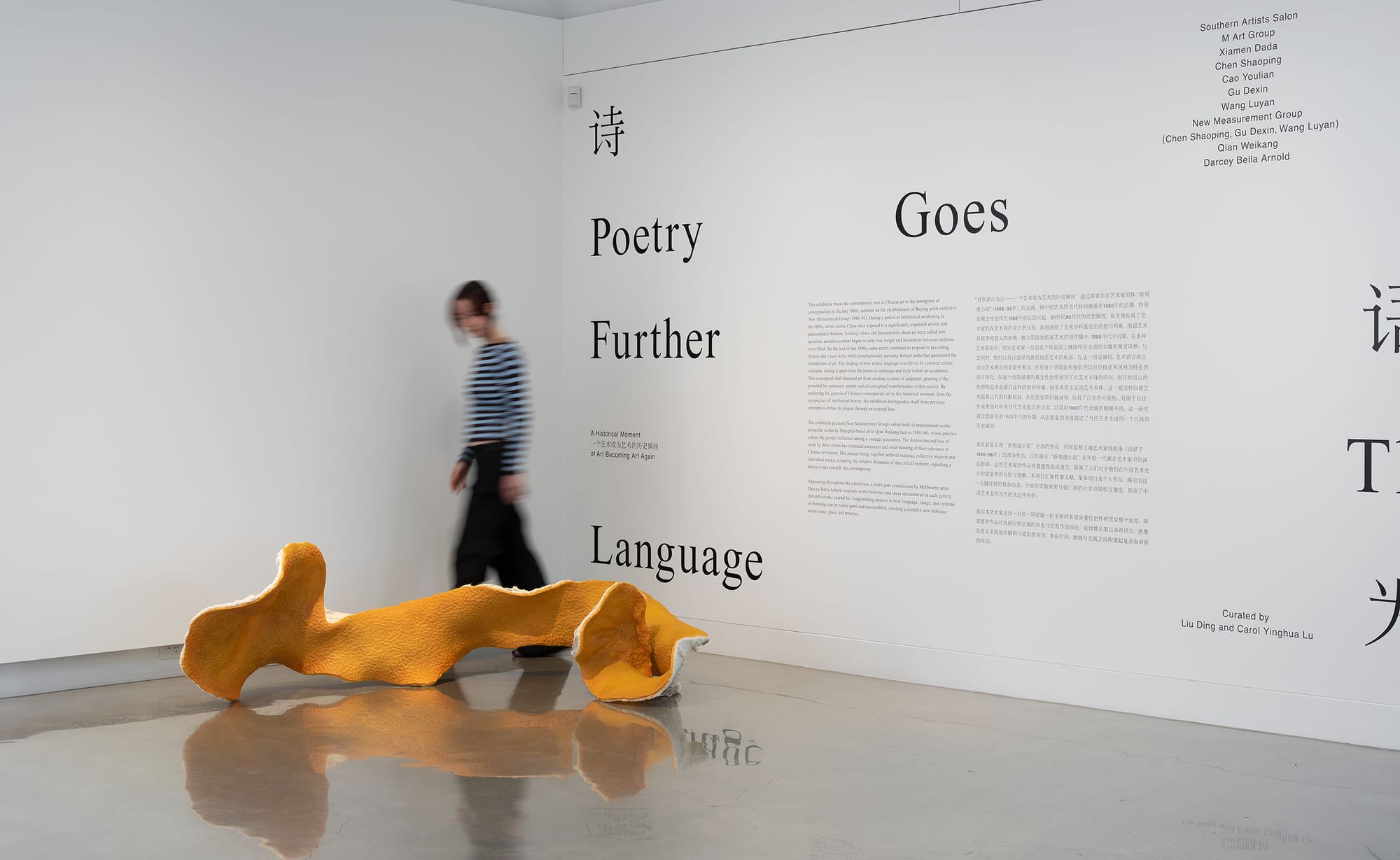
Installation view of QIAN WEIKANG, NEW MEASUREMENT GROUP and DARCEY BELLA ARNOLD’s “Poetry goes no further than language: A historical moment of art becoming art again,” at Buxton Contemporary, Melbourne, 2026. Photo by Christian Capurro.
The show opens with an introductory gallery establishing the post-1976 climate. Most of the walls are plastered with quotes in Chinese, with English translations, from artists, writers, and curators navigating the aftermath of the Cultural Revolution. These reveal an urgent drive to disentangle artistic practice from political and ideological agendas and official aesthetics. Some artists began working outside of painting and sculpture, disowning the traditions, values, and other inherited cultural baggage embedded within them. This philosophical shift is articulated by the exhibition’s title, a phrase by poet Han Dong arguing that language is the fundamental subject and material of poetry, not simply a passive vehicle for meaning.
Two subsequent rooms feature the works of the New Measurement Group and Qian in dialogue with new paintings and sculptures by Australian artist Darcey Bella Arnold, who was commissioned to respond to the Chinese conceptualists. Arnold’s most interesting contributions are her large-scale models of citrus peels, which answer the call of the exhibition’s title by interrogating linguistic slippage: in English, “mandarin” refers to both the fruit and the Chinese dialect, while in Chinese, the name for “orange” is a homophone of words associated with success and wealth.
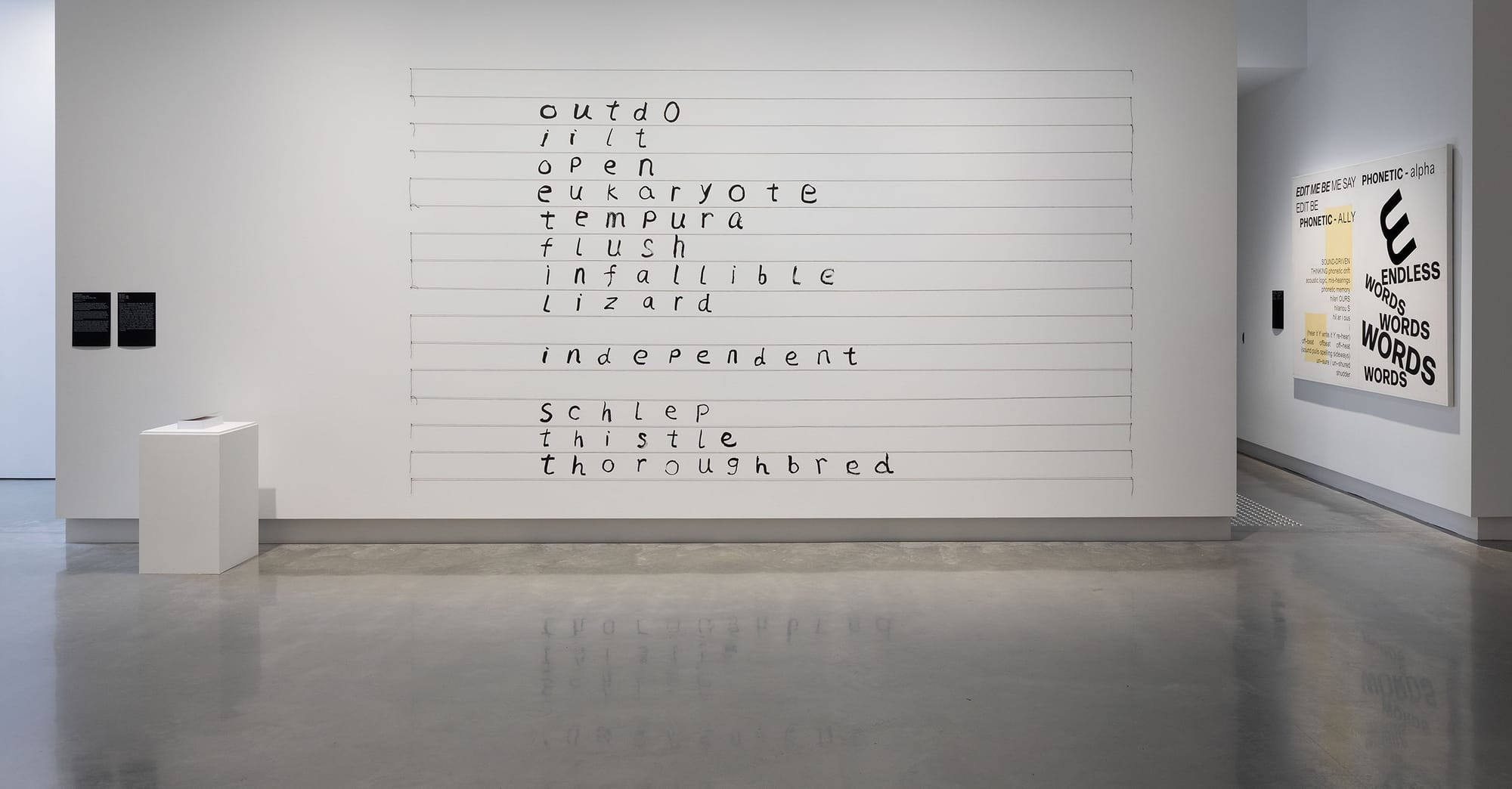
Installation view of QIAN WEIKANG’s Ladder Poem, 2026 (left), and DARCEY BELLA ARNOLD’s Fruit of Chance 11, 2026 (right), at “Poetry goes no further than language: A historical moment of art becoming art again,” Buxton Contemporary, Melbourne, 2026. Photo by Christian Capurro. Courtesy the artists.
Arnold’s oversized curls of citrus add verve to an otherwise austere show. The New Measurement Group’s oeuvre is by design visually dry. Seeking to purge all signs of the hand of the artist, the collective devised rule-bound, pseudoscientific systems to dictate artistic execution. As a result, many of their pieces take the form of A4 sheets filled with text, formulas, and numbers, some of which feel impenetrable. While well-written wall labels help decode them, brief texts can only partially explain the artists’ intricate methodologies.
Qian was similarly interested in systems. However, while the New Measurement Group strove toward uniformity, Qian developed processes that reveal the wonder of surrendering to chance. He made Ladder Poem (1990) by climbing a ladder and dropping strips of paper, each bearing a word randomly selected from a dictionary, to form an automatic poem. Restaged three times in the exhibition, the piece yields results that are strange, sometimes funny, and occasionally arresting—revealing the surprises that can be found when human intention collides with forces beyond our control. In Human Bio-energy, the seeming arbitrariness of the figures suggests that similarly unknowable influences exist even within our own bodies, operating beneath our consciousness in ways that numbers cannot capture.
Although the exhibition is packed with dense text, both on the walls and in the works, it ultimately inspires a hunger for more. The New Measurement Group considered their true artistic output to be the five books they published, all of which are on display. Hopefully Lu and Liu will one day pen their own book, gathering this show’s contents and their wider research into a volume that can reach global audiences and give these artists their due place in the history of art.
Oliver Giles is an art writer based in Melbourne.