Shows
Against Fixed Lines: “Soft Borders” at Blindspot Gallery

Soft Borders
Blindspot Gallery
Hong Kong
Sep 15–Nov 7, 2026
The contemporary age feels increasingly nebulous. Globalization, technological advancement, and manmade systems have created a vast web in which social, cultural, and personal boundaries are ever harder to define. “Soft Borders,” currently on view at Blindspot Gallery in Hong Kong, brings together six artists—Igshaan Adams, Aiko Tezuka, Bi Rongrong, Kazuko Miyamoto, Angela Su, and Yee I-Lann—whose works navigate the ambiguous frameworks that shape our identities, each through a distinct artistic and cultural lens.
Aiko Tezuka’s textiles open the exhibition from a historical vantage point, addressing the entanglement of artistic technique and style between her native Japan and European merchants from the 16th century onward. Her series Lessons for Restoration (2026) takes textiles depicting Western pastoral scenes and unspools their threads, intentionally defacing and obscuring the original focal points. The gesture responds to the cultural crossings of early globalization, when European artistic sensibilities began to override traditional Japanese methods. These pieces also literally break free of their frames, extending into three-dimensional space. In doing so, Tezuka invites reflection on how artistic languages adapt across time, in the past as much as the present.
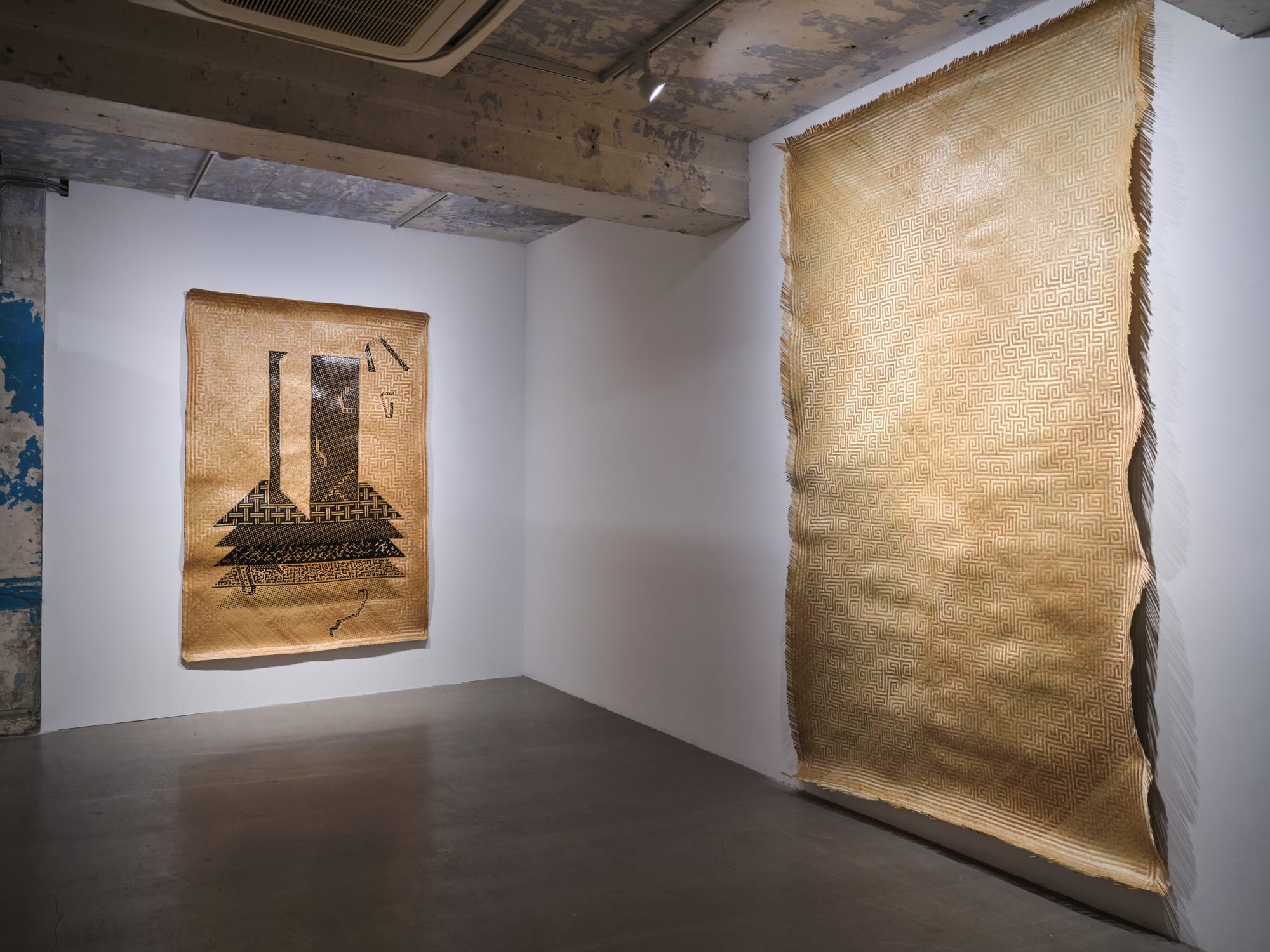
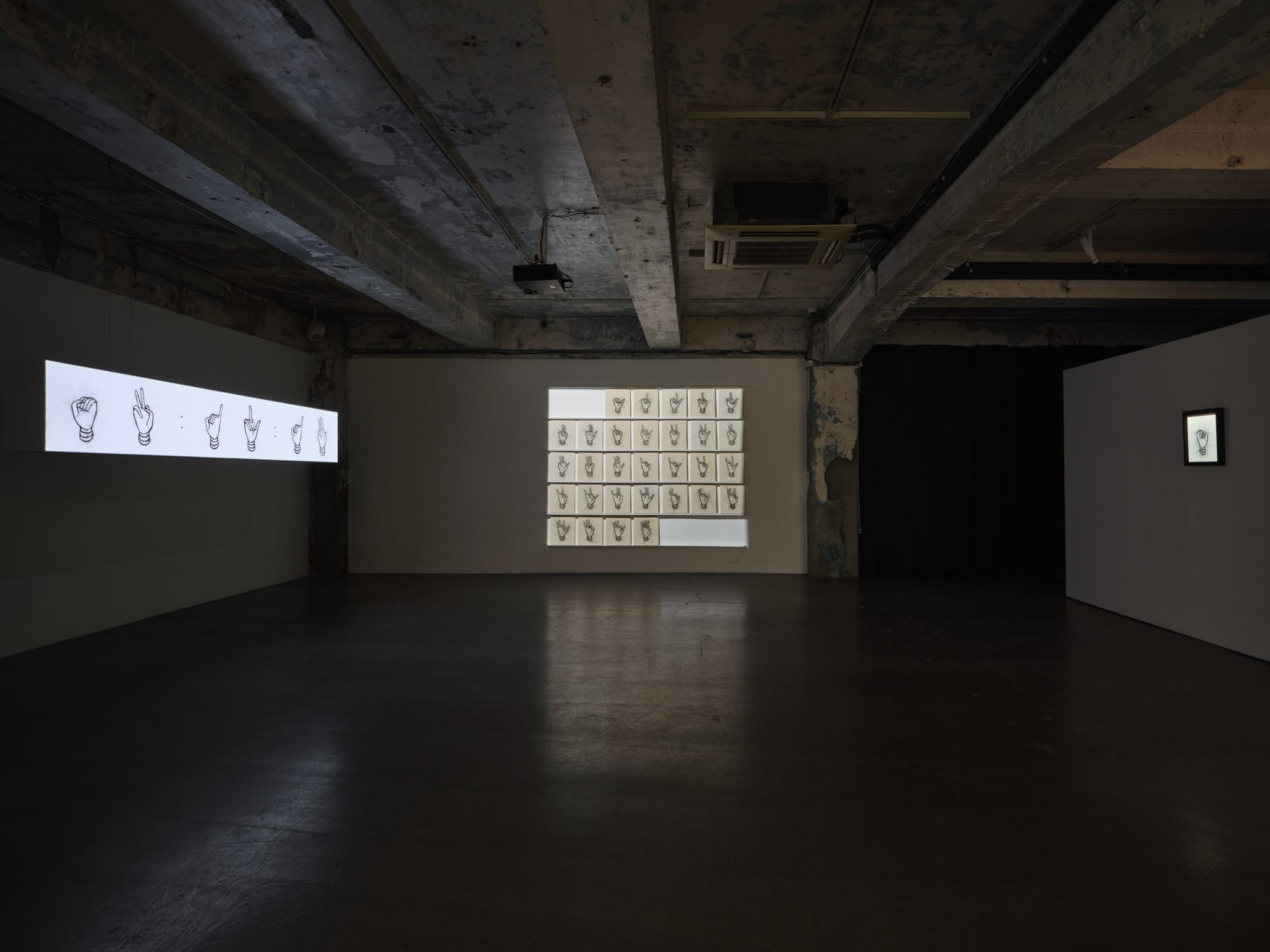
Installation views of YEE I-LANN’s Doormatic Glide Refractor and A map of Mansau-ansau, both 2024, split bamboo pus, weave with kayu obol (tuber), black natural dye, Multifilla Matt Sealant, dimensions variable (left); and ANGELA SU’s The Fabric of Time, 2026, programmed real-time clock (comprising stop-motion animation), hair embroideries on textile, dimensions variable (right), at “Soft Borders,” Blindspot Gallery, Hong Kong, 2026. Courtesy the artists and Blindspot Gallery.
Yee I-Lann extends this inquiry into colonialism’s cultural impact on Southeast Asia. Doormatic Glide Refractor (2024) is a bamboo pus-woven mat, onto which the artist has painted a series of patterned mats in black dye. Two rise perpendicularly, conjuring the image of an upturned table—a bulky European import that displaced the traditional use of lightweight mats across Malaysia and Indonesia. The configuration suggests that even the heaviest objects can be moved with ease when borne by something as humble as a mat. Adjacent, A map of Mansau-ansau (2024) shimmers and alters depending on the angle of view, its unadorned surface a formal echo of Yee’s broader proposition: the structures surrounding us can be radically shifted—depending on your perspective.
Angela Su’s The Fabric of Time (2026) punctuates the exhibition space with the steady beat of a ticking clock. Installed in near-darkness, the multipart work comprises a stop-motion-animated timepiece, a calendar of 31 hands embroidered in human hair, and a separately framed hair-embroidered clenched fist—the gesture for “null” or zero in one-handed finger binary. Each hand in the calendar denotes a value from one to 31 in the mid-20th-century system, which was developed as a biomechanical analogue to computer code. As synthetic calculation and automation increasingly become the norm in society, Su’s laborious renderings of hands in human hair—signifiers of the body rendered in material drawn from it—investigate how we perceive our anatomy and its inherent systems in light of technology. Su’s work channels the ever-present natural computation of human biology, the unseen labor that keeps our bodies functioning, and the fact that all processes, whether organic or mechanical, eventually run down. After all, the greatest border we inevitably come up against throughout our lives is time.
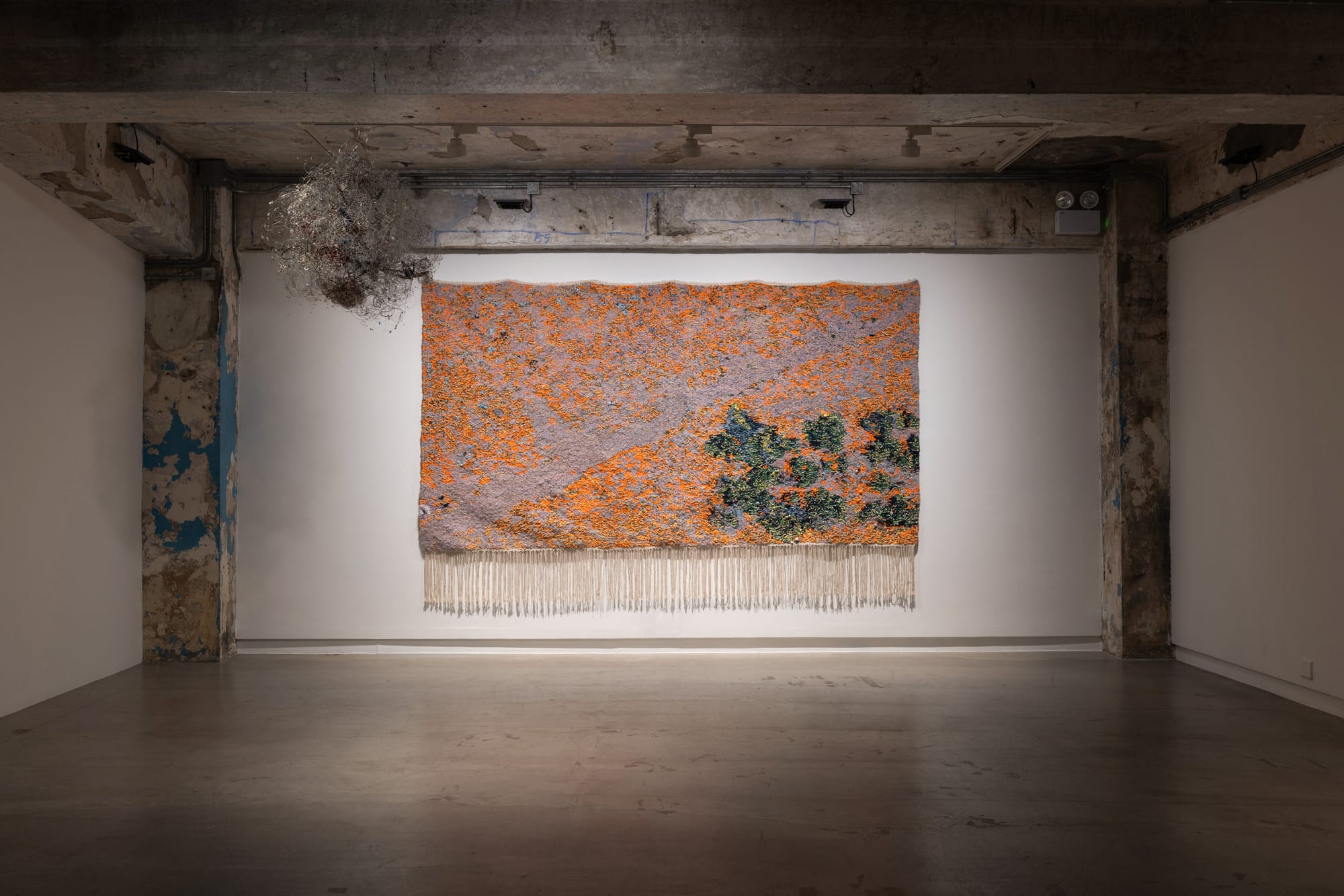
Igshaan Adams’s vibrant textile works offer a more positive outlook to round out the exhibition. Nama stap (ii) (2026), a tapestry comprising cotton twine and braided rope interwoven with beads, shells, lace, and ribbons, takes the form of a bird’s-eye view of human movement across the land. The “map” is a depiction of Namakwaland, the arid South African region that is radically transformed annually by a desert bloom. Drawing on his upbringing under apartheid, the piece considers how structures of oppression impose and enforce literal borders. Yet the seasonal flowering of daisies in the desert serves as a counterimage: a reminder that what appears rigid always falls, that things always change, and that hope always persists.
“Soft Borders” offers no definite answers to questions about our place in the world or how we ought to navigate what lies ahead. But it does invite us, if gently, to reconsider who we are, what we are made of, and which perspectives we ultimately hold on to.
Harison Butler is an editorial intern at ArtAsiaPacific.