Shows
Up Close: Sasha Gordon’s Portrait of Obsession

Nocturnal
David Zwirner
Hong Kong
Sep 23–Nov 14, 2026
Sasha Gordon’s sitter has a center part that is worryingly wide; I fret over it with the same scrutiny I give my own every morning. The unsettling fissure zigzags down her scalp, perhaps styled to soften the seam a straighter course would expose. The delicate strands, delineated with a finesse as cruel as it is heartbreakingly tender, gather into ebony banks fringing an emerald river of skin.
The face, this time, is not Gordon’s. Departing from the proliferating selves of her usual output, she depicts an anonymous friend in Hard Candies (2026), included in the group exhibition “Nocturnal” curated by Matthew Brown at David Zwirner Hong Kong. The gallery is on my way home, and across several visits my fixation has followed the same route: first the sparse roots, then the stray wisps that lead down to vitreous auburn pupils, themselves fixed on a glass paperweight poised gingerly in her hands.
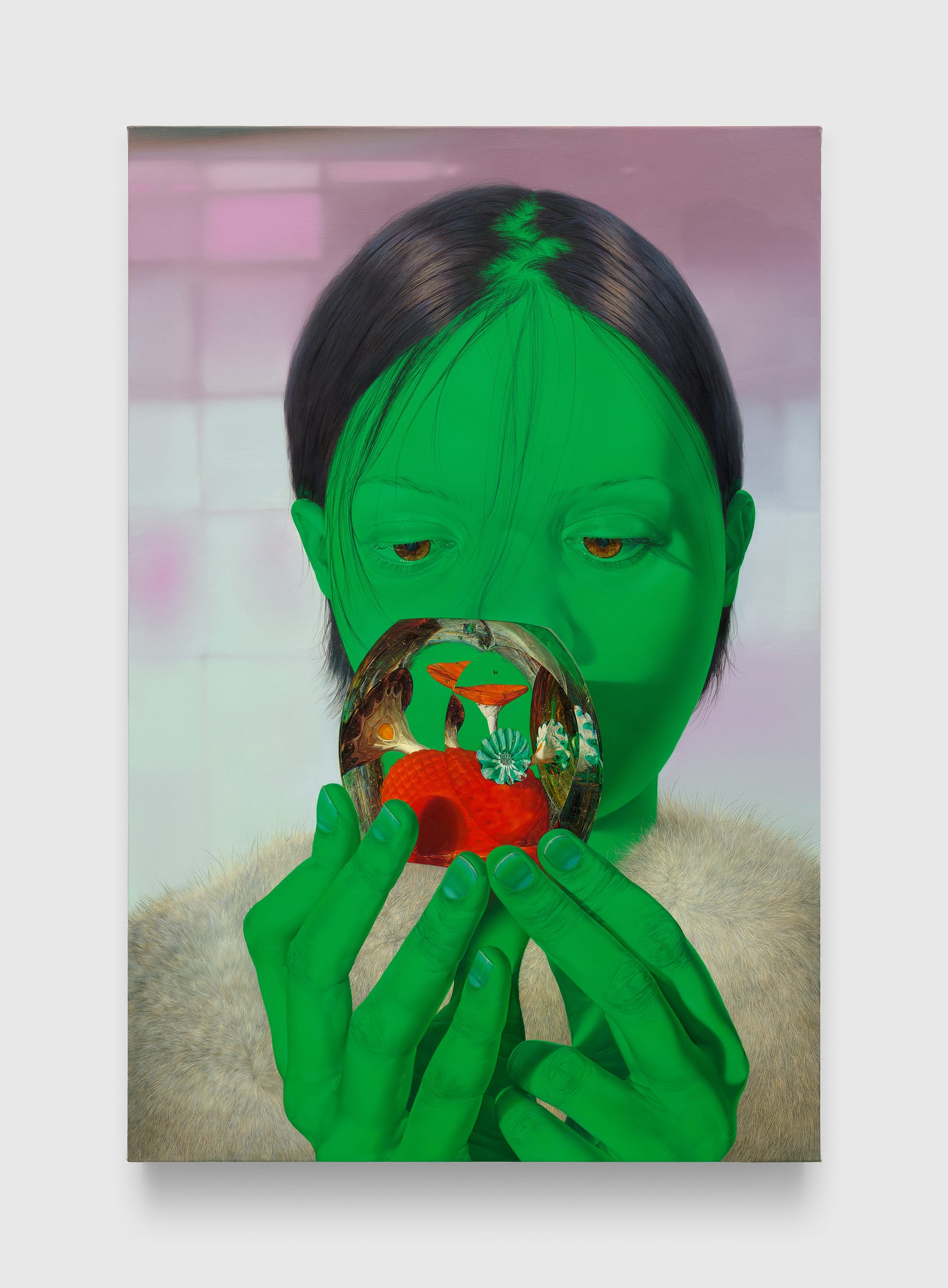
The talisman, held aloft with a reverence bordering on supplication, is an heirloom from Gordon’s grandmother. Here the artist’s technical virtuosity verges on ostentation: fungal growths and botanical forms swell and flourish in a miniature terrarium, their warping contours and kindling colors aflare in glancing light.
So much is available to the eye, yet nothing yields. A sumptuous white mohair crewneck solicits yet forbids touch, conveying at once a soft vulnerability and something feral, prickly. Behind her, misty lavender tiles suggest a bathroom humid with steam. These diffuse textures hush the edges of the picture, allowing for a sharp convergence of focus where the sitter’s attention and ours meet. And what we most obsess over is the most out of reach: an enclosed, precarious world sealed against access.
That withholding follows a period of giving too much of herself. Having made her own likeness so central to her work, Gordon is reconsidering the terms of that intimacy. “I think I have been very earnest. In the past year I started to feel quite vulnerable,” she tells me. “Like I’ve been a little too generous.”
The conspicuous hair part carries a trace of that openness. She recalls an earlier painting about trichotillomania, a work made with a candor she now hesitates to repeat. The detail in this work is something of a private joke—“an homage to that version of myself,” she explains.
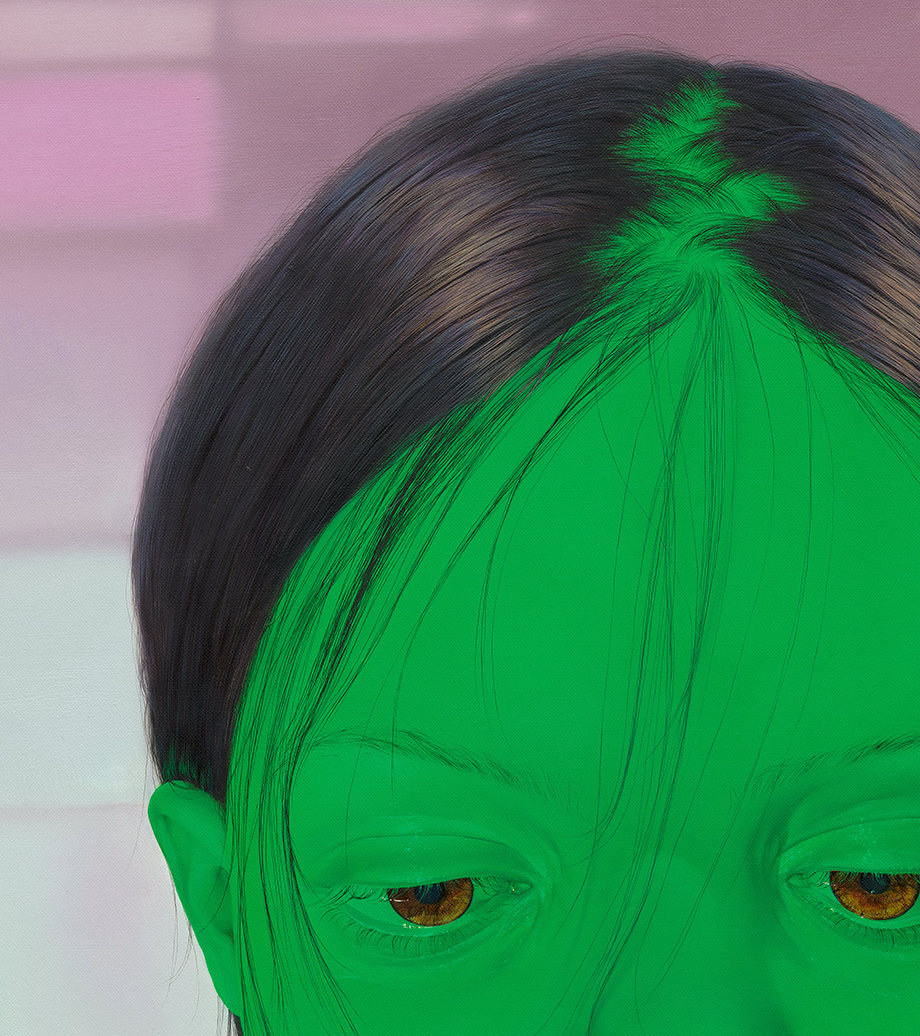
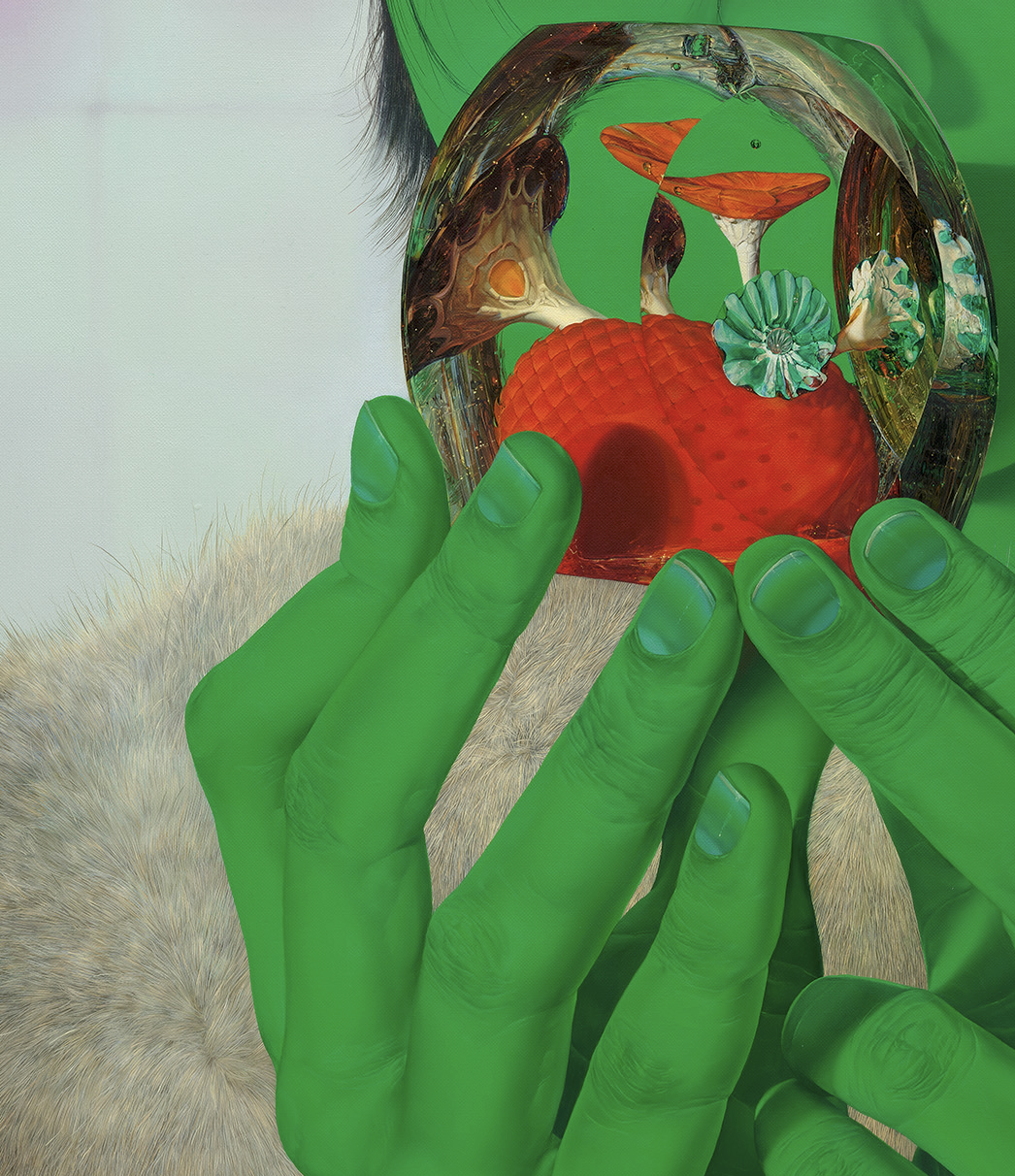
Details of SASHA GORDON’s Hard Candies, 2026. Courtesy the artist and David Zwirner, New York.
Here the face belongs to someone else, but the psychological charge has not diminished. “I think the figure is actually not what’s the most important in this piece. It’s the textures that add up to the figure. I am interested in psychological spaces and in creating spaces of tension, and here I was thinking about how I could express that not through a face or a portrait, but an object.”
Her expression inscrutable, the sitter’s absorption admits no audience. And yet Hard Candies arrests us precisely through this spectacle of attention we cannot enter: the figure’s gaze could be appreciation, grief, even hatred, or a kind of burning, searching, hope. In conversation I remark that the object feels to me like a crystal ball, teasing a future in its depths. “It is more than a crystal ball or a paperweight,” Gordon corrects me. “It could be like a loved one, or a memory.”
In portraying obsession, the painting also induces it, the paperweight a stand-in for all that we cannot bear to relinquish. But even the fiercest vigilance cannot forestall loss, nor scrutiny keep hair from thinning. A hard candy invites us to hold it gently on the tongue, resisting the impulse to bite; yet even the tenderest restraint does not stop it dissolving.
Michele Chan is managing editor at ArtAsiaPacific.