Shows
Musquiqui Chihying’s “A Life of Navigation” at Hayward Gallery
Musquiqui Chihying: A Life of Navigation
Hayward Gallery
London
Aug 25–Oct 18, 2026
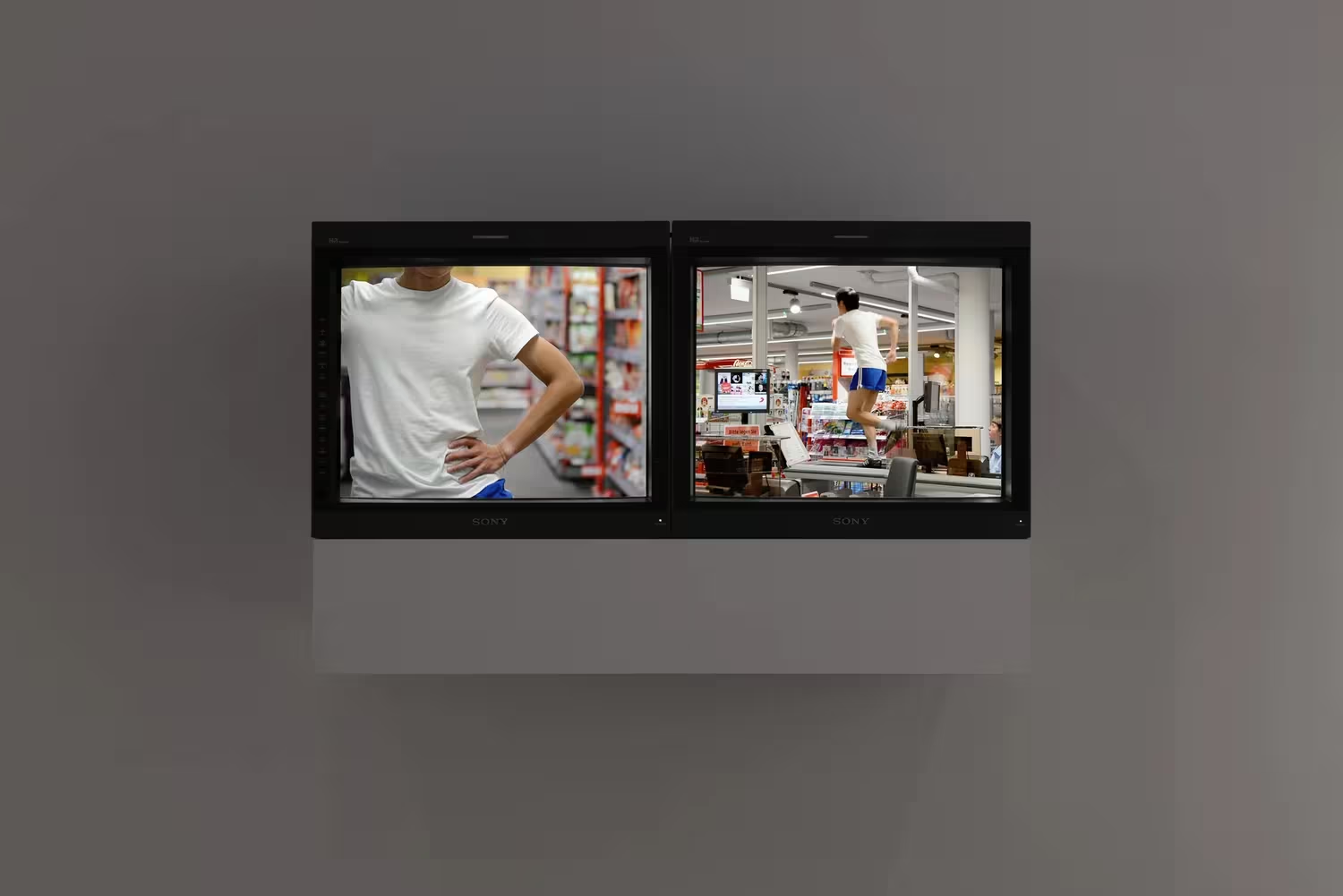
What is the cashier at the German supermarket thinking as she gawks up at the Taiwanese artist using her checkout as a treadmill? She stares with a look of resigned bemusement as he ambles in place, all elbows and knees in a pair of little blue shorts. The runner is Musquiqui Chihying, and his futile exercise session features in his film The Jog (2014), the earliest piece in “A Life of Navigation,” a mini-retrospective of the artist’s work on show at London’s Hayward Gallery. Concise and intentionally curated, it pulls from a decade of works that marry curiosity with humor to reveal the shift in mood of the past decade. The cashier surely gets the gist; after all, much of Chihying’s early work playfully needled social realities already clear to most people by 2014—here, he takes aim at the spiritual alienation of the daily grind, and the mundane conveniences that allow us to keep putting one foot in front of the other, whether or not it’s getting us anywhere.
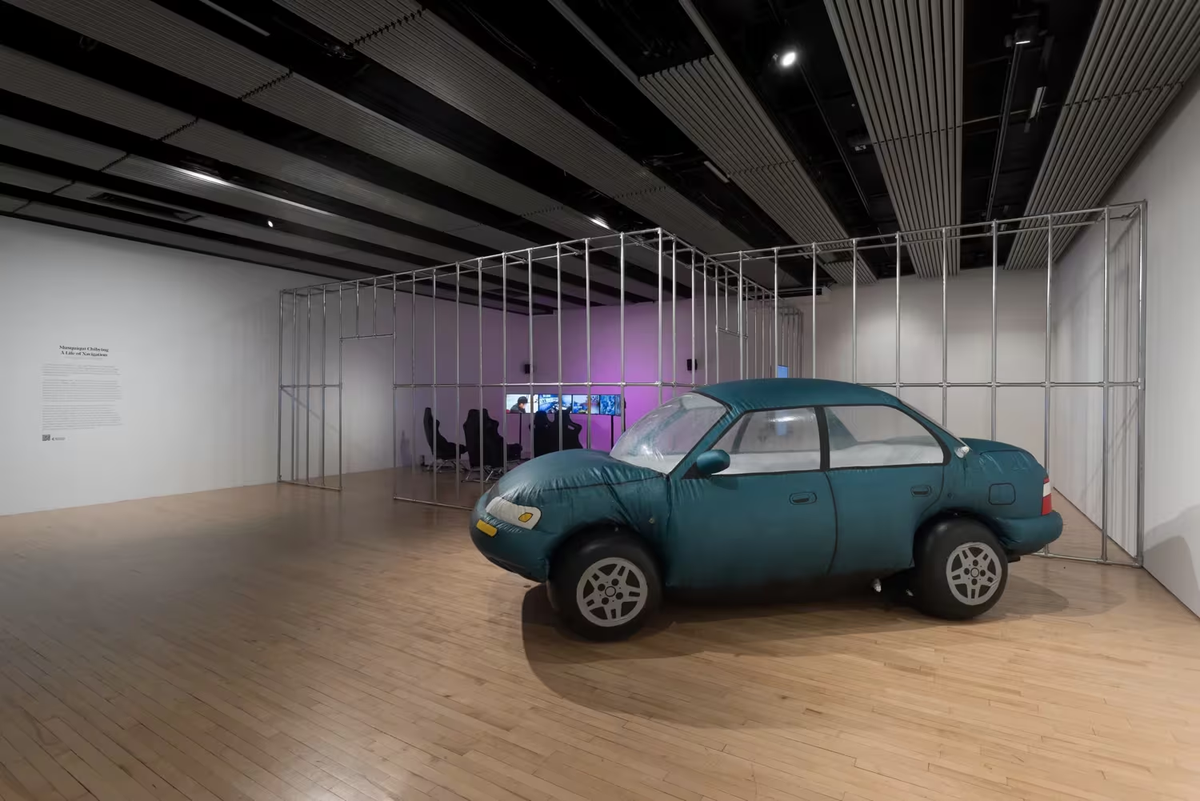
In a similar vein, The Toyota (2015) dwells on the ever-diminishing access to the public space and resources that this grind both demands and, supposedly, provides. A row of six framed photographs captures the artist’s father in the process of packing up the inflatable plastic car that he uses to hold his parking spot. It’s a clever ruse, and one that exposes realities of the squeeze on personal space that’s rife in cities like Taipei—and that’s not to mention a larger generational shift. Chihying reflects on the Toyota Corolla as a symbol of aspirational prosperity that felt abundant in the Taipei of his youth. For any young person who has tried to eke out a life in the city since, to be left with only the inflatable replica parked in the corner of the gallery may feel bitterly relatable.
As social issues go, the concerns of these early works are thoroughly well-trodden, if not a little dated, and watching Chihying’s light-hearted send-ups of them almost feels nostalgic. Oh, what I wouldn’t give to be fretting over taking psychic damage at the supermarket and finding a parking space. Here in 2026, it’s not hard to imagine the artist running in place at a data-collecting self-checkout. His dad would be locked in a self-driving car on its fifth lap of the city, more worried about getting out of the thing than where it was going to park. But that’s exactly the point. What the exhibition chooses to highlight here is the gulf of a decade—the enormity of the shift in tactics for naming and knowing the problems of our moment.
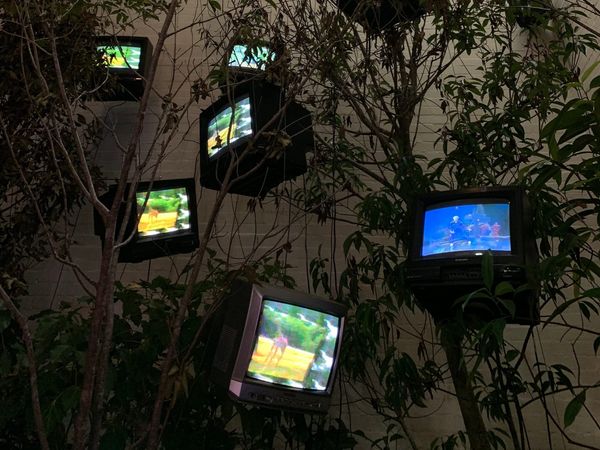
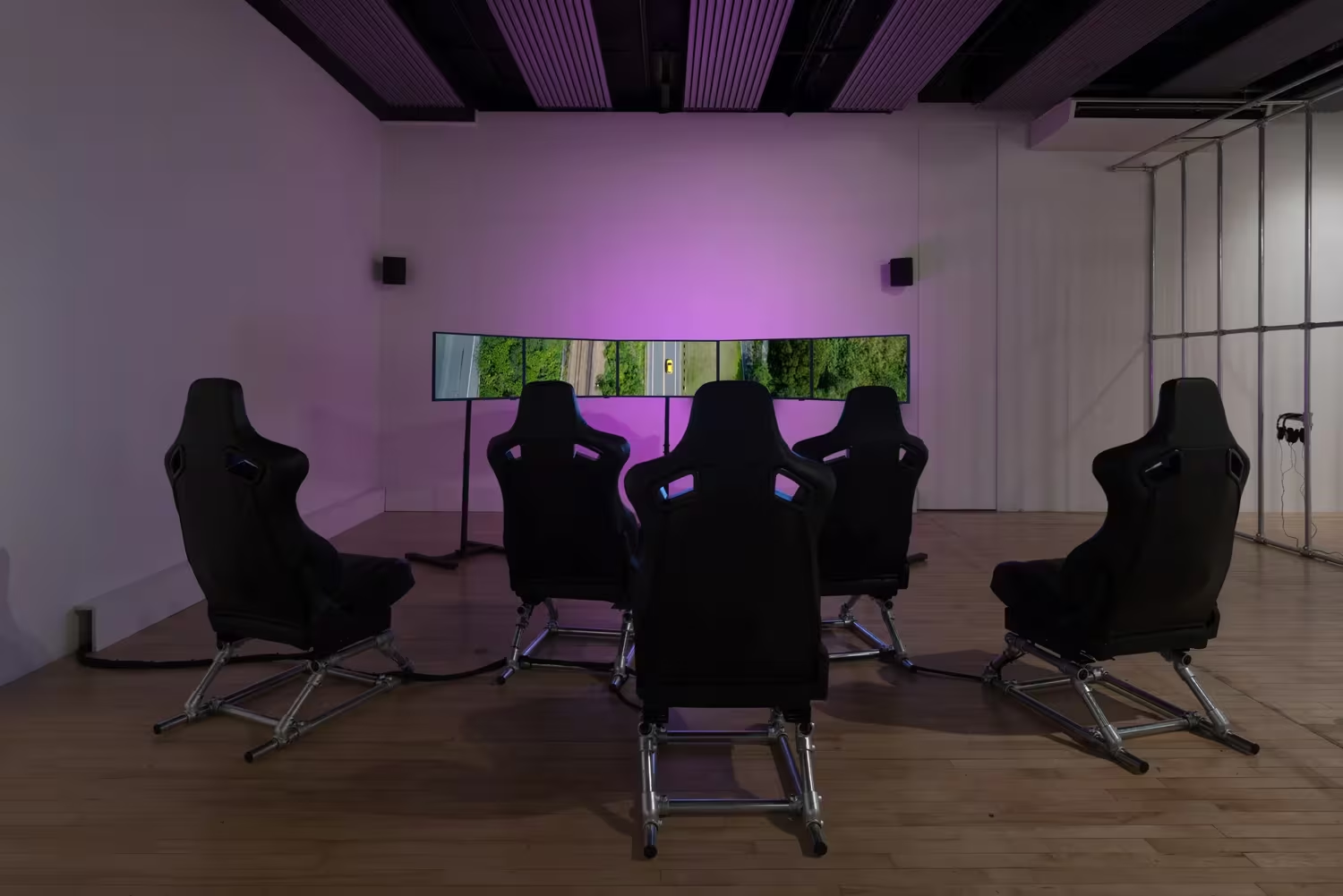
The move between Chihying’s older and newer works feels like a very millennial pivot—from irony to anxiety. The work seems to concur that the time for poking fun is over. We need answers. The more recent works in the show take an inquisitive turn, highlighting another technique that Chihying has cultivated from the early days of his practice: the interview. His film The Annotation (2025– ) returns to cars, but this time they are automated. The sleek leather drivers seats rigged up for the audience to recline into rumble as though perched on engines revving of their own accord. The film expands on the themes of access and alienation by bringing in AI scholars, journalists, and data workers, among others, to unpack pressing questions about the rise and impact of autonomous driving technologies. Who benefits, whose labor is exploited, and whose biases and instincts are allowed to inform these technologies as they develop? The talking heads on screen sound off.
The stances here are much less clear-cut than in Chihying’s earlier social commentary. At one point, a Taipei taxi driver gushes about the possibility of lavender-scented cabs, free from the worry of disgusting or dangerous human drivers, despite seemingly recognizing that this could well put her out of work. Across other conversations, experts credit the contributions of women to the burgeoning tech, while calling out the exploitation of data annotators in Africa.
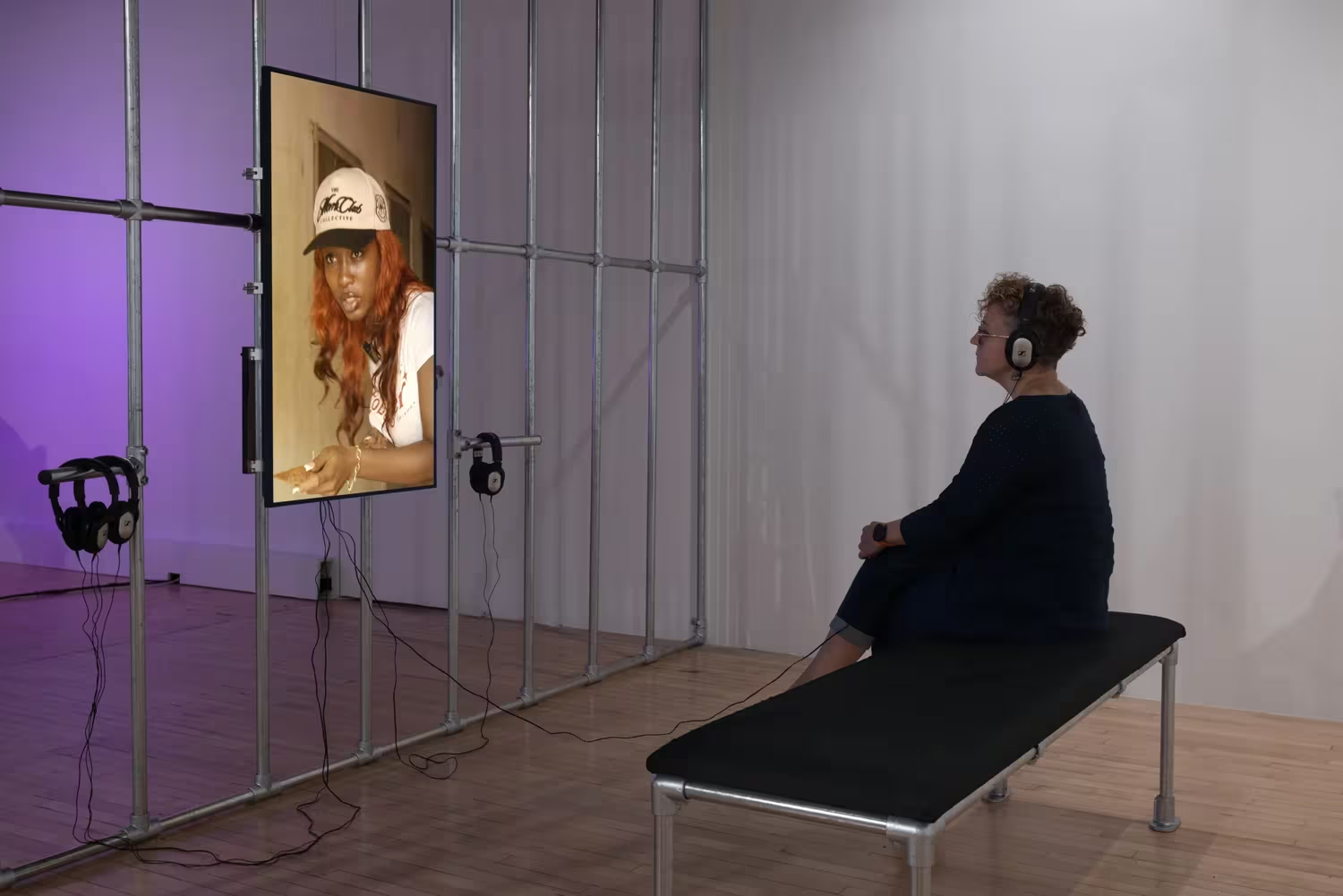
Chihying homes in on this latter issue in another short film, carving out space in the exhibition for one of the major threads of his recent work—the Afro-Asian entanglements produced by emerging fields such as AI. The Gamer (2026) follows a group of young people in Nigeria who make their living battling through games like Call of Duty, hunting for high rank and rare items on behalf of paying clients, mostly in China and Japan. It echoes The Annotation and its revelation of highly-educated, underpaid workers in former British colonies roped into tagging data for the profit of developers headquartered elsewhere. Between delivering answers to Chihying’s camera, his interviewees move through a building wielding sawed-off drainpipes and splintered 2x4s, LARPing the first-person shooters that pay their bills. It’s the same irreverent choreography that Chihying once deployed atop a supermarket conveyor belt to lambast the absurdity and alienation of the contemporary. However, here, the rigor with which these later works delve into the unsung quirks and nuances of these nascent industries allows Chihying to extend the unease to a whole new generation.
Christopher Whitfield is a writer and educator based in Taipei.