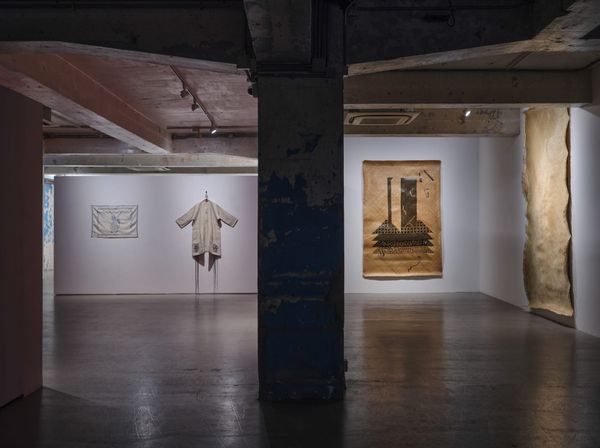
Shows
The Alien in the Archive: Tony Albert at the MCA Australia

Tony Albert
Not a Souvenir
Museum of Contemporary Art Australia
Sydney
May 21–Oct 19, 2026
At Tallawoladah, the Museum of Contemporary Art Australia (MCA) sits between two economies of Australian culture: the institutional archive and the souvenir trade. Located near the foundational site of British colonization and amid the tourist precincts of Circular Quay and The Rocks, it was a particularly charged setting for “Tony Albert: Not a Souvenir,” the Girramay, Yidinji, and Kuku Yalanji artist’s largest exhibition to date. Bringing together more than 150 works, the show examined how Aboriginal culture has been simplified, commodified, and circulated—and how these representations might be reclaimed.
“Clarity,” Wierdi curator Bruce Johnson McLean emphasized, guided the exhibition’s development. Yet clarity is complicated when confronting material at once familiar and insidious. Central to Albert’s practice is Aboriginalia: objects made largely by non-Indigenous people for non-Indigenous audiences, depicting Aboriginal people, art, and culture. More than 2,500 examples from the artist’s personal collection were presented, including matchboxes, ashtrays, tea towels, figurines, plates, and velvet paintings.
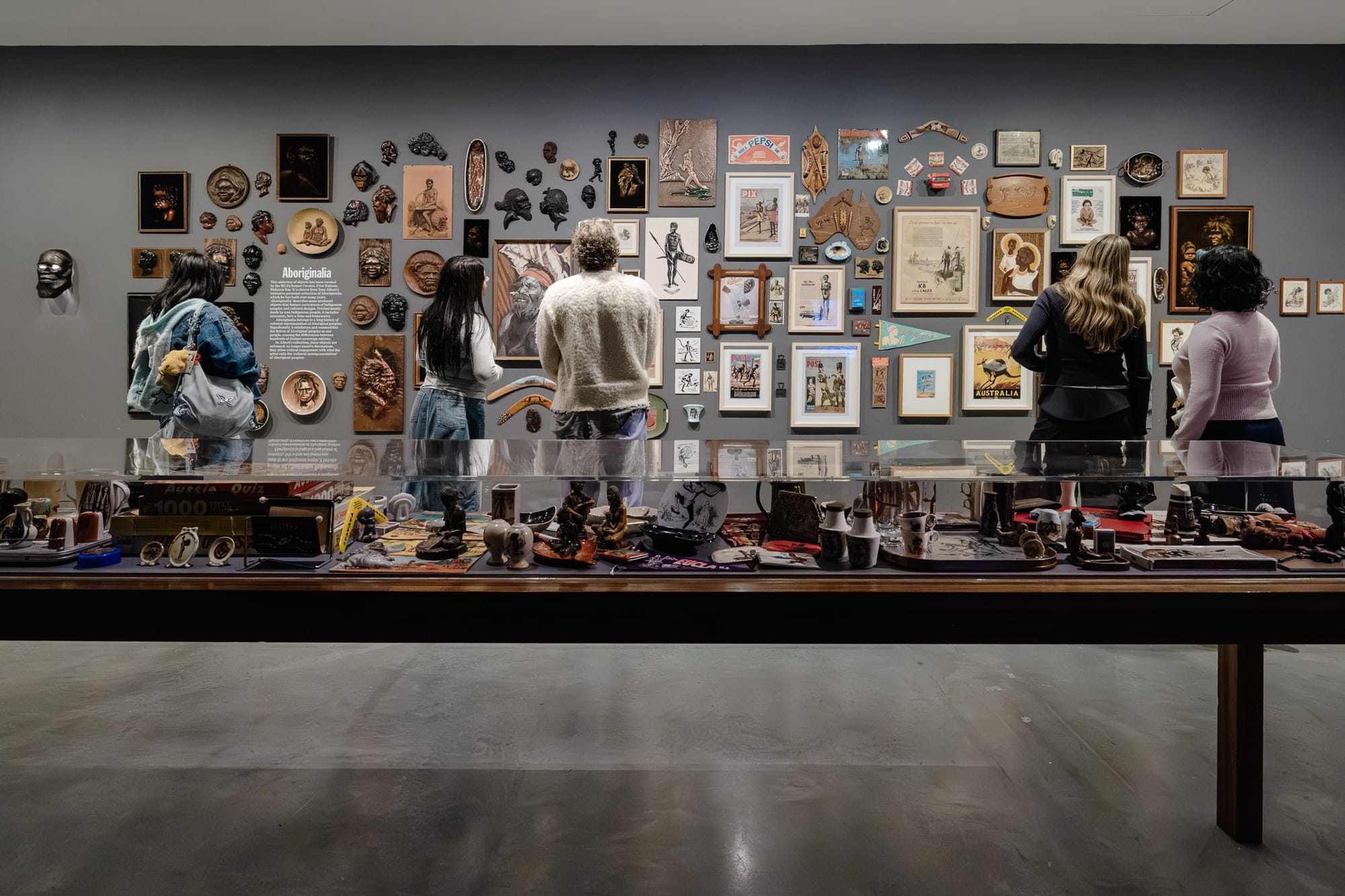
In the opening room, curated by former MCA curator of First Nations art Rebecca Ray, these objects formed an overflowing yet calculated taxonomy. Displayed en masse, their sheer volume revealed the scale at which racist imagery has been reproduced and consumed, demanding sustained attention to material commonly dismissed as kitsch. Albert and Johnson McLean describe this archive as “anecdotal, not academic,” grounded in the artist’s sustained proximity with the objects rather than institutional classification. Its entry into MCA exposed the exclusions underpinning the museum’s categories of cultural value.
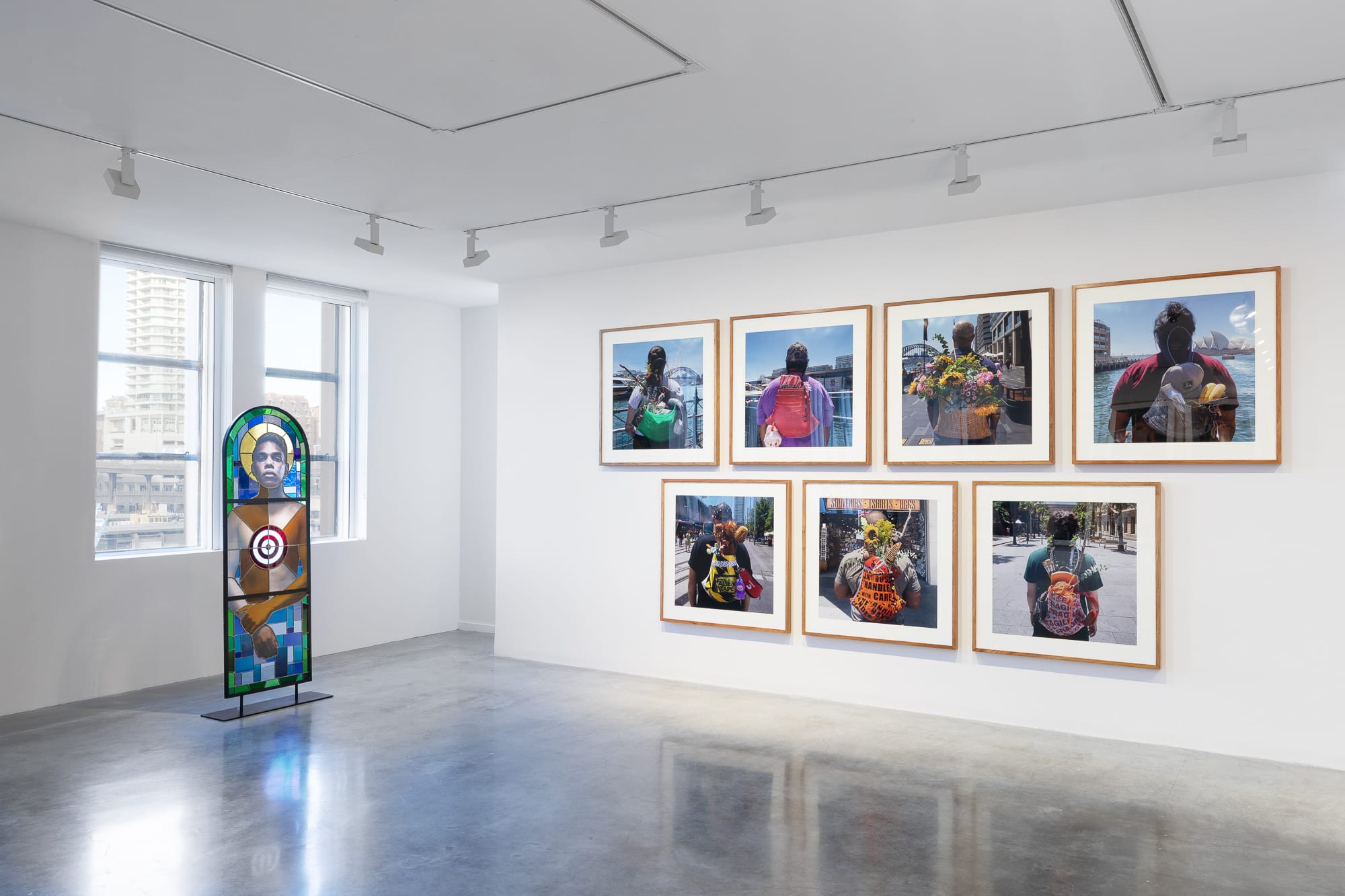
The next room shifted from caricatured Aboriginal bodies to contemporary Indigenous figures. Created with Girramay artist Erica Muriata, Albert’s photographic series Optimism II (2026) depicts Indigenous people around Sydney Harbour carrying jarwun—traditional baskets woven by Muriata—filled with present-day ephemera such as headphones, native plants, water bottles, and koala trinkets. Photographed from behind, the figures look across the water; viewers share their horizon rather than inspect them as anthropological subjects. The work reclaims the shoreline; the Aboriginal body is no longer the keepsake.
This direct visual address also responds to MCA’s institutional setting and foot traffic, where international tourists make up a substantial portion of visitors. The exhibition does not presume familiarity with Albert’s practice or the domestic trade in Aboriginalia. But accessibility does not slip into simplification. As Johnson McLean observes, the commercial mechanisms of racial souvenir trade are hardly unique to Australia; Albert uses local ephemera to expose a broader global colonial logic that any viewer can readily recognize.
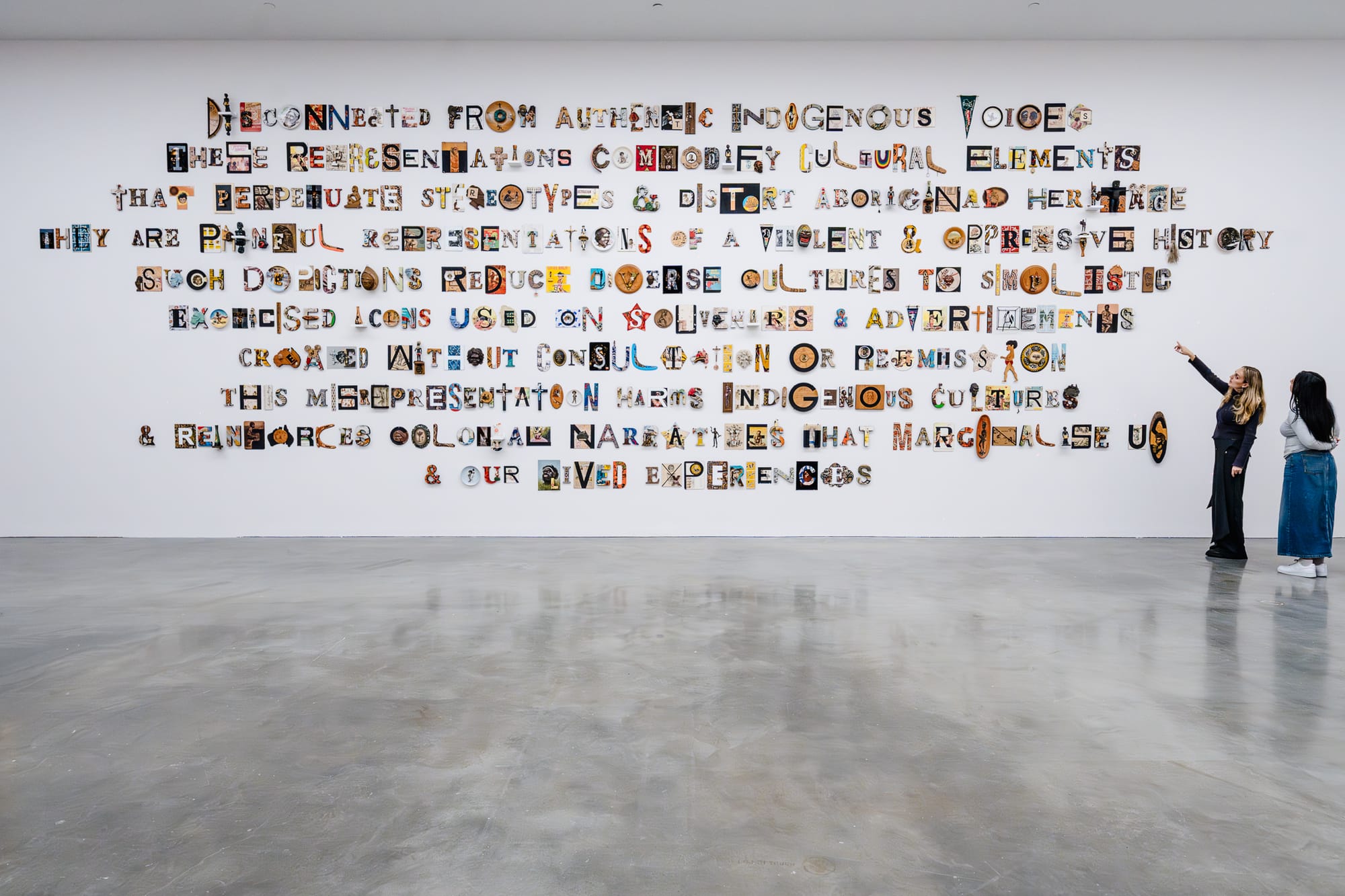
Language remains one of his sharpest critical tools. Disconnected (2025) is a wall-text manifesto composed of 450 letters cast from fragments of broken Aboriginalia. The work names the violence enacted by the very commodities from which it is made. Rather than discarding detritus, Albert splinters and reassembles it into a architectural counter-narrative, transforming the physical material of objectification into an apparatus of Indigenous critique.
This strategy extends to the institutional canon of Australian art. Renowned 20th-century painter Margaret Preston sought to establish a national modernist idiom partly through appropriating Aboriginal iconography, frequently without acknowledging makers or cultural restrictions. Albert’s Conversations with Margaret Preston: Christmas Bells (2021), based on Preston’s 1925 woodcut, is pieced together from vintage fabric squares and commercial tea towels emblazoned with the generic label “Australian Aboriginal Art.” Neither homage nor repudiation, the work forces the formal appeal of Preston’s print to share space with its exploitative legacy. Albert suspends the viewer within this contradiction, allowing beauty and violence, dry wit and critique, to co-exist as unresolved conditions of Australian culture and history.
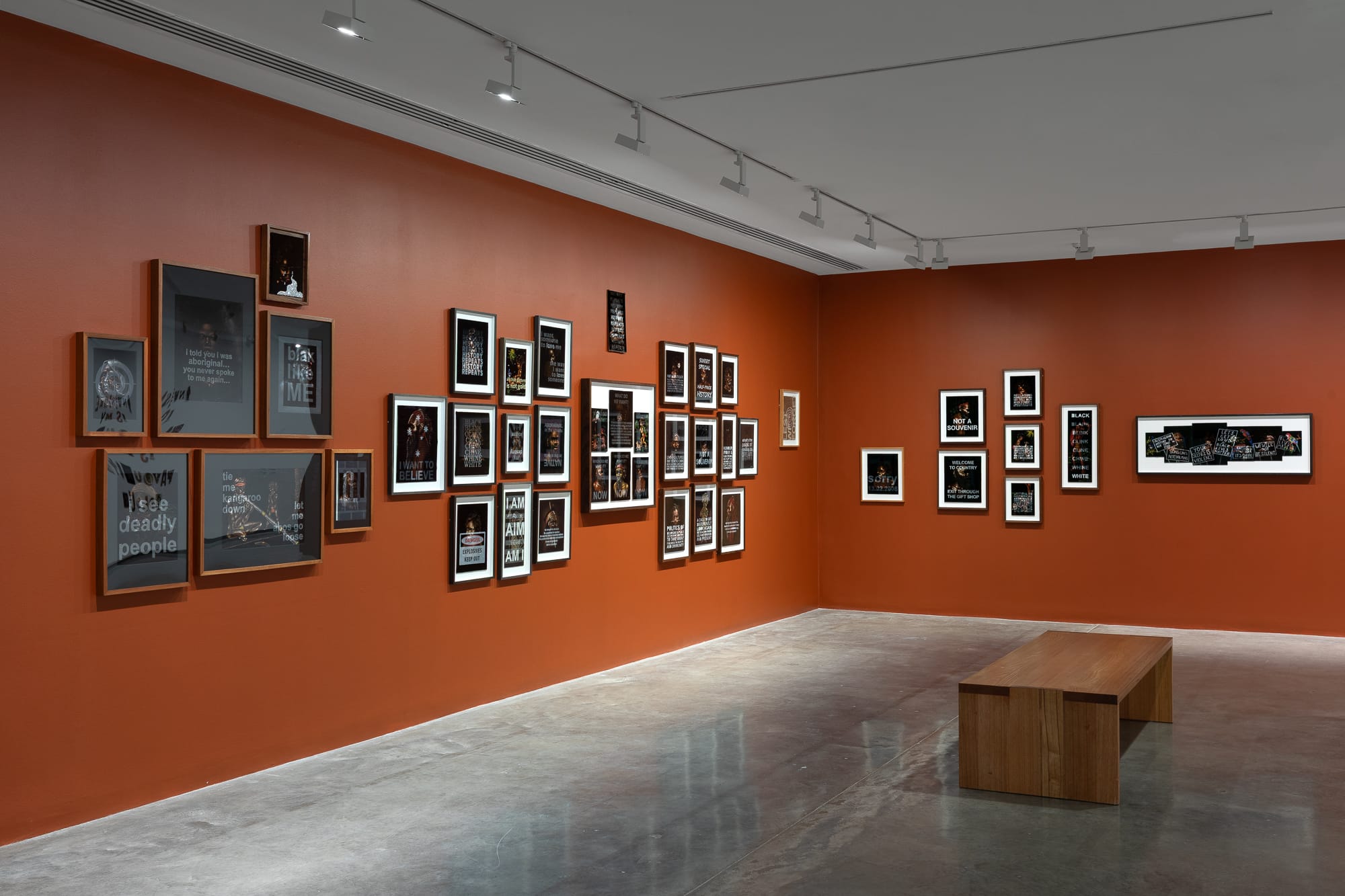
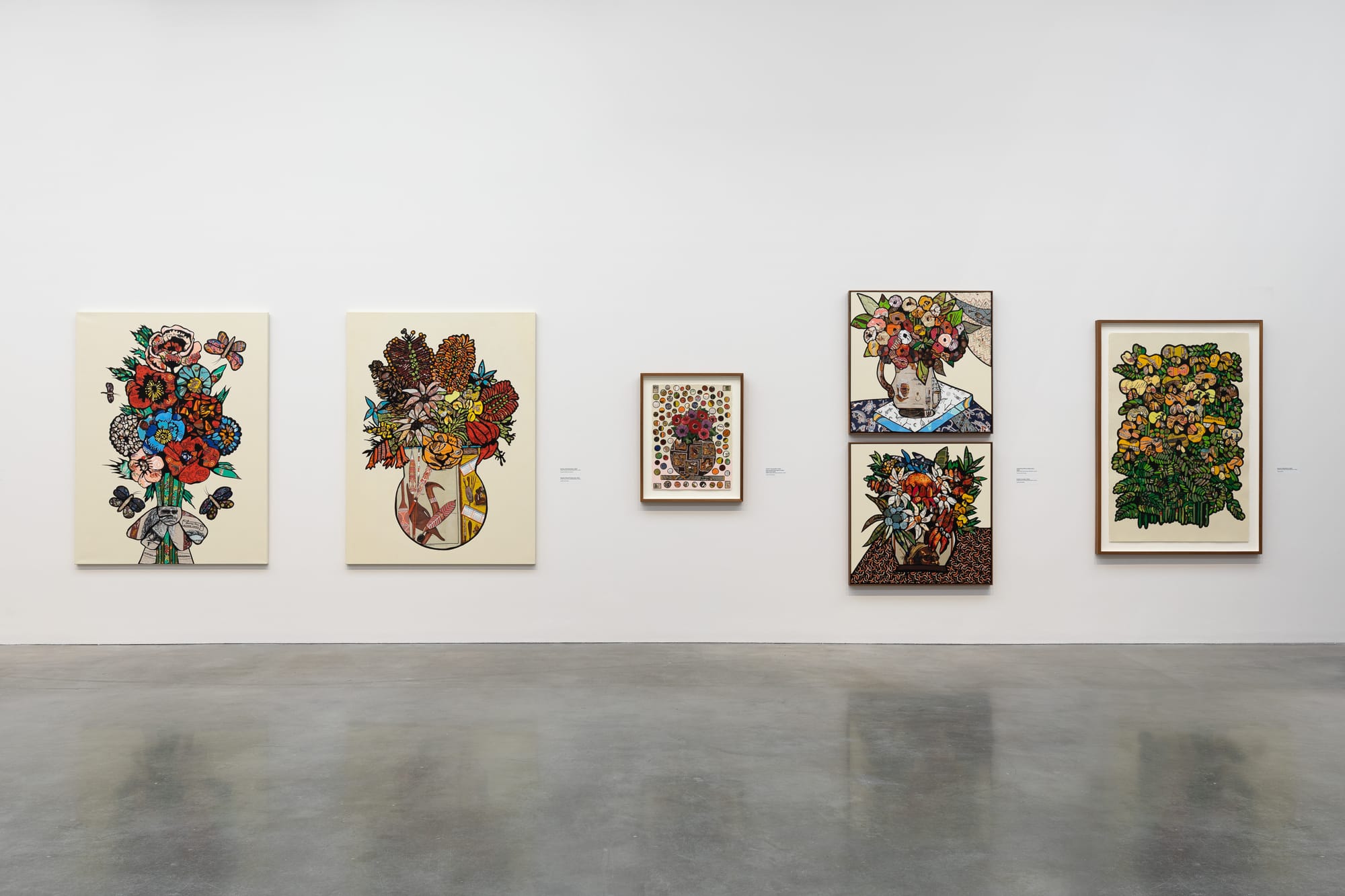
Installation views of TONY ALBERT’s “Not a Souvenir” at the Museum of Contemporary Art Australia (MCA), Sydney, 2026. Photos by Jessica Maurer (left) and Ravyna Jassani (right). Courtesy the artist and MCA.
Conversation operates not only as Albert’s subject but as his primary methodology. The exhibition emerges from a 25-year dialogue with Johnson McLean alongside a longstanding practice of working collaboratively with artists, communities, and institutions. These relationships allow him to challenge the limits of what the museum collects, validates, and exhibits, while remaining within its institutional machinery. As Johnson McLean puts it, “the relationship is the project; the work is the product.”
The exhibition’s public initiative, the Aboriginalia Appeal, expands this relational framework by inviting visitors to donate objects they no longer feel comfortable owning. Albert treats the acquisition of these objects as restorative and even “therapeutic,” as it converts domestic kitsch into material evidence of how mainstream Australia has codified Indigenous people.
Albert neither demands that the museum sanitize Aboriginalia nor asks the archive to purge on cue. Instead, he makes each answer for the other. At Tallawoladah, where colonial history, cultural authority, and tourist commerce remain uneasily entwined, he transforms the souvenir from a stagnant trope to active testimony within a living, contested history.
Michelle Wang is a writer exploring culture, art, film, and pop culture based in Sydney and London.