Shows
Regarding the Pain of Images: Dinh Q. Lê at 10 Chancery Lane
Dinh Q. Lê
Remembrance: A Tribute to the Work of Dinh Q. Lê
10 Chancery Lane
Hong Kong
Mar 20–May 23, 2026
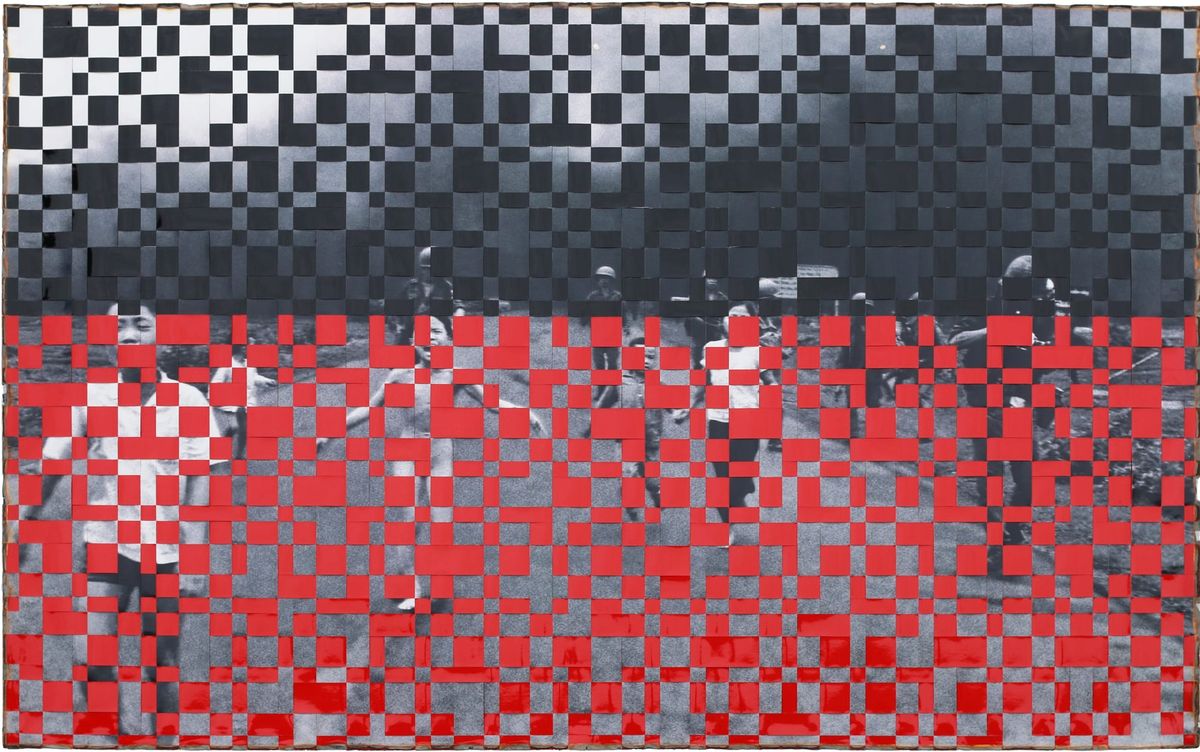
In 2003, Susan Sontag observed in Regarding the Pain of Others that “the more remote or exotic the place, the more likely we are to have full frontal views of the dead and dying.” A decade later, Dinh Q. Lê took one of the century’s most circulated photographs, The Terror of War (1972)—of nine-year-old Phan Thị Kim Phúc, naked and burning, fleeing a napalm strike near Trảng Bàng in Southeast Vietnam—and sliced it into strips, stitching it back together with bands of black, red, and white. The intervention initially appears censorial: in Untitled 1 (2013), black rectangles and squares blot out the top third of the image, swallowing the heads of onlooking soldiers, while a crimson matrix descends across the lower two thirds, its geometry falling with apparent precision over Kim Phúc’s genitals. In Untitled 2 (2013) the weave is denser and the occlusion deeper, but inverted: the girl’s body is almost entirely redacted by a white checkerboard, save for her screaming mouth, bare chest, and exposed groin, while in the left foreground, another fleeing child’s gaping mouth likewise escapes the grid.
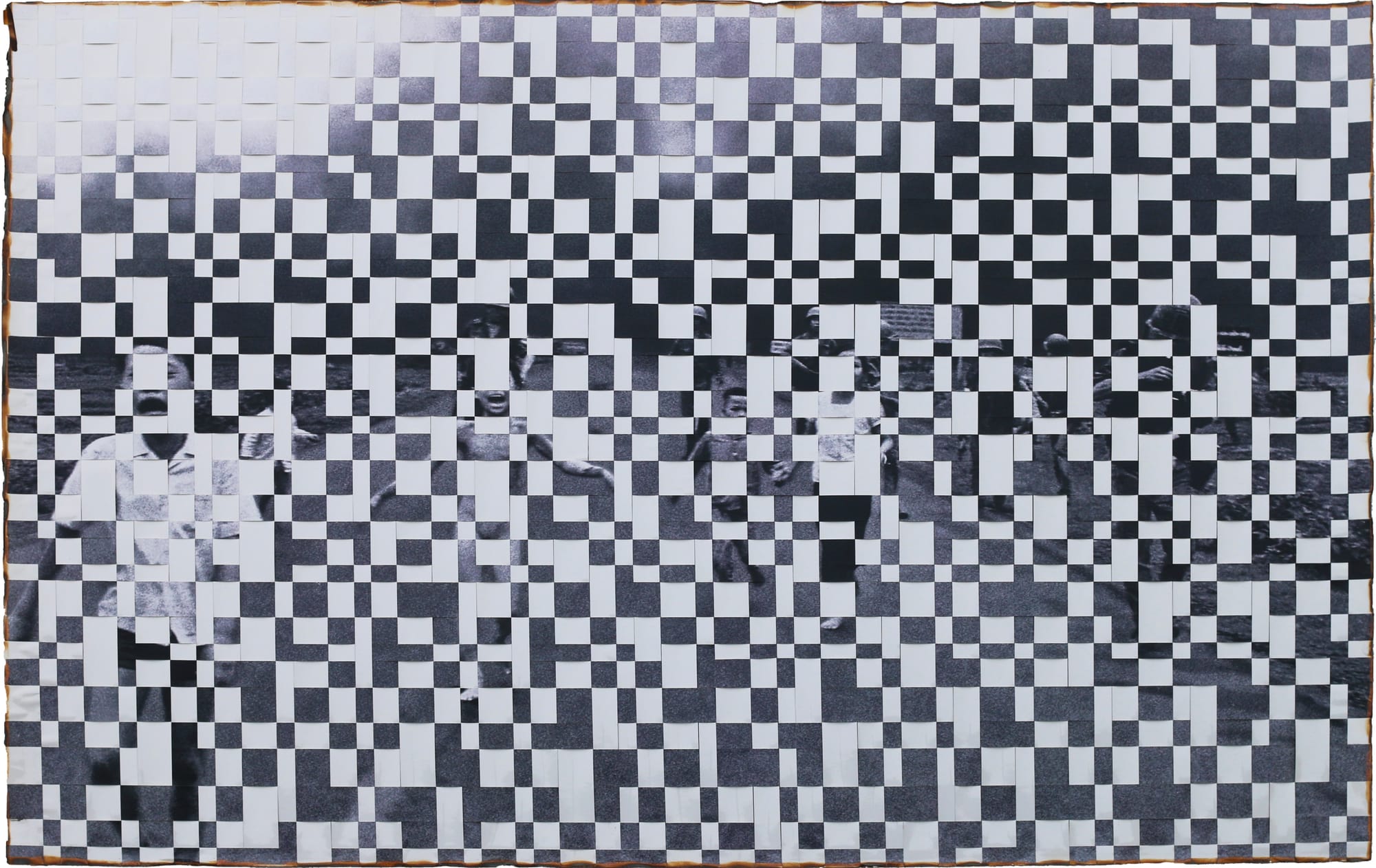
Heavily “pixelated,” the photographs remain recognizable, after perhaps a half-second’s lag. That fraction of delay and the time the eye then spends moving across the tableau—repeatedly blocked, rerouted, frustrated—hold the viewer in limbo between discernment and comprehension. The photograph ceases to be instantly consumable, the atrocity no longer a spectacle that licenses either voyeuristic or averted gaze. Lê’s surgical violence against The Terror of War breaks the image—destroying its spurious completeness, its claim to transparency, and its false legibility—and slows the digestibility of its horror.
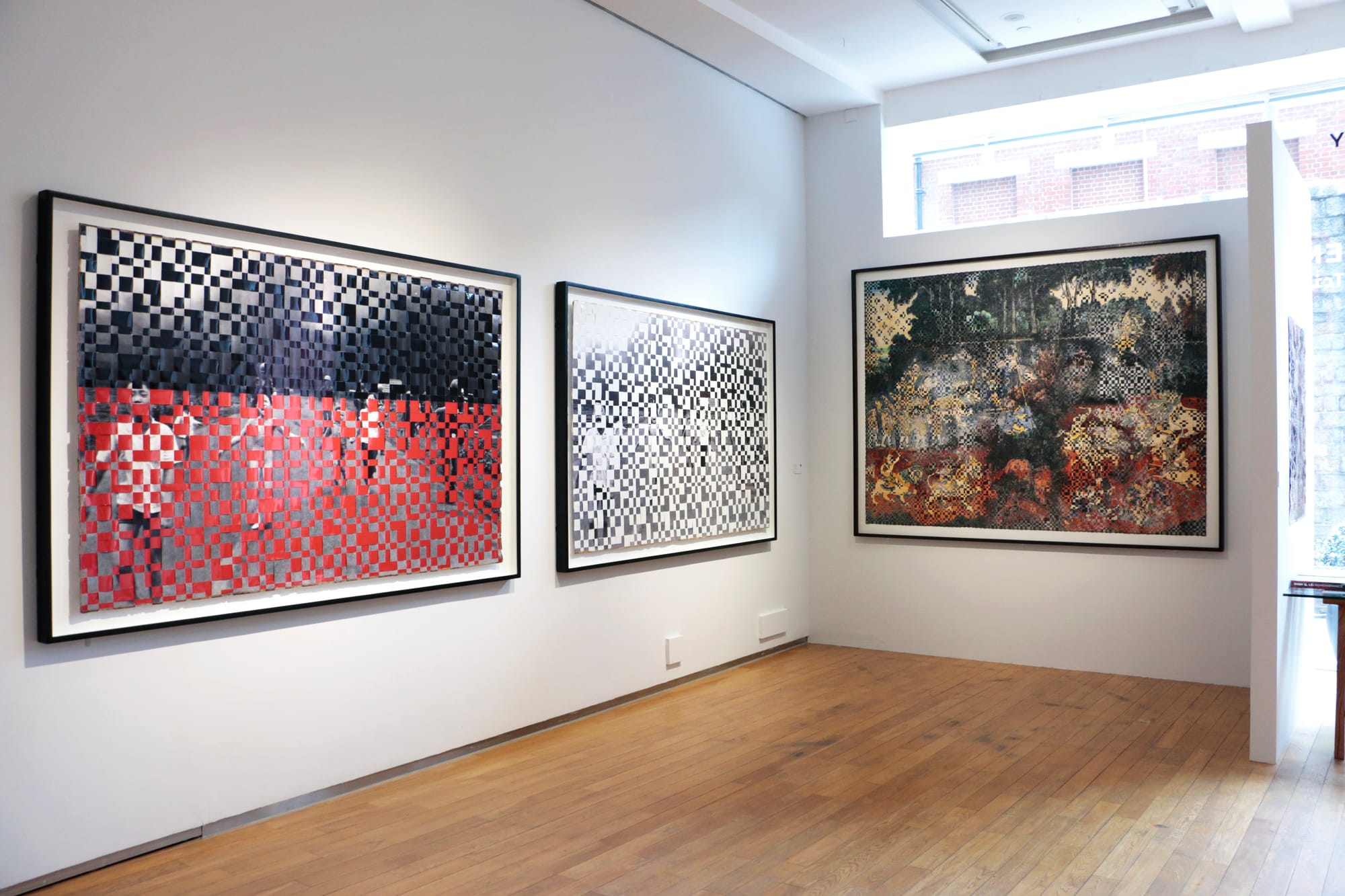
Untitled 1 and Untitled 2, hung side by side on the longest wall of 10 Chancery Lane in Hong Kong, anchor “Remembrance: A Tribute to the Work of Dinh Q. Lê,” a posthumous survey curated by David Elliott—writer, curator, and close friend of the artist—at the gallery that has represented Lê since 2004. The exhibition is compact and tightly edited, and deeply felt: a clear-eyed memorial to an artist whose practice, rooted in trauma and its photographic residue, asked us to look closer, deeper, and less complacently. Once made, a photograph endures, but it cannot move, speak, or utter its protagonists’ names. What does the image owe its subject? What do we, in turn, owe the image that carries another’s pain?
Installation view of “Remembrance: A Tribute to the Work of Dinh Q. Lê” at 10 Chancery Lane, Hong Kong, 2026. Courtesy 10 Chancery Lane.
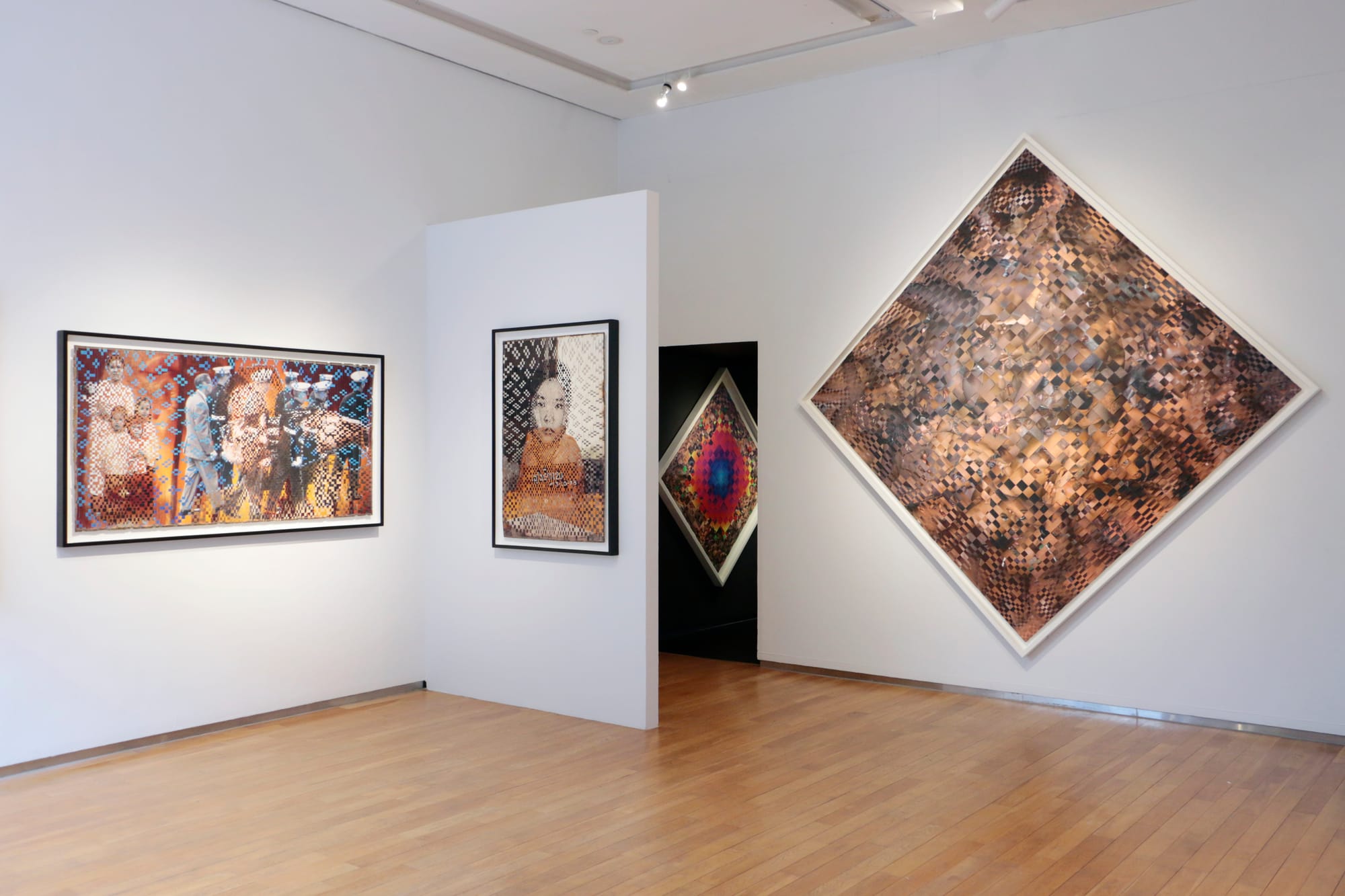
Elliott’s hang makes an unflinching turn from the scorched skin of a child to the airbrushed skin of pornography. On the wall perpendicular, Skin on Skin Black Mixed No. 9 (2018)—a towering, diamond-shaped tapestry of nudes—is woven from fragments of Western pornography that flooded Vietnam after the internet was legalized in 1997. Producing, owning, or showing adult films remained illegal, yet Vietnamese users could freely access a wholly foreign erotic economy even as sites like BBC were intermittently blocked. As Elliott observes wryly, “naked bodies were deemed less destabilizing than political commentary. Better, perhaps, to have citizens preoccupied with skin than with dissent.” The tessellated surface of exclusively black figures—cropped limbs, partial torsos, agape mouths—continually splinters, blocking the smooth circuitry of consumption and the promise of frictionless gratification. In this overplotted, illicit plenitude, skin muffles skin, gesture stifles gesture, much as Vietnam’s tacit tolerance of pornography served not as liberation, but the quieting of resistance.
The Skin on Skin works, which use matte paper, carry an almost painterly regality, resplendent with sensuous color gradations and alluring chiaroscuro. The reference is not incidental: Lê, who had arrived in Los Angeles as a refugee in 1979, spent his high school years absorbed in monographs of the Italian and Flemish Renaissance masters. In 1989, while a first-year undergraduate at UC Santa Barbara, he produced his first photo-weavings, splicing self-portraits with reproductions of Renaissance paintings: a poetic, pointed interrogation of the Western canon and his fractured sense of self. One such early work on view—Self Portrait #5 (Portraying a White God Series) (1989), on loan from Katie de Tilly’s personal collection—is an evocative double portrait: his own likeness interlaced with a Western Crucifixion. Quietly insistent, the elegiac superimposition enacts a riveting negotiation between inherited tradition and displaced selfhood.
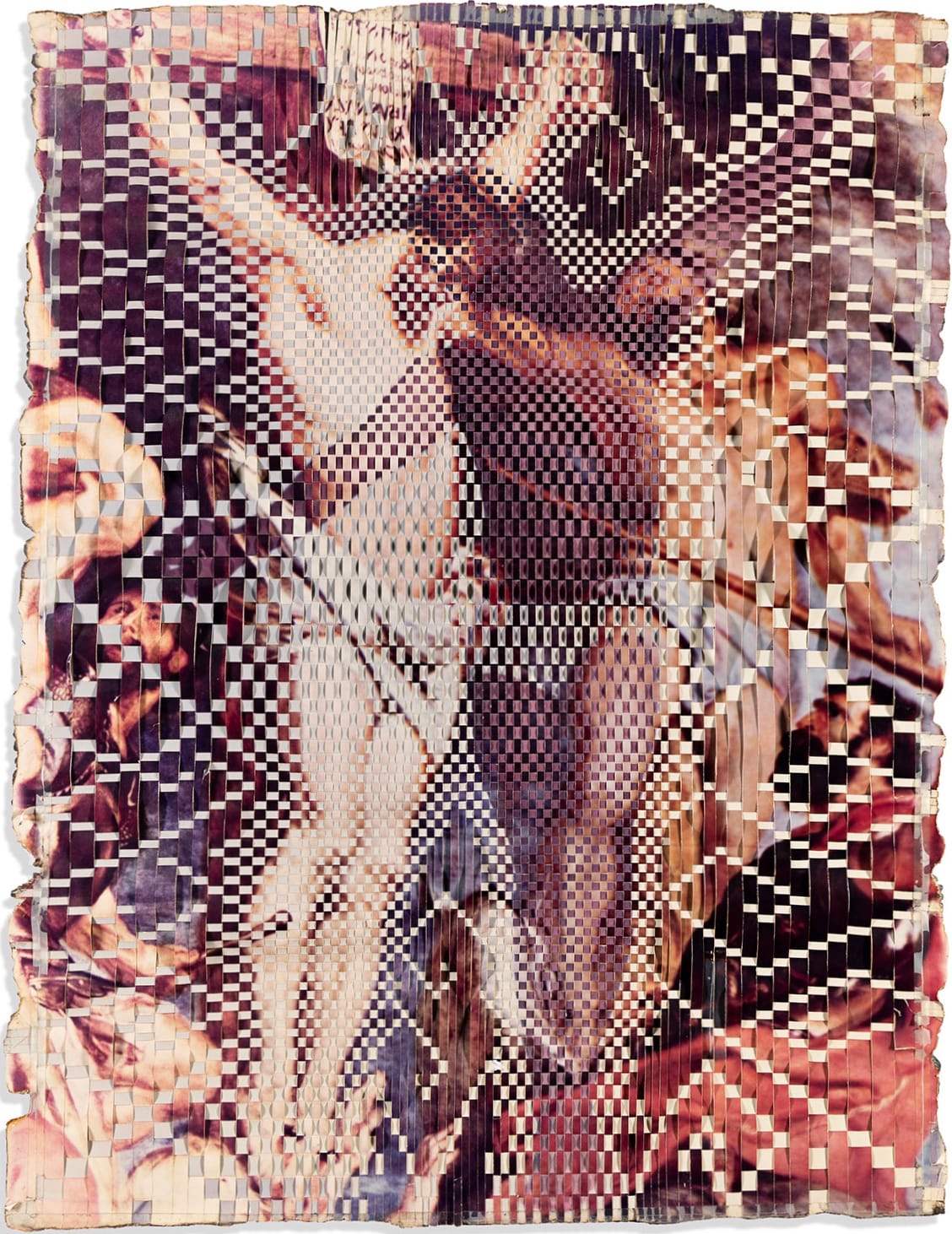
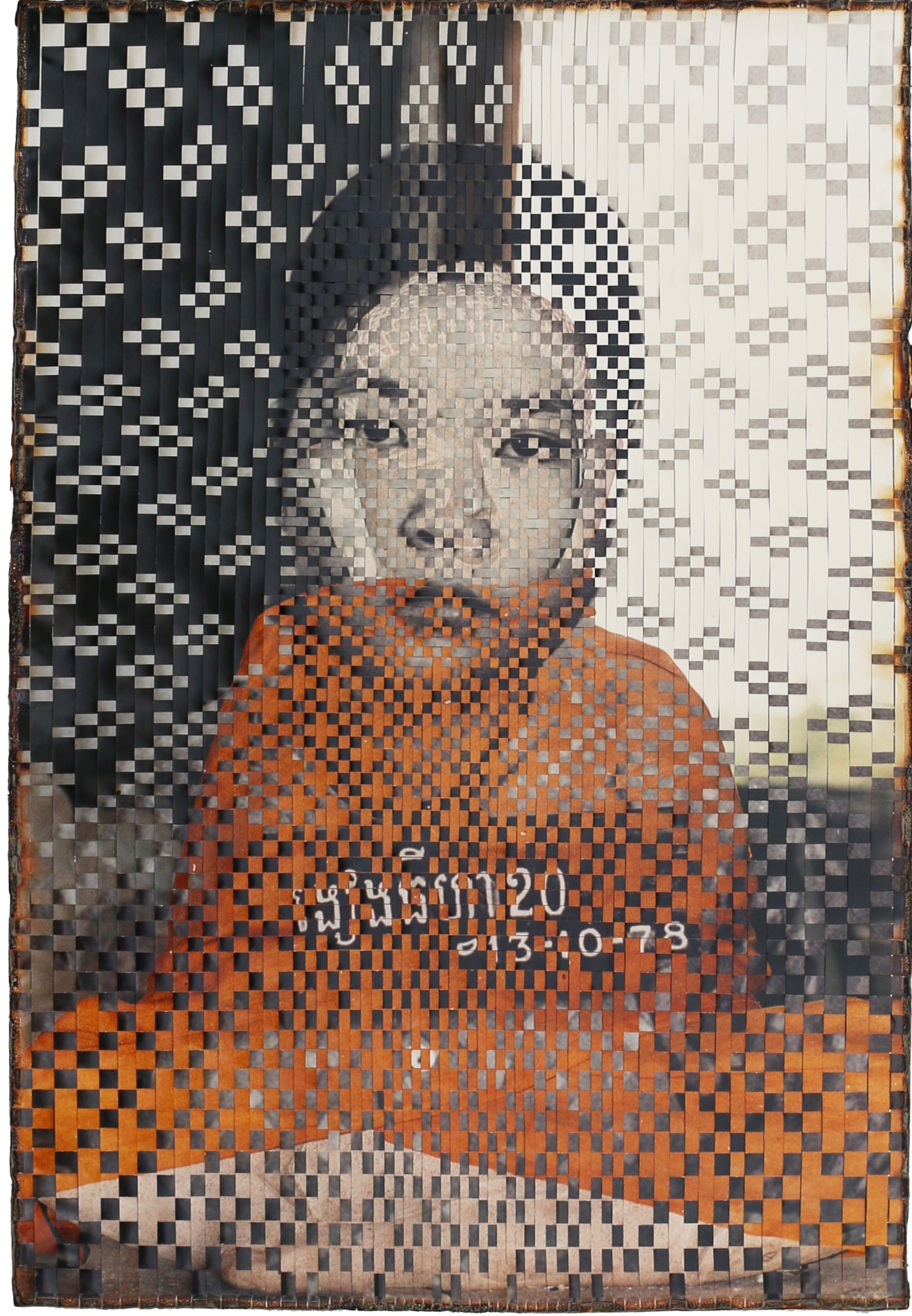
DINH Q. LÊ, Self Portrait #5 (Portraying a White God Series), 1989, cut and woven chromogenic prints, mounted to cotton canvas, 99 x 74.9 cm (left); and Portrait (from Cambodia Series), 1998, C-prints and linen tape, 112 x 76.5 cm, unframed (right). Courtesy 10 Chancery Lane, Hong Kong.
Perhaps the most haunting image in the exhibition is Portrait (from Cambodia Series) (1998), in which Lê superimposes, this time, portrait onto monument. Drawn from Cambodia: Splendor and Darkness—the series he began after his return to Southeast Asia in 1994 and his visit to the Tuol Sleng Genocide Museum in Phnom Penh—the work entwines the face of a young Cambodian woman, one of thousands photographed before torture and execution by the Khmer Rouge, with the meditative countenance of a stone Buddha at Angkor Wat. The Buddha’s nose surfaces faintly above the bridge of her own; higher up, her unseeing eyes are at once vacant and piercing. The viewer’s gaze falls back on the weave, whose narrow strips, close in breadth to the chiếu cói (grass sleeping mats) Lê learned to make from his aunt, draw attention to the small interstices where one band crosses another and a sliver of image disappears. The eye lingers on the cuts, the crossings, the gashes. This is what the work brings to light: the photograph as wound, rather than evidence.
What does it mean to look today, in a world of livestreamed atrocity, and then look away? What does it mean to truly face a photograph of the dead, the wronged, the unburied? Lê maimed the image neither to refuse it nor to redeem it, but to hold it open. It is through the wound that the photograph speaks, and the pause before recognition restores depth where lives had been flattened into statistics. A weave is always open; the wounds here do not close. Splayed, spliced, and sutured back together, the children of Trảng Bàng and the victims of Tuol Sleng do not testify so much as wait with us. This is what Lê leaves behind: a way of staying with the image long enough for its pain to endure.
Michele Chan is managing editor at ArtAsiaPacific.