Shows
Queer Horizon: “Spectrosynthesis Seoul” at Art Sonje Center
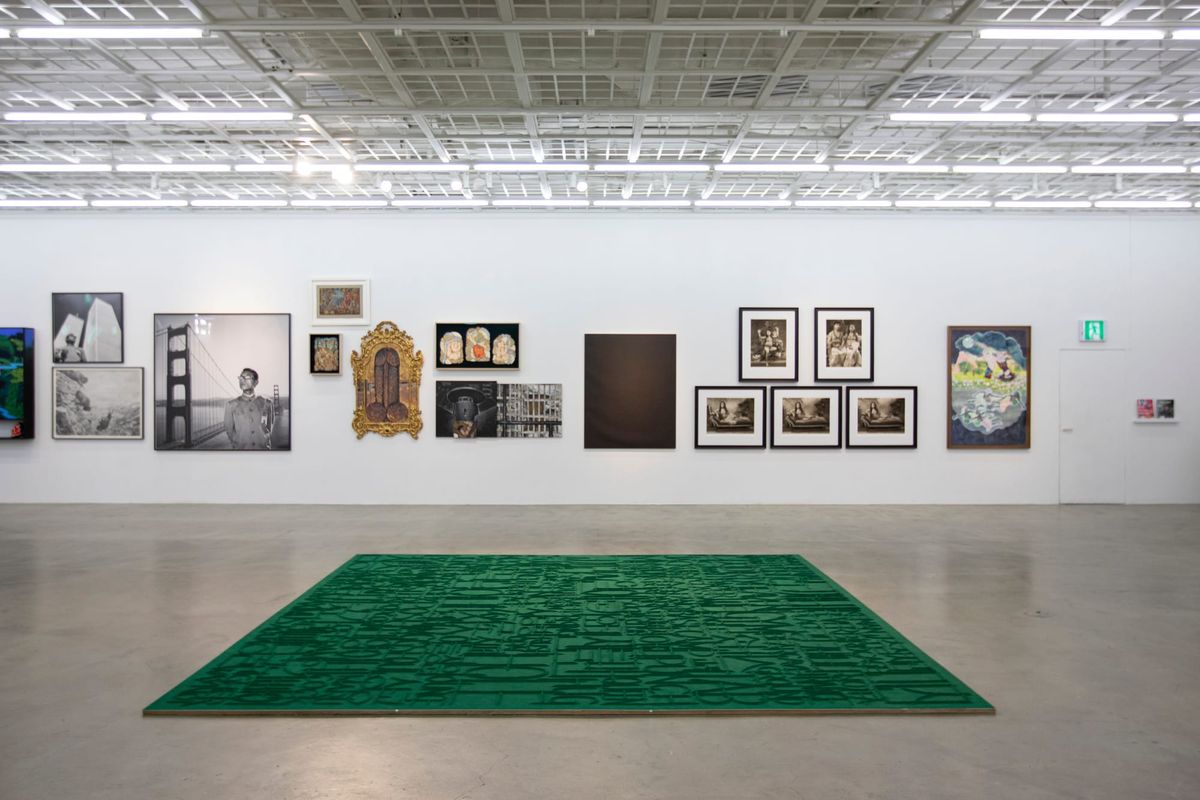
In his landmark study Cruising Utopia (2009), queer theorist José Esteban Muñoz proposed that queerness is not a state but a horizon of potentiality, a hope that “allows us to see and feel beyond the quagmire of the present.” Queerness, he argued, belongs to the realm of the “not yet here,” an ephemeral condition that survives the normative present while insisting on the existence of another world. And queerness is most alive in forms of aesthetic production—in the performance, the photograph, the gesture, the artwork—that hold open what hegemonic culture conspires to foreclose. The fourth edition of “Spectrosynthesis,” Sunpride Foundation’s exhibition series dedicated to LGBTQ+ art and practices in Asia, opens at Art Sonje Center in Seoul with this question of the horizon.
For Western audiences, who might associate queer exhibition-making with the hard-won social and cultural gains of the 1980s and ’90s, it might be tempting to read such an ambitious show as a normalized institutional gesture. But exhibitions have always carried different stakes in different political and geographical contexts. In 1989, as the US government’s catastrophic inaction on HIV/AIDS led to thousands of deaths, Group Material—a collective comprising Jenny Holzer, Julie Ault, Félix González-Torres, and Barbara Kruger, among others—presented “AIDS Timeline” at the Berkeley Art Museum and Pacific Film Archive in California, featuring works by David Wojnarowicz, Martin Wong, and Kiki Smith with documents drawn from mass media to indict governmental neglect through the force of the visual archive. What, then, does it mean to mount an exhibition of LGBTQ+ art at this scale in Seoul, a city shaped by compressed modernity, military dictatorship, violent democratization, and a digital revolution? South Korea’s recent political turbulence, from the 2024 declaration of martial law to the subsequent democratic convulsion that led to presidential impeachment, serve less as a backdrop than active context. “Spectrosynthesis Seoul” takes this condition seriously, and it assembles enough voices, forms, and histories to make the discussion urgently felt.
The exhibition unfolds in two parts: “The Two-Sided Seashell,” curated by Sunjung Kim, and “Tender: Invisibly Visible, Unlocatably Everywhere,” curated by Youngwoo Lee. Kim’s section feels closer to an international anthology, gathering historical and contemporary works in a dialogue structured by formal and thematic resonance across geographies, while Lee’s section constructs a unique topography of Korean queer experience.
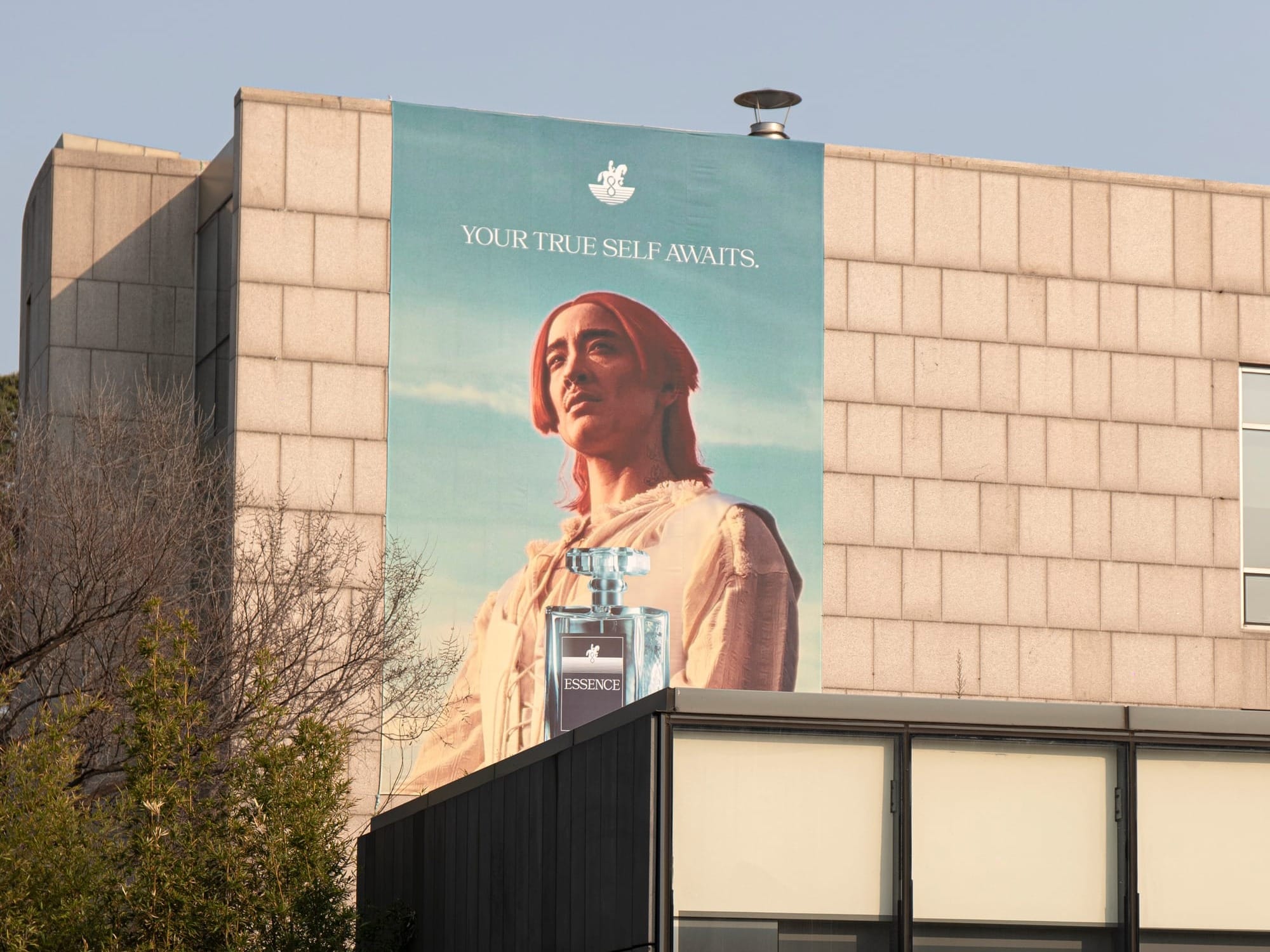
Before entering Art Sonje Center, visitors encounter a large billboard on the museum’s façade, carrying Sin Wai Kin’s ESSENCE (2024– ) project slogan “Your true self awaits” in luxury brand typography. At the blocked main entrance, a giant LED screen plays what appears to be a men’s cologne advertisement in which the artist’s hypermasculine persona, Wai Kin, rides a horse through a cinematic landscape. Sin Wai Kin’s dramaturgical performance of virility inverts the logic of advertising, so that the hollow promise at its center—that identity can be purchased—immediately becomes a farce.
In the basement, the tonal register shifts from satire to something more reverential. Young-Jun Tak’s Their Fear in Our Opening (2026) hangs from the ceiling: two wood sculptures of pollacks bearing, respectively, the carved head of the 17th-century general Im Gyeong-eop (who was venerated by fishermen and is also an ancestor from the artist’s maternal line) and the artist’s own head. Thick, sturdy ropes made of white silk thread coil around each of their necks. The sculptures were carved at an Italian studio with a 150-year history of supplying sacred statues to the Vatican, while the silk was produced by an artisan in North Gyeongsang Province continuing five generations of weaving tradition. The convergence of these labor histories on figures that are simultaneously divine, ancestral, and self-referential, begets a relational structure. In pairing his own likeness with that of his forebear, Tak proposes a genealogy organized not by biological continuity but by mythological identification.
Facing Tak’s sculptures is Derek Jarman’s Landscape (1991). Painted during the years that the artist spent tending to his garden at Prospect Cottage in Dungeness, the work belongs to the more luminous, chromatically saturated paintings of Jarman’s later period, which marked a formal departure from the dark, grief-laden canvases that immediately followed his HIV diagnosis. Jarman’s Prospect Cottage was never pastoral; it was cultivated in the shadow of nuclear power stations. It evokes, however quietly, what Édouard Glissant theorized as the “creolized garden”: a space where disparate elements establish unexpected kinship through proximity and the shared fact of survival. If “Spectrosynthesis Seoul” overall constitutes such a garden, then Jarman’s tableau here serves as something like its structural metaphor.
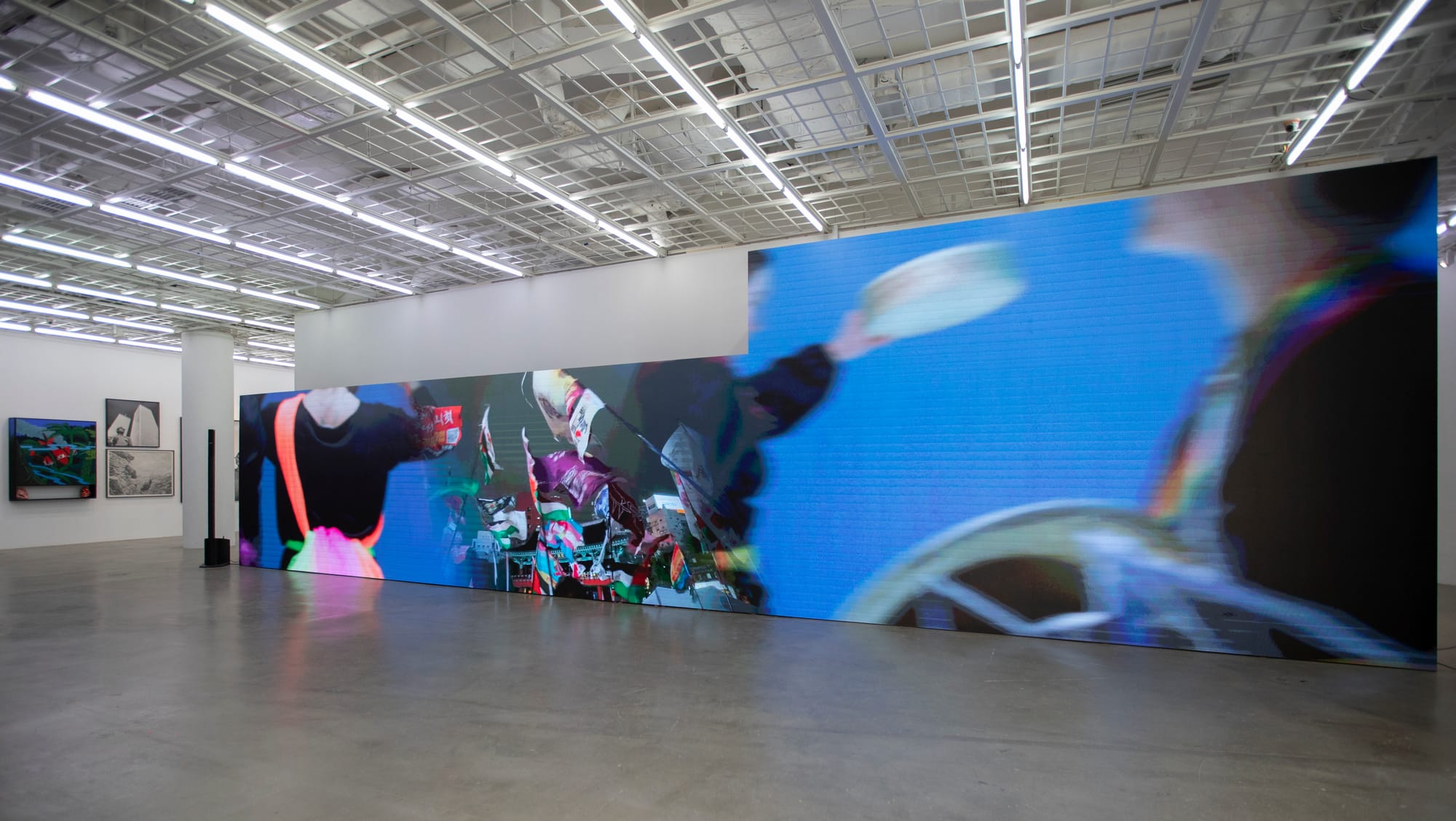
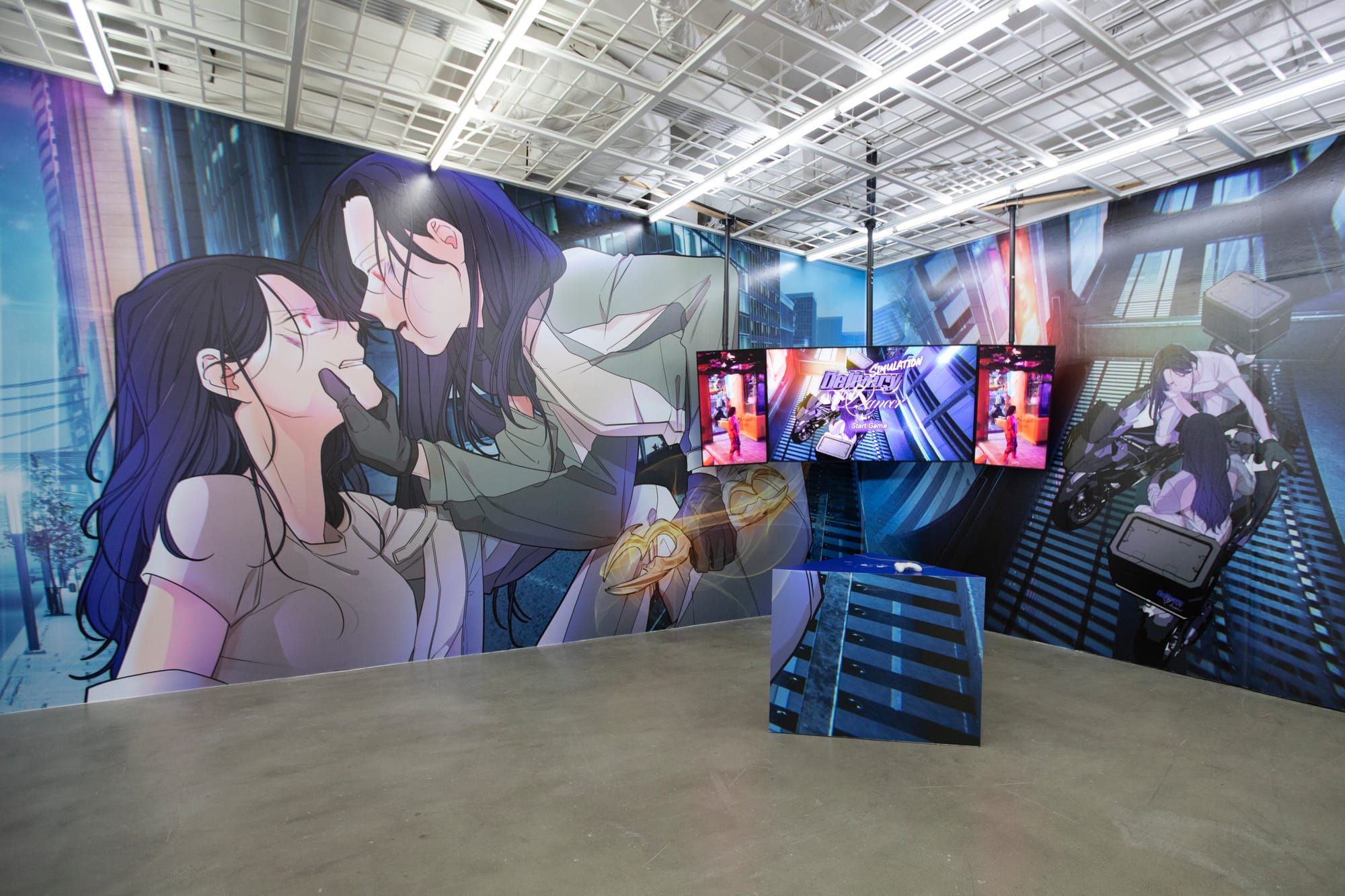
On the second floor, siren eun young jung’s Sick Seoul (2026) spans an entire wall. The monumental four-channel video traces the queer community’s presence in the plazas and streets of Seoul during the political upheaval that followed the 2024 martial law declaration. Refusing a clear-cut, successive visual narration, the scenes gradually bleed into one another: footage of protestors waving flags and light sticks, or chanting and drumming. Through the accumulated gestures of bodies occupying shared space, jung captures the process by which individuals are woven into a collective political subject. While jung’s work is rooted in the urgency of the present, Ayoung Kim’s manga-style wallpaper installation Evening Peak Time Is Back and her adjacent interactive game-based installation Delivery Dancer Simulation (both 2022) imagine a Seoul that is speculative, future-tinted, and slightly uncanny.
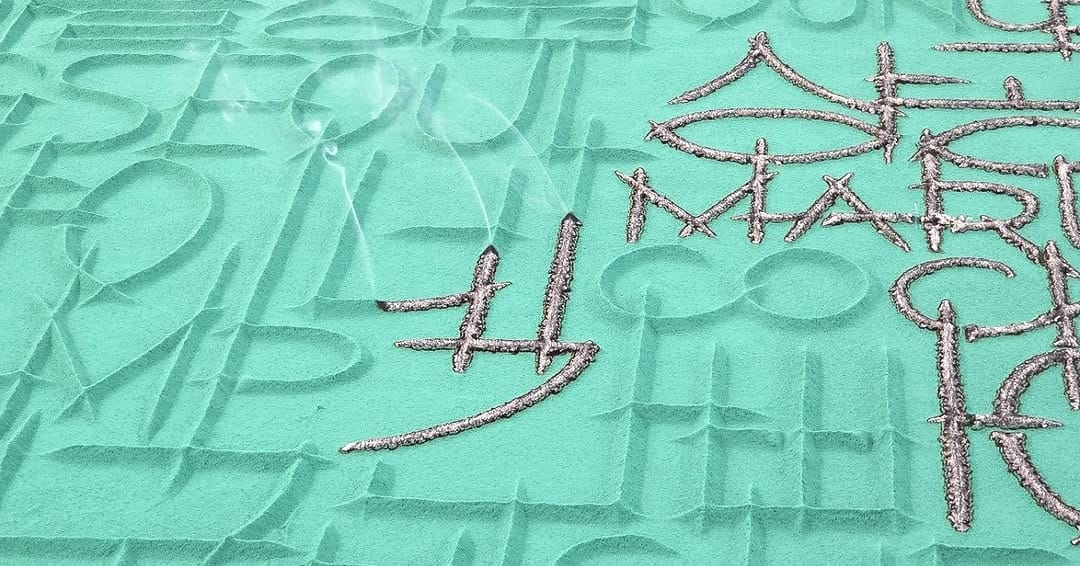
The second floor is permeated by a fragrance, or rather, by the slow combustion of one. In Where He Meets Him (2001– ), Inhwan Oh wrote out the names of various gay bars and clubs in Seoul on the gallery floor using powdered incense, forming a green mat-like field of characters. Once kindled, the work burns through the duration of the exhibition, transmuting text into smoke and scent, and by extension, into memory. The language of a community that has operated at the margins of social legibility is materialized and simultaneously extinguished, present in its own disappearance. Nearby, on a pedestal, Sin Wai Kin’s ESSENCE project resurfaces here as the cologne bottle that appeared in the advertising campaign at the museum’s entrance. Rather than containing a detectable fragrance, however, the vial is only filled with perfumers’ alcohol. While Oh’s work constructs presence from a material undergoing destruction, Sin Wai Kin offers a vessel of emptiness. Together they signify how identity, recollection, and desire circulate through objects.
This preoccupation with identity-as-circulation is also shown in Danh Võ’s and Tseng Kwong Chi’s works. Võ’s Born out of a uterus I had nothing to do with (2026) features a Rimowa aluminum suitcase containing a small 15th-century Flemish painting of a nursing Madonna, partially obscured by a replica of the 19th-century 13-star American flag. The dense constellation of objects investigates Catholic devotion, colonial transmission, American nationalism, and the accident of birth through a specific historical formation. Võ’s suitcase has long served as a sculptural structure for thinking about what we carry across borders and what enters the self through history, family, and empire. Identity, in this framing, is a process of circulation that moves, accretes, and transforms. Two photographs from Tseng Kwong Chi’s East Meets West series (1979–89), in which the artist, dressed in a Mao suit, dark glasses, and an ID badge reading “visitor,” poses with a blank face in front of the Golden Gate Bridge and the World Trade Center, respectively. The format of the tourist snapshot is adopted intact and then destabilized by the figure’s total expressionlessness and the slight surreality generated by the juxtaposition of national monument and rigid performance. Tseng does not argue against the stereotype of the Chinese tourist as absorbed within American popular culture—instead, he performs it so completely, without visible irony, that the performance itself becomes the critique.
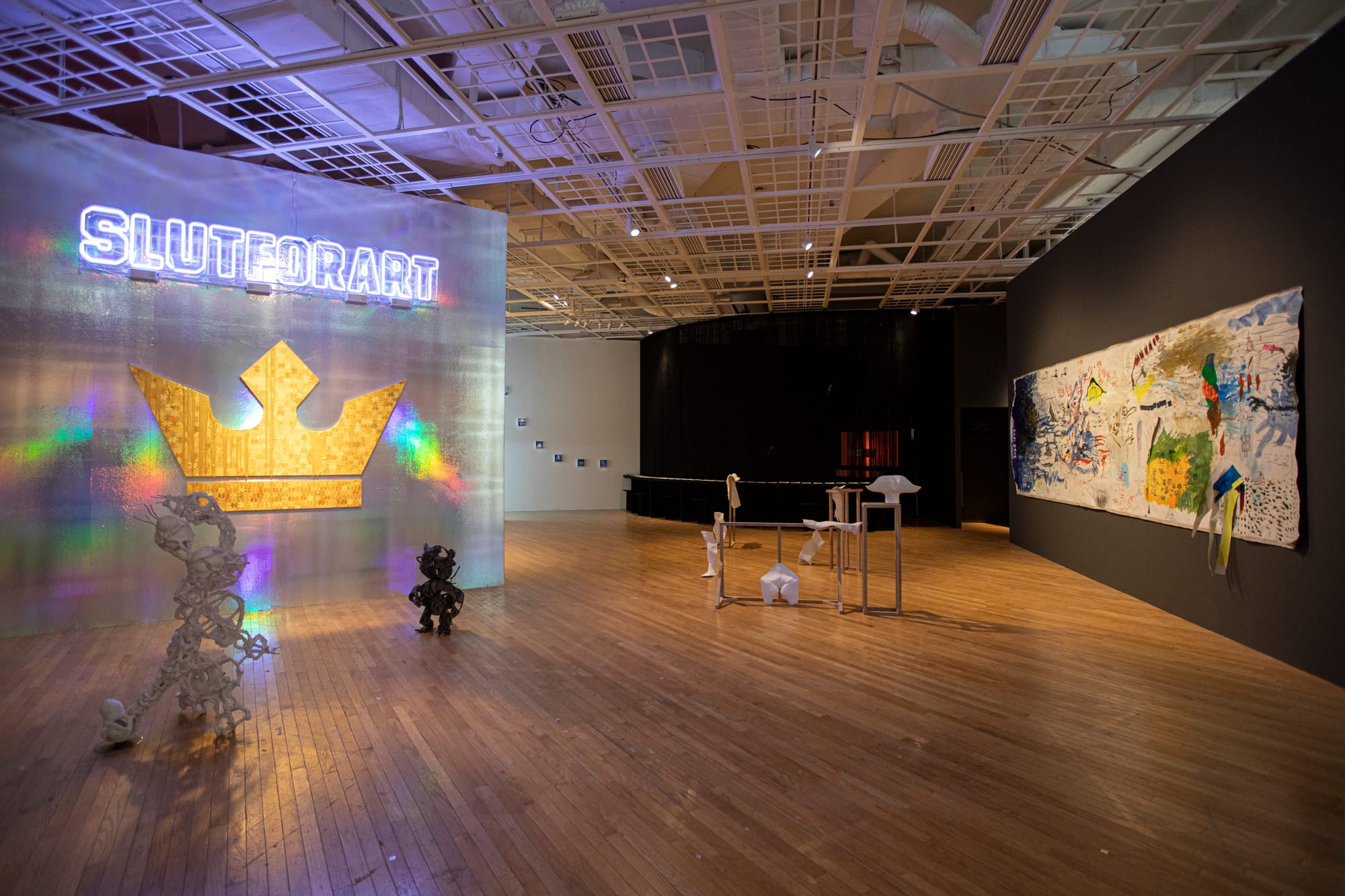
The third floor gallery, “Tender: Invisibly Visible, Unlocatably Everywhere,” opens with a provocation. Moon Sanghoon’s neon sign Future Queer Is Here (2019) glows in pinks and blues, its arrow pointing outward, seemingly toward the street. The piece borrows from the visual language of commercial signage and, in doing so, carries the same ambiguity that Sin Wai Kin’s ESSENCE project exploits. Read against the grain of its apparent optimism, the sign feels less as a celebration of arrival than as a demand for what remains absent.
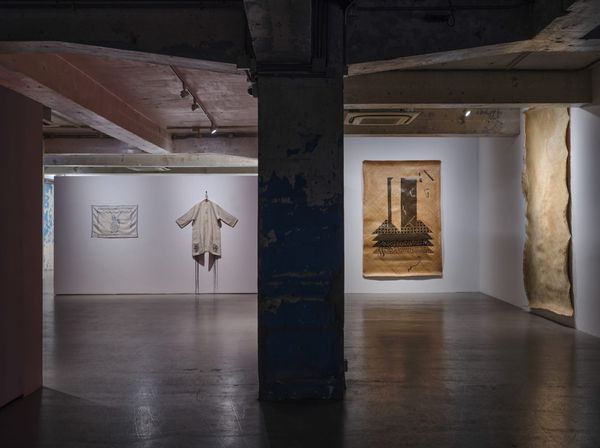
This tension between the anticipated future and an inadequately documented past forms this floor’s central concern. Kang Seung Lee’s monumental archival wall is organized around 15 drawings based on personal advertisements from newsletters published in the 1990s by Chingusai, Korea’s pioneering gay rights organization, alongside drawings of theaters that used to be cruising sites, and a graphite work that erases Tseng Kwong Chi’s figure from his own self-portrait series, leaving only a silhouette. The work does not render a linear history of the Korean queer community, functioning instead as a layered field of partial evidence and retrieved remnants, while inserting a form of mourning into a wall already dedicated to recovering what official history has seen fit to forget.
Ibanjiha’s painting Staying Alive Here in South Korea 2025 (2026) extends this archival impulse into the rawness of the streets. The artist assembles a series of collective traumas, from the 2014 Sewol ferry disaster and the 2022 Itaewon crowd crush to the 2024 martial law declaration and the solidarities formed among farmers, migrants, women, and queer communities in response to it. Through fragmented drawings and handwritten texts, these events accumulate on the canvas as both affective sedimentation and political manifesto.
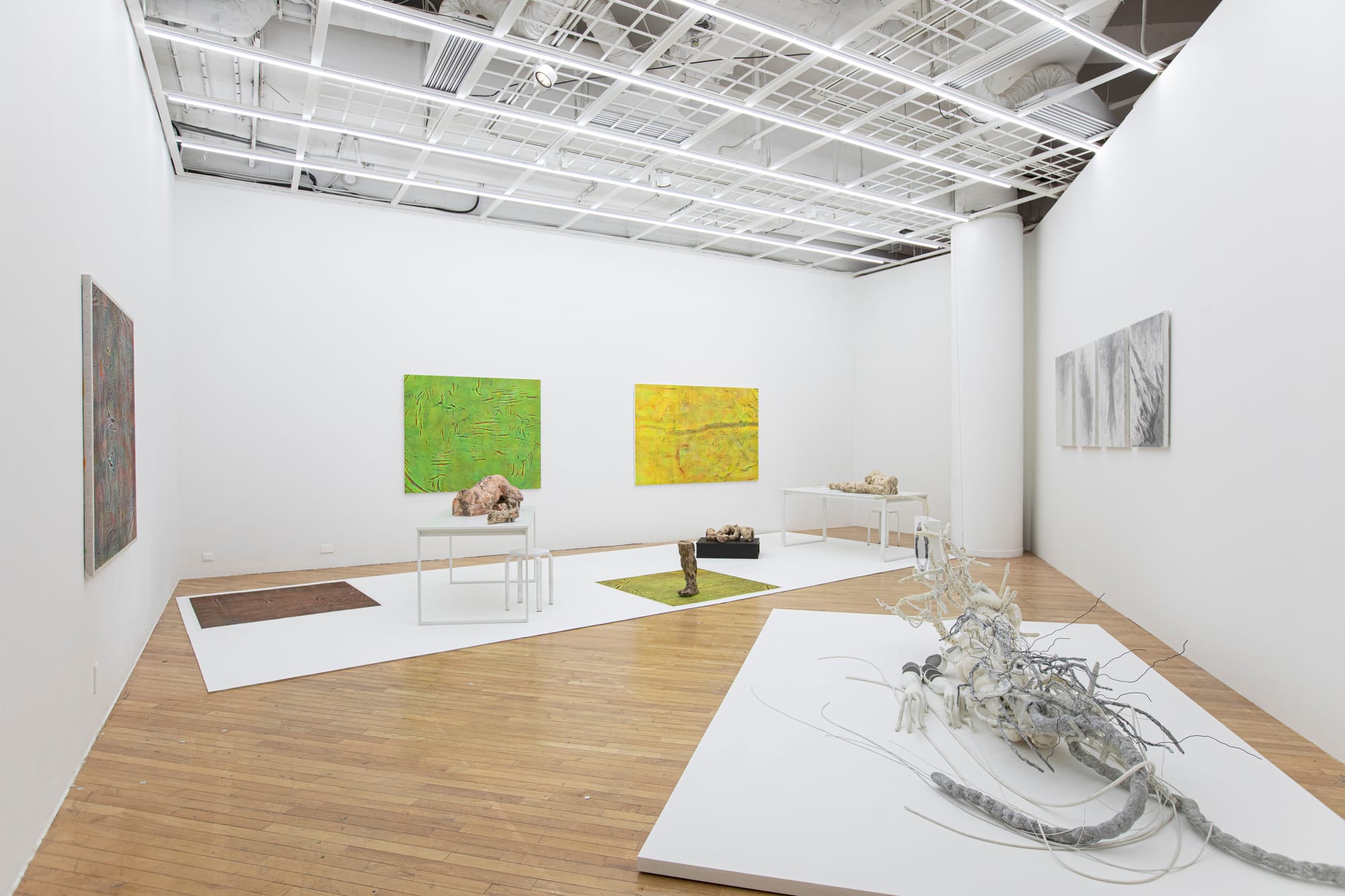
The floor’s final room holds Haneyl Choi’s The River of Juice and Hair and In The Act of Dying (both 2024). The former is a large surface consisting of hair affixed to silicone sheets and graphite marks—the artist calls it a “trace” rather than a painting. The latter emerged from the accidental perception of a hanged figure within a sculpture under reconstruction, which led Choi to contemplate total muscular release—a state that, in the extreme, becomes indistinguishable from death itself. Together, the two works excavate a narrow zone between sensation and dissolution, where the body is neither fixed subject nor object, but an ongoing process. It is also the condition that queerness has always known.
In the accompanying exhibition catalog, writer Harry C.H. Choi briefly chronicles queer Korean art. Art Sonje Center’s relationship with queer art extends back to 1998, when the institution hosted the inaugural Seoul Queer Film Festival. In 2000, the second edition was followed by a performance by G-Voice, the gay choir group affiliated with Chingusai. A solo exhibition by Inhwan Oh took place in 2008, and the center has since sustained engagement through programs including “off-site 2: Eleven Episodes” and collaborations with the Solidarity for LGBT Human Rights of Korea. “Spectrosynthesis Seoul” represents the latest iteration of this long-running commitment.
At what point does the exhibition space become a genuine site of change? The works gathered here do not consolidate into a coherent vision of what queer life should look like; they are too formally and historically divergent for that. Yet, what they share is a refusal to be fully assimilated into a framework that displays them. Queerness does not become socially effective by entering an institution; it becomes effective when it exceeds one. In this sense, the exhibition continues in what visitors carry out with them.
Louis Lu is an associate editor at ArtAsiaPacific.