Shows
Other Worlds of Light: Zarina’s “Beyond the Stars”
Zarina
Beyond the Stars
Luhring Augustine Tribeca
New York
Jan 17–Mar 28, 2026
Lines took on new meaning when I received my first atlas in kindergarten. Though my grasp of the world was limited, I remember learning about East and West Germany; the falling of the Berlin Wall could not alter the borders printed on those maps. Sometimes dotted lines separated neighbors over disputed territories—an ambiguity that must have been confusing. Who gets to draw these lines? I wondered. While the Earth is not marked like a jigsaw, the late Indian-born artist Zarina returned to the formal qualities of these invisible, arbitrary divisions—barriers that have drastically changed countless lives, including her own. Her black-and-white woodblock prints deftly navigate positive and negative space. Through carving, inking, rolling, pressing, and further manipulation of the paper, she distilled a lifetime of crossings into expansive, emotional landscapes bounded by the edge of the printing block.
Six years after her passing, Luhring Augustine presents Zarina’s first posthumous solo exhibition at its Tribeca gallery. The selection—prints, collages, cast paper works, and wall-based sculptures spanning seven decades—carries the weight of impermanence shaped by postwar politics, as well as the condition of lifelong exile. Drawn from different periods across her career, the works reflect a transient life punctuated by both literal and imagined lines on maps.
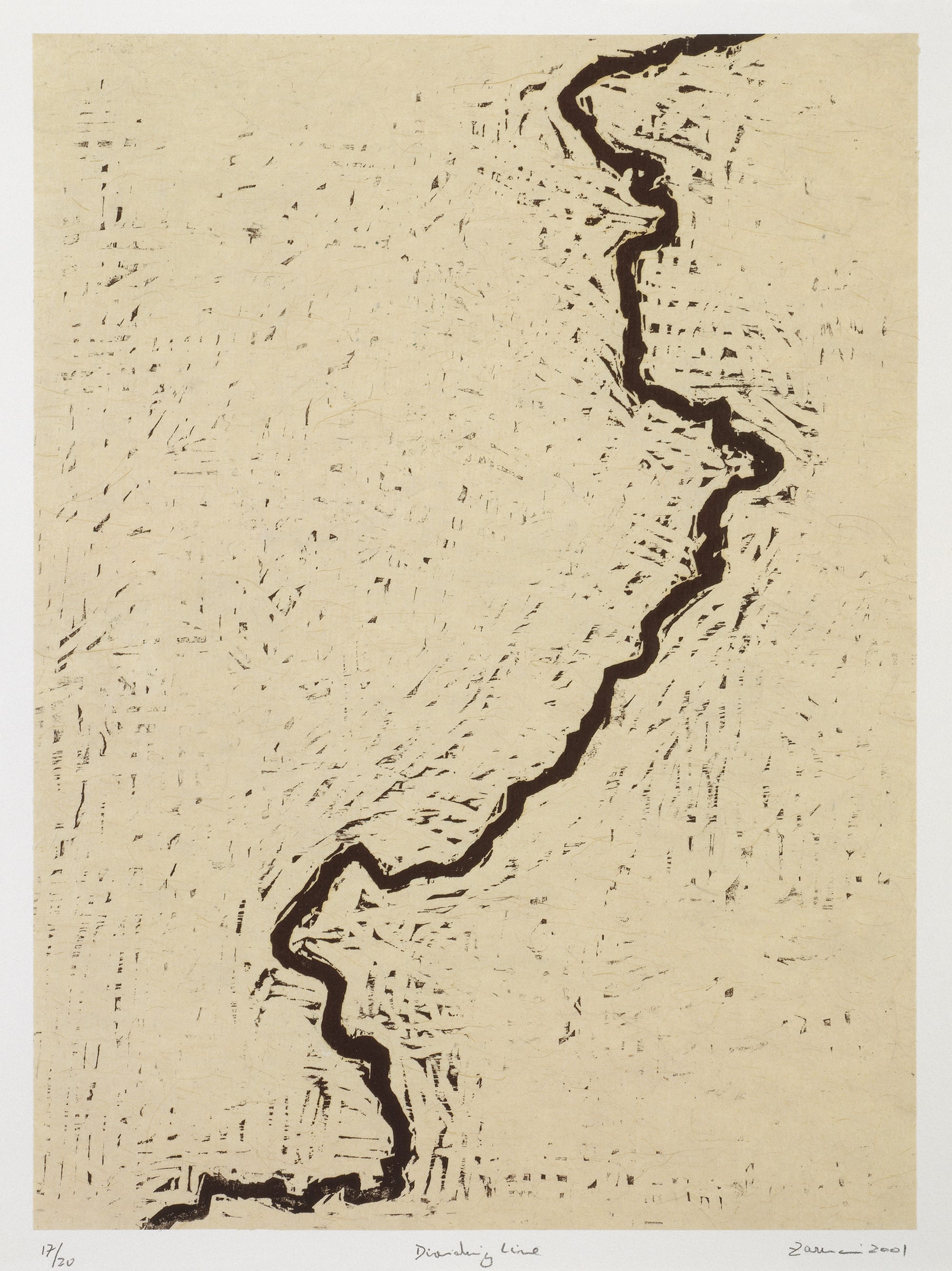
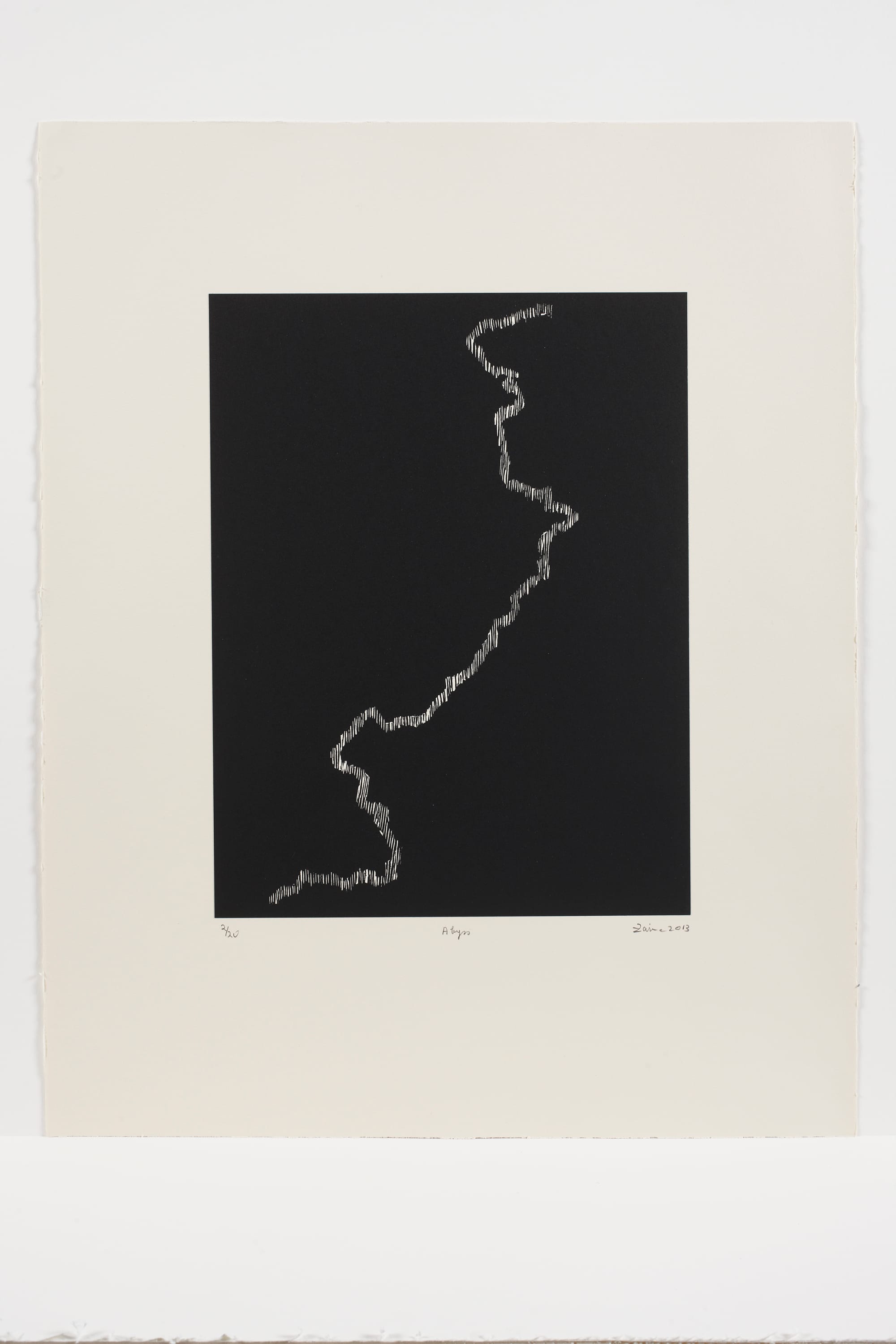
ZARINA, Dividing Line, 2001, woodcut printed in black on Nepalese handmade paper mounted on Arches cover white paper, 65.4 x 50.2 cm, edition 17/20 (left); and Abyss, 2013, woodcut on BFK light paper mounted on Somerset Antique paper, 69.9 x 55.9 cm, edition 18/20 (right). Courtesy the artist and Luhring Augustine, New York.
The Partition of India took place in 1947 when Zarina was 10 years old, and her family was among the millions of Muslims who relocated to the newly formed Pakistan before the imposed deadline. Often described as one of the largest mass migrations in history, the Partition was also among the bloodiest that ended up being a genocide, leaving a jagged line between India and Pakistan that endures as a scar. A recurring subject in Zarina’s work, this border—drawn by the British lawyer Cyril John Radcliffe (1899–1977)—appears in Dividing Line (2001) and Abyss (2013). Displayed side by side, the former presents a single black line halving the paper from top to bottom, while the latter renders a white, hatched void—a ghostly cliff splitting a dark, rectangular subcontinent. Zarina studied printmaking while shuttling around the globe as a diplomat’s wife, “writing” stories from her perspective in ink with a carving knife. Following her husband’s death, she settled in New York in 1976, where she lived and worked thereafter. Her nomadic existence surfaces in Mapping the Dislocations (2001), in which woodblock-printed lines tracing her movements are cut out and mounted on white paper, adding a sense of suspension.
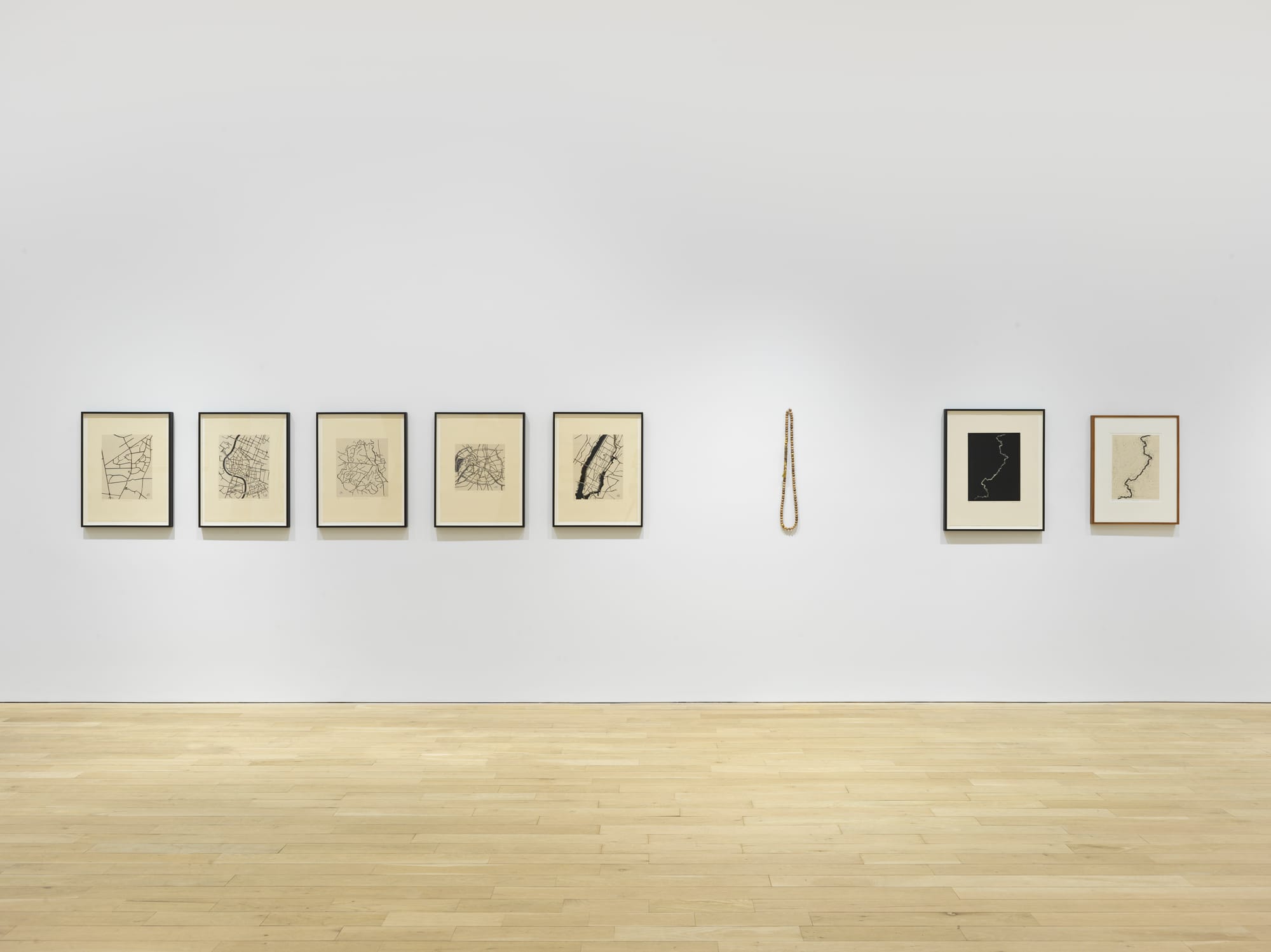
The theme of displacement continues through her use of maps and floorplans, both earthen and celestial. Cities I Called Home (2010), a portfolio of five prints, delineates the streets, highways, and rivers that structure her understanding of the places she inhabited, including Bangkok, Paris, and New York. Moving across languages and cultures, she often anchored her compositions with a word or verse in her native Urdu, whose fluid calligraphy offsets the geometric rigor of her forms. This exhibition takes its title from a 2014 print, Beyond the Stars, which is named after a poem by Muhammad Iqbal (1877–1938):
Beyond the stars there are
Other worlds of light;
There are more trials of love,
Besides those on earth.
The print unfolds as a galaxy of white dots within a pitch-black field, with gold accents extending beyond the printed area; beneath it, the Urdu phrase for “Beyond the stars” is inscribed. The work held particular meaning for Zarina as she mourned the death of her dearest sister. Loss—of home, of family, of a place and people to return to—permeates the gallery, emerging in gestures such as the gold leaf and paper patching the grid in Shadow House VI (2006), or the threads pulled through the openings of the embossed relief print Buttons (1975).
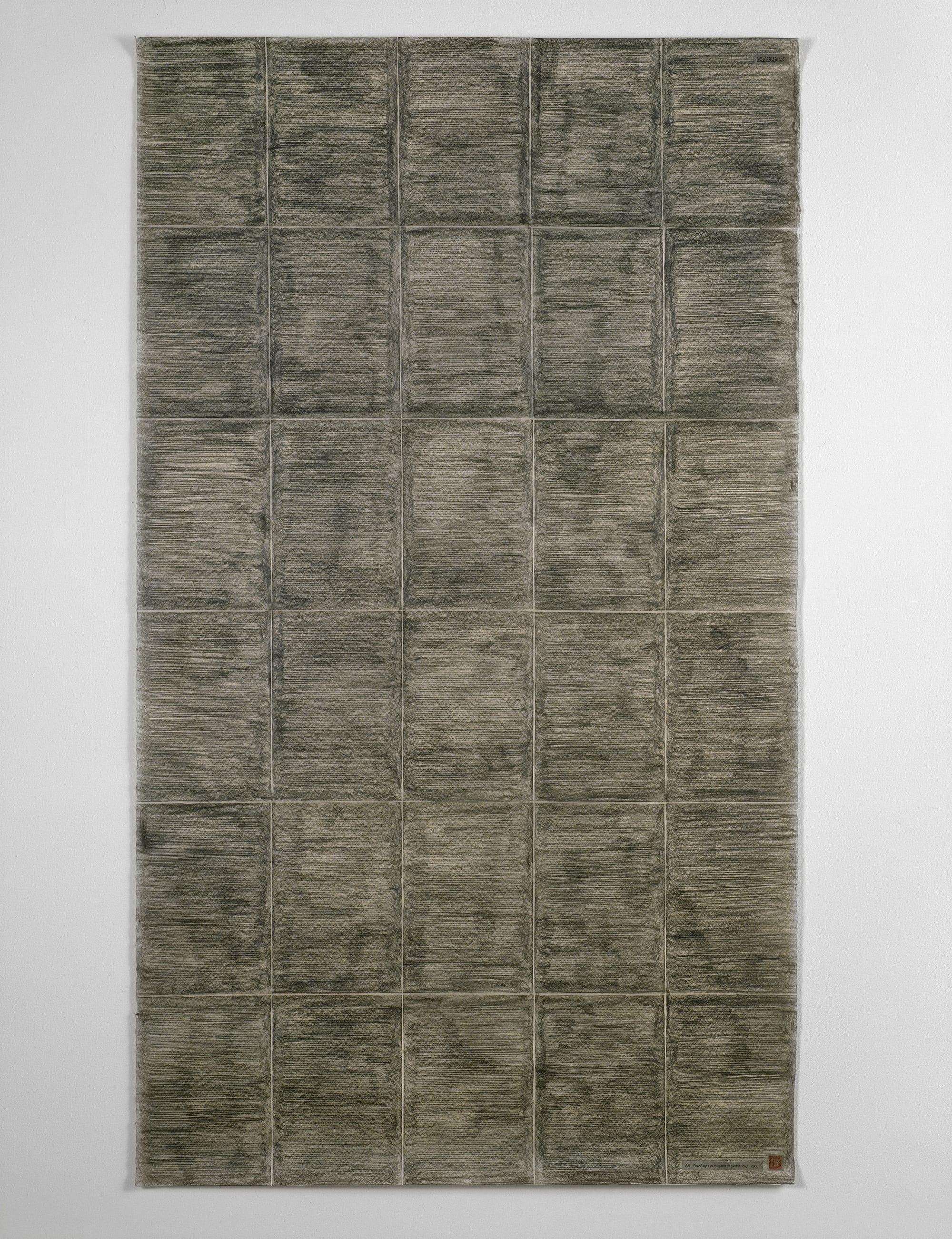
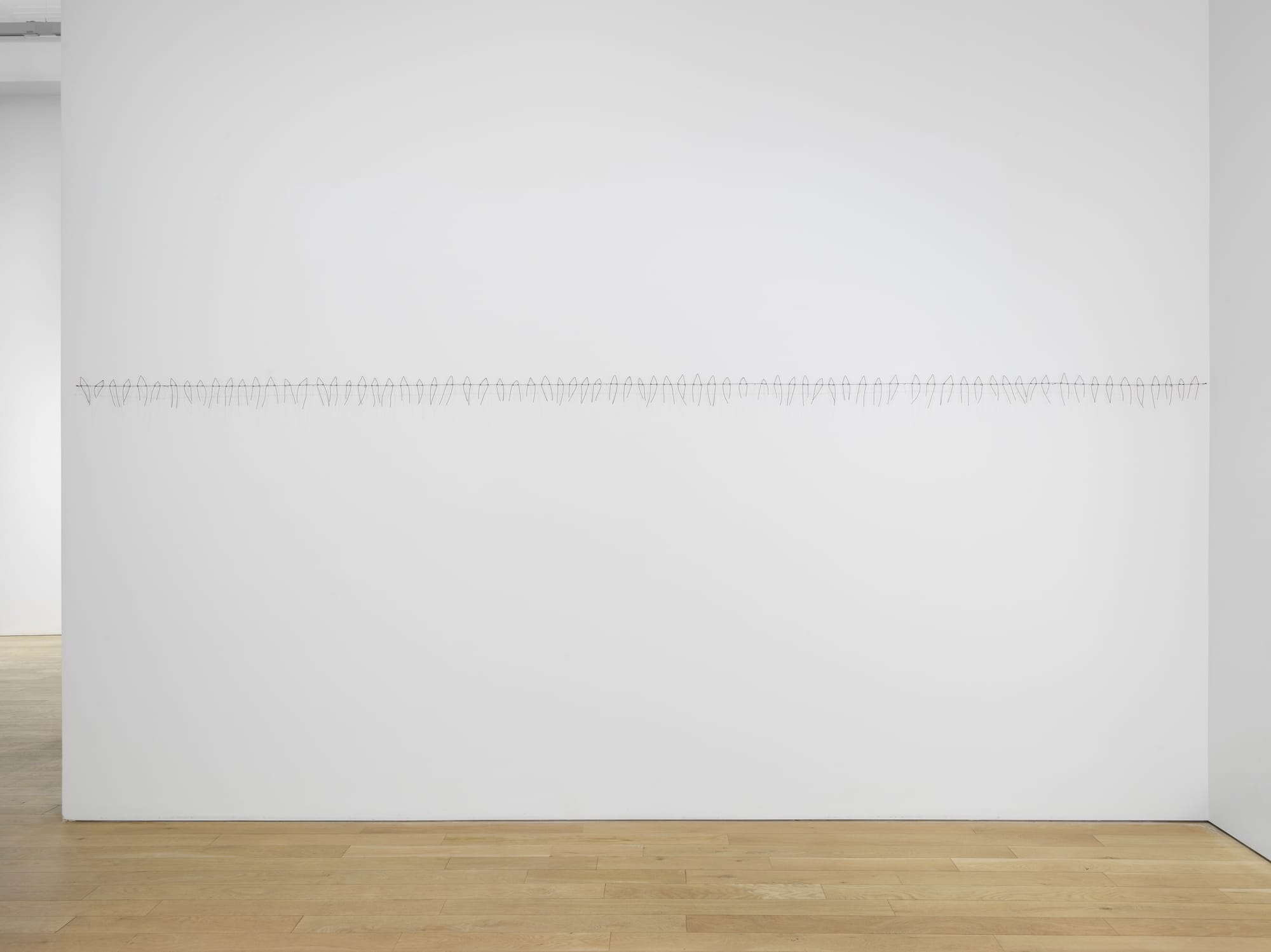
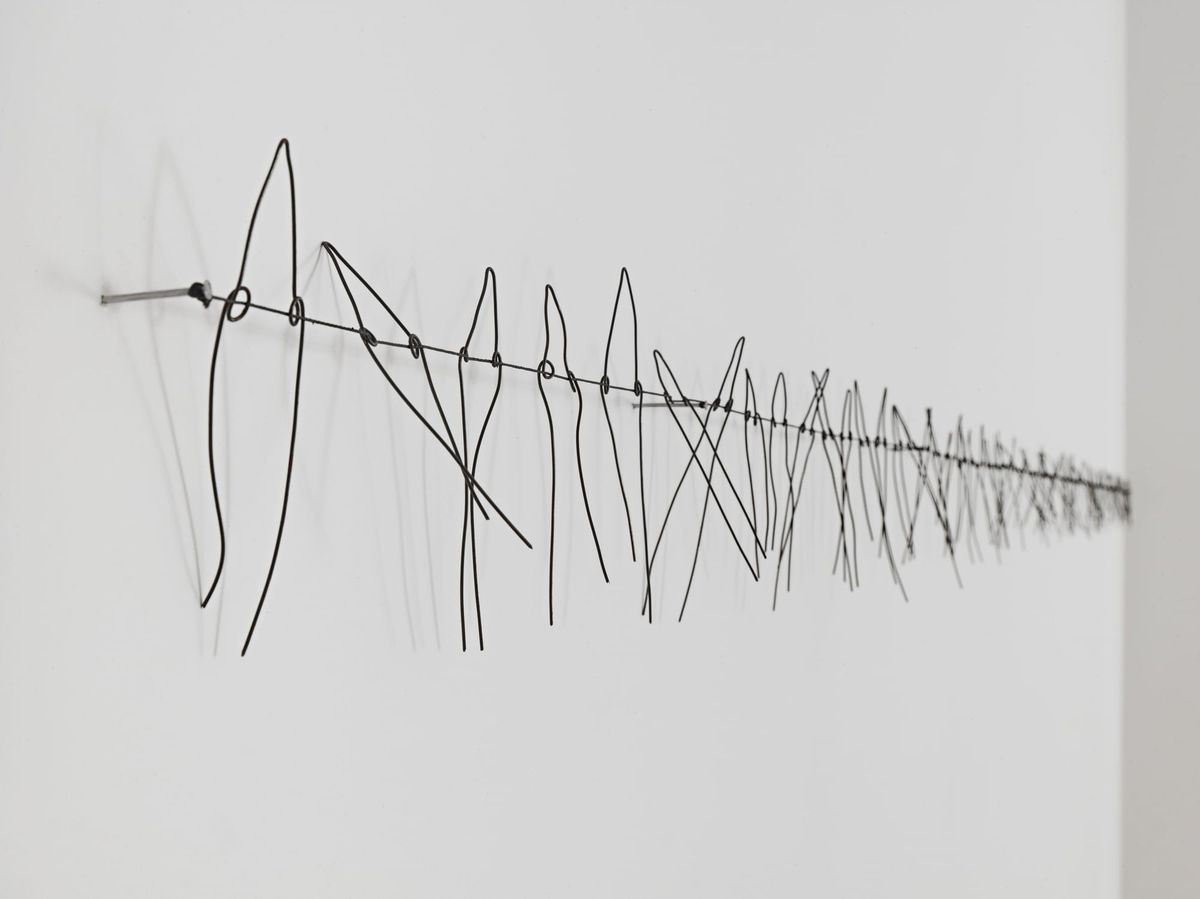
ZARINA, A Few Steps in the Land of Confucius, 2008, rubbing from woodcut on Okawara paper, 175.3 x 97.8 cm, edition 5/5 (left); and Hanging in There, 2000, wire and linen thread, 112 units total, each unit 11.4 x 2.5 cm (right). Courtesy the artist and Luhring Augustine, New York.
While paper was her primary medium, Zarina was adventurous with different techniques and materials, including pewter leaf. The exhibition reflects this range. A 2008 rubbing, A Few Steps in the Land of Confucius, engages questions of religion and philosophy, marked by a Chinese cinnabar-red seal in the lower right corner. Nearby, giant tasbih prayer beads made of wood and green onyx hang like waterfalls—another form of line that at once separates and communicates. In the small viewing room, the wall piece Hanging in There (2000), composed of wire and linen thread, traces little kite shapes strung across a line, like abstracted birds perched on a cable. Migration here becomes a waystation, a state of waiting without resolution.
In past interviews, Zarina described paper as seemingly fragile yet resilient—capable of aging, of holding secrets, like skin. In “Beyond the Stars,” the constellation of works forms a portrait of the artist: her warmth, precision, and quiet playfulness still shine through. In her woodblock prints, paper becomes a faithful record of layered cartographies—the texture of the paper, the grain of the wood transferred to its surface, the positive forms held in tension with what has been carved away. The labor resides in the negative space. There are, indeed, other worlds of light, just beyond what we think we see.
Kelly Ma is a New York-based curator and writer.