Shows
Whitney Biennial 2026: Care, Catastrophe, and Private Gestures
A biennial is a capsule of creativity and reflection from recent years, indexed by themes. The Whitney Biennial, now in its 82nd edition, opted this year for a stripped down, self-referential title in italics sans subtitle. For a show that bills itself as “the longest-running survey of American art,” this decision reads as a telling gesture of identity and self-awareness. The Whitney is, after all, a museum of American art that constantly broadens and loosens what America is in an everlasting existential exercise. At a juncture when everyone is questioning what the US stands for, it is instructive to see how artists attempt their definitions.
Among the hundreds of artworks by 56 artists, duos, and collectives featured in this exposition in the 250th year of the country’s founding, here are my highlights.
Care, Memory, and Loss
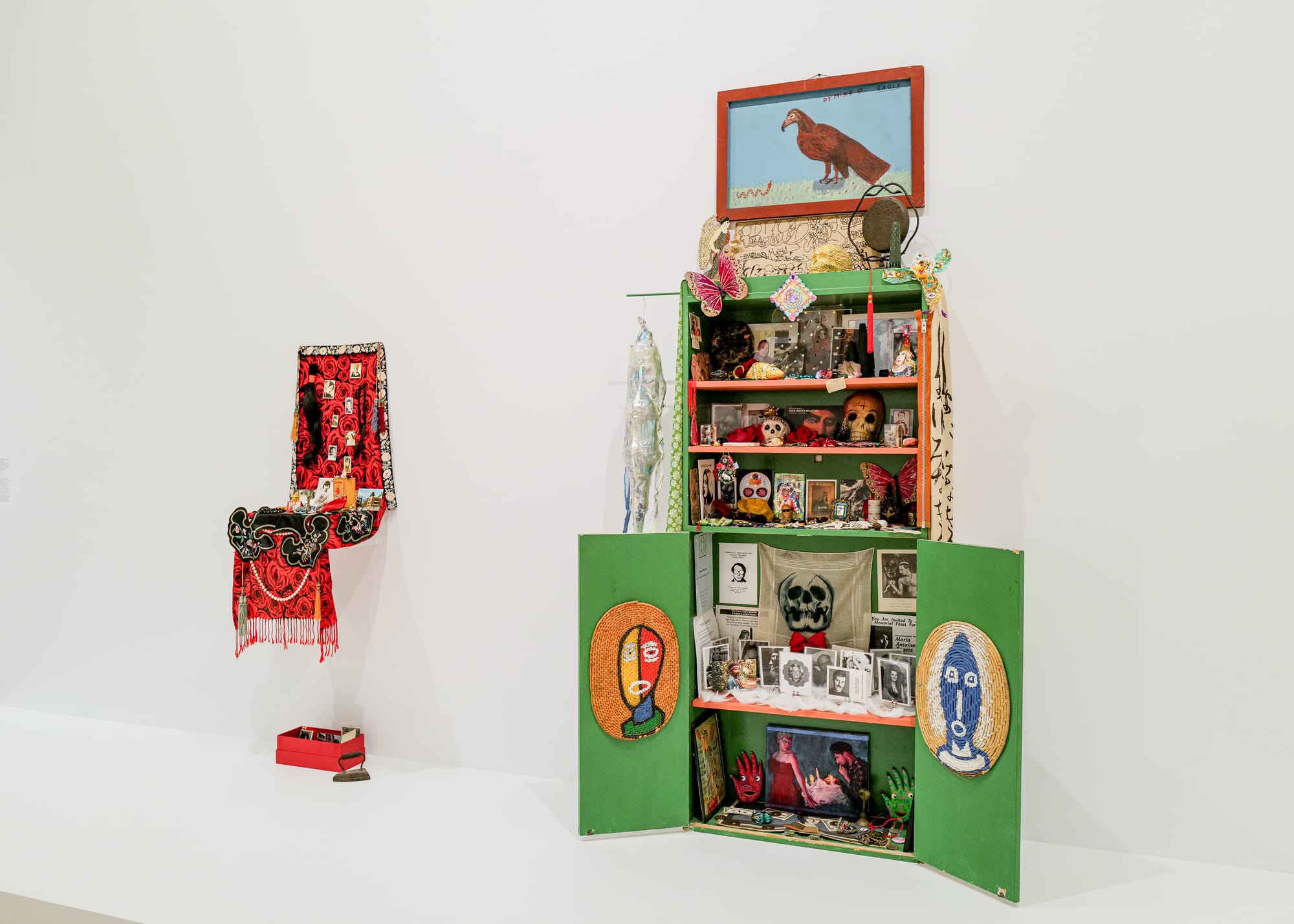
In life, only death is certain. Agosto Machado carved his own path in the downtown arts scene in 1959, joining Andy Warhol’s Factory, Peter Hujar’s studio, and later LaMama Experimental Theatre Club, where he performed with drag icons Jackie Curtis and Candy Darling. When friends and lovers began to succumb to AIDS during the 1980s, he was their caregiver and created domestic shrines for them with photographs, drawings, and personal memorabilia that he had collected. He became an archivist of the era—a title he was getting used to along with his new-found recognition. Of the four shrine sculptures he contributed to the biennial, one is dedicated to Ethyl Eichelberger, a drag performer and playwright who committed suicide in 1990. In the exhibition’s audio guide, Machado reminisced about his friend with modesty and admiration. On March 21, mere weeks after the biennial opened, Machado died following a brief illness. A “New York orphan” of Chinese, Spanish, and Filipino ancestry and a self-described “street queen,” he never disclosed his age, quipping, “A lady never tells.” Carrying the memories of his loved ones in his heart, he had arranged for his own cremation; his ashes would be mixed with some of his friends’—including those of trans-rights activist and fellow Stonewall veteran Marsha P. Johnson—and spread into the Hudson River near where Johnson’s body was found in 1992.
On the fifth-floor landing, visitors encounter Emilie Louise Gossiaux’s Kong Play (2025), a scattering of 100 Crayola-colored, cornetto-shaped ceramic chew toys (dog treats can be hidden in the Kong company-designed rubber versions) on an oval-shaped two-tier platform. On the curved, pastel blue wall nearby, a series of pen and crayon drawings portray vignettes of companionship between a guide dog named London and the artist. Gossiaux, who is blind, started creating this body of work as London’s health declined; she died in late 2025. This tenderness forms a nursery that cradles the happy times and an imagined afterlife—filled with toys and treats—for a loyal and beloved friend.
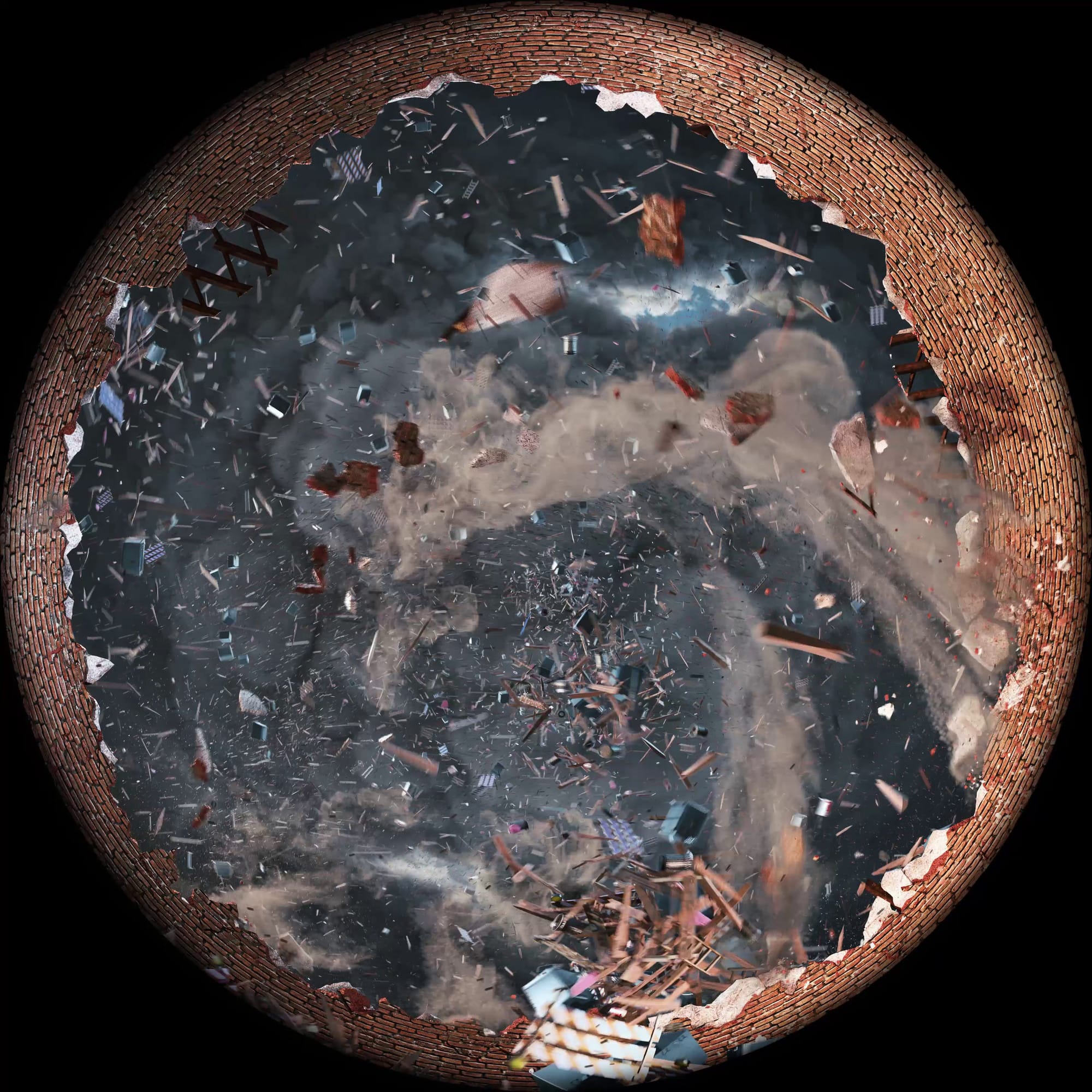
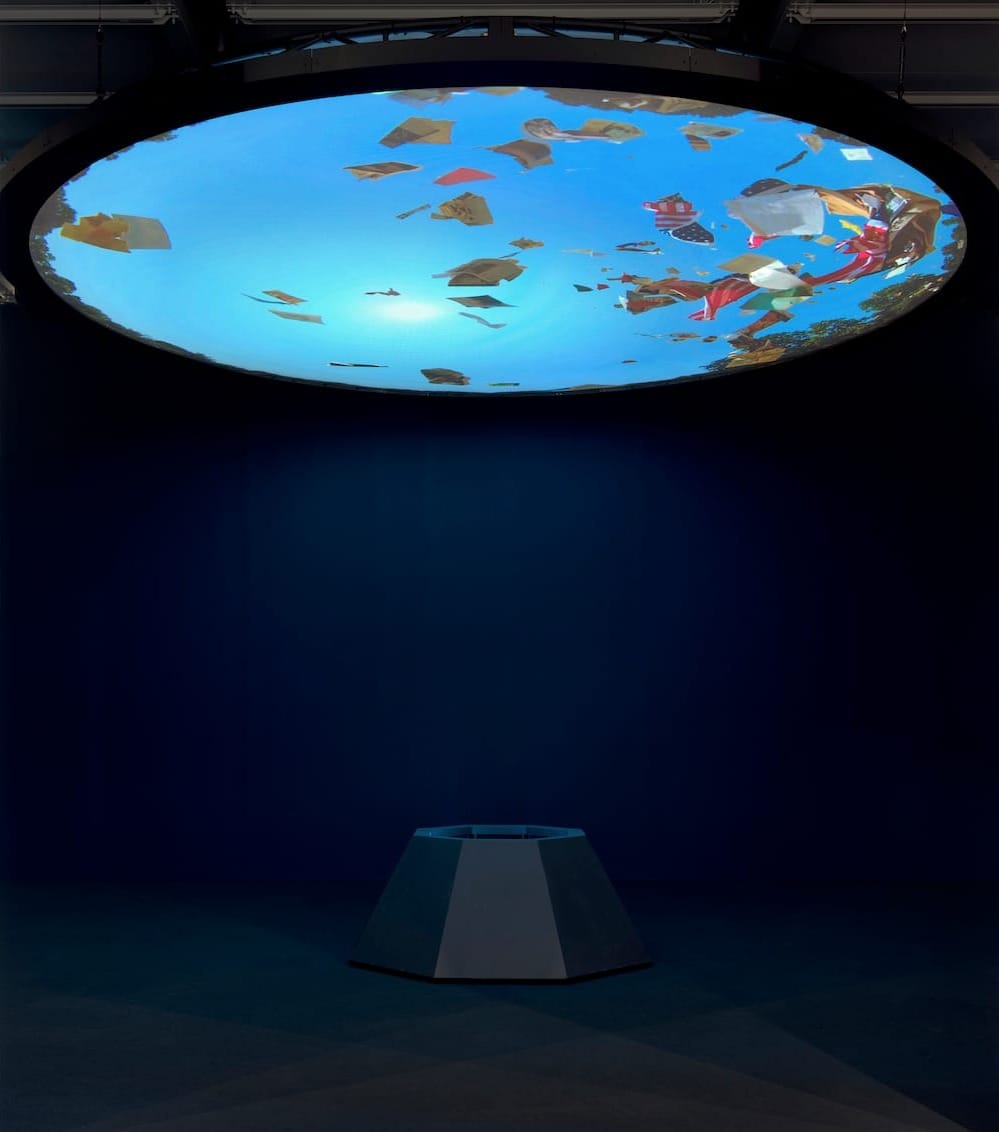
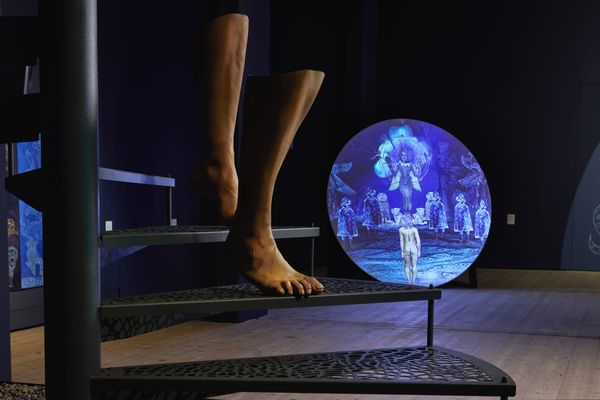
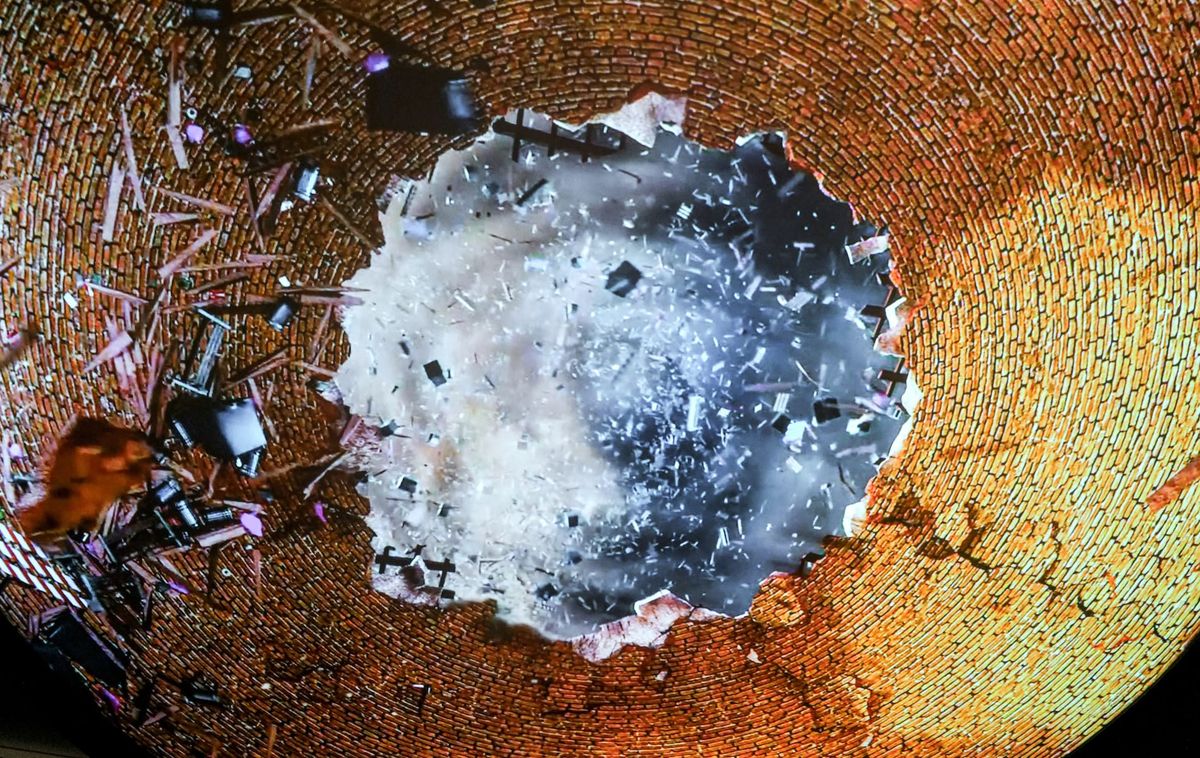
Installation views of MICHELLE LOPEZ’s Pandemonium, 2017–25, high-definition digital video projected on six-meter-diameter circular screen, color, and sound: 20 min, at the Whitney Biennial 2026, New York. Copyright and courtesy the artist.
Humanmade Catastrophes and Their Shadows
Upon exiting the elevator on the sixth floor, many biennial-goers are sucked in by a circular ceiling projection of a video showing windswept newspapers against a blue sky. This cinematic preview of an apocalypse has a surround sound of doom, namely roaring gusts with a viola trio. Filipina American sculptor Michelle Lopez first performed Pandemonium (2017–25) live at the Franklin Institute (a science museum named after the scientist and Founding Father) in Philadelphia (where the Declaration of Independence was signed) with a tornado machine. What is more concerning: people lying on the carpet entranced by bad news flying around, or the threat knocking on the door as civilization collapses? Maybe this is the most truthful depiction of America—from rational idealism at its founding to an influencer-led, pseudo-science-believing mess—like the satirical film Don’t Look Up (2021), just looking, well, literally up.
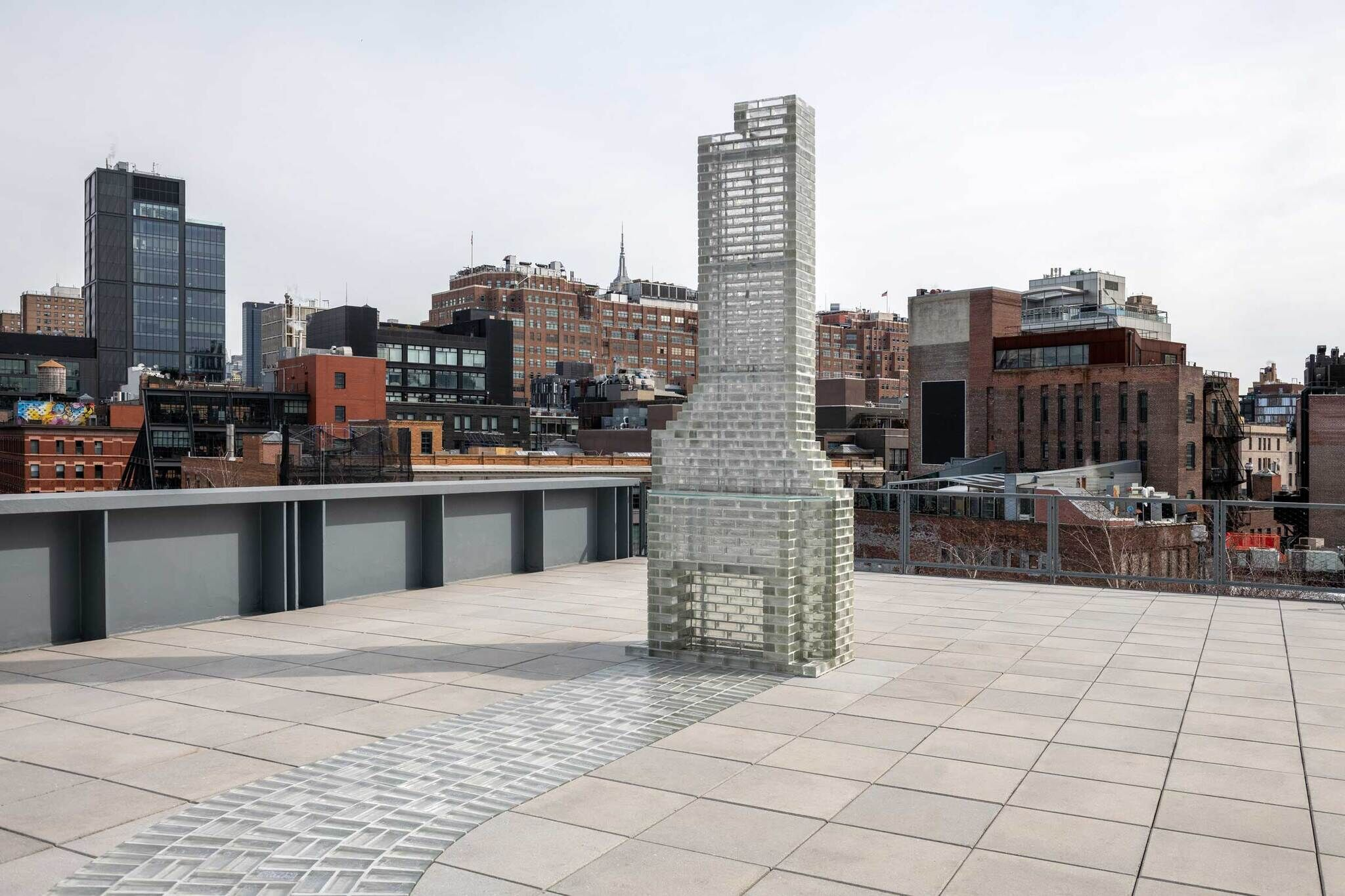
Kelly Akashi’s Imprints, comprising embossed paper, and Inheritance (Distressed) (both 2026), in Cor-Ten steel, are inspired by her grandmother’s collection of doilies, which the artist salvaged from a garage sale but lost to the 2025 Eaton Fire. The domesticity and femininity of the individually framed Imprints are amplified as they line the wall like family portraits in a narrow corridor leading to the terrace. Inheritance, blown up in scale and rusting away on the terrace, appears masculine and industrial like Richard Serra’s sculptures of the same material. Nearby, a glass brick chimney—a replica of the remnant of Akashi’s home and studio—stands against the Manhattan skyline as Monument (Altadena) (2026). Her fireplace, which survived the blaze, now poetically glistens in another material shaped by heat and flames.
Public Spaces and Private Practices
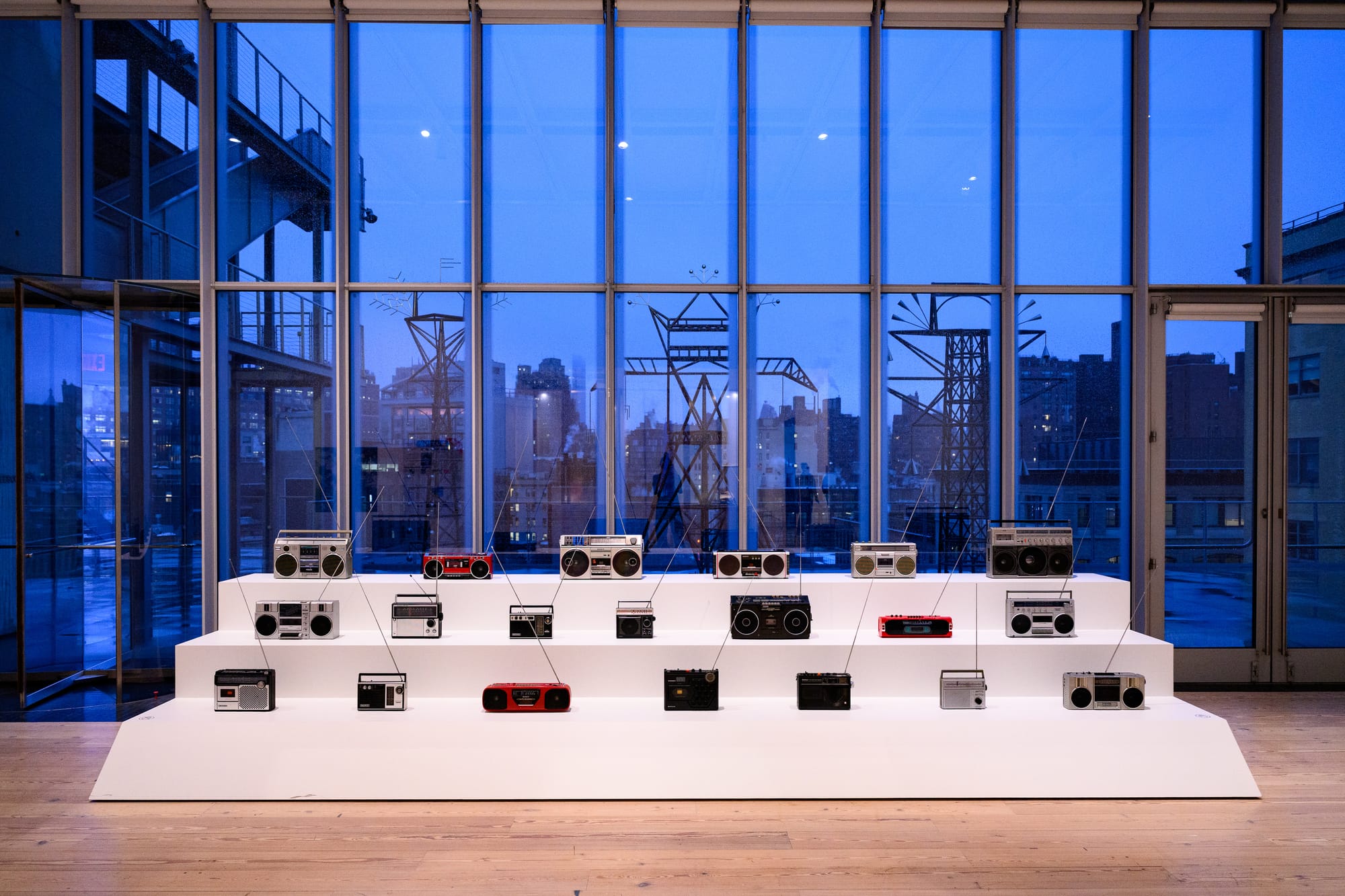
Aki Onda’s Ugnayan (1974/2026) is a restaging of a sound installation by the Filipino musicologist and composer José Maceda (1917–2004). The staticky sounds for Ugnayan, Music of Twenty Radio Stations (1974) are multitrack recordings of various Philippine Indigenous instruments, fusing “village music” with European avant-garde techniques. Each version was to be broadcast from a different radio station, for which Maceda set up “Ugnayan centers” across Manila where people could bring their radios and tune into one of the frequencies on New Year’s Day 1974. Onda, who has long researched Maceda’s legacy vis-à-vis Ferdinand Marcos’s dictatorship, sees a lesson for the present in the late Filipino composer’s dedication to finding spaces for democratic listening and gathering.
The biennial also features a robust performance program. In the gallery, Maia Chao’s Scores for the Museum Visitor (2026) exists as sets of instructions printed on the wall, inviting visitors to carry out ordinary actions in the exhibition space, such as “stand facing an artwork,” or “hold a museum brochure and drop it.” Her playful choreography of Dos-and-Don’ts contrasts with David L. Johnson’s Rule (2024– ), made up of decommissioned codes-of-conduct signs in New York dating back to 1961, prohibiting homeless people—and Occupy Wall Street protestors in 2011—from loitering in privately owned park-like plazas. Chao’s BEING MOVED (2026) will take place in May amid the collection exhibition “Untitled (America).” Reflecting the title of the 2015 Whitney collection survey “America is Hard to See” that marked the institution’s relocation to its current home, Chao’s works encourage the audience to try out these moves that may go completely unnoticed by non-suspecting biennial-goers.
Kelly Ma is a New York-based curator and writer.