Shows
Material Collisions: Mandy El-Sayegh’s “For Theresa” at Space K Seoul
Mandy El-Sayegh
For Theresa
Space K Seoul
Seoul
Mar 19–Jun 21, 2026
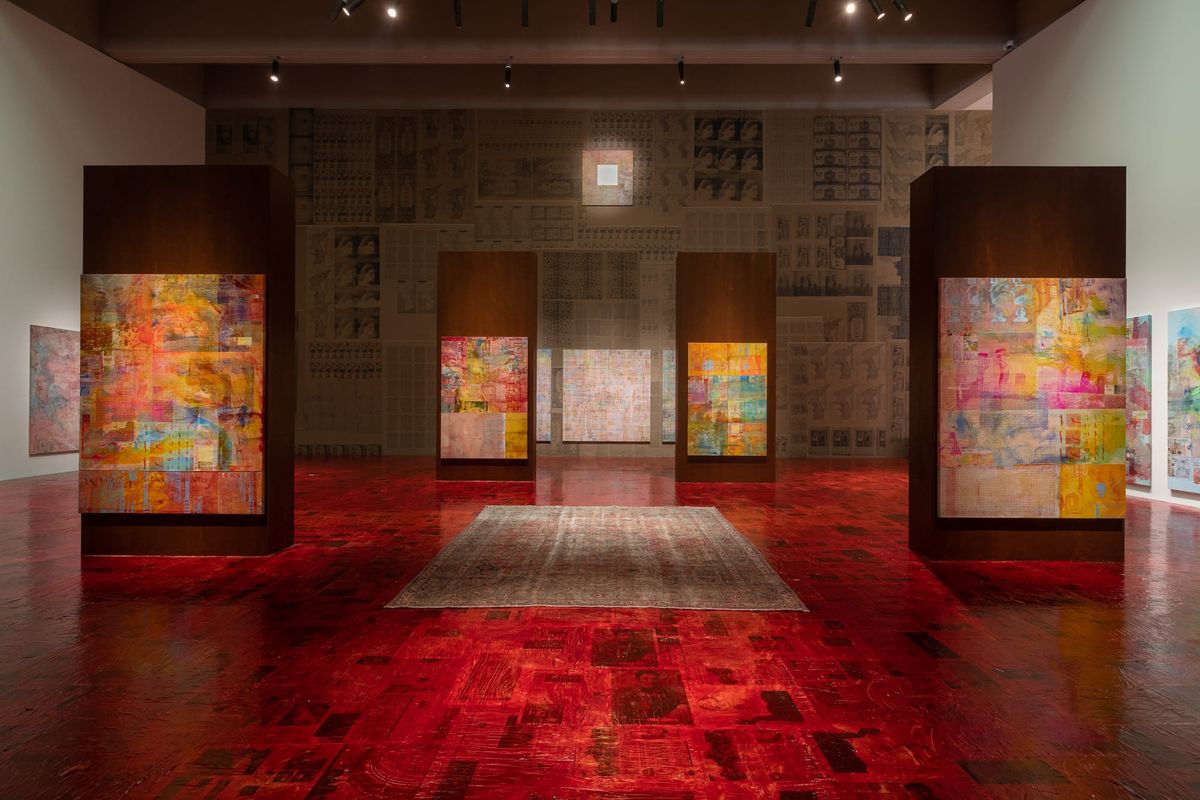
Banknotes from multiple currencies, newspaper clippings that operate both as documentation and propaganda, female figures from classical paintings and popular ad campaigns, centuries-old maps, and medical diagrams: these materials and motifs saturate Mandy El-Sayegh’s “For Theresa” at Space K Seoul. Bringing together recent and new painting series with immersive installation and scenographic staging, the exhibition creates a dense field in which disparate registers co-exist without being reconciled. Its title invokes the late Korean American artist Theresa Hak Kyung Cha (1951–1982), whose book Dictee—published just a week before she was murdered in New York—remains a crucial model for thinking through fractured, mutating language, gendered memory, and diasporic historical consciousness. Yet El-Sayegh’s homage transcends mere citation. It extends Cha’s investment in rupture and dispersal into a visual domain where icons, images, and bodies remain suspended in uneasy proximity.
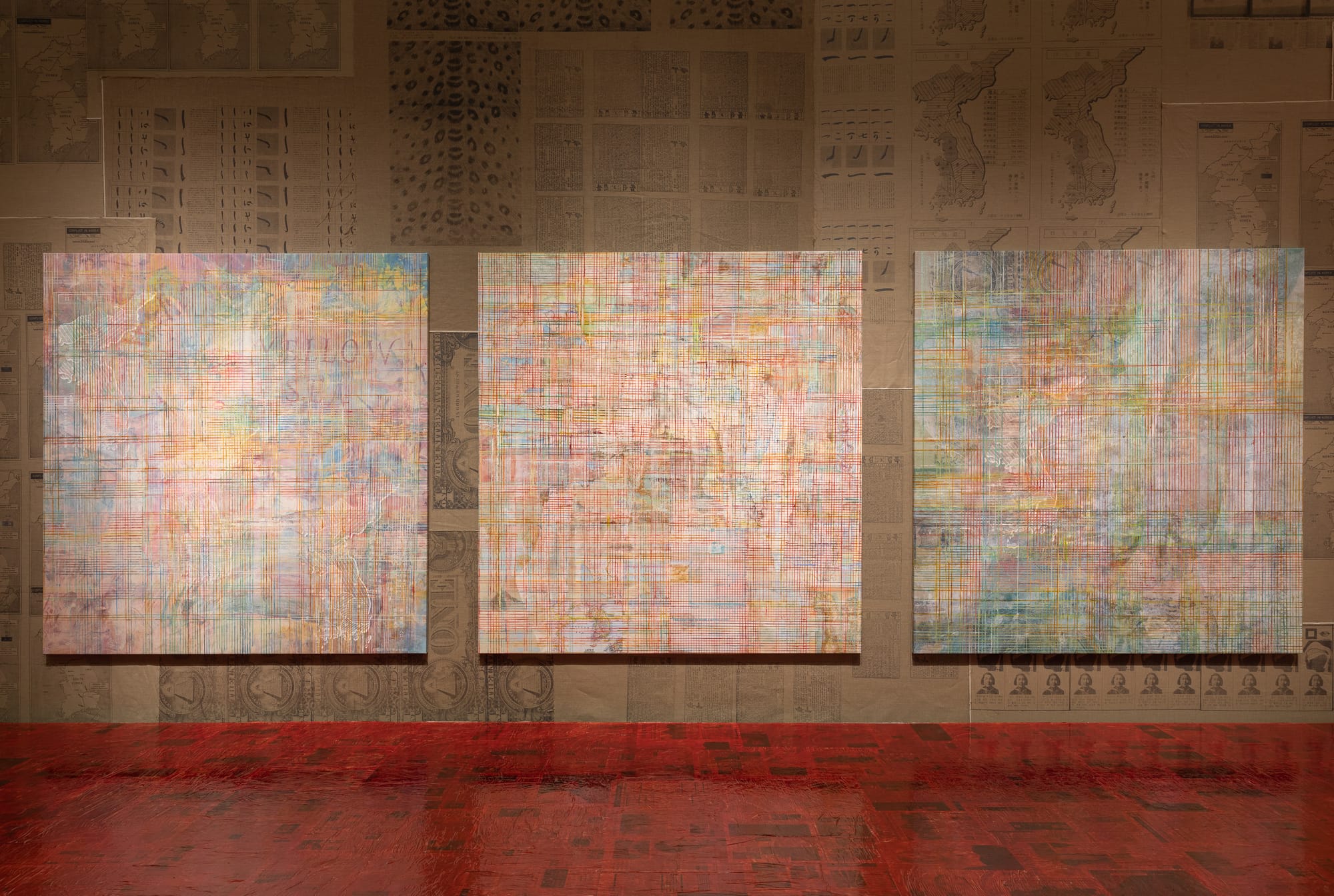
The exhibition is loosely arranged into four sections, each governed by a different density. The show opens with El-Sayegh’s signature Net-Grid canvases (2010– ) and her new Grand Collection of World Art tableaux (2026), which line walls plastered with newspapers, resulting in an architectural surface that recalls traditional Korean paper doors, which divide space while allowing light and air to pass through. Composed of printed matter that the artist sourced from museum archives, antique book shops, and flea markets in Korea and elsewhere, the walls form an indexical but non-specific backdrop against which the paintings’ compact grids and collaged fragments set different forms of attention in motion: eroticized images instantly—almost involuntarily—catch the eye; letters and notations demand to be read, even when they withhold full comprehension; smudges, drips, and folds keep pulling one’s gaze back to the physical textures.
This unstable overlap is particularly acute in Grand Collection of World Art. The series draws on El-Sayegh’s research into colonial and migrant histories in Korea, whereby she found a secondhand book on “world art” featuring Jean-Auguste-Dominique Ingres’s 19th-century oil painting Grande Odalisque on its cover. Long absorbed into the canon of Western painting, Ingres’s reclining nude represents two fantasies at once: the naked female form as a readily available object of desire, framed through the voyeuristic male gaze; and the “Orient” idealized as a distant realm defined by Eurocentric perspectives and salacious projections.
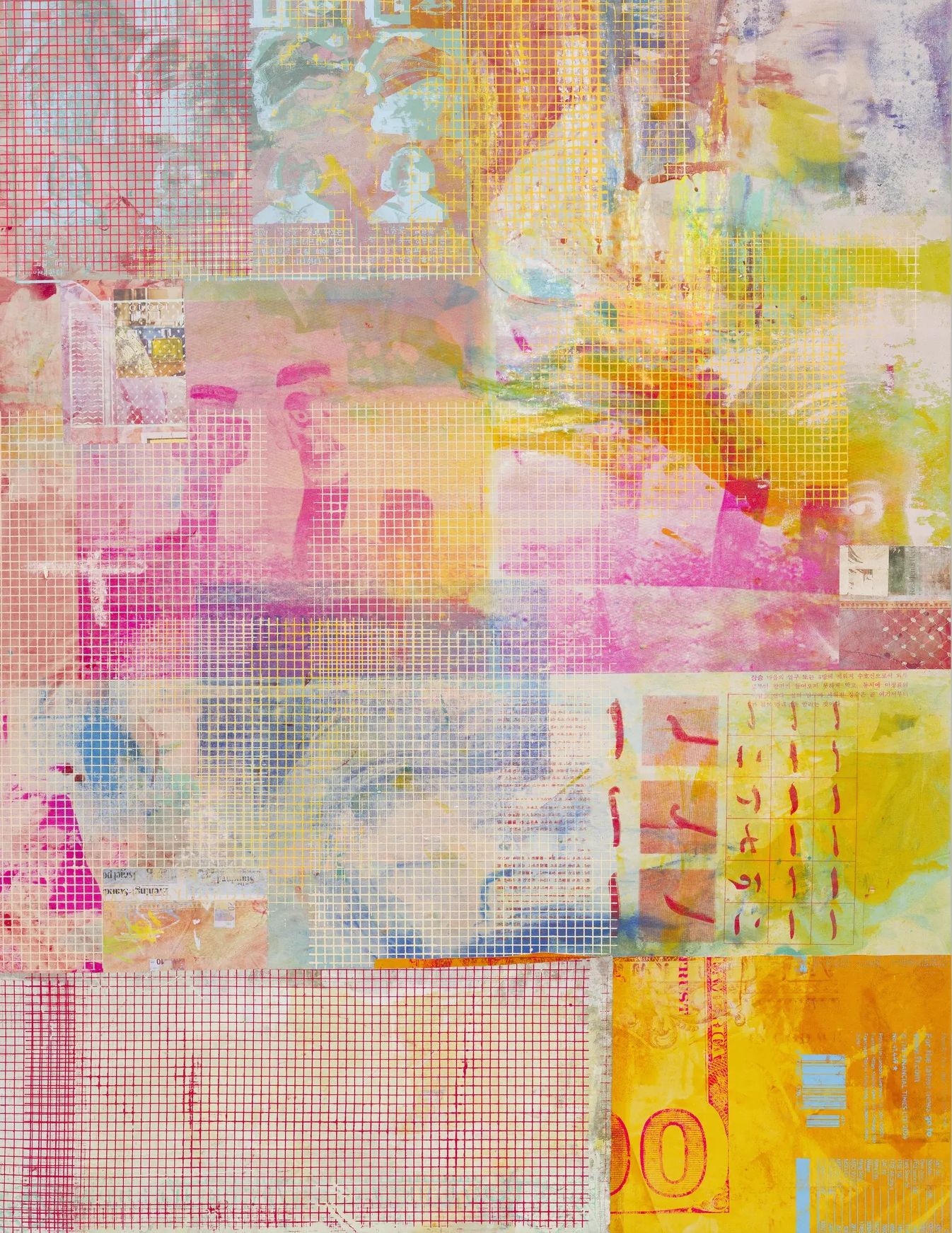
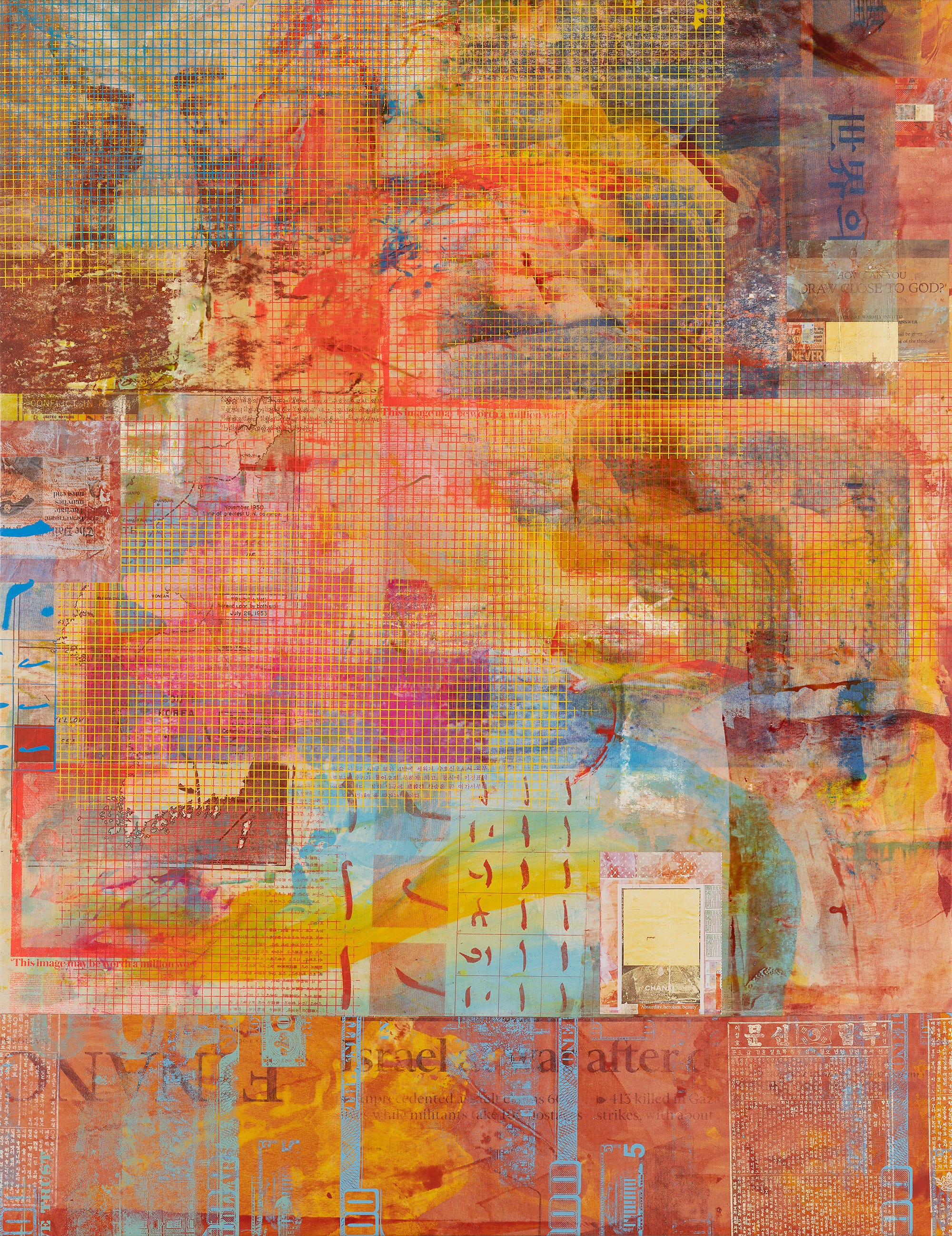
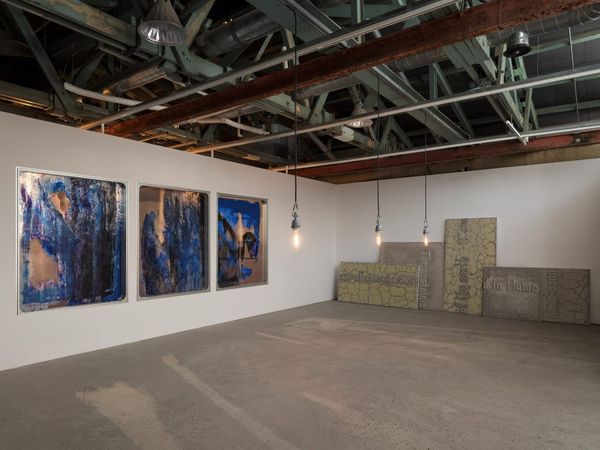
MANDY EL-SAYEGH, Grand Collection of World Art (Totem), 2026, oil and acrylic on canvas and linen with collaged and silkscreened elements, 210 x 162 cm. Courtesy the artist and Thaddaeus Ropac (left); and Grand Collection of World Art (Canon), 2026, oil and acrylic on canvas with collaged and silkscreened elements, 212 x 164 x 4.5cm. Courtesy the artist and Space K Seoul (right).
In one work from the series, the odalisque’s face hovers faintly at the upper-right edge of a luminous, gridded panel. Though detached from the body that made her canonical, her visage is still recognizable through her steady over-the-shoulder stare. Meanwhile, the rest of the composition is inundated with collaged and silkscreened printed matter, Korean script, advertising images, all steeped in vibrant colors: a segment of The Independent, Korea’s first privately owned newspaper, founded in 1896, and the glossy poster of a luxury brand are pressed into the same pictorial surface. Rendered in neon pink in the upper left quadrant, the bulging eyes of a jangseung duo (village guardian figures) pierce through the overwhelming medley. Rather than resolving into a readable cultural map, these collisions produce a compressed landscape of contemporary life, where late-capitalist exchange, premodern signs and beliefs, and women’s bodies as visual currency co-exist without synthesis. Here, Ingres’s odalisque is no longer a fixed emblem of Western art history, but a malleable image shaped by unequal systems of power and circulation.
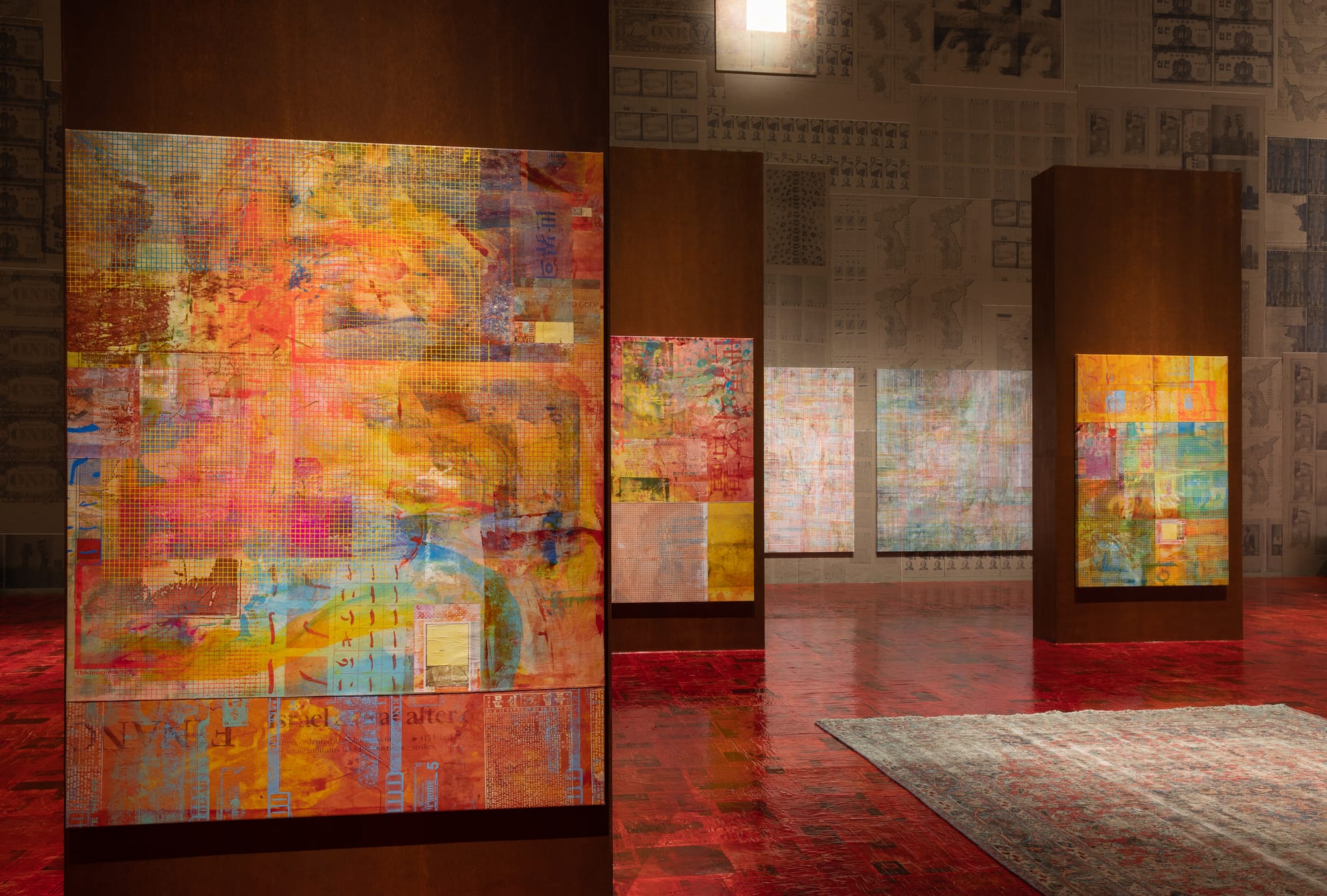
The final section intensifies this complexity. The gallery floor is covered in sheets of newspaper, which El-Sayegh smeared with a thin layer of red latex, turning the ground into a blood-tinged tract of printed matter. As visitors step across the sanguine floor, the red latex evokes both personal and social registers, as it pays tribute to Palestinian resilience, Chinese symbols of prosperity, the human life cycle, and El-Sayegh’s mother’s memories of working on rubber plantations in Malaysia. Paintings are mounted on freestanding walls, resembling enlarged tombstones, while the ambient soundscape is interrupted by eruptions of revival-style prayer.
In the Burning Square series (2023– ), snapshots from a Tiffany campaign with actress Anya Taylor-Joy—a modern-day embodiment of classical beauty—appear behind newspaper coverage of massacre and violence, blurred or partially obscured by gold joss paper (which is usually burned during East or Southeast Asian spiritual ceremonies). Among the gazettes, a Financial Times front page is headlined “Israel at war after deadly Hamas attack.” The mashup is jarring—not because these symbols can be translated into a single critique of opulence, death, or spectacle, but because they remain locked in a troubling adjacency. Glamor, mourning, bloodshed, and ritual practice occupy the same arena.
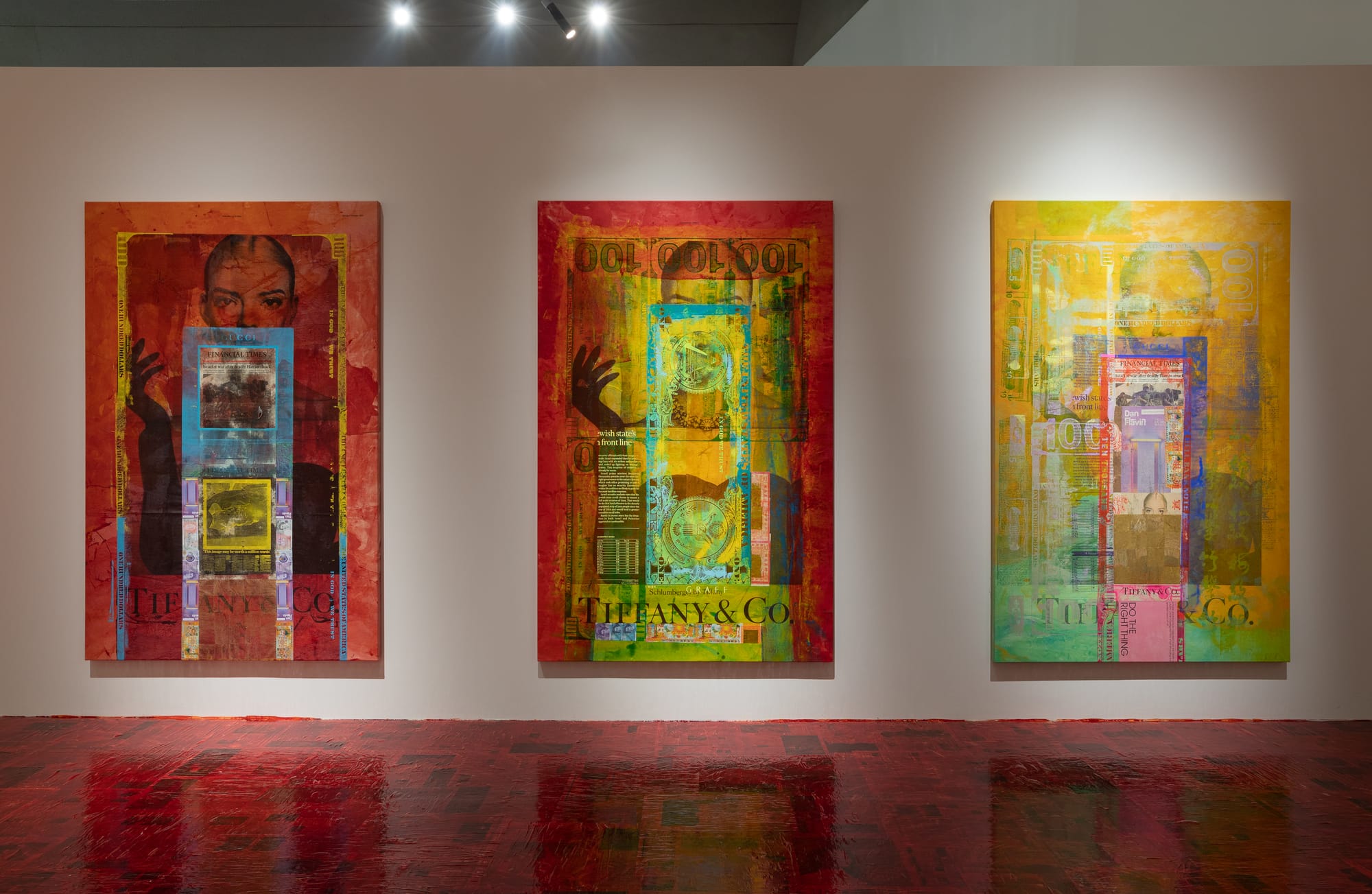
This is also where the exhibition exceeds the curatorial language of “giving voice” to the unheard. El-Sayegh’s work does not simply speak for marginalized women or articulate the meanings behind these images or marks. To frame it that way risks missing the material friction that keeps the paintings from becoming purely illustrations of a political argument. What matters is not that these remnants are finally made legible, but that they are kept in conversation without reconciliation, inviting multiple, even contradictory readings. “For Theresa” is strongest when it treats the archive not as a place where silenced histories are (re)stored, but as a site where images continue to collide, adhere, shift, and accuse. Even as the works remain infatuating, their visual pull does not dilute the political charge—they keep us looking long enough to feel implicated in its circuits.
Jiwon Yu is a curator, writer, and translator mainly based in Seoul. She was the assistant curator of the 11th Seoul Mediacity Biennale (2019–21) and a curator at the Leeum Museum of Art (2022–24). Since 2016, she has been a member of the art writers’ collective Yellow Pen Club and is currently the co-director of its program and exhibition space, YPC Space.