Shows
Grounding the Body: Jin Shan at the Jiayuanhai Art Museum
Jin Shan
All Begins with The Body…
Jiayuanhai Art Museum
Shanghai
May 1–Jul 26, 2026
On the outskirts of Shanghai, nestled among the vineyards and rice fields of Dayu Village, the Jiayuanhai Art Museum rises against the horizon in Tadao Ando’s signature smooth concrete forms. My father was kind enough to drive me, though he spent most of the journey complaining about how far out of the way it was. Near the end of the journey, a small flock of sheep blocked the way, and I walked the remaining 15 minutes.
The museum’s remote location, austere design, and proximity to nature resonate with Jin Shan’s sculptures on view. The Shanghai-based artist’s solo exhibition, “All Begins with The Body…,” curated by Hou Hanru, doubles as a reflection on the contemporary mind-body dualism and a parent-child workshop inviting visitors to engage with the space. On the day of my visit, a children’s tour happened to be underway. Rather than unpacking the works’ conceptual layers, the staff offered a simple takeaway: “Our bodies are the most important thing.” Unexpectedly, this straightforward statement cuts to the heart of the show.
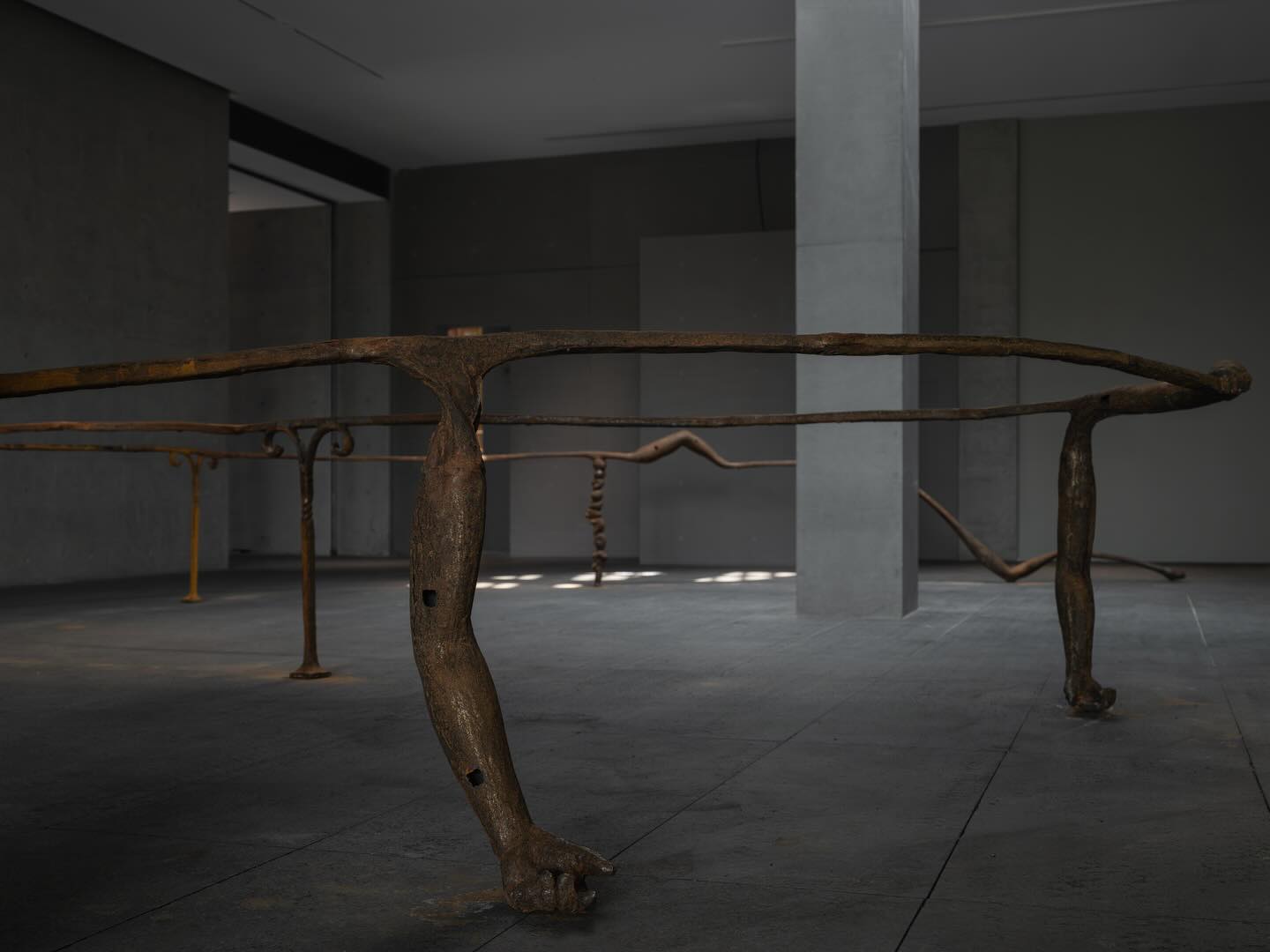
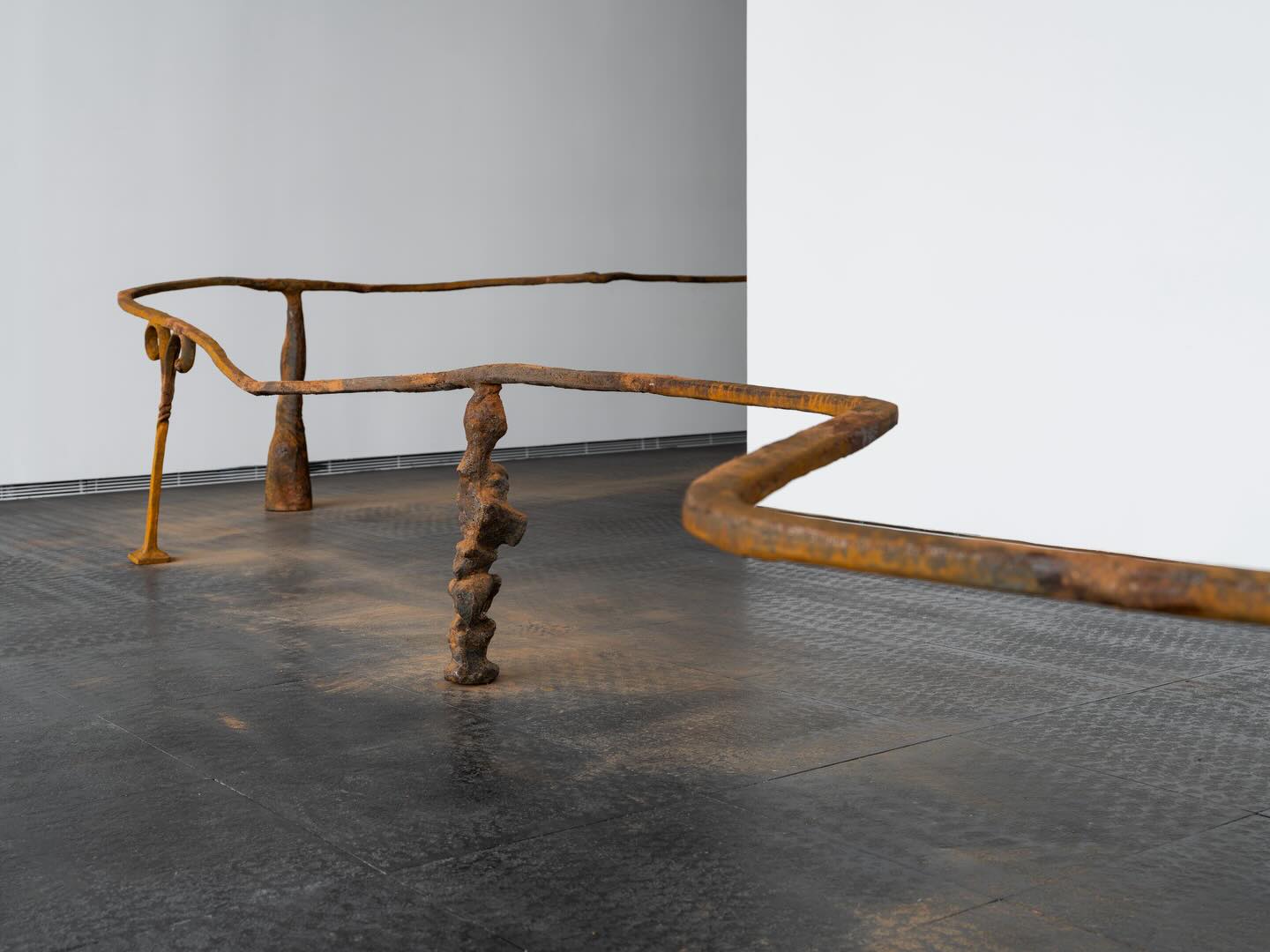
Installation views of JIN SHAN’s Ouroboros, 2026, cortex steel, 12000 × 100 × 80 cm, at ”All Begins with The Body...,” Jiayuanhai Art Museum, Shanghai, 2026. Courtesy the artist and the Jiayuanhai Art Museum.
The exhibition is loosely mapped according to human anatomy. At the central hall is Ouroboros (2026), a site-specific, 120-meter-long metal railing that winds through the space like a spine, encircling disparate works at its center while mediating access to them. Supported by and affixed with limbs and organs—hands, arms, legs, hearts, stomachs—the balustrade’s rusted, twisted form recalls ancient bodily remains. Its title derives from the Greek mythological serpent that eats its own tail, symbolizing self-consumption and cyclical time. Ouroboros traces a circular path that ultimately returns to its point of departure, yet the viewing experience differs depending on which side of the railing visitors choose to start their route: staying “inside” draws them into the enclosed constellation of works, while remaining “outside” keeps them looking in from a distance.
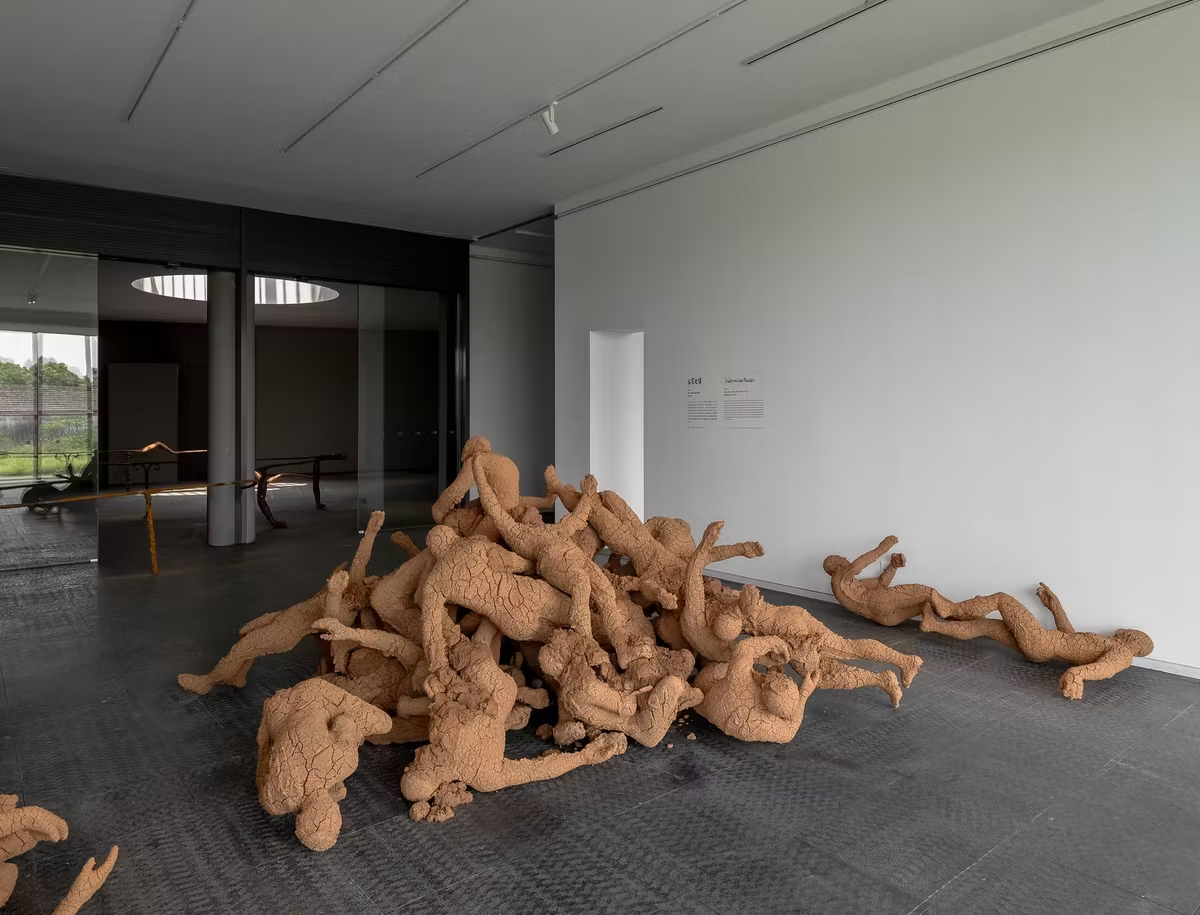
I chose the right-hand path, which placed me on the latter course. Across a dim corridor, natural light pours through floor-to-ceiling windows into three interconnected galleries, where some 50 clay figures are scattered across the floor. Titled Indeterminate Matter (2026), the human-sized sculptures are frozen mid-rest or mid-struggle—sitting, standing, reclining, or piled atop one another. Their dry, cracked surfaces suggest skin and muscle weathered by time, yet their bodily presence persists. Tatami mats placed among the figures invite visitors to sit and join the congregation; at one point, a little girl wandered away from the children’s tour and settled onto one, momentarily becoming part of the installation.
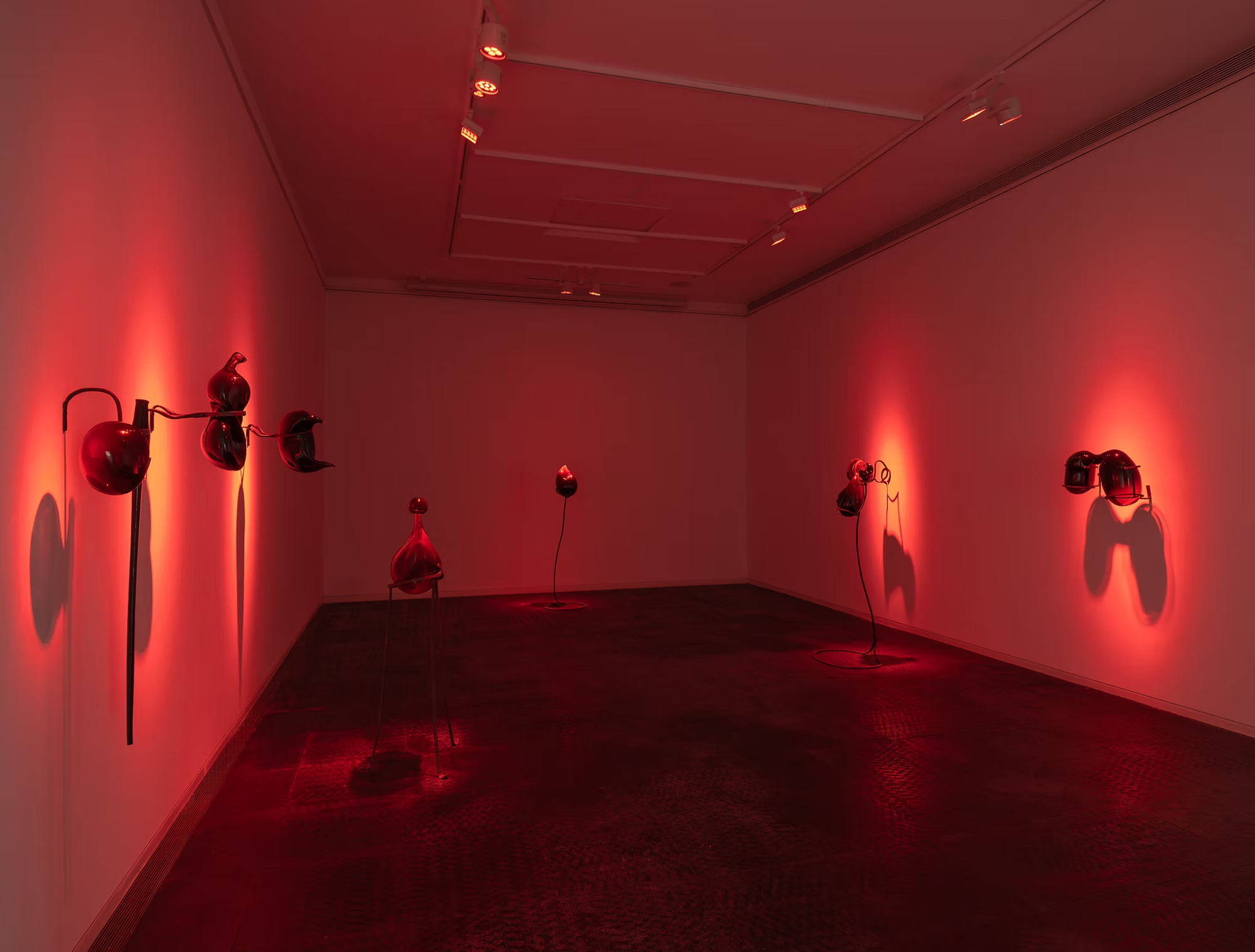
As a counterpart, Interior Desolation (2026) occupies an adjacent gallery, reached by retracing one’s steps to the left side of Ouroboros. Eight scarlet, glass-blown forms, mounted on metal racks, resemble abdominal organs, their translucent surfaces evoking flushed flesh and tissue. From skeletons and limbs to flesh, muscle, blood, and organs, the exhibition guides visitors through a corporeal journey, inviting a renewed awareness of one’s body—a grounded consciousness in our physical being.
Outside, workers were plowing the fields; I imagined that come autumn, the museum would be merged in golden rice spikes. The exhibition’s meditation on the body concluded in a small open-air yard where Jin Shan had buried his sculpting tools underground, leaving indents visitors can fill with plaster to recast them. The intervention turned the space into a graveyard—and a site of rebirth—for artistic labor. The work’s title, Limbo (2026), transliterates the Chinese original, 灵泊, which loosely translates to “where the soul comes to rest.” In English, “limbo” carries connotations of suspension, in-betweenness, and transition, echoing the cyclical logic of Ouroboros.
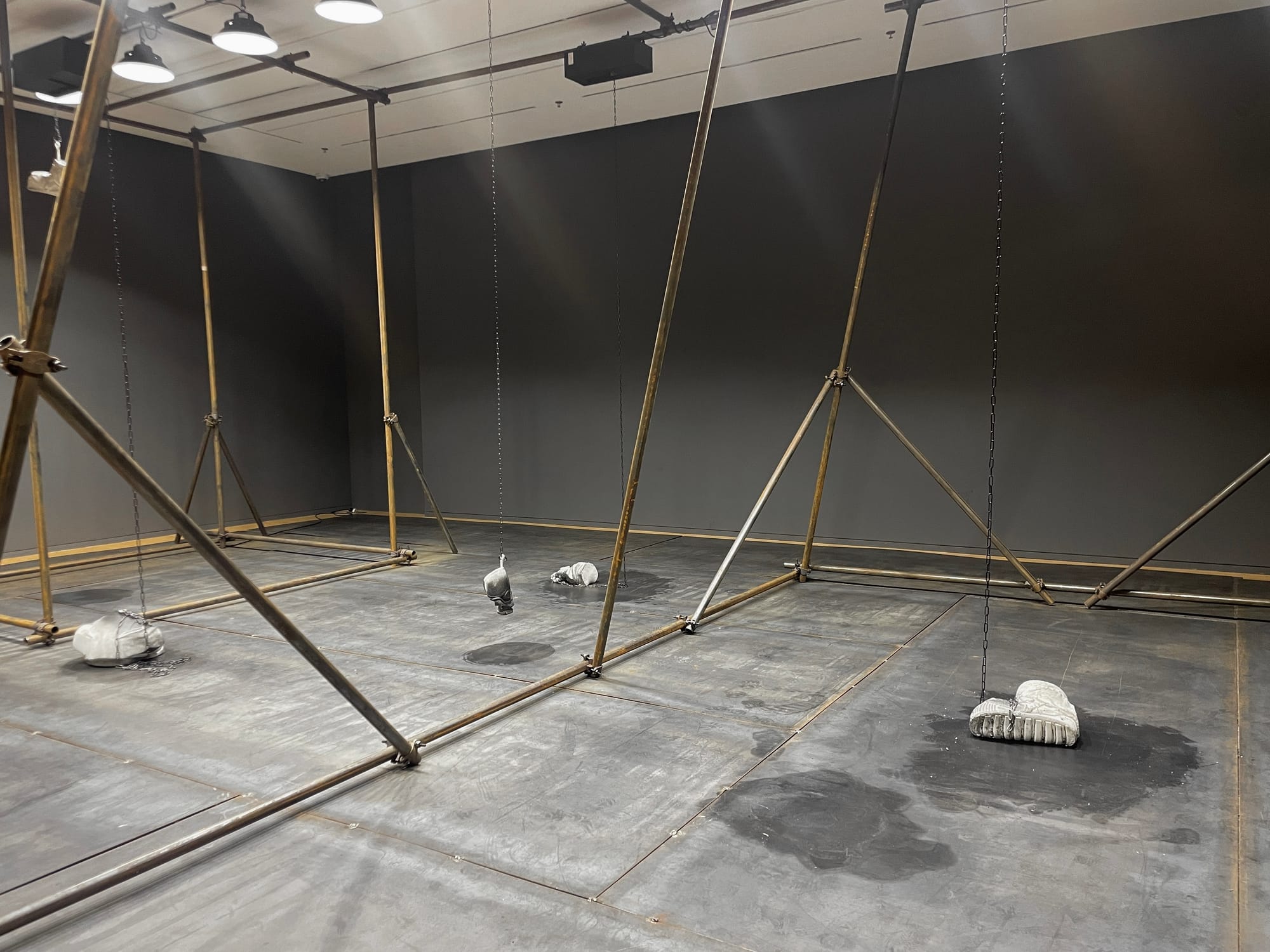
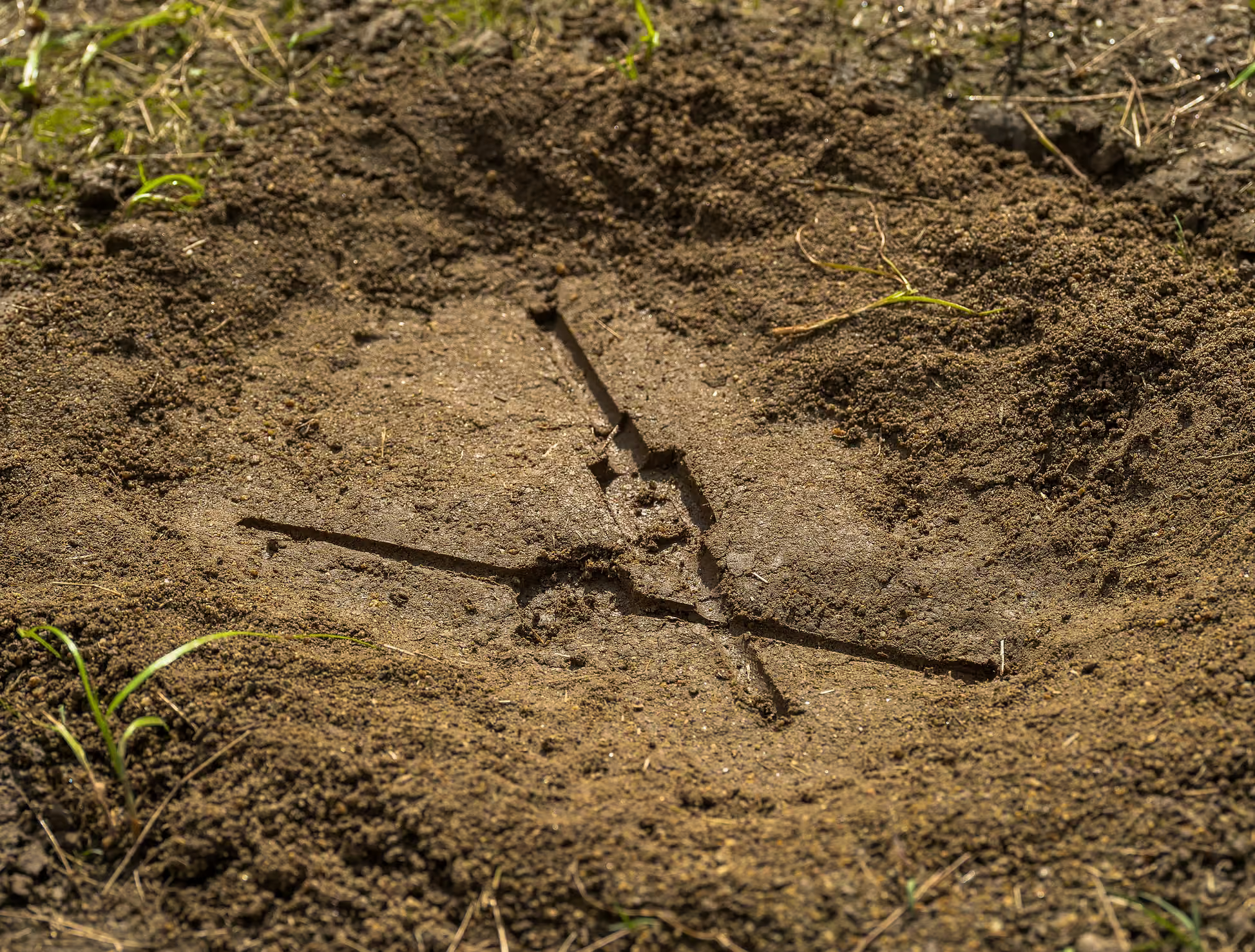
Installation views of JIN SHAN’s Recursive Loop, 2026, soft silicone, iron chains, motors, iron pipe, 800 × 900 × 300 cm, at ”All Begins with The Body...,” Jiayuanhai Art Museum, Shanghai, 2026. Photo by Yuqian Fan for ArtAsiaPacific (left); and Limbo, 2026, plaster, dimensions variable, at ”All Begins with The Body...,” Jiayuanhai Art Museum, Shanghai, 2026. Courtesy the Jiayuanhai Art Museum (right).
The final work, Recursive Loop (2026), occupies a separate gallery near the central hall. Suspended from a mechanical apparatus, soft silicone forms resembling fragments of an astronaut’s spacesuit rise slowly, then are abruptly released—crashing onto the metal floor with dull, reverberating thuds. Flattened upon impact, they regain shape only to be lifted and dropped again. Jin Shan calls these forms Su-Jin-Ki, a philosophical concept in material culture describing objects that become extensions of human life through prolonged use. Here, they channel humanity’s technological ambitions, yet every attempt at elevation is interrupted by gravity. In an age increasingly defined by disembodied consciousness and technological acceleration, Recursive Loop reminds us that before we reach for lofty elsewheres, we remain creatures of flesh and weight.
Before leaving, I stopped at the counter to ask how the show was initially conceived. A staff member told me the artist had found his inspiration doing clay crafts with his daughter. There is something quite apt about an exhibition concerned with physical existence and tactile experience beginning with simple acts of making, one generation’s hands quietly guiding the next. In an art world favoring grand metaphysical propositions, “All Begins with The Body…” insists on something fundamental: before bodies become political, philosophical, or symbolic, they are simply where we begin.
Yuqian Fan is an editorial assistant at ArtAsiaPacific.