Shows
A Discipline of Feeling: On “Youth Palace” at the Rockbund Art Museum
Youth Palace: or, some small acts of self-making
Rockbund Art Museum
Shanghai
Jun 1–Sep 20, 2026
There is a particular architecture of socialism that anyone raised under it can summon instantly. In China, as across the former Soviet world, these spaces had a distinct name: the Youth Palace, or Children’s Palace (shaonian gong)—the state’s principal vehicle for after-school formation and extracurricular life, opened in city after city from the mid-20th century onward to round the young into model citizens through dance, chorus, calligraphy, theater, and gymnasium classes. For the generations that passed through its halls, it is more than just a building: it is a structure of feeling, a sediment of shared memory.
To use this specific institution as the conceptual armature for an exhibition is to propose an analogy that comes close to the museum itself. This is the premise of “Youth Palace: or, some small acts of self-making,” a sprawling group show at Shanghai’s Rockbund Art Museum, curated by X Zhu-Nowell. If the Youth Palace shaped habits of leisure, organized knowledge, and lent certain values the authority of culture, then what, the exhibition asks, does a museum do when visitors walk through its doors? What kind of education is being dispensed through objects and wall labels, that indicate what counts as art and what does not? These questions are not new, but the conceit of the Youth Palace gives it an unusually intimate, almost autobiographical charge.
The exhibition’s title enacts displacement at a linguistic level. The Chinese title, Yousipalisi, is a phonetic transliteration of the English “Youth Palace.” The name of the edifice itself descends from the Soviet Dom pionerov/Дом пионеров (House of Pioneers)—a state center for members of the Young Pioneers, and a place of instruction that was also a built promise of the socialist future. As its designation is reduced to pure sound, drained of semantics, the Youth Palace is cut loose from its political origin and instead points to something spectral: the you (幽) embedded in yousi (幽斯) is the same character that anchors youling (幽靈), the Chinese word for “ghost” or “revenant.” It is a clever piece of philology that allows the exhibition to announce itself not as the aspirational site of modernity and collectivity but as its haunted afterimage—a liminal, phantom palace, denoting both ruin and return.
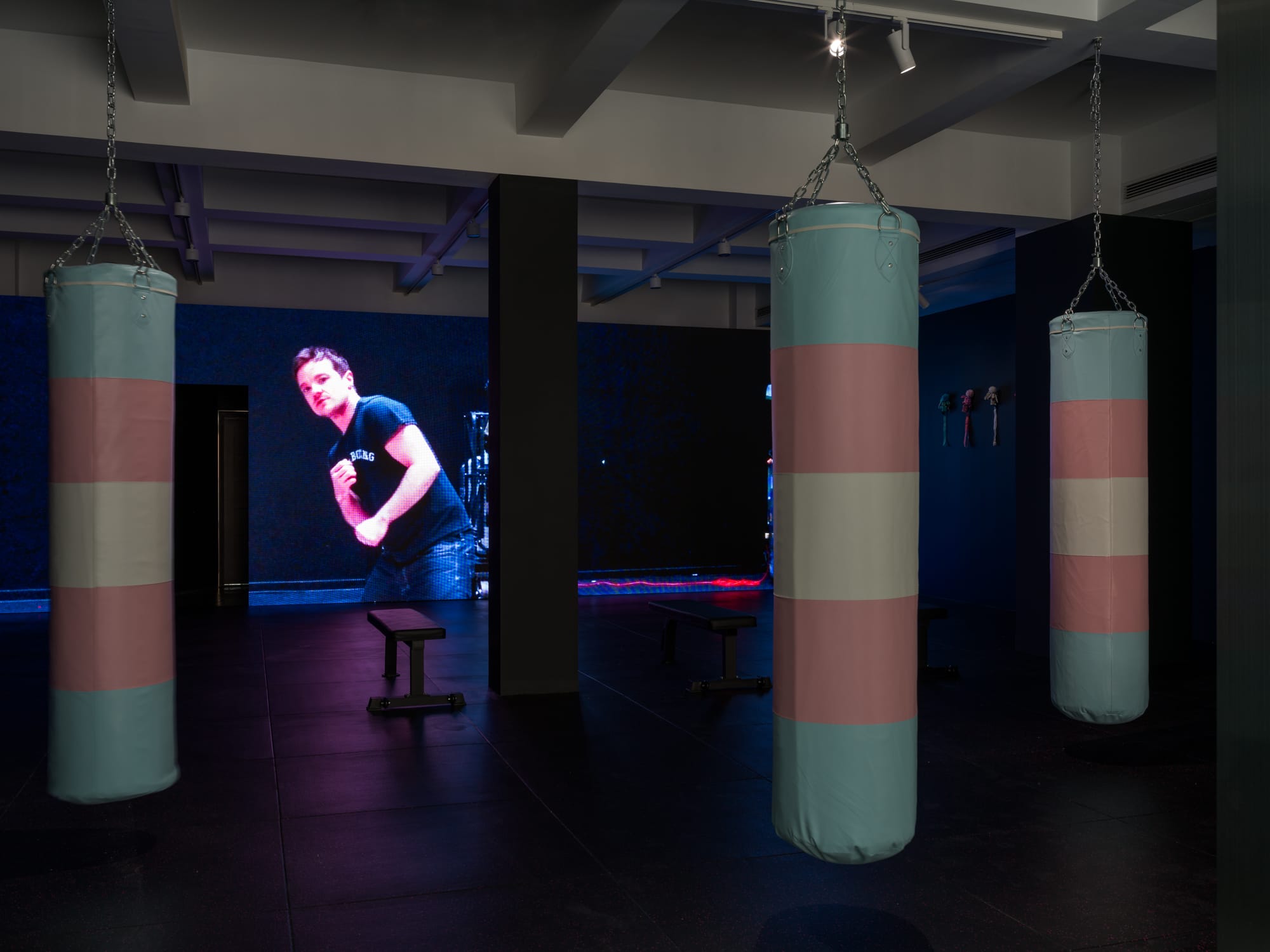
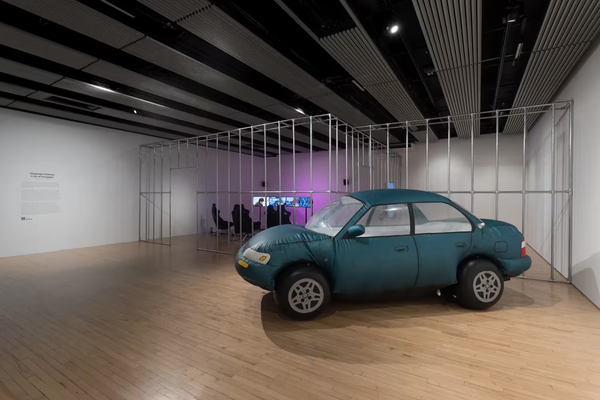
“Youth Palace” embodies this melancholy even as it attempts to convert it into critique. On the ground floor is a working boxing club by Japanese Puerto Rican artist Puppies Puppies (Jade Guanaro Kuriki-Olivo). Punching bags with white, pink, and pale-blue stripes (a nod to the transgender flag) dangle above rubber mats; gym benches line the room; a large, wall-based screen runs self-defense tutorials in boxing, Muay Thai, and jiu-jitsu. Ten self-defense kits—each consisting of a key knife, whistle, door opener, kubotan, cat knuckles, pepper spray, stun gun, Bluetooth tracker, alarm, and window breaker—are mounted on another wall, attached to blue, white, and pink lanyards with pom-poms and lipstick pouches. As the artist’s statement notes, “we must take on these roles of care and survival within our own communities.” Against systems that have failed the vulnerable, self-defense becomes essential “in the face of perpetual violence” directed at women, people of color, trans and queer people, and others held at the margins.
If the socialist gymnasium trained the body for the collective future, for production and national defense, Puppies Puppies retains the apparatus of physical conditioning but reroutes its purpose entirely. Exercise is no longer the rehearsal of a citizen-body for the state but the equipping of a precarious body against it—an intersecting field of gendered, racialized, and transphobic harm. It is a forceful opening, though it also raises the question of how North American identity politics could be translated into the Chinese pedagogical context that the exhibition tries to invoke.
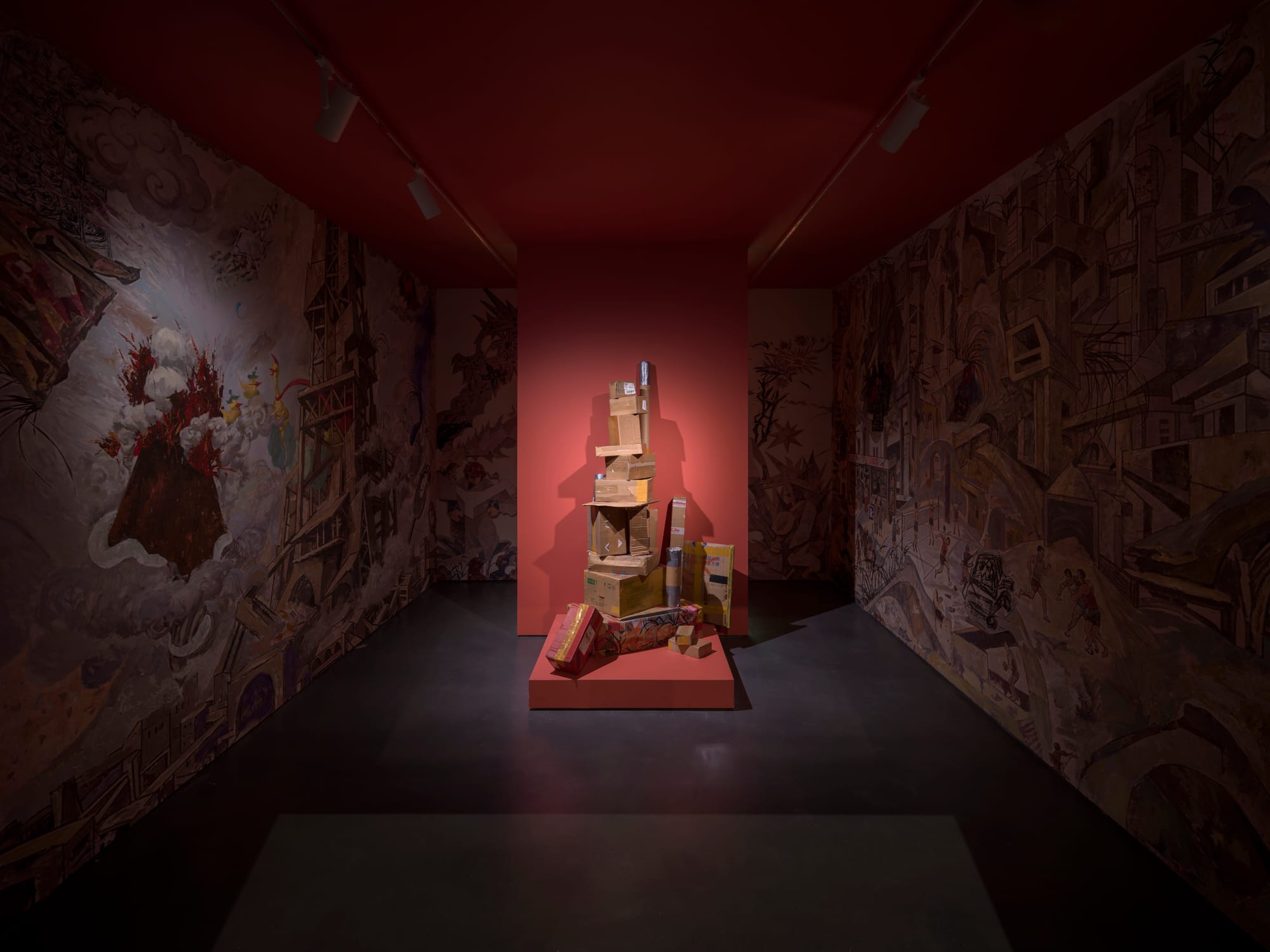
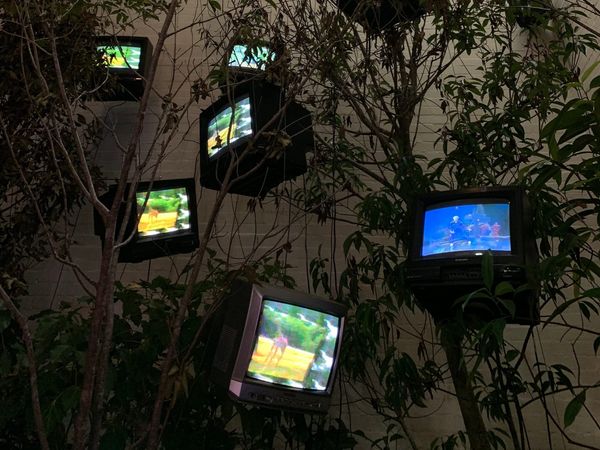
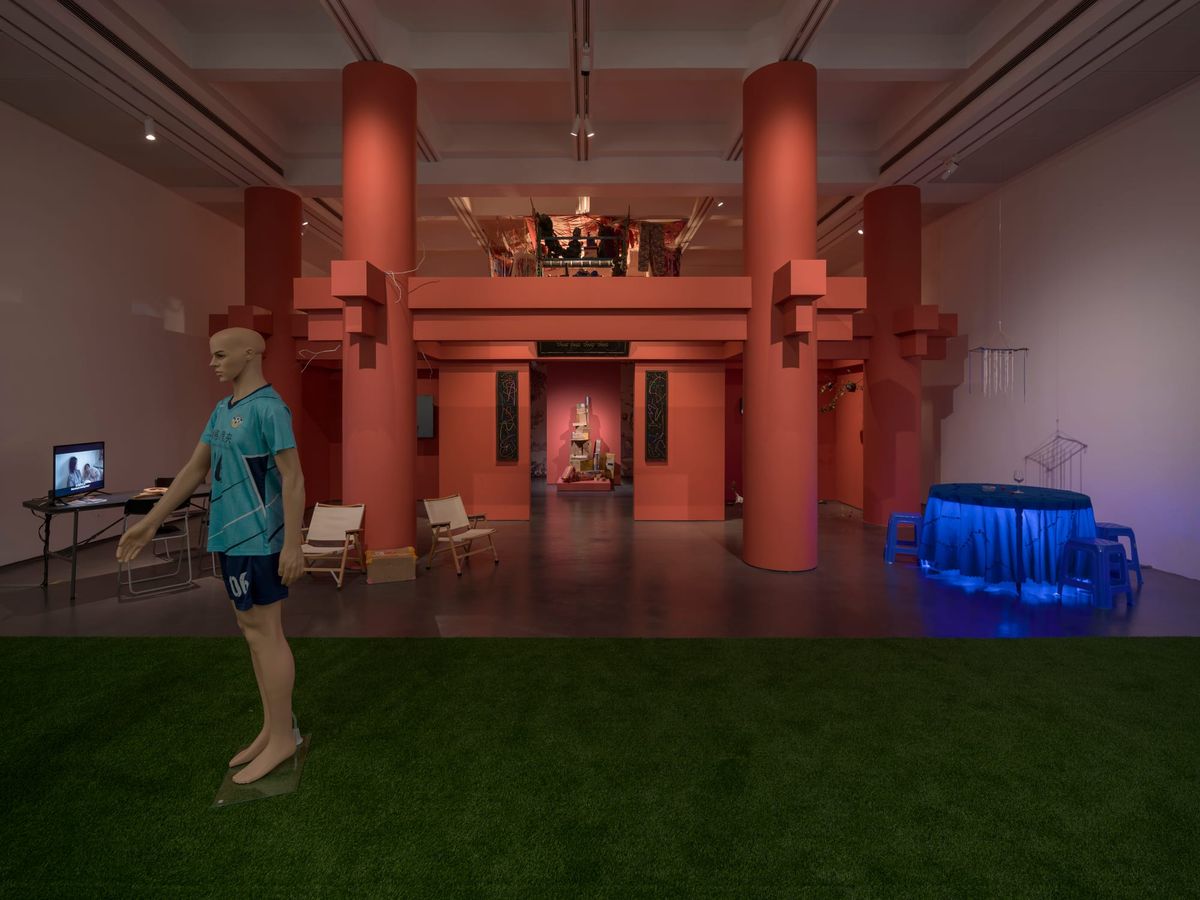
Physical exercise is complicated, more wryly, on the second floor. Here, Chinese artist Ge Yulu marshaled a number of artists to build a “hall of activities” titled Xu Wu Tang (虚务堂)—the Hall of the Use-Less, which puns shiwu (实务), meaning practical and productive business. Since 2017, Ge has interrogated the social value system through the lens of non-productivity. In the foreground, a miniature soccer arena by Peng Xueying features artificial turf with balls scattered around for visitors to kick, while jersey-wearing dummies clustered at the entrance recall Isa Genzken’s mannequin-sculptures. Surrounding TVs screen footage of the artist and recruited participants playing soccer in the streets of Guangzhou; scuff marks streak the wall and one of the displays is cracked—residues of the convivial game. In the background looms a solemn orange-red structure of pillars, wherein a mural depicts young people running and exercising among concrete gray landscapes and buildings whose style is unmistakably reminiscent of Soviet Constructivism, representing the once-aspirational emblems of a social utopia. Near a monumental tower, toy-like figures appear that resemble a squeaking rubber chicken and a bath-time duck—a deflationary intrusion that punctures the optics of grandeur and ultimately tips the tableau toward sardonic pastiche. The installation locates non-productivity as a sly form of refusal; a “uselessness” that withholds the body from both the plan and the market, socialist and neoliberal alike.
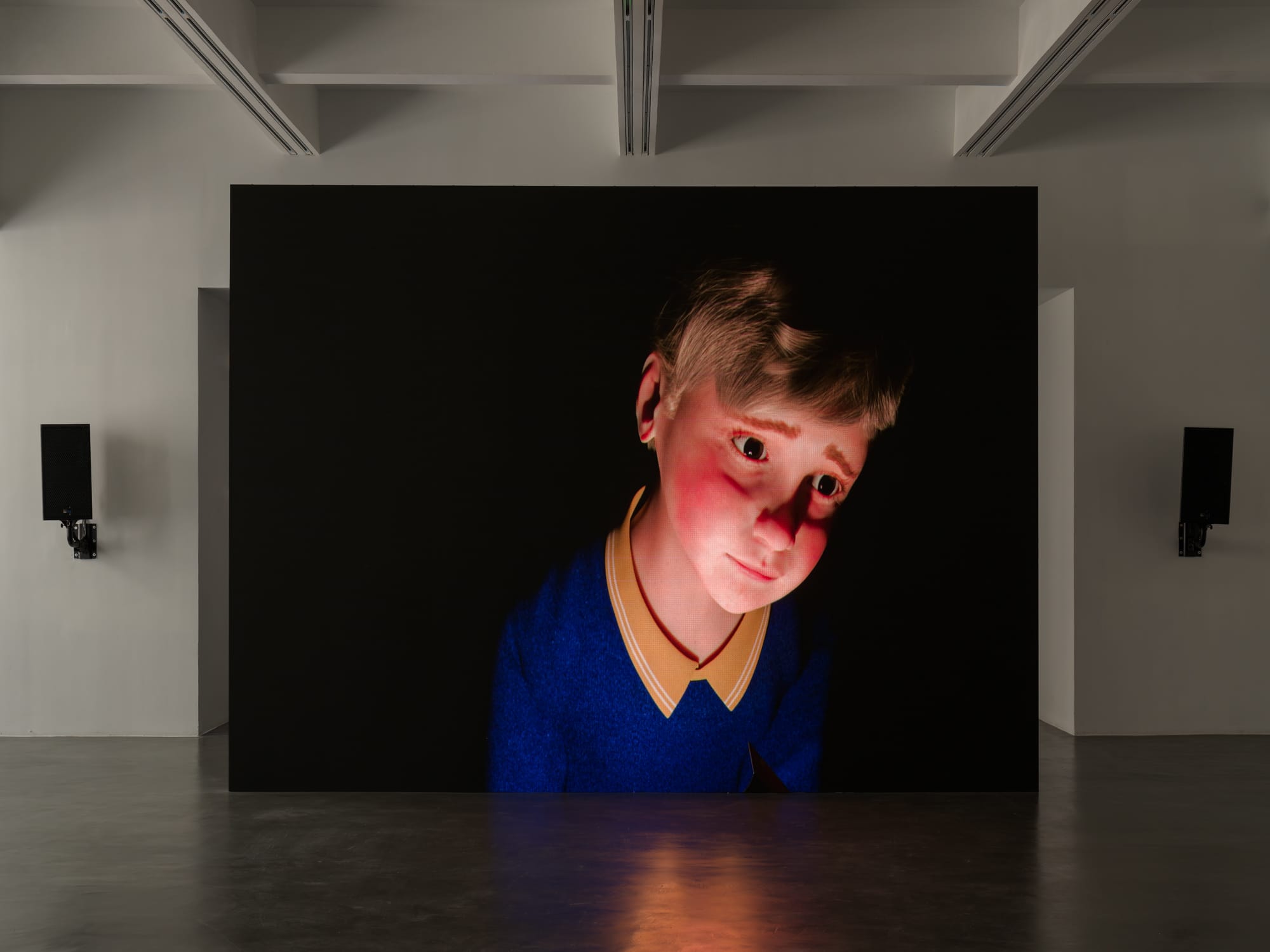
The third floor turns to the disciplined psyche, specifically to the child as an ideological vessel. Diego Marcon’s video work Ludwig (2018) shows a lone child, set against a dark background under dramatic, theatrical lighting, singing in a melancholic, almost pitiable way as thunder mutters in the distance. With no overt politics in sight, the film’s subject is something closer to a free-floating dread. But encountering it within “Youth Palace,” one can’t help but feel the curatorial frame retrofit it with meaning. The socialist children are “Little Leninists” in the Soviet lexicon, the “morning sun” in Mao’s words—they are successors, bearers of the future. Marcon’s solitary singer, stripped of all collective scaffolding, almost allegorizes the affective cost of being made into a symbol, and the sentimental and disciplinary violence accumulated in that experience.
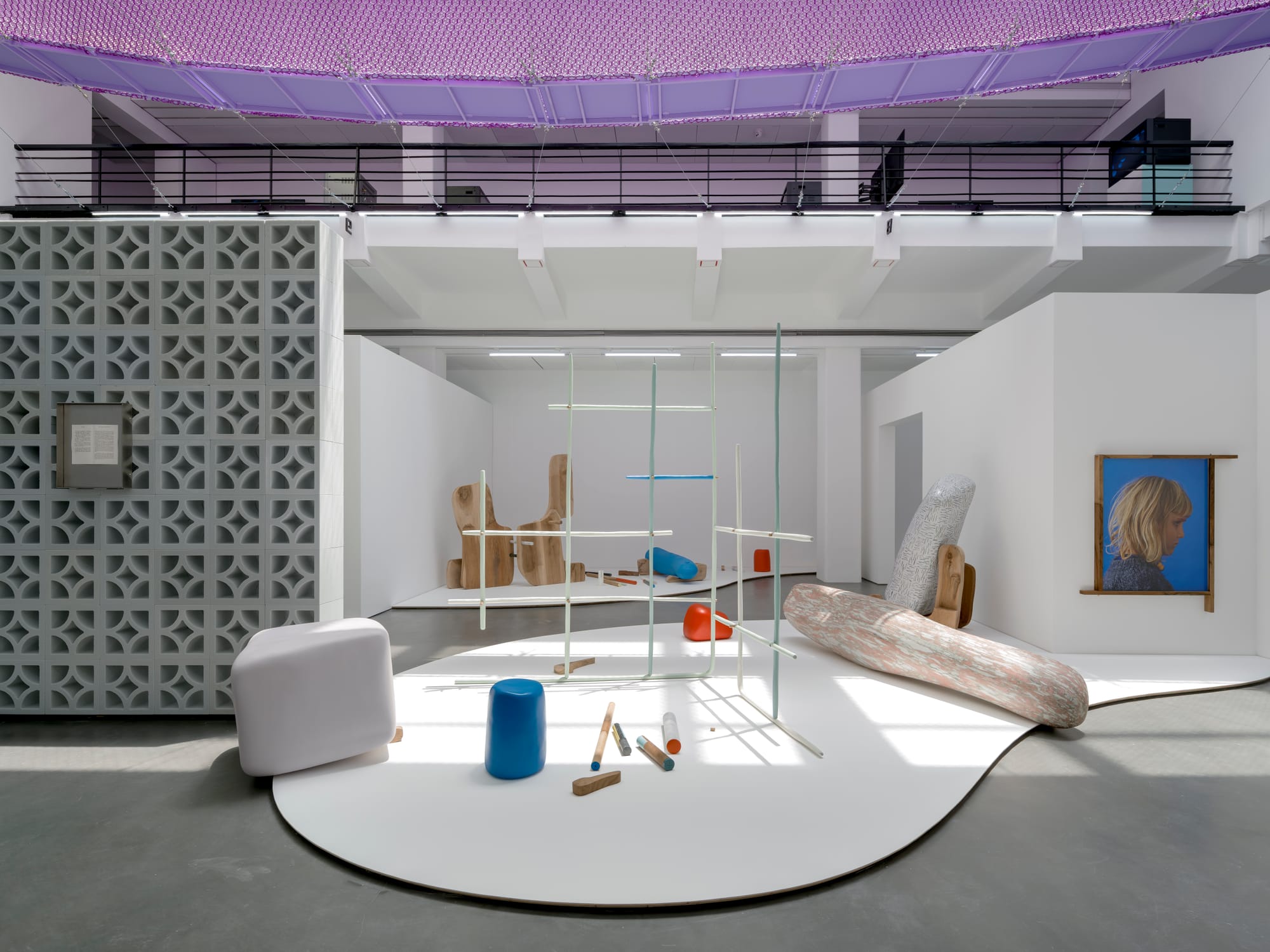
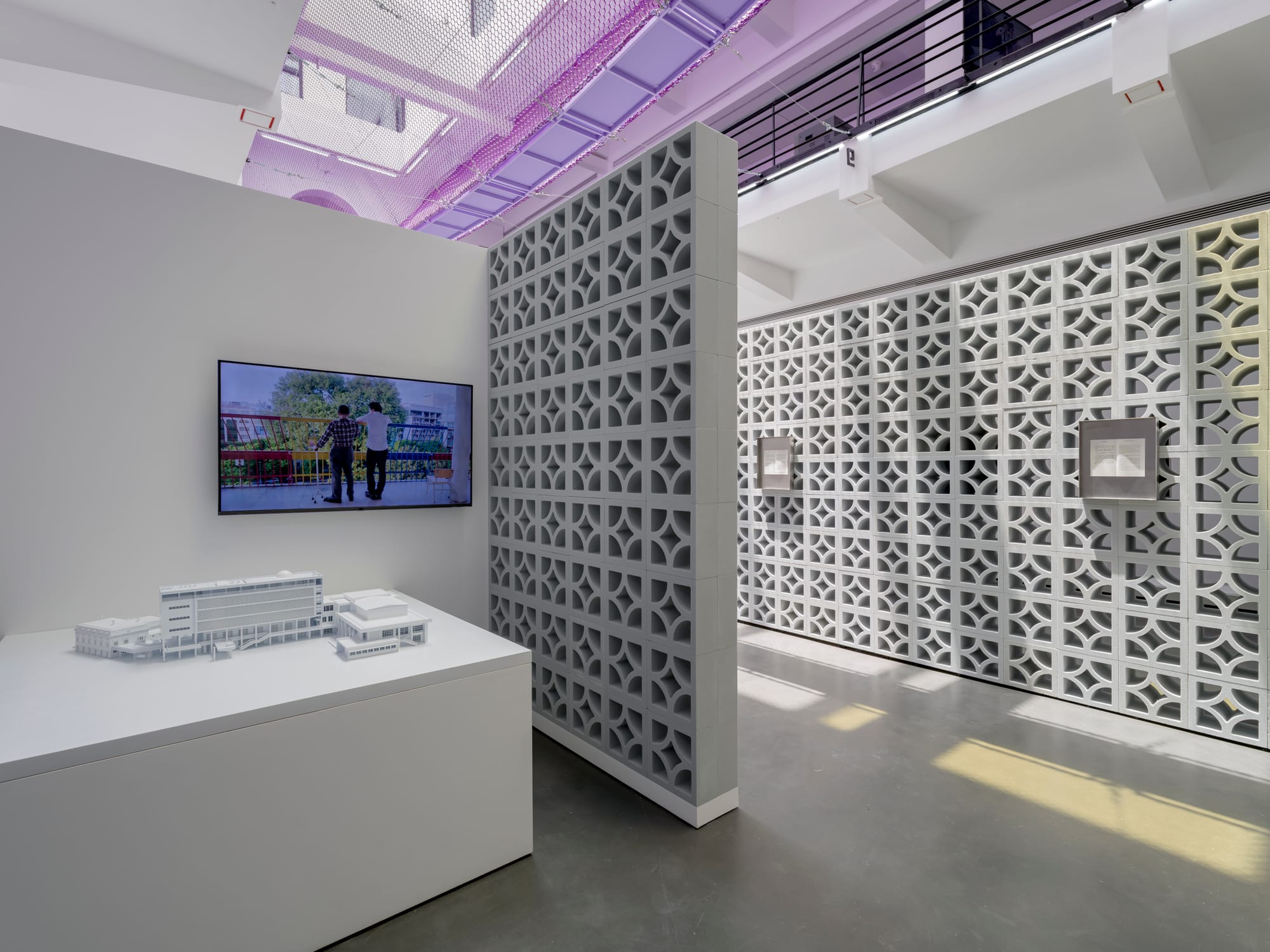
This inquiry into a child’s interiority continues on the fourth floor in Nairy Baghramian’s Misfits (2021)—biomorphic sculptures made of varnished aluminum, carved marble, and walnut wood. Modeled on children’s assembly-building toys, these candy-colored shapes look as though they should dovetail but do not. They are studies in the affect of incongruity, in the frustration and small grief of a toy that refuses to function, of parts that will not cohere into a whole. This argument about unity finds its counterweight in the documentation, installed on the same floor, of the Hanoi Children’s Palace—a site-specific curatorial project first presented in the 2024 Hanoi Creative Design Festival. Here, it includes an architectural model tucked into a corner.
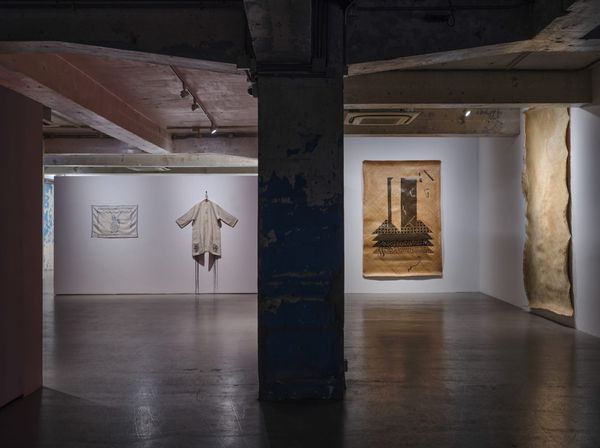
The site began as a kindergarten under French colonial rule in the 1930s; in 1946 it was taken over by the Democratic Republic of Vietnam and made into the headquarters of the Young Pioneer Organization, whose mission to stage cultural life as well as mobilize children and youth persisted through the anticolonial movement and the war against the US. In 1974, supported by the Czechoslovak Socialist Republic in the spirit of Soviet-bloc camaraderie, architect Lê Văn Lân transformed the building into a six-story complex distinguished by its perforated concrete sunshades and the Red Scarf Theatre. The Palace was thus a node in a transnational network of cultural-didactic infrastructure, with the formative task to spatialize ideology and choreograph a collectivity pitched toward what was to come, all in the service of rebuilding a nation from the wreckage of war. Beneath this history, however, the project stirs a more visceral emotion—not quite longing, but something closer to nostalgia. Encountering a giant photograph of the Red Scarf Theatre printed on fabric, I was transported back to Monday mornings with the red scarf knotted at my neck, to the rows of students assembling for the flag-raising ceremony, and to the group exercises that followed in the school courtyard. For the conditioned viewer, the project feels like a tender repository of a faraway childhood.
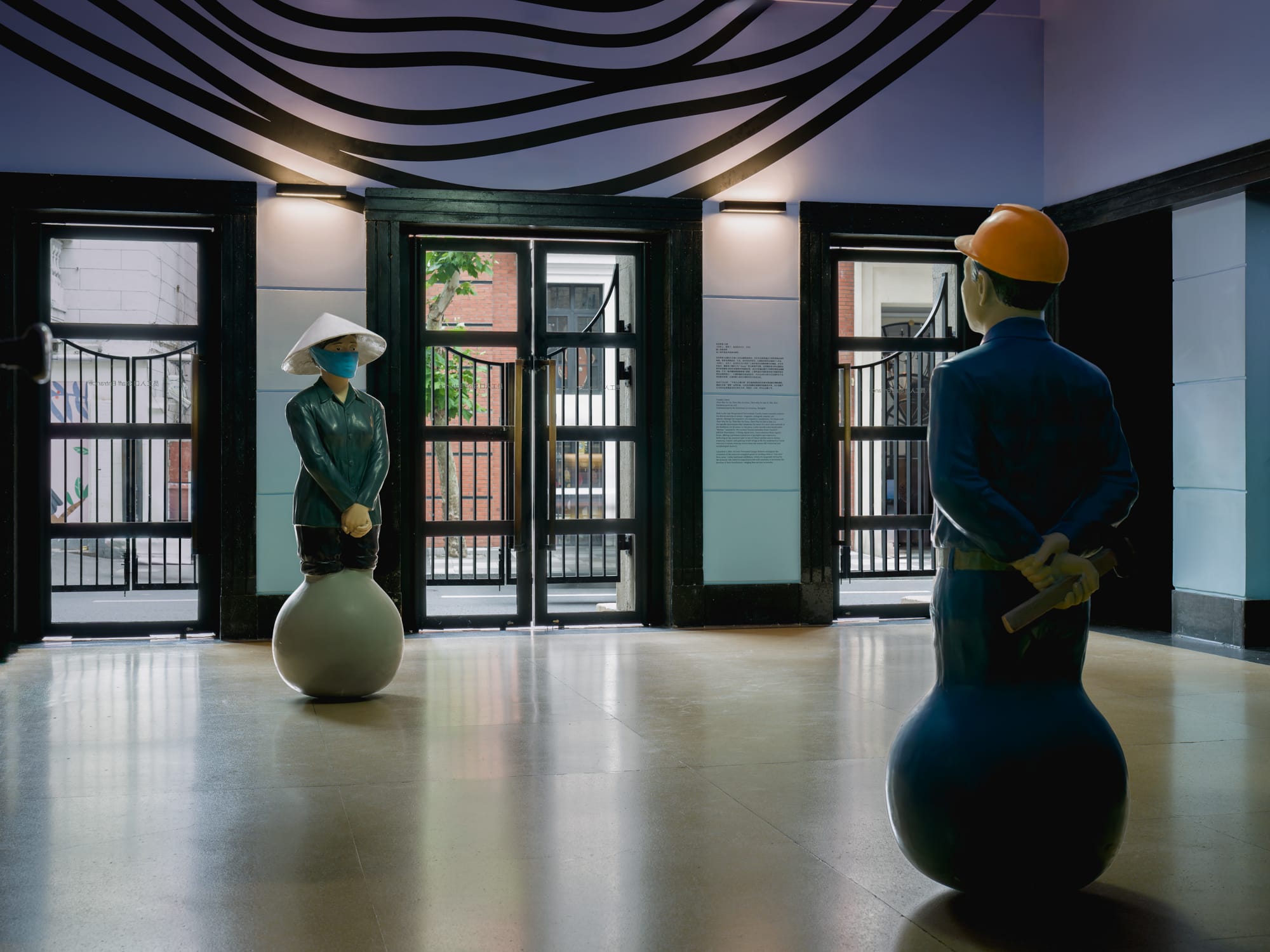
Stationed around this photographic reproduction is Nguyễn Trần Nam’s We Never Fell (2010), a set of life-size composite-fiberglass sculptures derived from the lật đật, a roly-poly balance doll imported into Vietnam through Soviet and Eastern-bloc aid and trade from the 1960s through the ’80s. Two stand on the fourth floor; three are dispersed across other levels of the museum. Each is modeled on a vocation in socialist Vietnam, including the peasant, the teacher, the worker, the student, and the artist. The roly-poly’s mechanism—righting itself with every push—exemplifies resilience and stability. Yet it also prompts the question of whether relentless self-correcting might calcify into rigidity, creating an organism that stays alive only by declining to change. Are we the hand that pushes, the work asks, or have we already been wound into the contraption? The scene is a meditation on socialist pedagogy as such—on discipline, on observation, on the suspension of action—where perseverance can no longer be told apart from an unwillingness to change. Set beside Baghramian’s Misfits, the floor produces the show’s most generative tension.
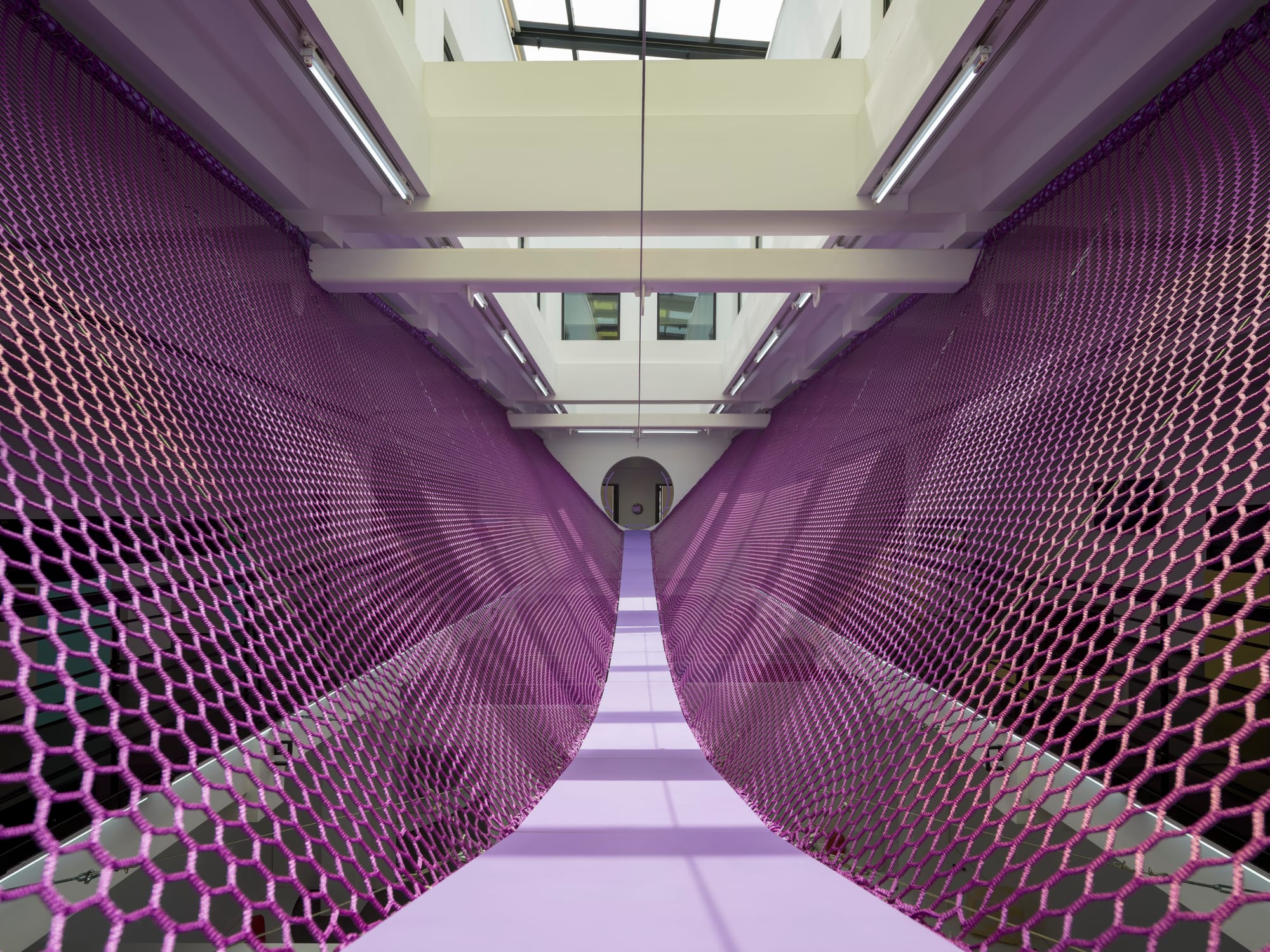
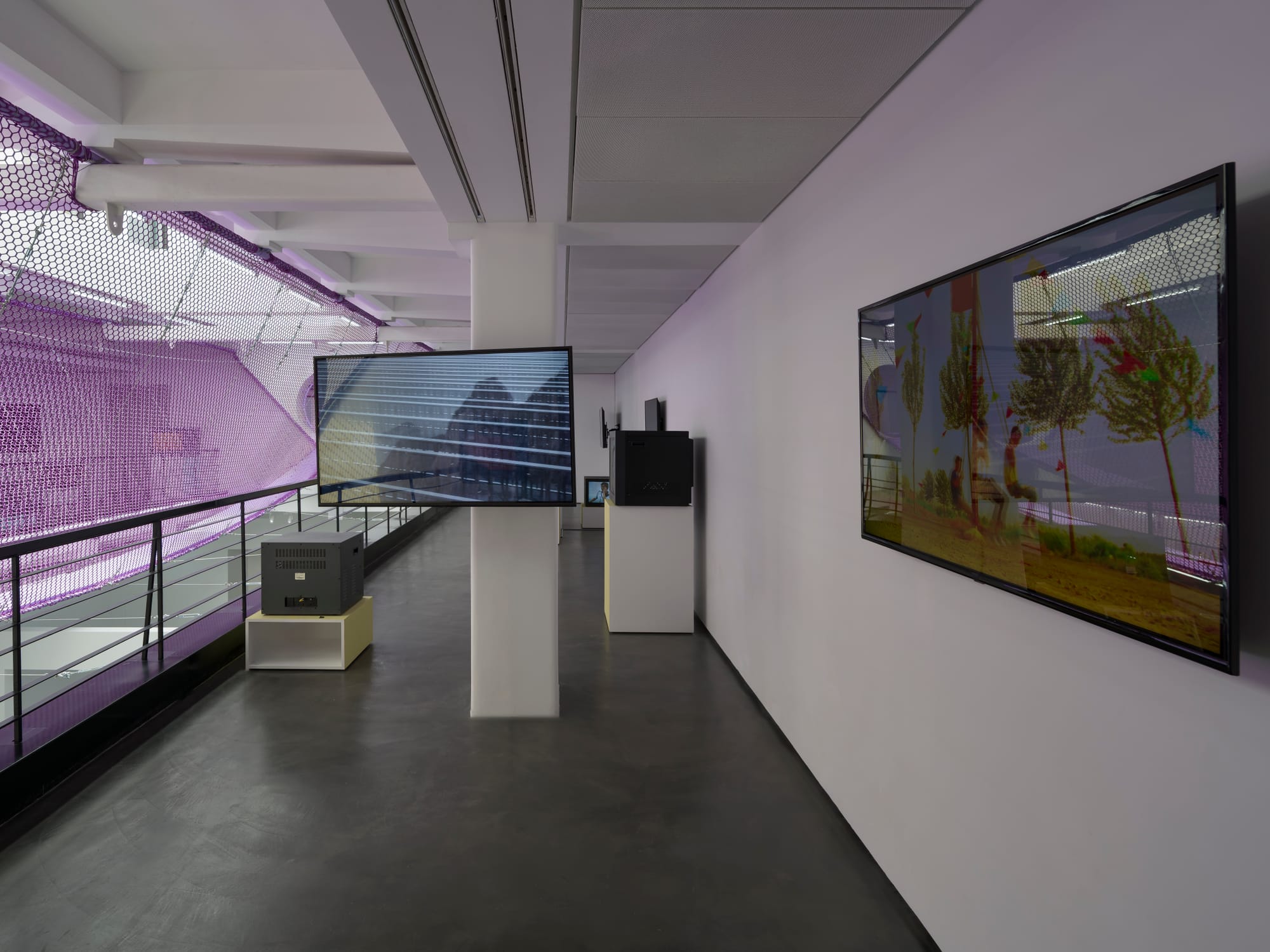
The fifth floor returns, in the manner of Ge’s Hall of the Use-Less, to the politics of unproductive play through Li Ming’s enclosed suspension bridge made of rope. The newly commissioned installation stretches across a central void, hovering over the fourth floor. The work draws on the “Path of the Brave,” an obstacle course commonly set up in Chinese children’s palaces, and is accompanied by videos that Li made with artists Lin Ke and Yang Junling, his classmates from the China Academy of Art in Hangzhou. These films belong to a decade-long and ongoing annual ritual in which the three document days spent deliberately slacking off together: going places, laughing, doing nothing of consequence. By setting the ideologically freighted Path of the Brave against a self-imposed rite that amounts, by design, to nothing, Li makes idleness into a serious proposition.
Zhu-Nowell frames the stakes as a question put to the institution itself: whether an art museum, as a discursive establishment, can “tolerate the opacity of meaning, the provisionality of structure, and a lateral transmission of knowledge that breaks down the walls between disciplines.” If discipline manufactures its subjects through repetition, surveillance, and the internalization of control (to paraphrase part of Michel Foucault’s discourse), then the museum too is a structure into which bodies enter to be made—a covert pedagogical apparatus that produces “aesthetic knowledge” and confers the legitimacy of taste. The curatorial gesture of “Youth Palace” confronts a socialist legacy and bends it toward a new use: it seeks to expose its machinery and, in the same motion, to imagine the museum otherwise as a “heterogeneous” space, to quote the curator, capable of producing an aesthetic experience that opens onto a vital freedom somewhere on the horizon.
Louis Lu is an associate editor at ArtAsiaPacific.