Shows
Up Close: stephanie mei huang’s “yellow porcelain” at DE SARTHE
stephanie mei huang
yellow porcelain ii (outside the Los Angeles Police Academy)
DE SARTHE, Hong Kong
May 16–Jun 27, 2026
Perched on the hills of Elysian Park, less than three kilometers north of downtown Los Angeles, the Los Angeles Police Academy commands a sweeping, elevated view of the surrounding neighborhoods. The campus, built in the 1930s by public intoxication arrestees, serves as a training facility for the city’s law enforcement and has become an emblem of police power in both Southern California’s sociopolitical history and its pop culture, appearing in multiple Hollywood films and remaining partially open to tourists.
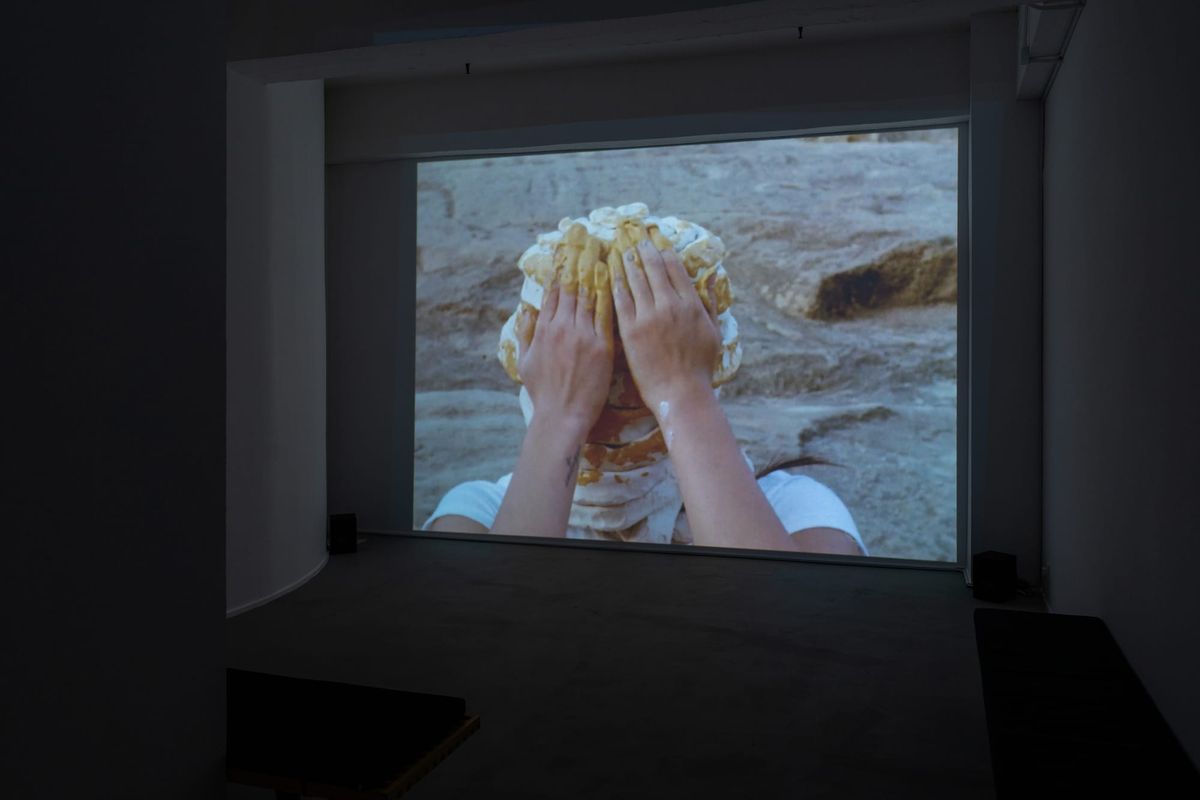
It is here that stephanie mei huang filmed their three-part self-armature series (2019), the second chapter of which is yellow porcelain ii (outside the Los Angeles Police Academy), currently on view at the New Media Room of DE SARTHE’s Hong Kong outpost. In it, huang stands against vast, barren sandstone formations—typical of the state’s arid landscape—facing the camera while slowly wrapping their head with strips of clay. The clip is entirely soundless, the footage interrupted by reddish flickers that break across the frame without warning, evoking the rawness of 16mm film and an underlying current of violence, discomfort, and anxiety. Slowly yet steadily, the artist seals off their neck, face, and hair, as if constructing something like a helmet that blinds as it shields—an act of self-defense that persists with the same desperation as that of self-harm.
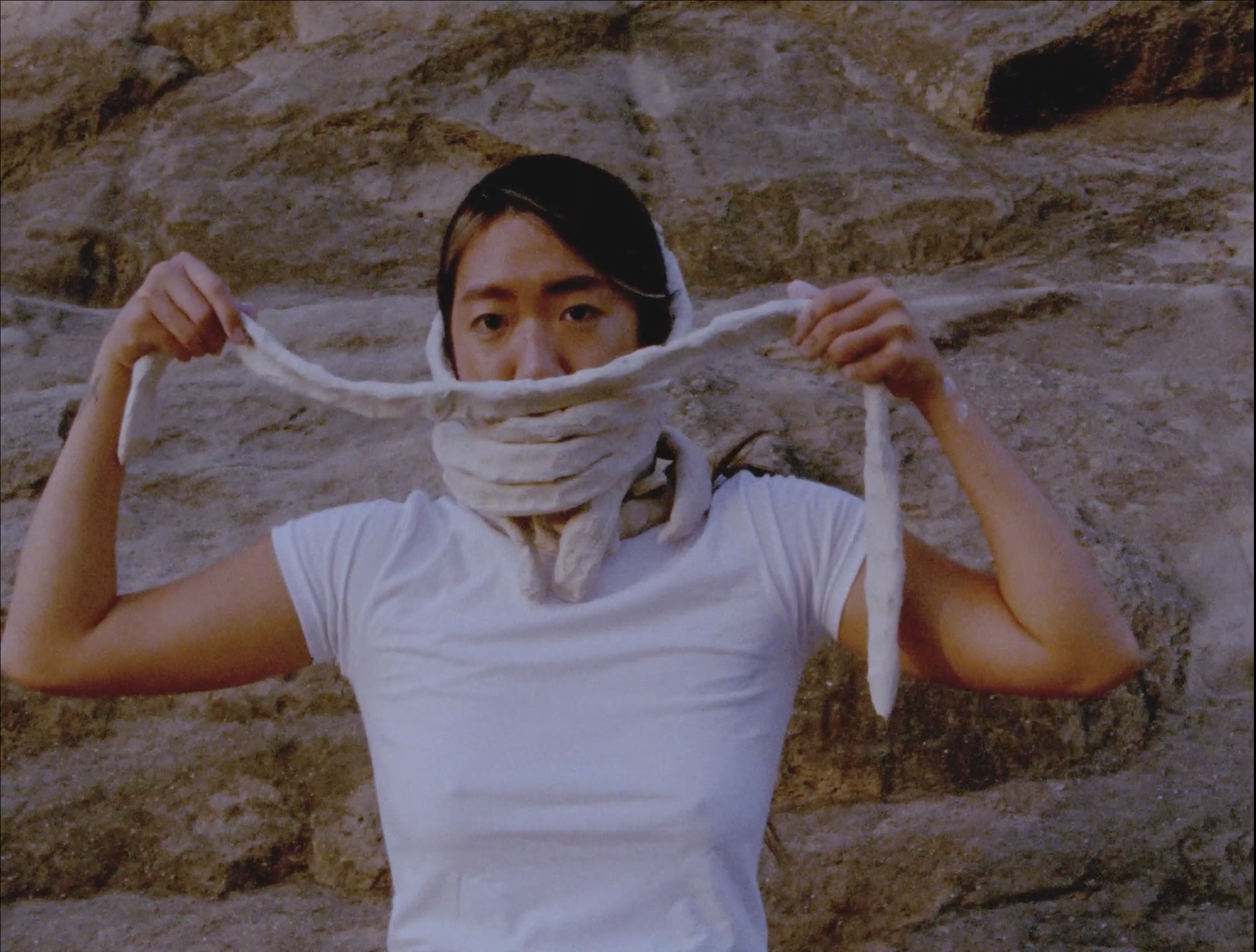
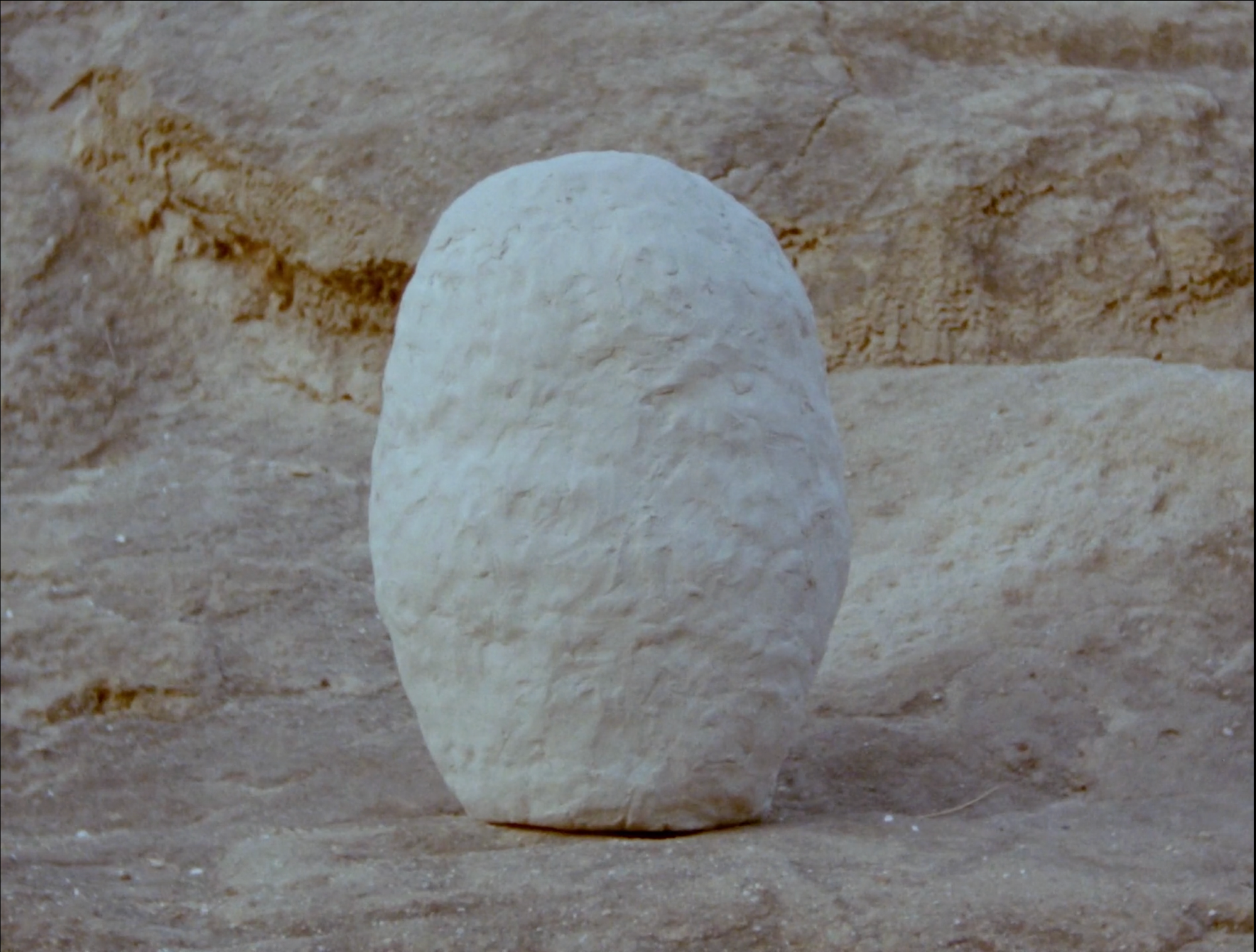
STEPHANIE MEI HUANG, yellow porcelain ii (outside the Los Angeles Police Academy), 2019, stills from video, 6mm converted to digital: 5 min 34 sec. Courtesy the artist.
The work’s perceptual intensity speaks less of obstruction than of systemic hindrance. A Chinese American artist who grew up between the US, Japan, and China, huang engages questions of gender- and race-related power dynamics and oppression across their practice, often using their body as a site where multiple layers of tension converge. Toward the end of yellow porcelain ii, the clay ensemble huang wears begins to resemble an inverted pot. The artist then rubs coarse yellow ocher across its surface in rough, unseeing strokes, turning their head into literal “yellow porcelain.” In doing so, they simultaneously embody and critique an Orientalist symbol deeply embedded in the Western imagination—one that reduces Asian women to fragile, harmless, and passive objects. The defiance reads even sharper given the performance’s location: the police academy, a site that casts its colonial gaze across the land, a factory in which the state reproduces its authority, a symbol of public order but also of top-down violence, masculinity, and white supremacy.
The last frame of the film is a static shot. The artist removes themself from the set, and in their place rests a human-sized clay form, cocoon-like in shape. The earthen figure invokes the history of clay pigeons as shooting targets, yet here manifests as a motif for possibility, latency, and becoming. Standing at the foot of a cliff in California, a place fundamentally constructed by immigrants and shaped by centuries of racial conflict, it is at once hollow and monumental: holding its form, holding its ground.
Yuqian Fan is an editorial assistant at ArtAsiaPacific.