Shows
Up Close: Chitra Ganesh’s “Journey to the Great Below”
Chitra Ganesh
Journey to the Great Below
Baltic Centre for Contemporary Art
Gateshead
Jul 4, 2026–Jan 15, 2027
Stepping into Chitra Ganesh’s solo exhibition at the Baltic was like being condemned to hell. Immediately upon entering the cavernous, dimly lit space, visitors are invited to pass beneath an archway inscribed with ominous glyphs, including chimerical beasts, watchful eyes, and women tumbling through the air. Beyond it, one finds oneself dwarfed by a headless votive figure. Only after traversing the underbelly of this supersized statue does one arrive at the show’s centerpiece: the animation Journey to the Great Below (2026), in which the ancient Mesopotamian goddess Inanna similarly negotiates a sequence of passageways to reach the underworld.
Journey to the Great Below trades the meditative pace and implicit narratives of Ganesh’s previous animated works for an action-packed retelling of the goddess’s descent. Relating the story solely through imagery, the video opens with a tectonic rumble that ushers Inanna toward the netherworld. She adorns herself with weaponry, jewelry, and armor before entering the hostile domain ruled by her sister Ereshkigal. At each gate of hell, however, a piece of her regalia is stripped away. By the time she meets Ereshkigal, she is powerless and swiftly defeated. Learning of Inanna’s death, her assistant pleads for help from the god Enki, who fashions a team of winged creatures from his nail filings to rescue Inanna. A condition for Inanna’s release is that someone must take her place in inferno. Upon returning to the world of the living, she chooses her husband to suffer that fate.
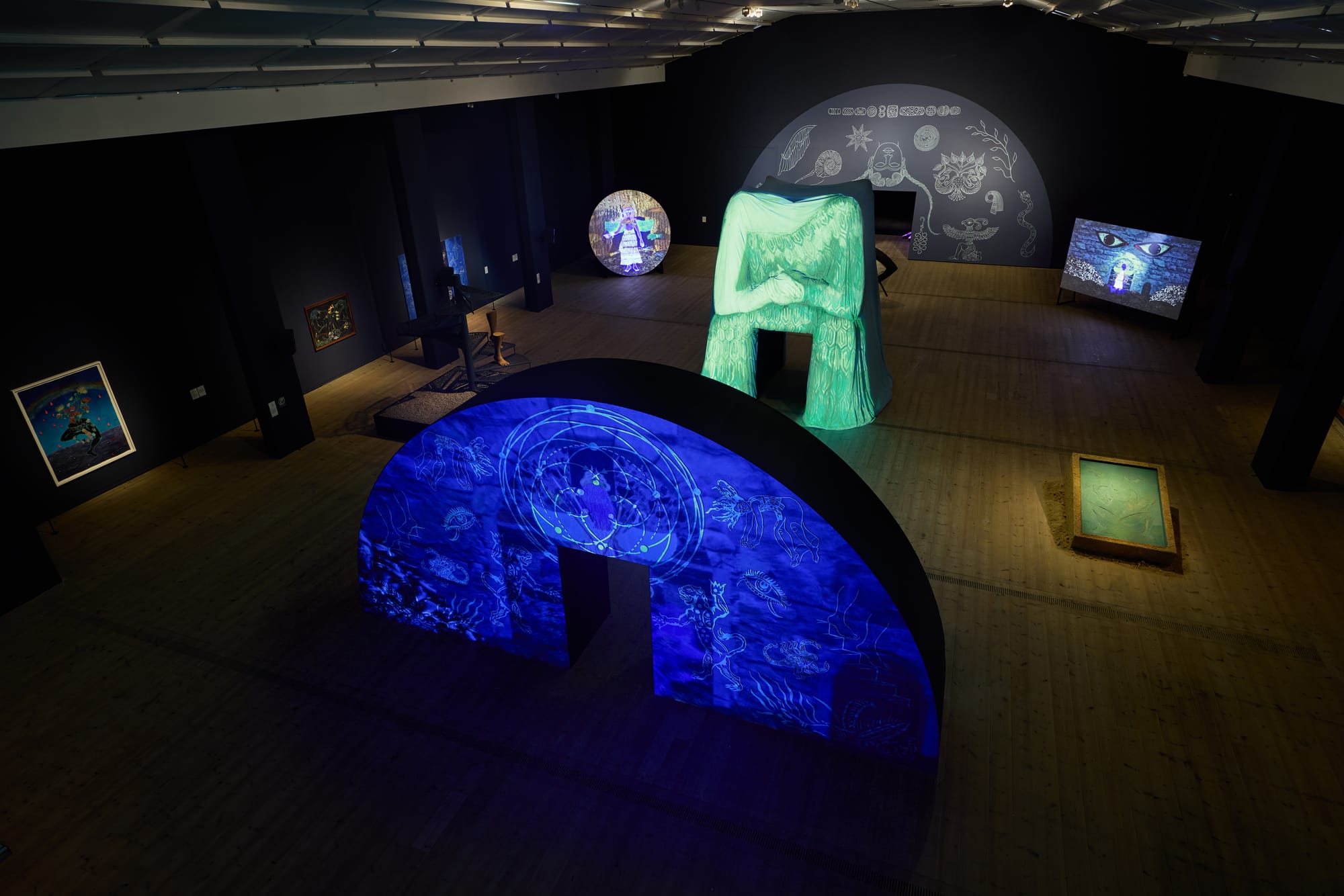
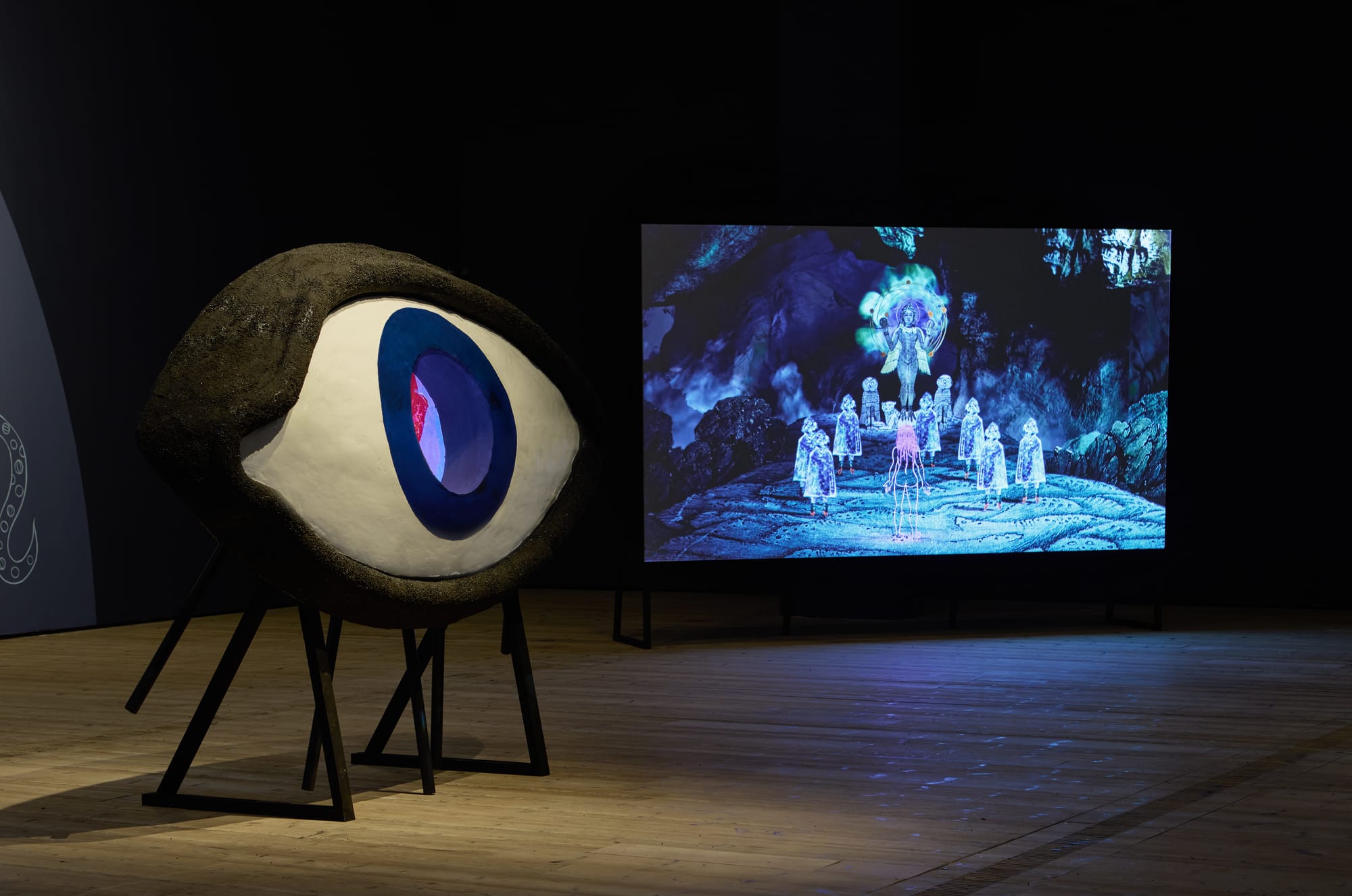
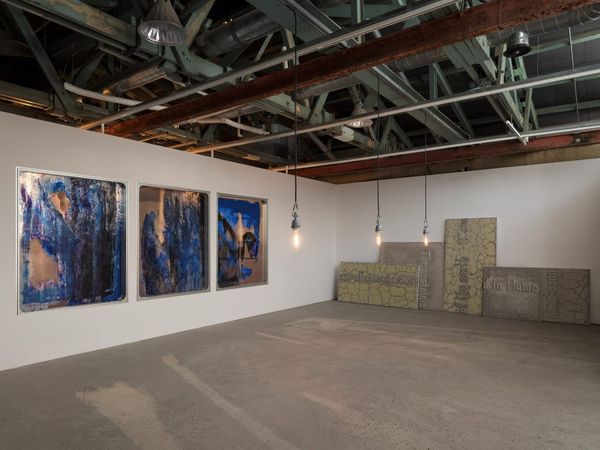
Installation views of CHITRA GANESH’s “Journey to the Great Below” at Baltic Centre for Contemporary Art, Gateshead, 2026. Photo by Tom Carter. Courtesy Tom Carter and the Baltic Centre for Contemporary Art.
While unusually linear in narrative, the animation extends a visual language that runs throughout Ganesh’s practice: collage. A single scene might juxtapose hand-drawn elements rendered in solid, comic-like outlines with more fluid strokes of watercolor. Photographs of artifacts and monuments further enrich these textures. Introductory frames of the underworld, for example, recast a bronze bust of an Akkadian ruler as a ghoul alongside a hovering Lamashtu carving tinted blue, while a black-and-white image of the tombs of Dara, cut into bedrock mounds, forms part of the landscape. By collaging these relics, Ganesh challenges the museological impulse to preserve them and their interpretations, proposing instead that perspectives on them will shift as contexts change.
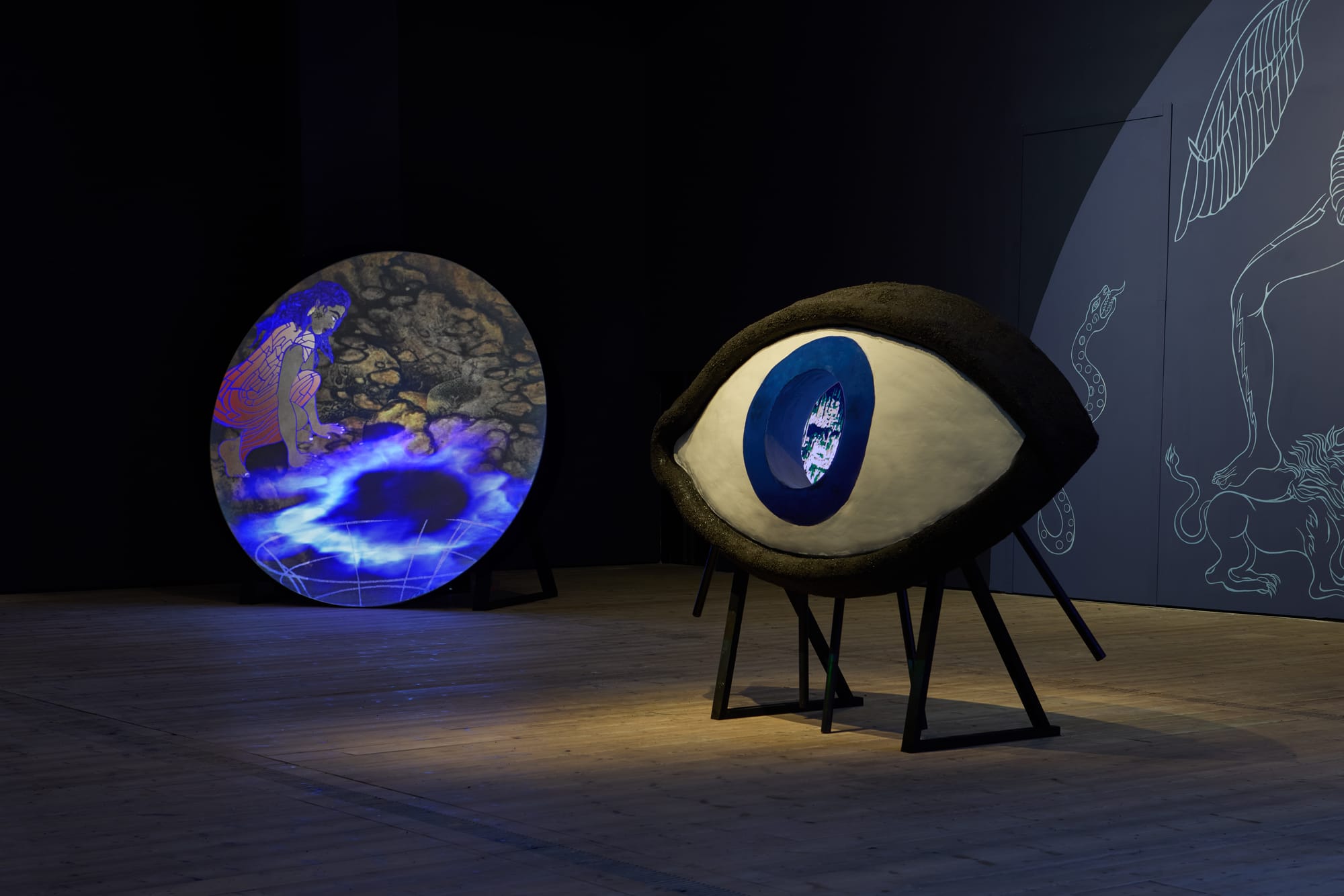
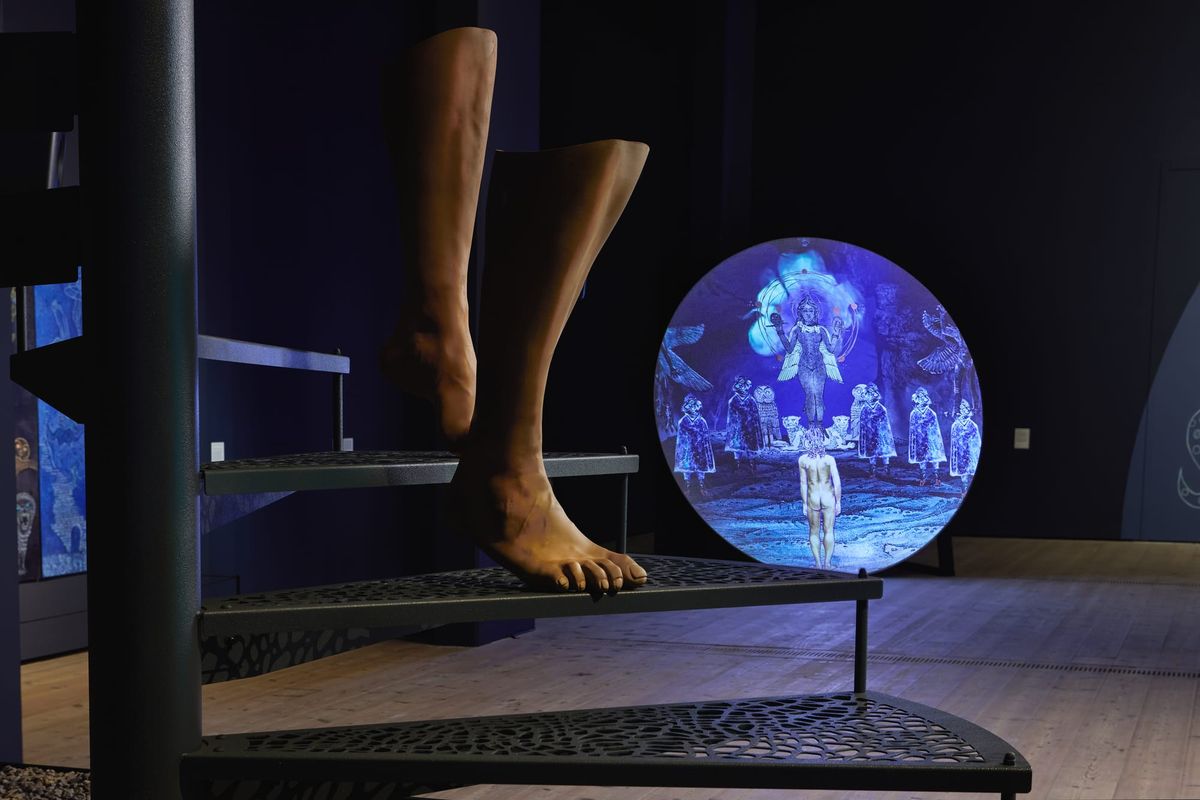
Inanna herself embodies this fluidity. Within Journey to the Great Below, she is at once a mighty deity and a damsel in distress. In broader Mesopotamian texts, she personifies the slippery duality of creation and destruction. Some traditions hail her as a divine queen of love; others specify sexual love, given her lack of loyalty to a single husband. Attendants at her temples included transgender men and women, believed to have been transformed by Inanna herself, a champion for the unruly ways bodies present and behave. As kingdoms waned and rose, she continued to morph, reappearing in various holy guises across the Phoenician, Greek, and Roman civilizations. In the show, Inanna’s shapeshifting is crystallized in Descent (2026), a sculpture of a pair of legs descending a spiral staircase with steps patterned like snakeskin, evoking the layers she shed. As Ganesh suggests, hell was but an opportunity for Inanna to exercise her true power—the capacity for continual reinvention.
Chloe Chu is an art writer and editor based in London.