Shows
“This is (Not) Conceptual Art” at MMCA Seoul
This is (Not) Conceptual Art
MMCA, Seoul
Jun 19–Oct 11, 2026
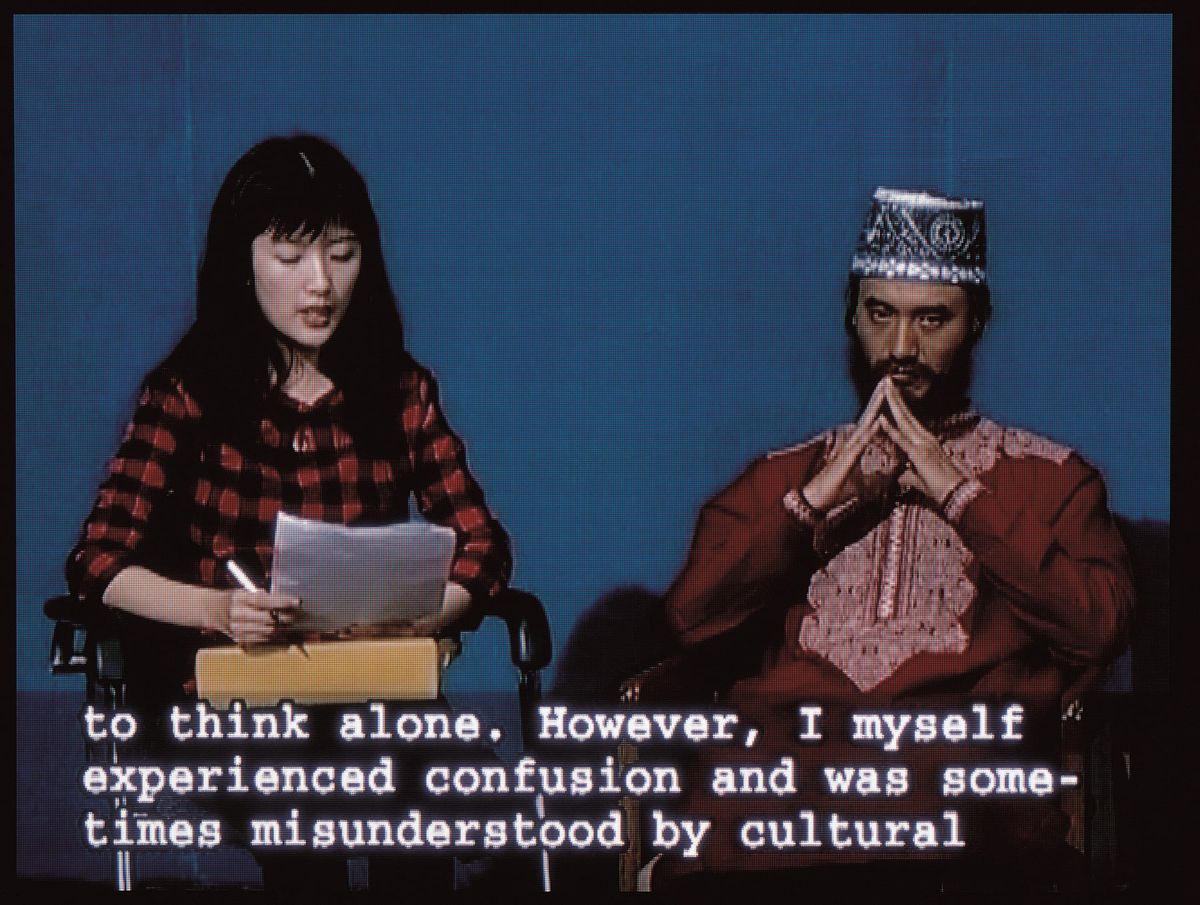
Museums do not simply inherit art history; they produce the terms through which it is told. By arranging works into a lineage and giving scattered practices a shared frame, an institution can transform loose affinities into a historical category. “This is (Not) Conceptual Art” at the National Museum of Modern and Contemporary Art, Korea in Seoul (MMCA Seoul) openly stages this operation. Its title, with the “not” tucked into parentheses, does not simply ask whether the works on view qualify as conceptual art. It asks whether “conceptual art” can meaningfully hold together a broad range of Korean practices—140 works by 28 artists, spanning the 1970s through the 2000s. A circle drawn on a school field, a wooden chair growing out of a flowerpot, and a newspaper “missing persons” ad searching for the “real” artist suggest the exhibition’s scope. Thee works move between linguistic propositions, absurd objects, everyday materials, and popular media, using humor and irony to unsettle questions of place, value, authorship, and belief. What does this range tell us? To sharpen the question posed by the title, one unspoken premise must be made explicit. Is this, or is this not, Korean conceptual art?
The question is consequential because “conceptual art” has long occupied an ambiguous place in Korean art history. It has appeared less as a clearly defined movement than as an underlying tendency, especially in discussions of artists who emerged after the perceived divide between monochrome modernism and Minjung Art in the 1980s. For the new generation of artists in the 1990s, it became a catchall descriptor for works that belonged neither to Minjung Art’s representational politics nor to modernism’s formal reduction. Their humble materials, verbal propositions, deadpan wit, and understated objects made “conceptual” feel plausible yet ungraspable.
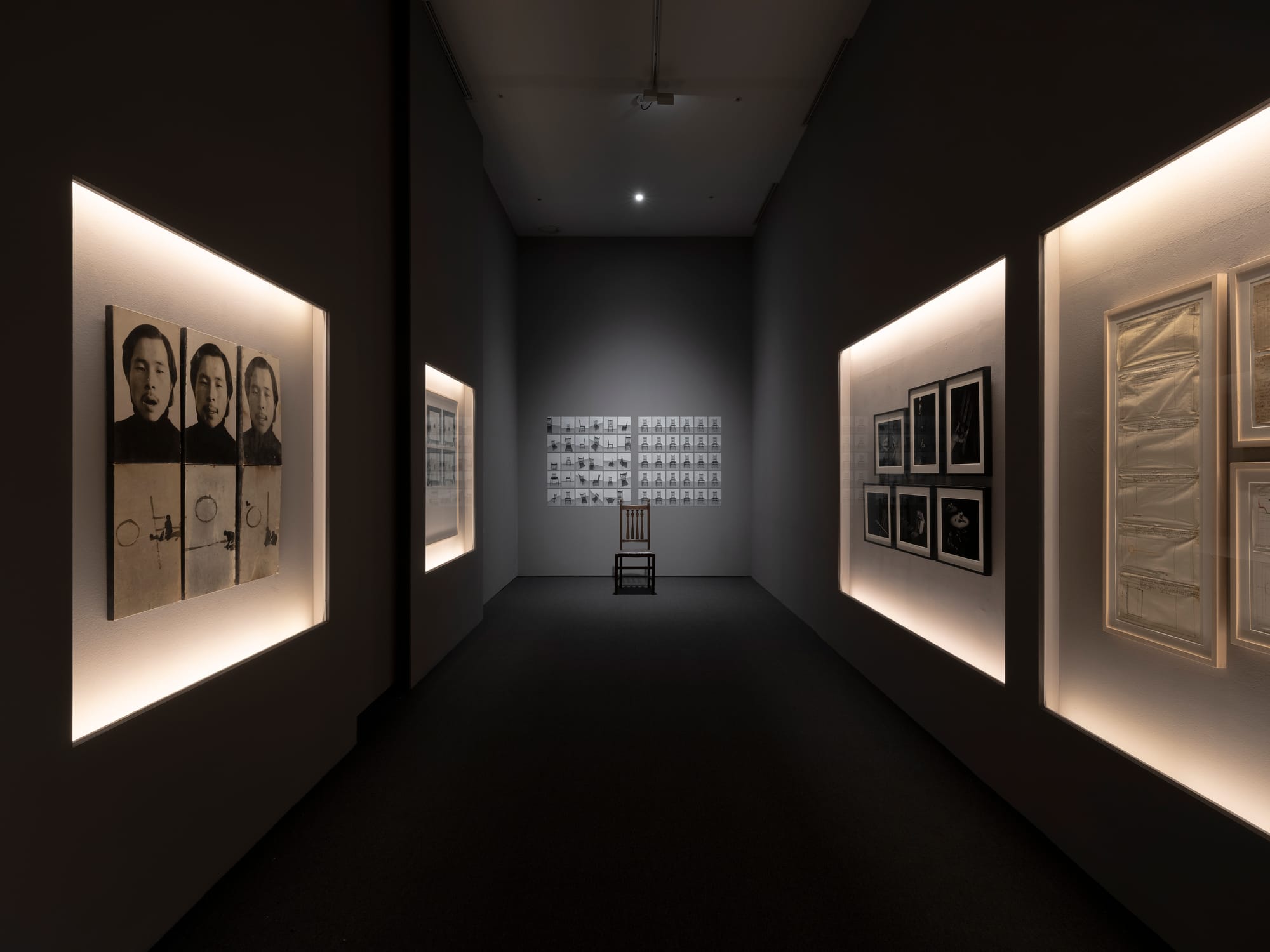
The exhibition opens with Lee Kun-Yong’s Logic of Place (1975), among other photographic records of performance-based works. In the piece, the artist draws a circle on a field, points to it from outside and says “there,” steps inside and says “here,” then exits again to say “there.” In this section, titled “Language, Logic, Performance,” the works of Space & Time (ST, 1969–81), framed just three years ago as “experimental art” in MMCA’s Guggenheim collaboration “Only the Young: Experimental Art in Korea, 1960s–1970s,” are reintroduced under a different register. This time, rather than emphasizing their unruly resistance to established media and institutions under authoritarian modernization, it recasts their everyday gestures as “events” governed by a linguistic logic. The shift is intriguing, but also fatiguing. How many times can the same historical materials be renamed before naming begins to feel less clarifying than compulsory?
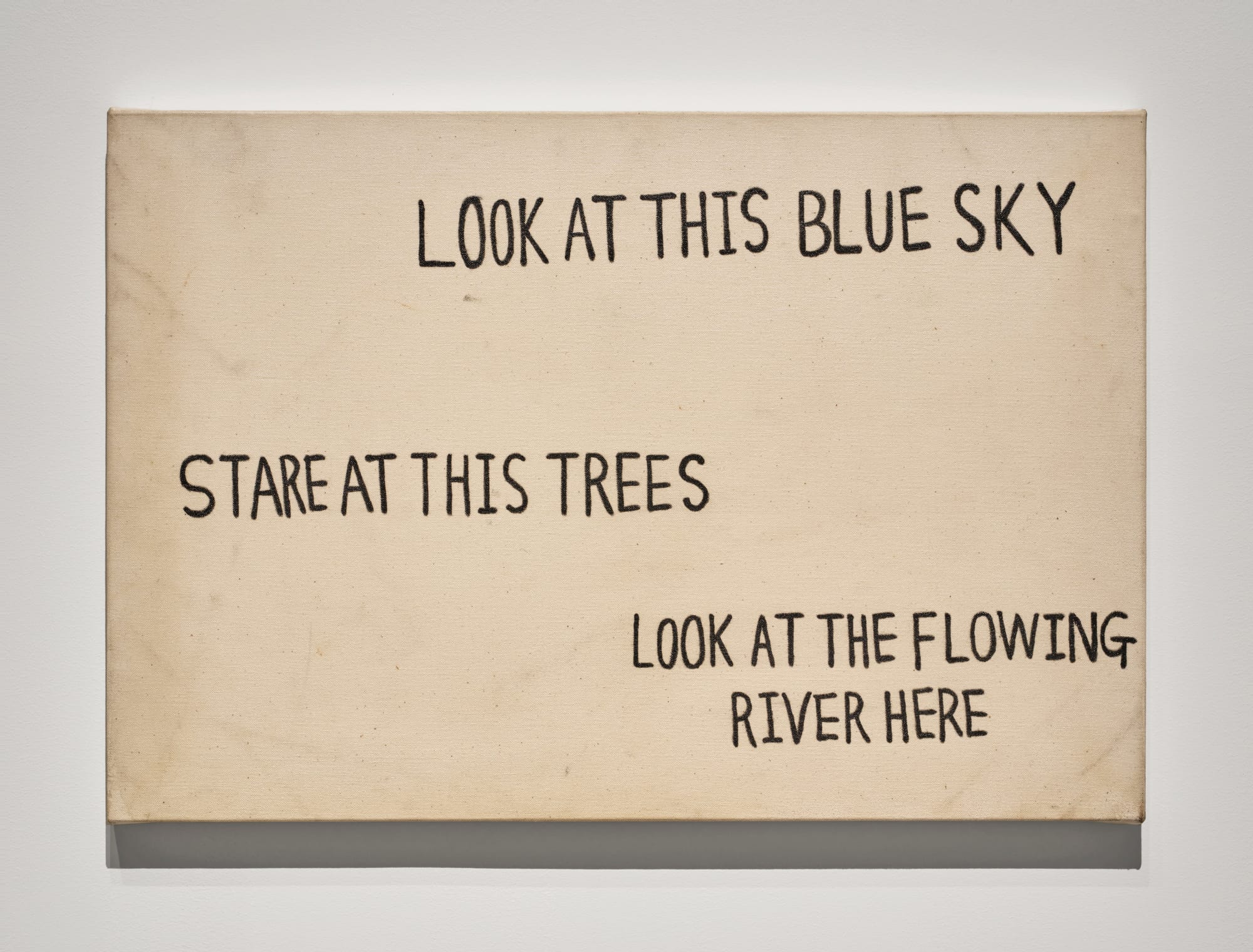
Beyond the pressure of its framing, the following section, “Objects and Language,” contains some of the exhibition’s most resonant works: Ahn Kyuchul’s Five Questions for an Unknown Artist (1991), with doors marked “Art” and “Life” and a chair leg spouting from a flowerpot; Kim Beom’s 1995 matchstick drawing, which imagines an unviable mass game; Kim Soungui’s punning Vide & O – Kunsthaus Hamburg (1989), in which a television monitor made of ice melts into the void it names; Bahc Yiso’s Score and Translated Lyrics of Honesty (1994), a score of Billy Joel’s song with a handwritten Korean translation; and Chung Seoyoung’s uncannily scaled Observatory (1999). It is a rare pleasure to see them together. They offer a vivid taste of Korean contemporary art through poetic imagination, bitter irony, spare materials, and spiced absurdity. Yet the density of the installation leaves little room for each work to breathe, making them feel at times less as distinct propositions than as textbook illustrations. The problem is not that any of these names should be omitted, but that the show cannot bring itself to leave anyone out.
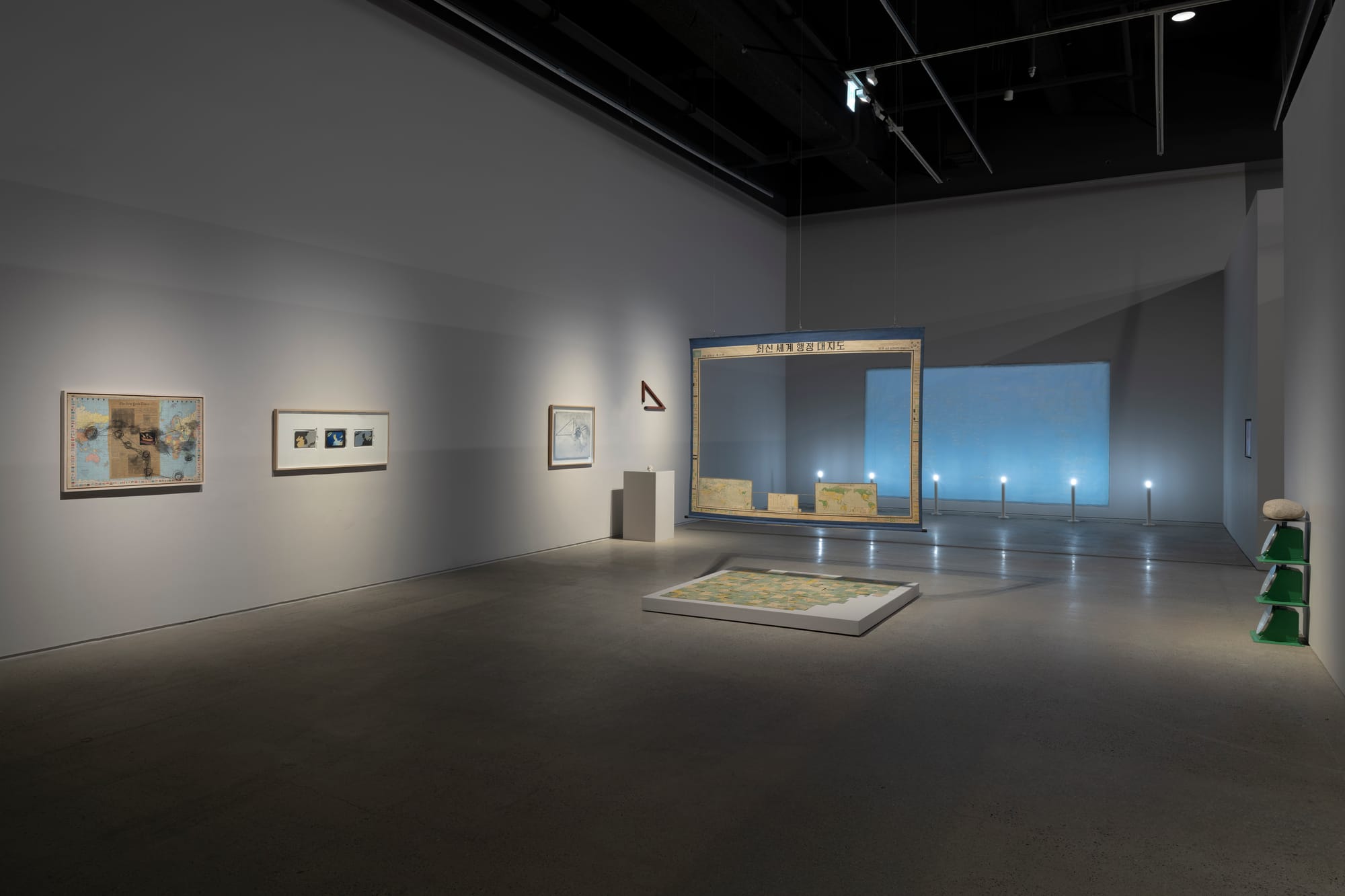
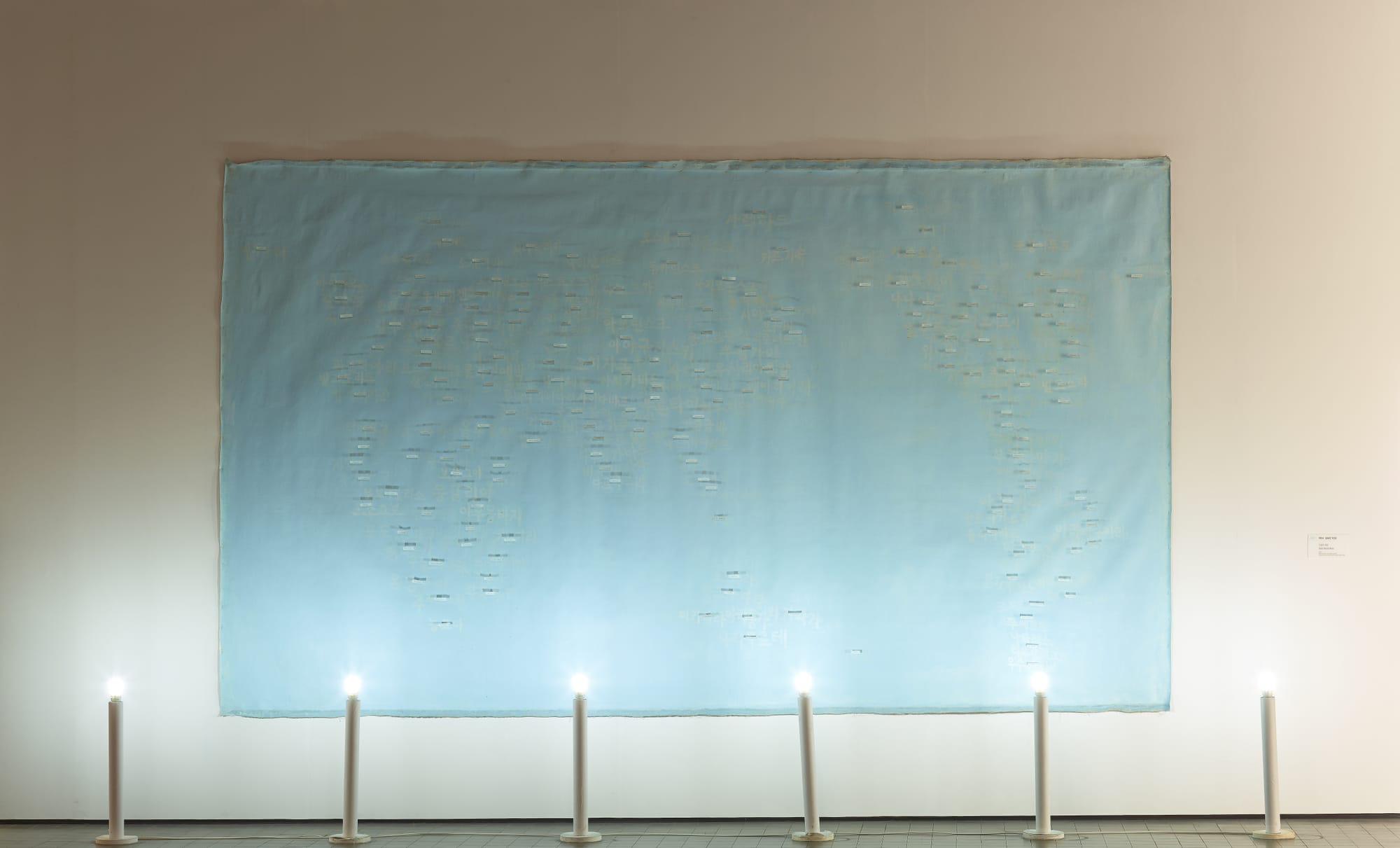
The same tension runs through the later sections, where iconic works by major artists appear in impressive profusion. “Mapping and Measuring” includes Sung Neung Kyung’s An Upside-Down Map of the World (1974), a world map torn into some 300 fragments and rearranged beside its emptied frame; Tchah-Sup Kim’s Right Direction (Triptych) (1988), which flips the Korean peninsula to reroute geopolitical orientation; and Kwak Duck-Jun’s 4 Clocks (1973), in which identical clocks tell different times. “Manipulators of Signs” gathers another formidable group, including Kim Kulim, Kim Yong-ik, Yoon Dongchun, Inhwan Oh, Kim Sora, and Gimhongsok. Across them, maps, clocks, newspapers, advertisements, and systems of circulation appear not as neutral structures but as things to be cut, inverted, redirected, and destabilized.
Encountering so much at once is rewarding, and the exhibition’s breadth allows viewers to draw their own lines of relation. One possible route is to follow the tension between globalization, translation, and hybrid identity. Bahc Yiso’s Capital=Creativity (1986/90), reversing Joseph Beuys’s concept “Creativity=Capital,” turns mistranslation into critique, while Gimhongsok’s One and Three Friends (2008), after Joseph Kosuth’s One and Three Chairs (1965), keeps the structure of object, image, and definition, but replaces the chair with a friend, shifting the work from tautology to the instability of social relation. Beyond such direct references, many works register the uneven condition of making contemporary art while negotiating imported vocabularies, shifting identities, and the social fabric of Korea.
In a way, “This is (Not) Conceptual Art” performs the exhaustion of its own category. It gives form to a spectral term that has long hovered over Korean contemporary art, only to reveal that the idea loses its power once materialized. What comes forward instead are works that refuse spectacle and literal symbolism, operating through small disturbances: a word that fails to secure its object, a map that no longer orients, a stone that seems to listen, a joke that opens onto institutional critique. Perhaps the exhibition ultimately leaves behind not a definition of Korean conceptual art, but the sense that the term has done its work. What remains are the works themselves: funny, exacting, modest, strange, and intellectually alive.
Jiwon Yu is a curator, writer, and translator mainly based in Seoul. She was the assistant curator of the 11th Seoul Mediacity Biennale (2019–21) and a curator at the Leeum Museum of Art (2022–24). Since 2016, she has been a member of the art writers’ collective Yellow Pen Club and is currently the co-director of its program and exhibition space, YPC Space.