Shows
Furies Unbound: Nalini Malani’s “Of Woman Born” in Venice
Nalini Malani
Of Woman Born
Magazzini del Sale
Venice
May 9–Nov 22, 2026
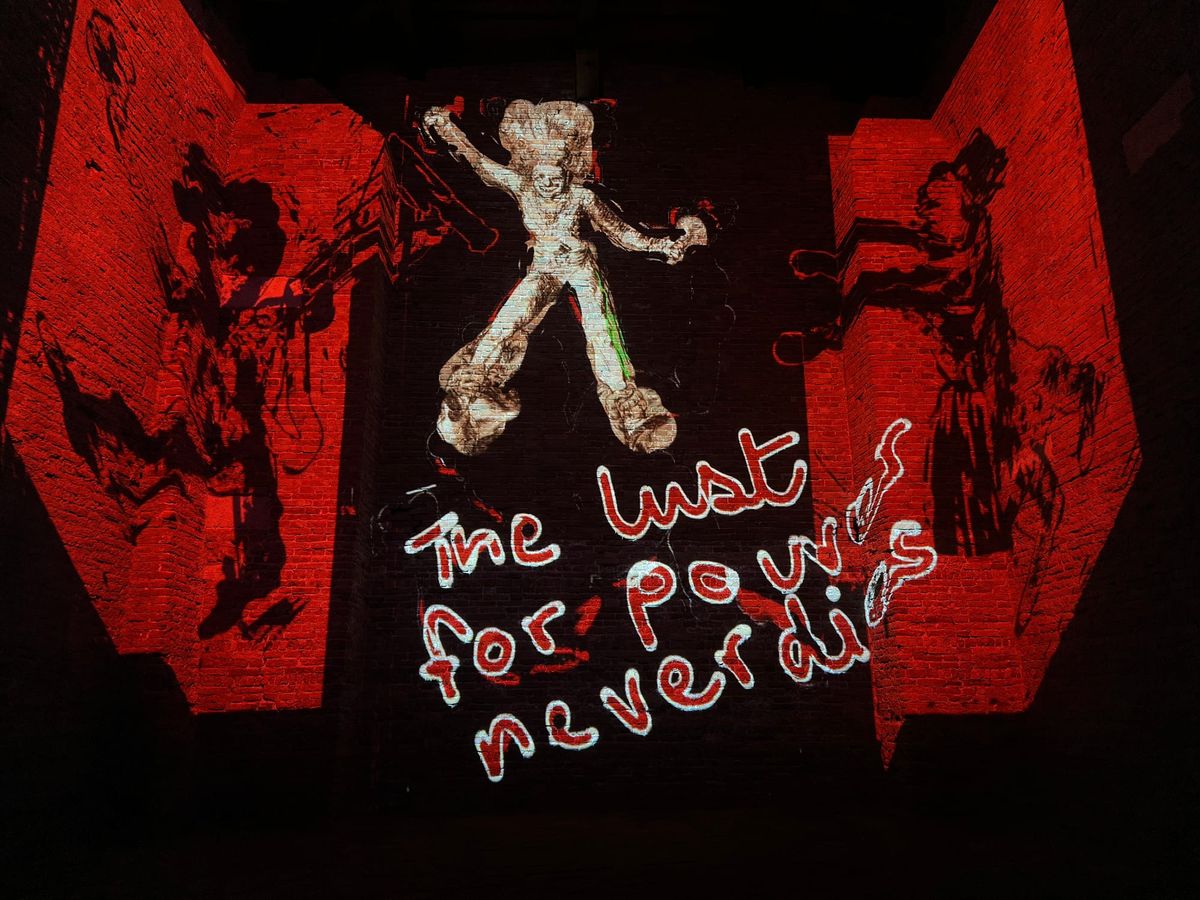
Shadows swallow sight, but my ears find their way to a hall taken over by Nalini Malani. Her voice reverberates through the long, cavernous space of the Magazzini del Sale in Venice, at one point proclaiming vehemently, “The lust for power never dies.” The interior flashes with red and white light as semi-distorted, spectral figures continuously emerge and disappear, from close-ups of adult faces with wide eyes to scrawled silhouettes of children dancing, skipping, standing still, collapsing. Even as they flit from wall to wall, their presence is steadfast and hypnotic, accompanied by incisive quotes drawn from various literary sources, projected onto the chipped-brick surfaces: “Remember us—if at all—not as lost violent souls, but only as the hollow men”; “Hatred is a master of contrast / Above all it never tires”; “Who will ask the women?” Another quote, all in block letters, reads: “OUR POWER STRIPPED / CAST OFF.”
“Of Woman Born” is immediately arresting. Curated by Roobina Karode, artistic director and chief curator at New Delhi’s Kiran Nadar Museum of Art, the exhibition is a collateral event of the 61st Venice Biennale, centering on a titular site-specific work featuring 67 animations derived from over 30,000 handpainted and digitally rendered iPad drawings. The scintillating images are screened across nine video channels, each sequence lasting three to five minutes, pulling you further into its orbit the longer you watch. The sheer scale seizes your entire body, not just your eyes.
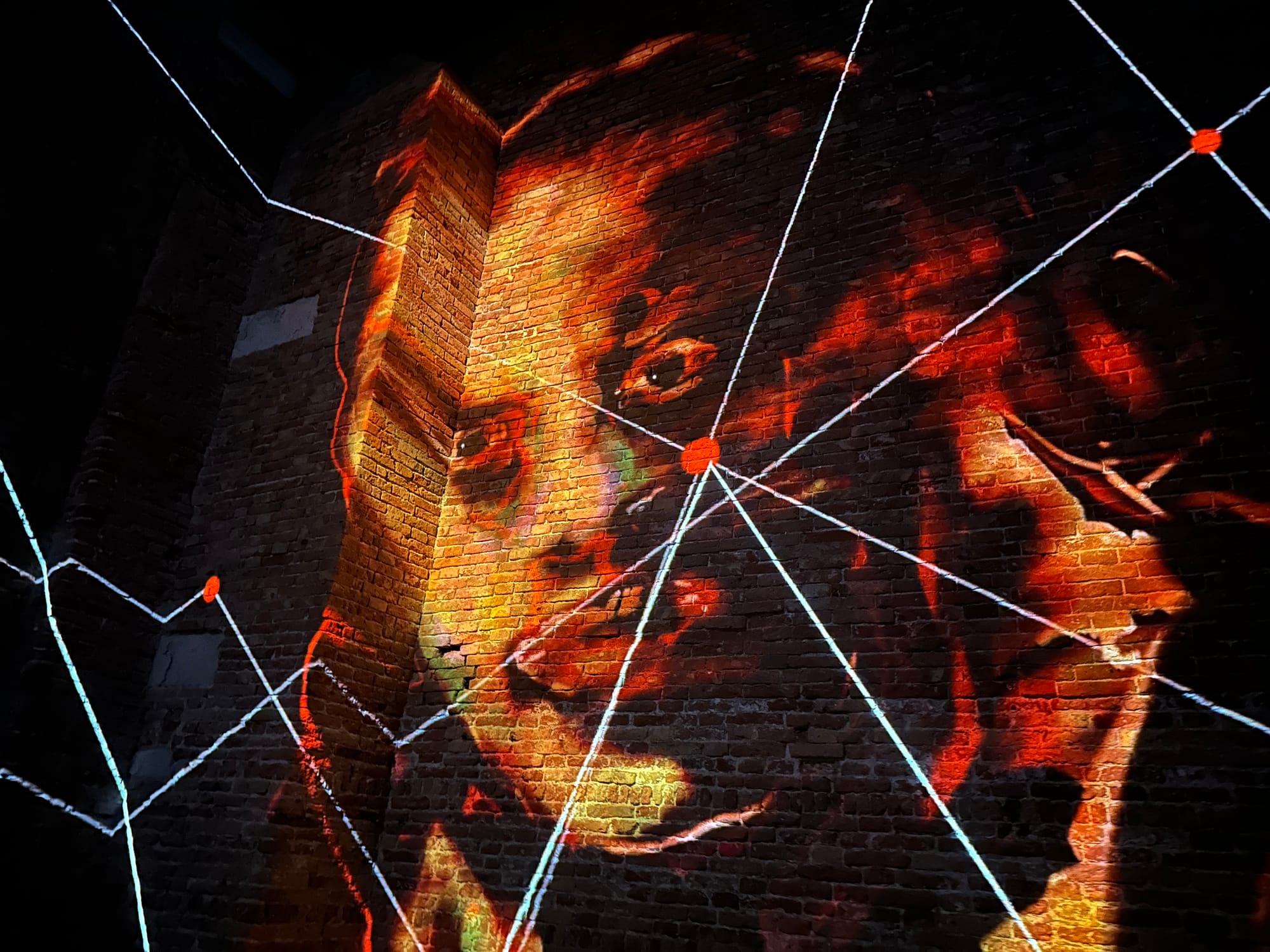
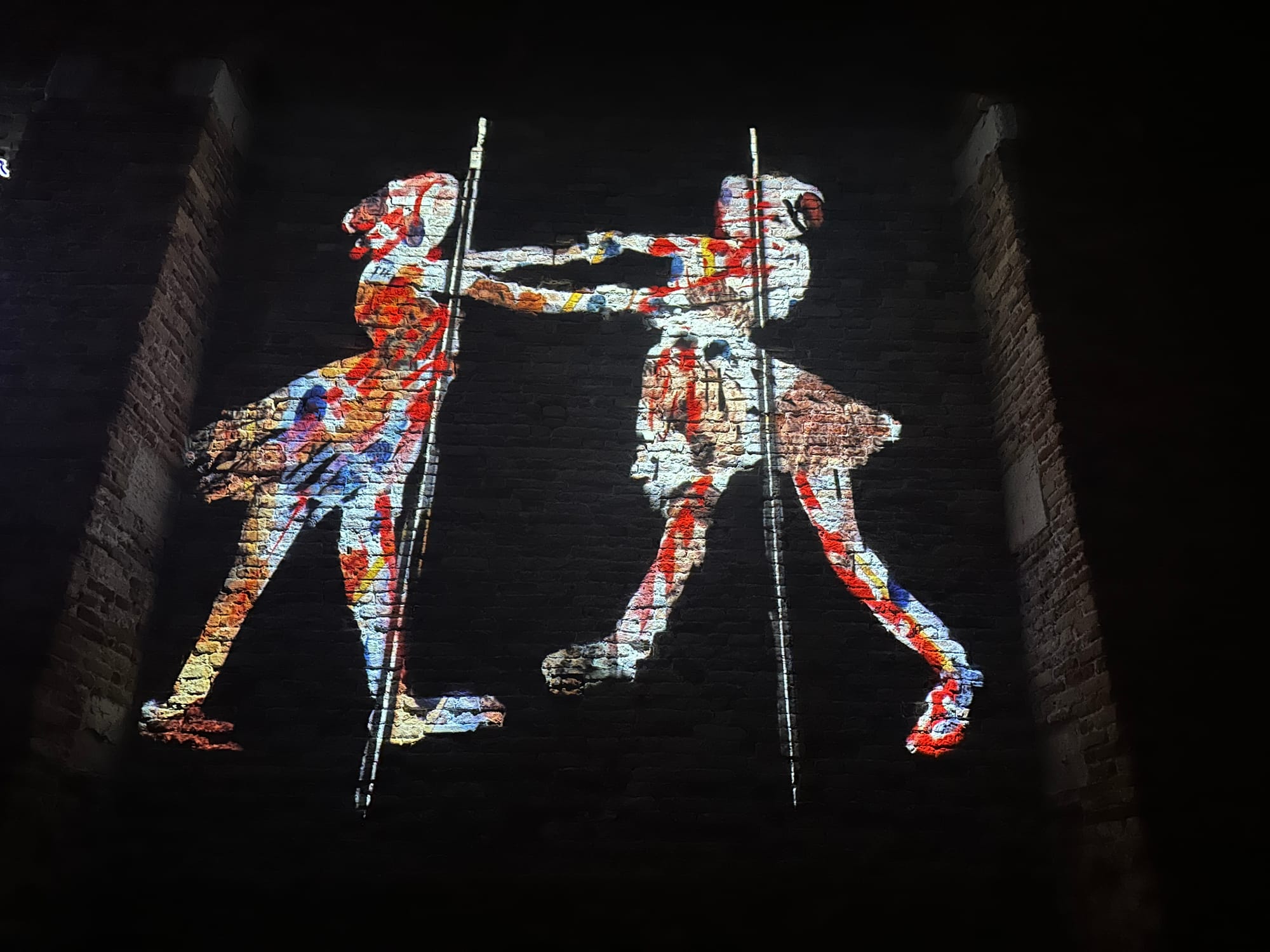
Installation views of NALINI MALANI’s Of Woman Born, 2026, nine-channel iPad animation chamber, sound, dimensions variable, at the Magazzini del Sale, Venice, 2026. Collection of the Kiran Nadar Museum of Art (KNMA), New Delhi. Copyright the artist. Courtesy KNMA.
Malani’s voice periodically booms throughout the Venetian warehouse, which was once used to store salt (or “white gold,” as it was dubbed). Salt preserved food and built fortunes, but it also started wars. The merchants who worked within these walls could not have foreseen that one day, creation and reckoning would take up residence here. A layered soundscape further transforms the venue: a haunting, sirenic rendition of the closing lines in T.S. Eliot’s The Hollow Men (1925), sung by Neha Karode (the curator’s daughter); mournful violin and organ chords, ominous rumblings, and several women occasionally narrating passages from the Greek trilogy Oresteia, which confronts humankind’s primitive acts of bloodshed and vengeance. Running through the work like a current is the myth of Orestes, who killed his mother and was hunted by the Furies but ultimately absolved by Athena without retribution.
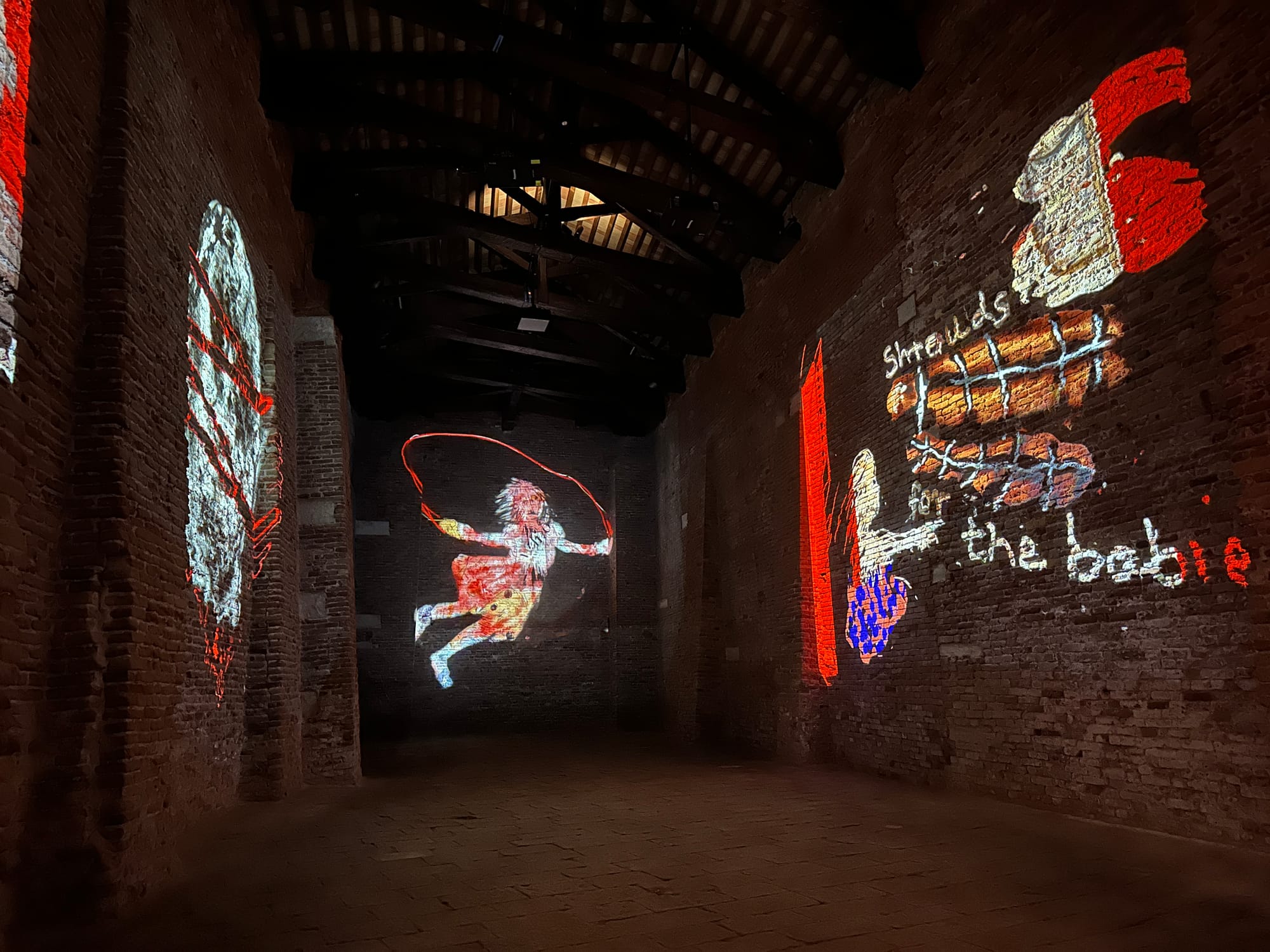
For Malani, this tale of violence is not ancient history—it defines the contemporary age, playing out on loop: wars waged in the name of self-defense, atrocities that go unaccounted for, women who bear the brunt of conflict while geopolitical borders shift around them, their agency erased. Malani asks us to look at the map differently, to find and listen to the voices that were silenced. The work does not moralize. It bears witness not only to the unthinkable tragedies that continue to mar our world, but also to the moments of raw, unwavering survival, distilled here within the body of the Skipping Girl—a recurring character in Malani’s animations since the 1990s, symbolizing innocence, resilience, and freedom.
Malani’s animation chamber further evokes the agora, an open public space in ancient Greece that served as a site for civic exchange. In the spirit of the 61st Venice Biennale, Of Woman Born generates an immersive encounter that exceeds spatiotemporal parameters as its ancient references speak with startling directness to the present moment. The fluidity in its storytelling feels urgent, like a message that has traveled across millennia to be heard. There is something almost geological about the work, as though layers of time have been excavated to reveal what was always there, waiting to be discovered—voices, memories, lives that have long existed within these brick walls, surfacing now to warn us: the unquantifiable horrors of humanity will repeat themselves. “Being witness to injustice and cruelty in the 21st century, we all—no matter what profession, gender, age, or religion—have a responsibility to create a more humane society,” the artist said. “This is not the time when we can lay back in a leisurely consumeristic style to reflect on the world.”
Shreya Ajmani is a writer and art professional focusing on art from Asia and its diasporas.