Shows
Desire, Deferred: Eroticism in Southeast Asian Art
Passion is Volcanic: Desire in Southeast Asian Art
National Gallery Singapore
Singapore
Apr 24–Aug 30, 2026
The 1952 painting expedition to Bali by Singapore’s four male Nanyang school artists—Liu Kang, Chen Chong Swee, Chen Wen Hsi, and Cheong Soo Pieng—was famously revelatory. Liu Kang, Chinese émigré to Singapore and pioneering figure of the Nanyang school, described Bali in his 1953 essay Trip to Bali as “Heaven on Earth,” observing that “erotic forms of desire could act as creative forces for questioning and change.” The exhibition’s title, “Passion is Volcanic: Desire in Southeast Asian Art,” draws from Liu’s musing that “[Balinese women’s] passion is volcanic; when it explodes, men find them irresistible and instead of trying to flee, willingly become prisoners of their love.” The exhibition explores eroticism in Southeast Asian modern and contemporary art and is the National Gallery Singapore’s first R18 exhibition—access restricted to audiences above 18, with photography strictly prohibited. The restriction is both antithetical to viral Instagram culture and ironic, considering the voyeuristic gaze of Liu and his posse.
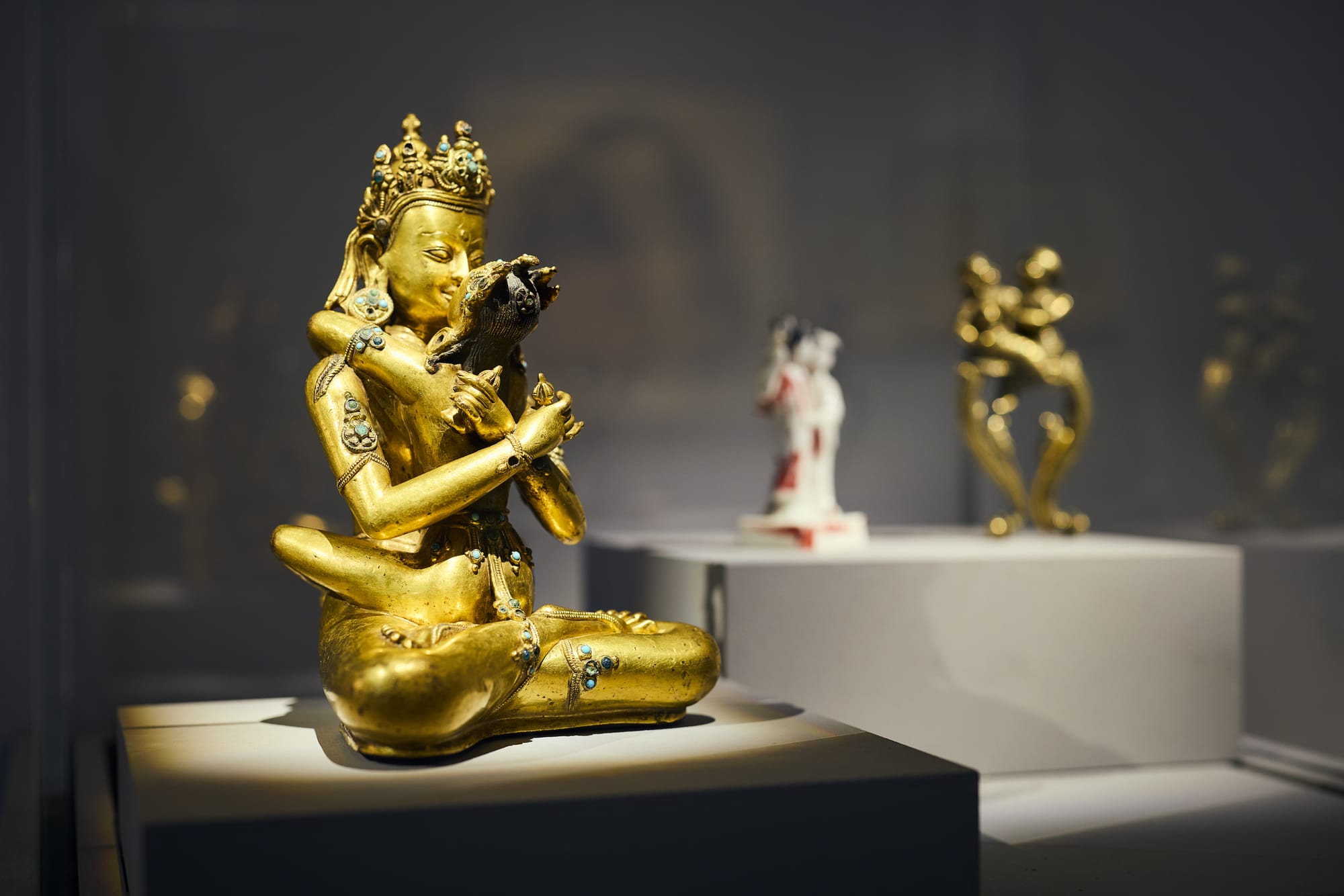
“Passion is Volcanic: Desire in Southeast Asian Art” purports to use the erotic as a lens to interpret works from Singapore’s national collection and the wider region, examining how it “can advance alternative forms of knowledge and subjectivity in art” by reexamining norms and expressing different perspectives. Its first work, Araya Rasdjarmrearnsook’s video I’m Living (2002) immediately challenges viewers’ perceptions of the erotic by placing different articles of clothing over an actual dead body of a young girl, her face partially covered and her feet stiffened by rigor mortis. These acts may have been regarded as “sensuous engagement”—were the girl not dead. Rasdjarmrearnsook accompanies her unsettling film with an erotic written story about the end of girlhood and becoming a woman; the work is placed in the section “Asian Mythos and Ritual,” which attempts to propose and ground definitions of the erotic. A loan of the statue of Vajradhara and Prajnaparamita (14th to 15th century) positions the erotic as precolonial, embedded in tantric Buddhist and Hindu practice. The smaller female consort, Prajnaparamita, straddles the much larger male buddha, Vajradhara, lips locked in a passionate kiss; their union representing the synthesis of wisdom and compassion at the highest state of enlightenment.
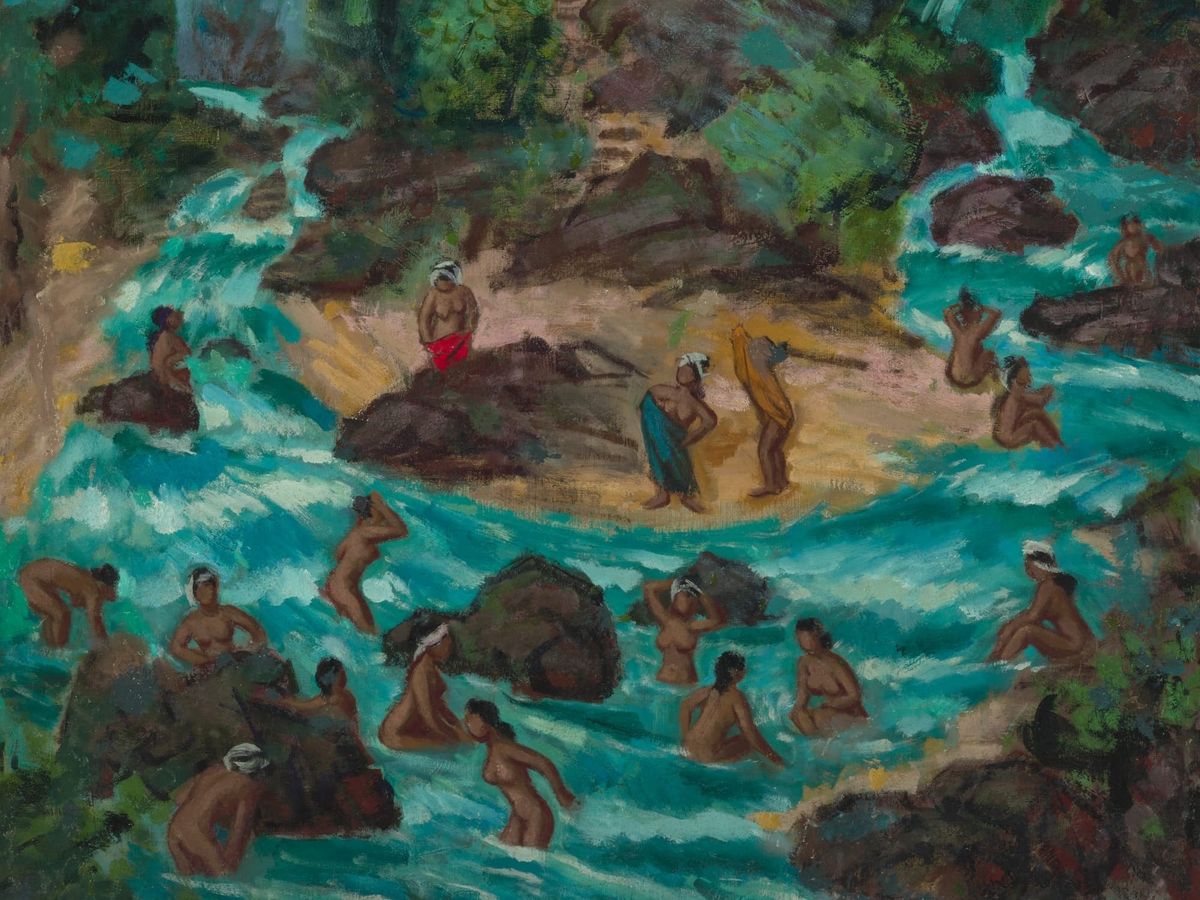
The second section, “Conventions of the Erotic,” examines shifts in artists’ studio practices and thinking. Liu’s en plein air Scene in Bali (1953) sees the artist stepping away from the studio model and “connecting the female form to Bali’s landscape”: 18 naked women bathe in a river while hilly terraces recede behind them. In the same section, Ahmad Zakii Anwar’s Sixtynine 1 and Sixtynine 3 (both 2000)—still-life acrylic paintings of bananas in their titular sexual positions—do what still-lifes are meant to do: beneath the surface provocation, they meditate on the passing of time and the inevitability of physical decay.
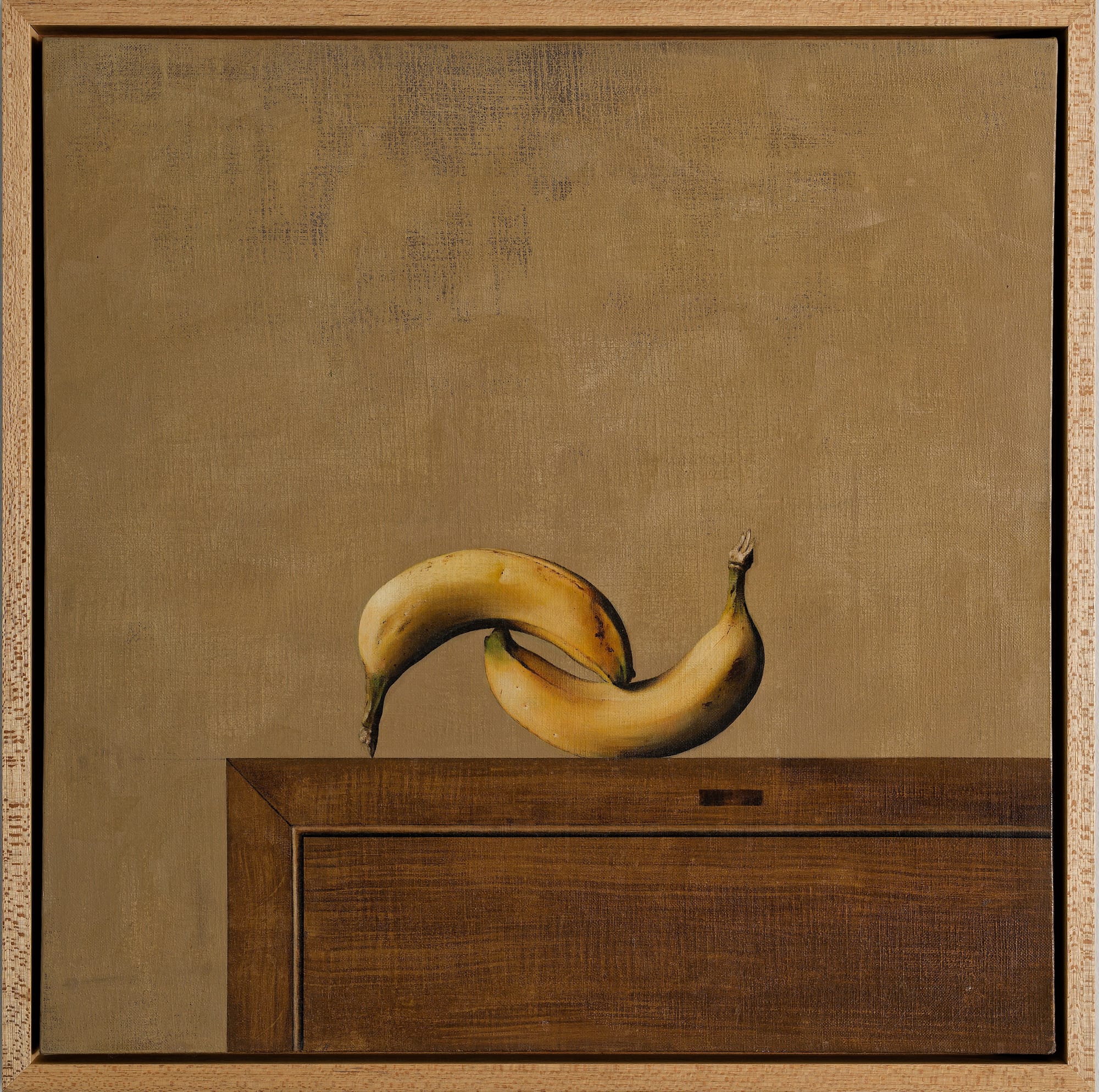
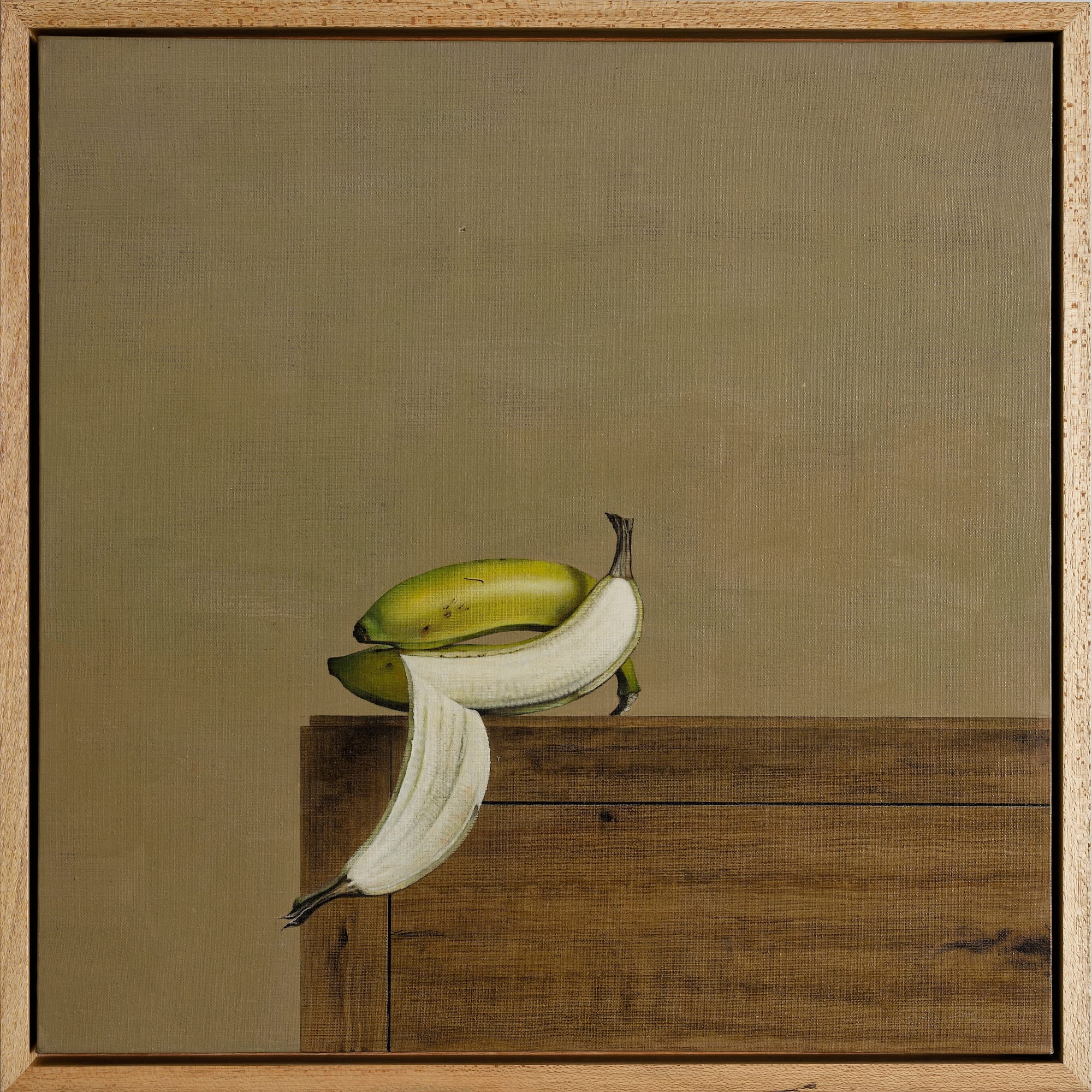
AHMAD ZAKII ANWAR, Sixtynine 1 (left) and Sixtynine 3 (right), both 2000, acrylic on canvas, 69 x 69 cm each. Private Collection. Courtesy National Gallery Singapore.
It is the exhibition’s final section, “Public Arenas/Private Interiors,” that is most compelling, perfectly captured in Singaporean artist Jimmy Ong’s mixed-media work Glorious (1989), a recent acquisition depicting a nocturnal public heterosexual encounter in Singapore’s Esplanade Park—a popular gay cruising ground at a time when same-sex dalliances were illegal under section 377A of Singapore’s British India-inherited Penal Code. The law was repealed only in 2023, 34 years later, with a constitutional amendment prohibiting gay marriage enacted in the same stroke. Similarly, Tan Peng’s TV for Everyone (1993) depicts two men sitting atop a CRT television, one loosely embracing the other from behind, while a similar but heteronormative scene plays on the screen below. Tan and Ong’s works register not so much as a pushback against heterosexuality, but as an index of the loneliness and isolation faced by sexual minorities in society at the time. It is here that the exhibition edges closest to the darkest days of Singapore’s post-independence art history, stopping short of addressing the government’s decade-long de facto ban on performance art following Josef Ng’s Brother Cane (1994), a performance protest against the police entrapment, arrest, and caning of gay men.
Around the corner, transgender artist and performer Marla Bendini’s Tiger Lily (2020) is a back-facing self-portrait in feline therianthropic form, emphasizing how transpeople are often spoken about behind their backs, their public identities reduced to the status of their body parts. It is only in private arenas that a sense of normalcy could be maintained, as seen in the vitrine presentation of photographs from the personal collection of Judy Chia, a trans woman sex worker who worked on Singapore’s notorious Bugis Street in the 1970s. These small photographs of fellow transwomen and their clients were used as keepsakes, gifts, and calling cards between friends. Pinaree Sanpitak’s Noon-Nom (2016), a ball-pit filled with stuffed breast-like forms, disembodies the eroticism surrounding the breast—rendering it tactile and quotidian, much as breasts are perceived by children.
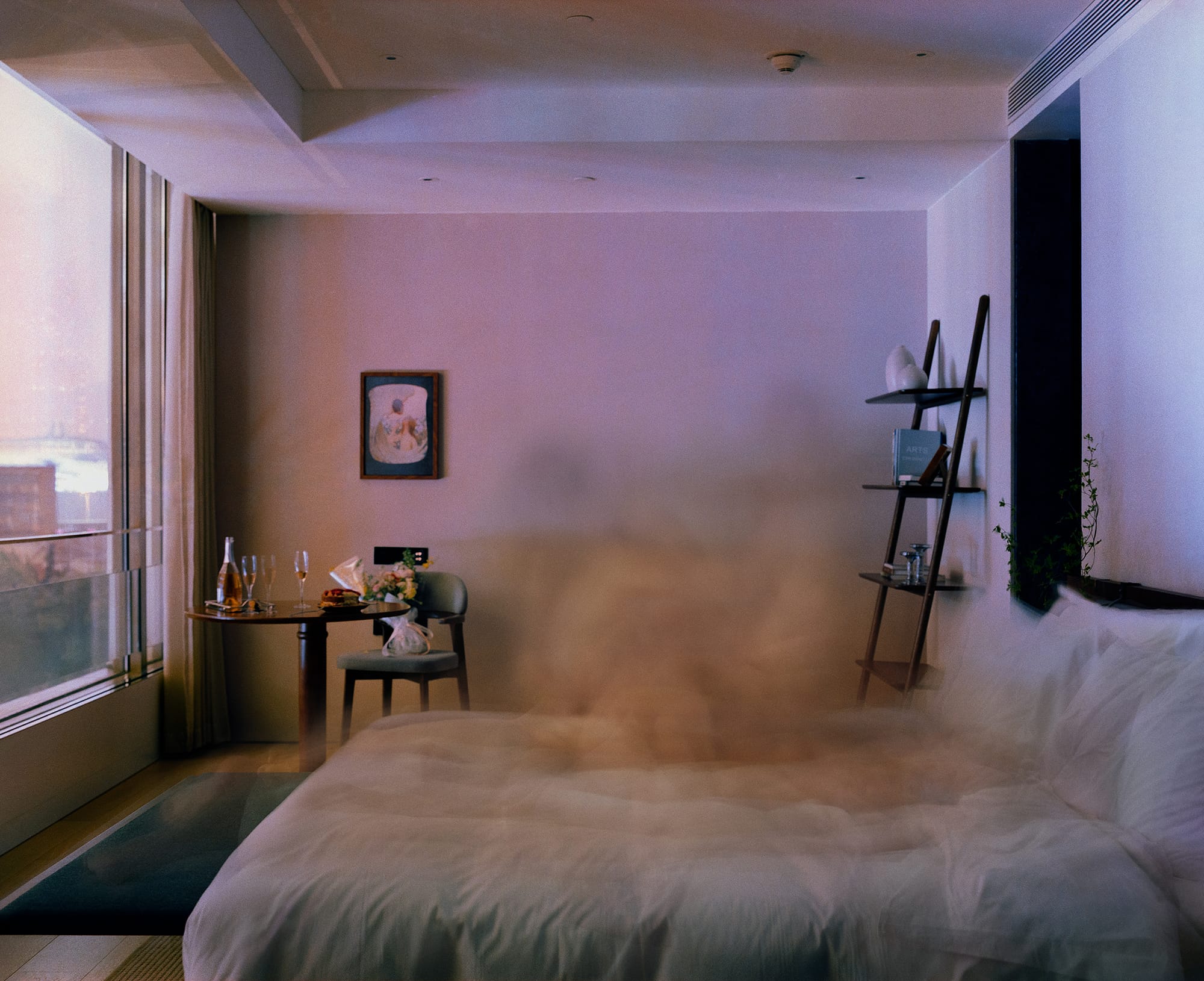
Lavender Chang’s Dissolving into the Same Breath #1–#3 (all 2024) originates from a Chinese advertising commission for the erectile-dysfunction drug Viagra, using long exposure photography to capture sexual activity of three couples in their own homes. The result is a blurred depiction of anonymous figures mid-coitus, set against perfectly appointed interiors. While Chang’s abstraction of the erotic in Asian society brought considerable success, I Gusti Ayu Kadek Murniasih’s explicit depictions of sexual and erotic acts did not—her paintings shocked audiences and failed to sell during her lifetime, unlike the posthumous reception her works enjoy today. The same can be said for Tan Peng, who exhibited at the now-defunct Substation in 1993 and became the first Singaporean artist to publicly come out as gay. He subsequently withdrew from public life and ordained as a Buddhist monk. Several of his works appear in the current exhibition only after sitting dormant in the national collection for decades—perhaps waiting for laws, and society, to change. It is unfair that only heterosexual men were given the license to lean into the erotic; passion may have been volcanic for them, but for others it was dire. This modestly sized exhibition is not so much the gallery’s long-awaited “sex show” as an exhibition that holds space for the different strands of the erotic and puts them out before the public. This is the institutional backing that many of the artists, their ideas, and their lives deserved all along.
Ryan Su is counsel at QC Queen Street LLC and a contributing editor to ArtAsiaPacific.