People
“A Score for a Human Life”: Wallace Chan at Shanghai’s Long Museum
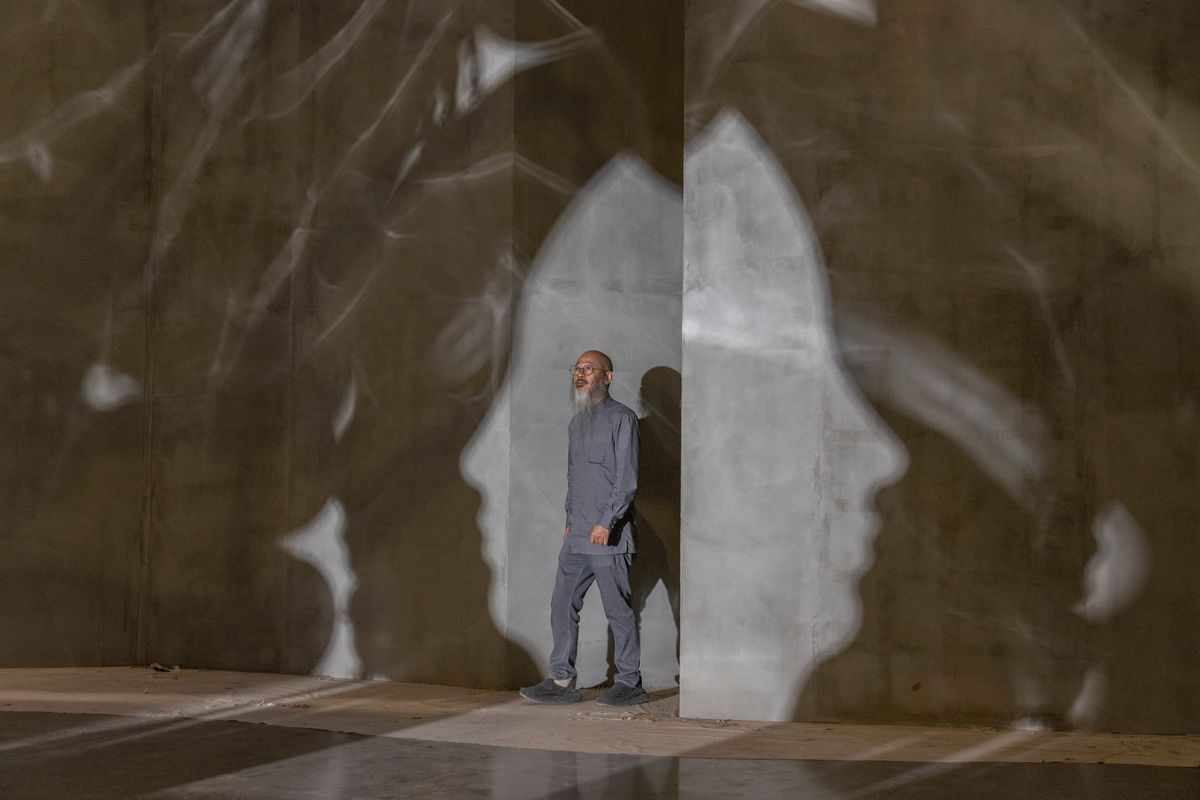
I met Wallace Chan this past May in Venice during the opening week of the Biennale, which coincided with the debut of his two shows in the city—“Vessels of Other Worlds” at the chapel of Santa Maria della Pietà and “Mythos” at the Scala Contarini del Bovolo. In conversation he returned repeatedly to the word vessel, drawn to its doubleness: a thing that holds and also travels, “capable of absorbing the culture of wherever it arrives and then returning, altered, to its point of origin.” This July, “Vessels of Other Worlds” opened its second chapter at the Long Museum in West Bund, Shanghai. The forms first seen in Venice have grown to monumental scale, the tallest reaching 10 meters. Staged in two cities built on maritime trade, the presentations are in dialogue across the distance, water running through both as a thread of reflection and transformation.
The Shanghai show opens along a dim corridor leading to colossal sculptures of semi-abstract visages in blackened titanium, their features partially emerging from metal. The adjoining hall holds several outsized human figures, accompanied by a spare, unsettling score by Brian Eno. Part reliquary, part science fiction, these works deliberately mix registers, and the art-historical references they evoke are similarly unfixed—pointing as much toward Giacometti’s attenuated figures as to Richard Serra’s sheer mass and raw physicality.
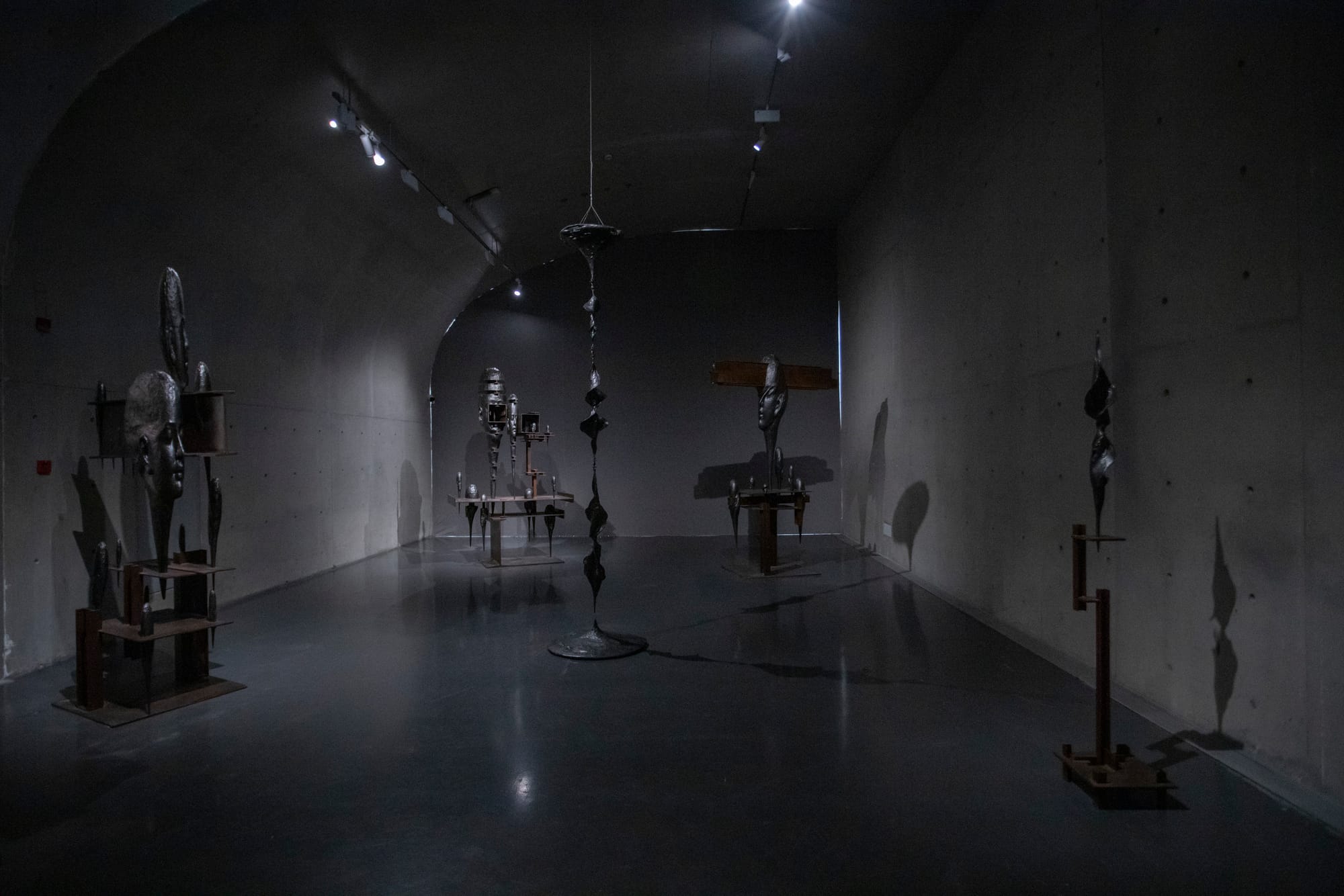
Much of that openness follows from the setting. In Venice, the works occupied spaces steeped in history. “The chapel, the water, the light, the history—all of these things enter the work before the viewer even arrives,” Chan said. There, the sculptures could afford to turn inward. The Long Museum, by contrast, is vast, bare, and concrete, with no inherited frame to absorb them. “In Shanghai, the sculptures must build their own atmosphere,” he told me. “They have to stand with their own body, their own weight, their own presence.”
At the core of the exhibition are three titanium sculptures rising seven, eight, and ten meters, each assembled from thousands of interlocking components—a single vessel is held together by more than 20,000 screws—and one is large enough for viewers to enter. The scale demands the same close looking as Chan’s much smaller gem and jewelry work: the surfaces are crowded with human figures and mythological creatures, worked over nearly every inch. From a distance, they register as mass and silhouette; up close, their façades resolve into figures, shifting with the light as one moves around them. The density owes little to any modernist economy of form; Chan cites Bosch’s The Garden of Earthly Delights (1490–1510), specifically “how Bosch creates an entire world within a single work—humans, animals, plants, architecture, desire, suffering, fantasy—all coexisting within one grand vision.” What the comparison leaves unanswered, however, is a question the sculptures themselves raise: what happens when that kind of teeming imagery is carried by industrial metal?
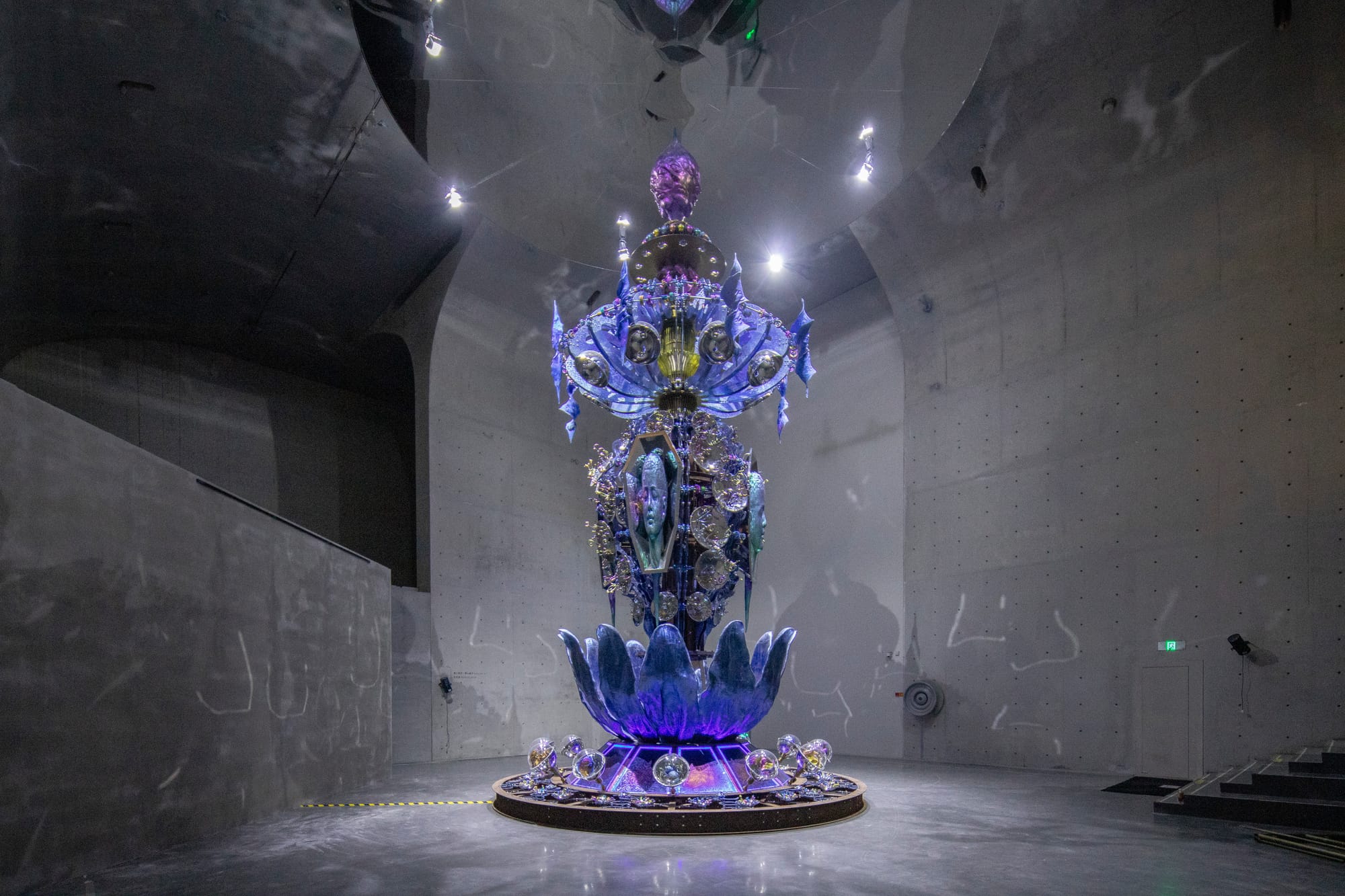
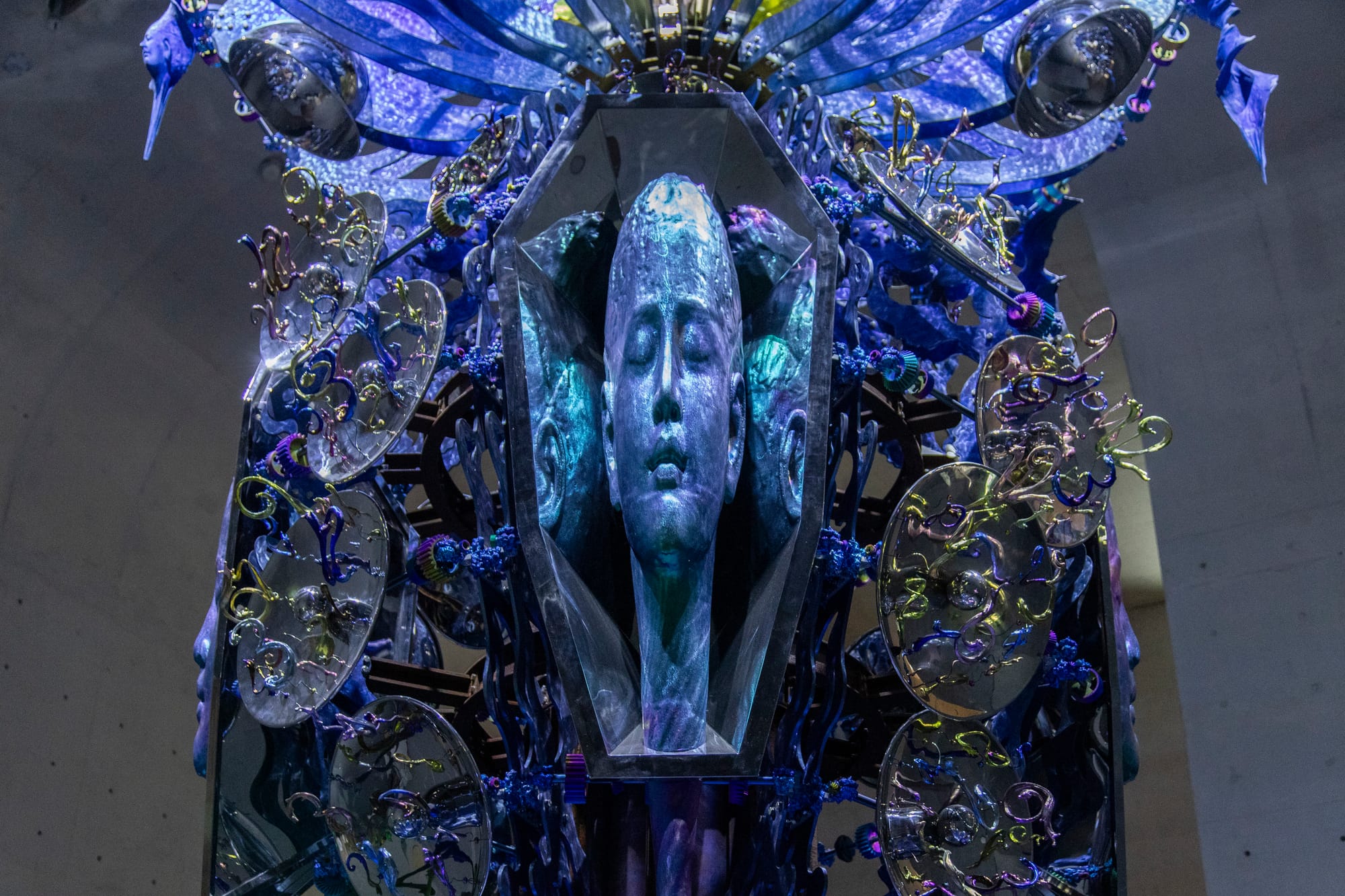
Chan is precise about why the material matters. Titanium carries associations with medicine, engineering, and aerospace—disciplines he wants the work’s spiritual content to push against. “Spiritual ideas should not remain floating in the air,” he said. “They need resistance. They need weight. They need something difficult to pass through.” The color running across the surfaces—shifting hues of yellow, red, and blue, more saturated than in his earlier, more restrained work—comes from the Olea Sancta, the consecrated oils used in Catholic baptism and anointing. “Oil is among the most ancient substances of transformation,” he said. “It passes through matter and, in these liturgical contexts, renders matter sacred.” He reads the anointing as a process of distillation, reducing a substance to its concentrated, essential force—“a kind of birth,” in his words. Three of the works unfold accordingly as movements of birth, growth, and rebirth: “a score for a human life.”
Chan began carving in 1973, at 16, in the classical Chinese tradition of Buddhist deities and Guanyin figures. In the 1990s, he gave away his possessions for a six-month monastic study of Buddhist art. His turn toward Western sculptural forms came through a specific event: when he was 33, his grandfather passed away and was buried in a Christian cemetery. Walking among its funerary angels, Chan began to sketch them repeatedly, embarking on a path through Greek mythology, Western philosophy, and early Christian iconography.
He chose titanium partly for its practical properties—its exceptional strength relative to its weight, and its resistance to deformation—but he speaks of it as the substance closest to permanence. It is a fitting body for work that persistently circles cosmology, history, and time itself. “I continue to create works that will outlive me,” he said, imagining each sculpture extending far beyond the span of his own life. The vessel, in this sense, holds not only form but duration: as Chan put it, the works “truly become vessels of other worlds.”
Louis Lu is an associate editor at ArtAsiaPacific.