Issue
Up Close: Yuko Mohri
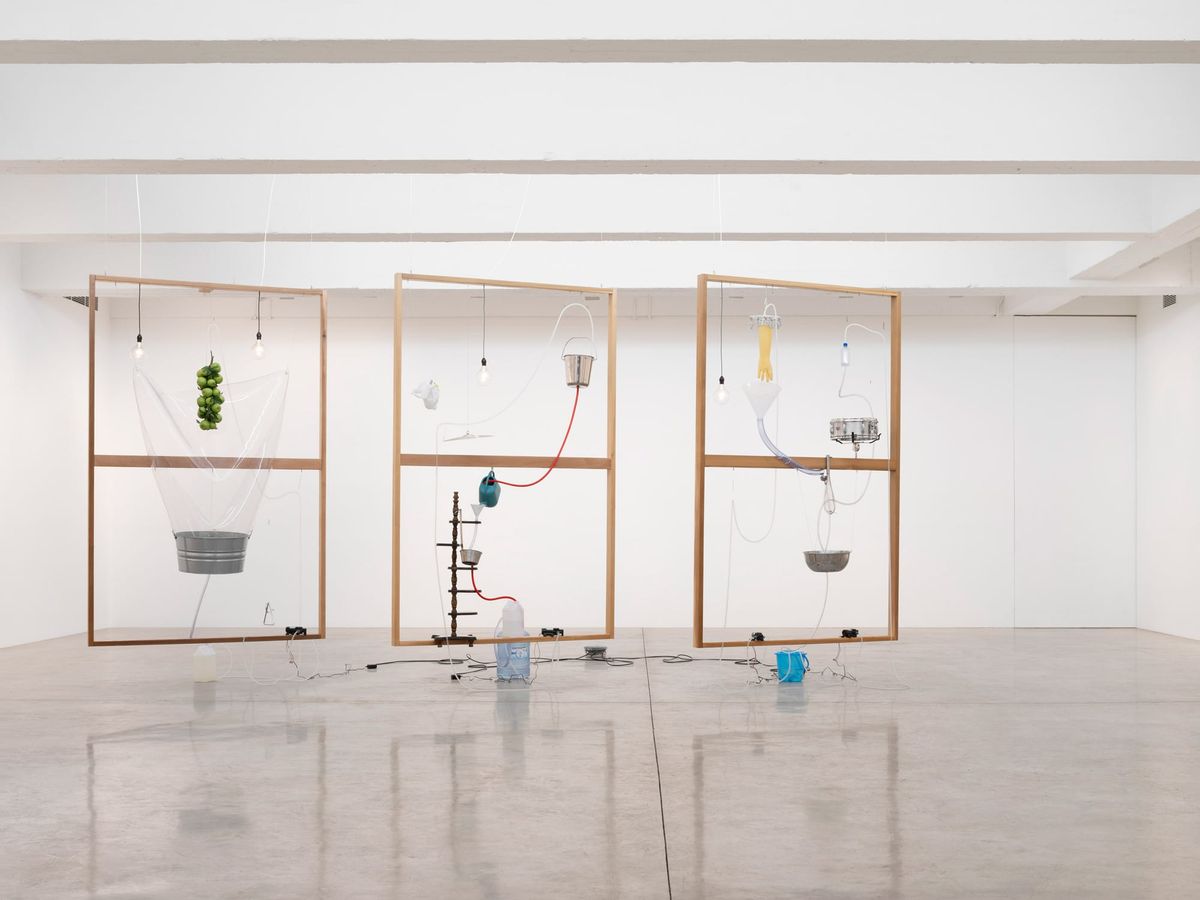
Water carries contradictions in our cultural imagination. It conjures survival crises—droughts, tsunamis, floods—yet also symbolizes transcendence and purification. This shapeless material has long captivated artists: think Bruce Nauman’s Three Heads Fountain (Three Andrews) (2005), the elegiac stillness of Félix González-Torres’s twin circular pools, or Bill Viola’s theatrical videos of bodies emerging from water. Humanity has attempted to channel flow into predictable paths and harness its power through dams or levees. Despite the best efforts, leakage persists. Instead of curbing the spillage, Yuko Mohri asks: what happens when an artist embraces the leak itself?
At Tanya Bonakdar Gallery, the Tokyo-based artist and winner of this year’s Calder Prize unveiled three installations as part of her Moré Moré (Leaky) series (2015– ), which feature plastic tubing, stainless steel buckets, bottles, watering cans, gloves, and other found objects suspended within tall wooden frames. Modeled after Marcel Duchamp’s iconic The Bride Stripped Bare by Her Bachelors, Even (The Large Glass) (1915–23), they are an elegant homage to the modernist who arguably created one of the earliest conceptual pieces about fluidity (or its absence): Fountain (1917). Even as Duchamp’s influence is profound, Mohri reverses his conceptual gesture. The readymade’s operation was to convert ordinary items into artistic objects by neutering their use-value. Mohri does the opposite: her objects go back to work, even if that work remains short-lived, jerry-rigged, or held together through constant adjustment.