Issue
Khaled Sabsabi: Splintered Worlds
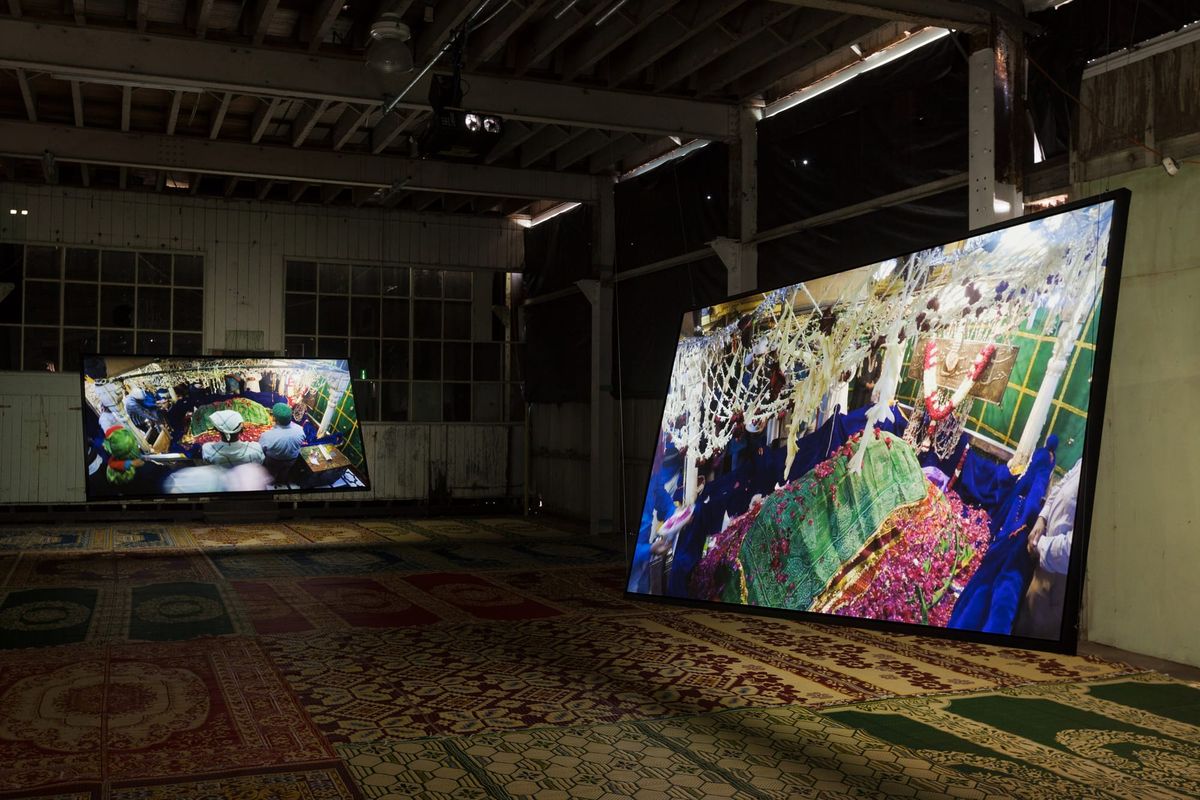
Is it possible to visualize what exists beyond human perception? How can we transcend the worldly domain—to unravel the layers of the self and access divine consciousness? For nearly 40 years, Lebanese Australian artist Khaled Sabsabi has pursued these questions not as abstractions but as matters of survival, drawing on the philosophy of tasawwuf (Sufism), the mystical branch of Islam that seeks a nexus between the physical and the spiritual to grasp the essence of life.
This introspective and holistic approach is rooted in Sabsabi’s embattled biography. Born in 1965 in Tripoli, northern Lebanon, he fled the country with his family in the late ’70s after the Lebanese Civil War (1975–90) broke out, seeking refuge in Australia. They settled in the suburbs of Western Sydney, an area known for its culturally diverse and prominent working-class demographic, where his parents ran a small video and music shop—a business that proved formative for Sabsabi as he grew up ingesting the heterophonic textures, ornamental vocals, and percussive syncopation of Arab songs. “It opened my eyes to the different possibilities of composition, rhythm, and pulses,” he told me in an interview in early February. Such cadences infuse his videos and mixed-media installations, whether through overt sonic elements or, on a more conceptual level, the visual manifestation of repetition and progression—gestures mirroring spiritual observance in that they require vast amounts of patience, discipline, and time.
Take Lefke Morning (2012–18), an 18-minute video work that Sabsabi developed during his travels to Cyprus, where he secured recordings of members of the Naqshbandi-Haqqani Sufi Order as they met every day at dawn for meditation. The film is deliberately out of focus, low-lit, and green-tinted, at first calling to mind the disquieting scenes of US soldiers conducting night raids during the 2003 invasion of Iraq, taped via night-vision helmet cameras. The initial association with such “anti-terror” special operations and combat footage, which dominated the global news cycle in the early 2000s and implicitly fueled Islamophobic attitudes in the West, quickly gives way to an enthralling soundscape as the blurred subjects begin to perform Zikr (“remembrance”), repeatedly reciting prayers and Allah’s name in Arabic. Together, their disembodied voices result in a sonorous chant that—despite, or perhaps because of, its monotony—heightens into a transporting chorus, evoking a sense of concatenation and oneness. While subtly confronting the insidious mechanisms of American mainstream media and flipping entrenched biases, Sabsabi reorients us to a moment of serenity, staging an intimate encounter with the communal act of recitation through sheer audial harmony.
Aside from classical Arab tunes, Sabsabi’s work is strongly inspired by the intonations of hip-hop. Before becoming a visual artist, he produced and performed his own hip-hop music under the pseudonym “Peacefender” throughout the ’80s. Coming of age as a migrant and Muslim in a country that shunned him, he found solace and community in this tribalized cultural movement—The Message (1982) by American hip-hop group Grandmaster Flash and the Furious Five particularly resonated with him, as it explicitly critiqued economic and racial inequality, as well as systemic oppression, demonstrating the activistic potency of music, the spoken word, and self-expression. Hip-hop served as a tool for Sabsabi to address societal issues and aid marginalized cohorts—especially Arabic, Aboriginal, and Pacific Islander youths—through workshops and projects like Hip Hopera. While he experimented with music and art on the side, he worked in schools, detention centers, refugee camps, hospitals, and prisons, solidifying his commitment to public service and social advocacy on both a grassroots and institutional level.