Issue
Up Close: Mona Hatoum
Mona Hatoum has long harbored a deep fascination with the uncanny. This sense of unease, conceptualized by Sigmund Freud in his 1919 essay Das Unheimliche as a feeling provoked by something that “is in reality nothing new or alien, but . . . familiar and old-established in the mind,” is a constant tenor in her sculptures, installations, and videos, which lay bare the architectures of violence that haunt the everyday. Throughout her nearly five-decade career, the Beirut-born Palestinian artist has persistently drawn on psychoanalytic theory and minimalist aesthetics to destabilize the razor-thin threshold between the ordinary and the strange—not to resolve the divide, but to inhabit it. In doing so, Hatoum has forged a vast repertoire in which commonplace materials and objects (such as kitchen utensils, metal scaffolding, even strands of hair) become detached from their original functions, serving instead as disquieting emblems of the structures that subtly pilot our lives.
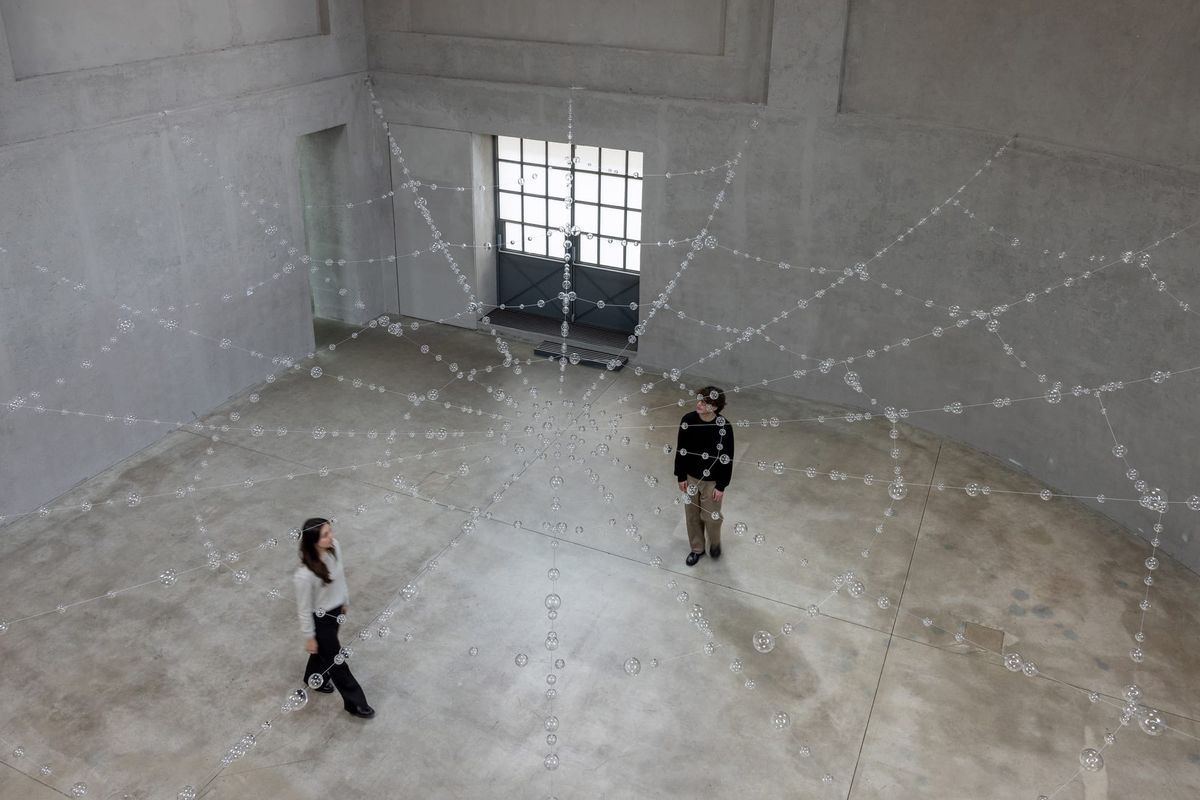
For her latest solo exhibition at Milan’s Fondazione Prada, “Over, under and in between,” the artist continued her inquest into the banal veneers of institutionalized power and global turmoil through three large-scale installations. Staged within the lofty industrial spaces of the Cisterna building, a former alcohol distillery, each project articulated a recurring motif in Hatoum’s oeuvre: the web, the map, and the grid. Near the entrance, visitors encountered a pristine constellation of handblown glass spheres held up by wires—unambiguously titled Web (2025), the work loomed overhead, evoking a spider’s silken snare adorned with glistening dewdrops. The delicate lines and beads possess a cosmic poise, reifying the interconnected emotional and physical nodes of our existence. Yet, as one gazes upward at the radial design and pellucid orbs, awe gives way to foreboding—the slightest disturbance, and this exquisite, fragile canopy might cave in.