Issue
Singapore: “Elia Nurvista and Bagus Pandega: Nafasan Bumi ~ An Endless Harvest”
Elia Nurvista and Bagus Pandega
Nafasan Bumi ~ An Endless Harvest
Singapore Art Museum
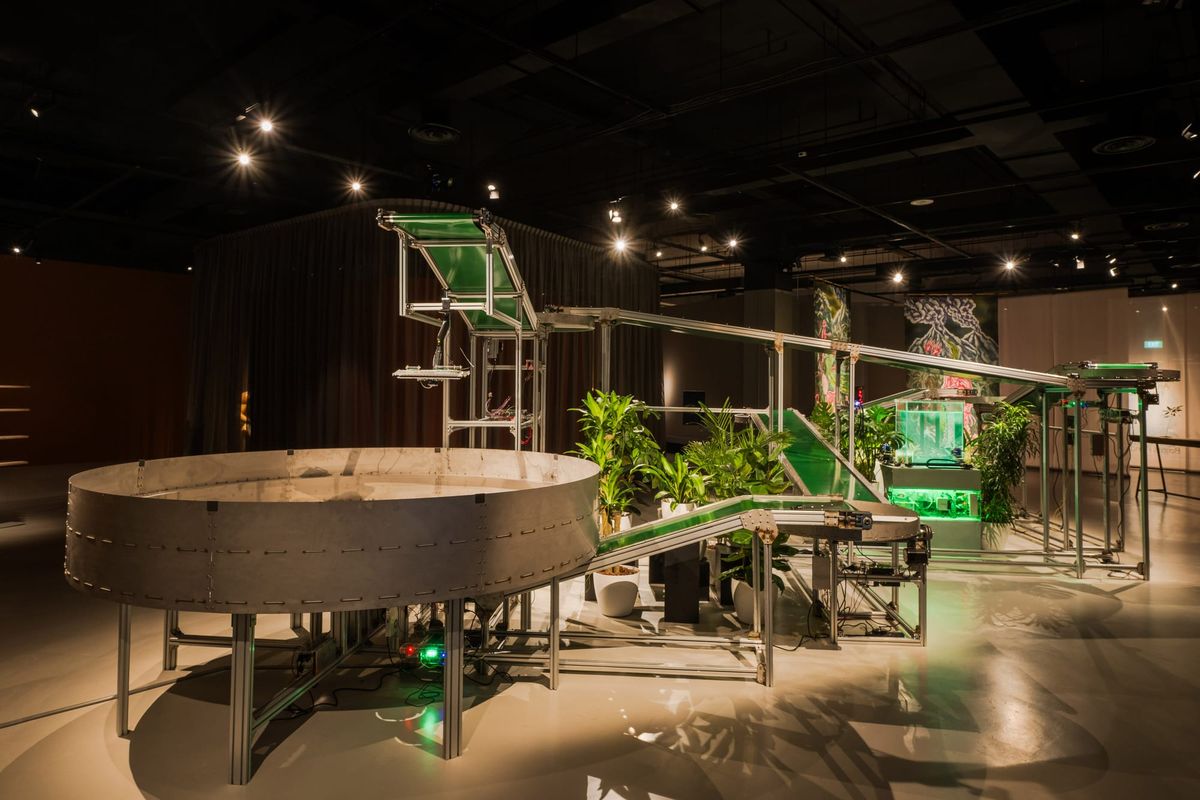
At the Singapore Art Museum, nickel moved to the pulse of tropical plants. In Bagus Pandega’s L.O.O.P (Less Organic Operation Procedure) (2026), fragments destined for the batteries that power our devices and green futures traveled along a 10-meter conveyor regulated by plant biofeedback, climbed a ramp, and dropped into a metal basin in a series of resonant clangs. The impacts converted into signals, triggering gamelan-like tones from music boxes mounted on a slab of rare Borneo hardwood set on trestle legs. Mined metal animated felled timber; from its cut surface, a sapling grew.
Regeneration doesn’t counter extraction; it runs on the same circuitry. What looks like renewal is just another turn of the loop. As Timothy Morton reminds us, there is no outside to the ecological mesh—no clean break, no pure elsewhere. Repair comes pre-entangled with the system it tries to fix. A joint presentation by Pandega and Elia Nurvista, “Nafasan Bumi ~ An Endless Harvest”—nafasan bumi meaning “breath of the Earth”—held renewal and exhaustion in tension. Rooted in Indonesia’s oil palm plantations and nickel mines that feed global demand, the exhibition traced the itineraries of extraction, showing how its consequences drift like seasonal haze: sources obscured, air shared.
Sprawled across the gallery, L.O.O.P read as exposed infrastructure: steel frame, wiring, plants threaded through its network. Pandega is known for his hacker’s ethos, rewiring industrial machinery into systems that privilege recalibration over top-down control. During the preview, fluctuations in plant signals flung nickel off the belt—a hiccup that made the point: stability is provisional. Nearby, Gurat Lara (Scars) (2026) suspended a copper-coated face in a tank of nickel solution. As electroplating progressed, metal accrued across the surface of the visage, the process broadcasted live simultaneously on screens mounted on L.O.O.P’s scaffolding. The allegory is obvious—the human marked by extraction—but the work turned metaphor into enactment, subjecting itself to real-time material consequence. In Fabric of the Earth (2025), mud from the ongoing Sidoarjo disaster—triggered by controversial gas drilling two decades ago—was processed into filament and fed into a 3D printer that translated residents’ drawings of their lost homes into palm-sized forms riding a conveyor. The glitch-prone machine mirrored the precarious terrain it drew from, while the printed objects accumulated—an expanding ledger of displacement.