Issue
Riyadh: “Bedayat: Beginnings of Saudi Art Movement”
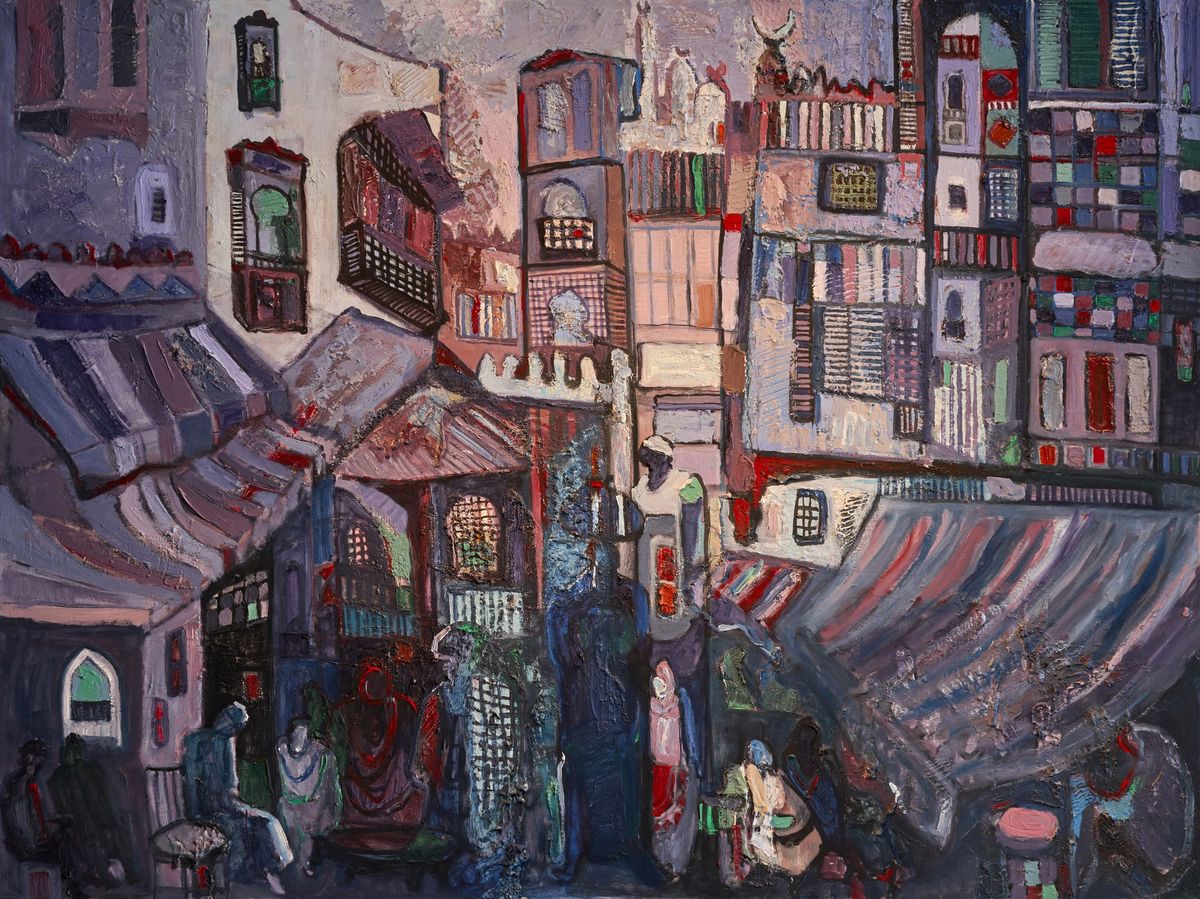
Bedayat: Beginnings of Saudi Art Movement
National Museum of Saudi Arabia, Riyadh
“Bedayat: Beginnings of Saudi Art Movement,” an important if unevenly curated exhibition of Saudi art from the 1960s to ’80s, brought together over 250 works by 73 artists. The exhibition texts largely sidestepped the kingdom’s seismic political and social transformations during the period: GDP soared from USD 1.75 billion to USD 164.5 billion, population more than doubled from 2.4 to 6 million, and car imports and television access multiplied. The 1973 oil crisis, the 1979 Iranian revolution, and the Soviet invasion of Afghanistan further reshaped everyday Saudi lives. These markers of industrialization, mass media, and urbanization would have sharpened the contextualization of the artists’ courageous, often vulnerable explorations of the self, society, and environment.
The first section, “Foundations of the Modern Art Movement in Saudi Arabia,” was strongest with its archival materials. Brochures, newspaper clippings, letters, and even PhD dissertations offered a fascinating window into a nascent, rapidly evolving art scene. Catalogs from the Ministry of Culture’s “First Fine Arts Competition” (1976) and “First Group Exhibition of the Artists of the Central Region” (1980) appeared alongside the Jeddah Fine Art Group’s 1971 show announcement; letters granting overseas scholarships underlined hunger for travel and exposure; while documentation of Dia Aziz Dia’s 1979 sketch for Makkah Gate (1985) hinted at early public art ambitions.
The second section, “Currents of Modernity,” featured paintings by many artists who had studied or traveled abroad, particularly in the US and Europe. While their experiments with surrealism, expressionism, cubism, collage, and abstraction were not always stylistically innovative, they spoke collectively to societal anxiety and a quest for new artistic languages. Memorable examples included Khalil Hassan Khalil’s The Broken Mirror (1982), a deconstructed head portrait alongside an intact clock, and Abdulsattar Al-Mussa’s The Sailor (1986), a poignant carving on cardboard of a weather-beaten man in a shemagh, cigarette raised, lighthouse and bobbing boats behind him in the distance.