Shows
Pittsburgh: 59th Carnegie International: “If the word we”
59th Carnegie International
If the word we
Various locations, Pittsburgh
May 2–Jan 3, 2027
Organized by Ryan Inouye, Danielle A. Jackson, and Liz Park, the 59th Carnegie International, “If the word we,” is a layered proposition of collaboration and quietude. Taking its title from a text by thought partner Haytham el-Wardany, the exhibition is concerned with collective forms of working, living, and imagining—with how a “we” might be built among artists, cultural practitioners, and the public. In his essay, el-Wardany warns against any fixed or named definition of that pronoun; for him, “we” should instead be thought of as an ear that listens, open to transformation and change. The title thus sets out both the exhibition’s ethical framework and the shared ambitions of its conveners. Though each curator brings forth a different perspective, their attitudes and contributions are felt throughout in ways that are varied but clearly interconnected.
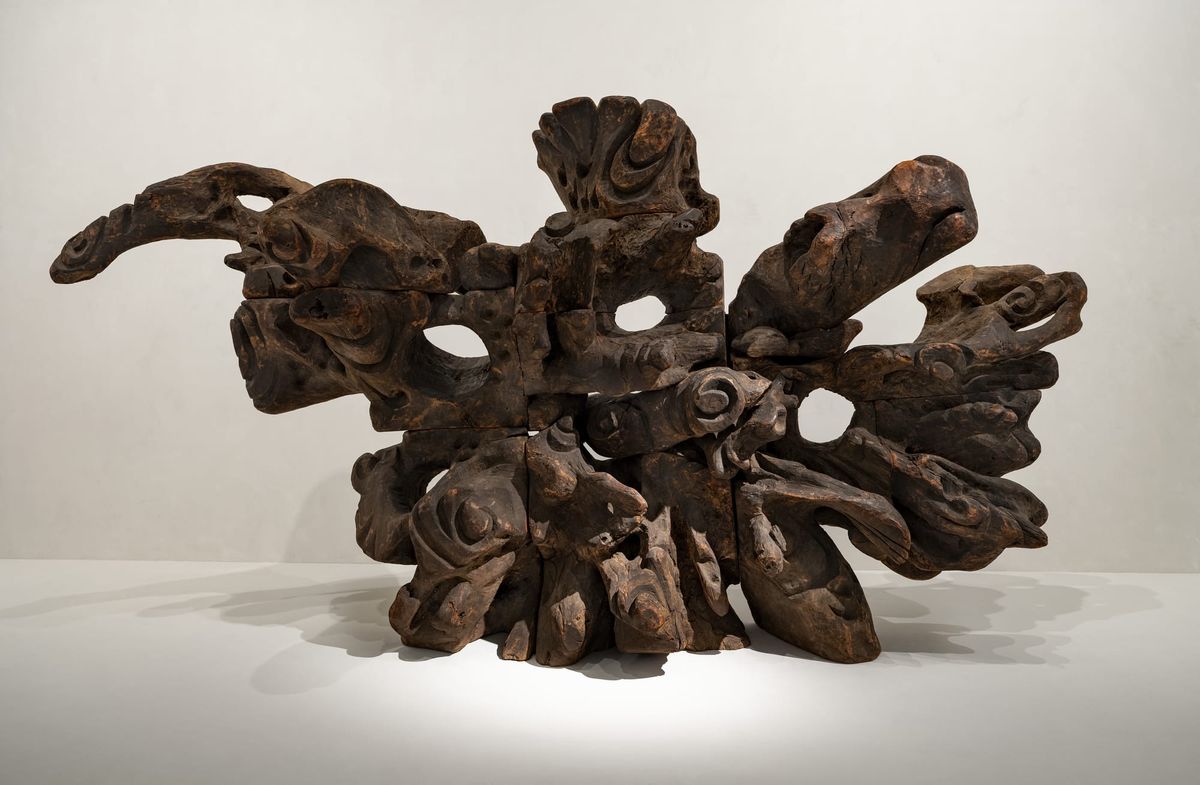
Two works by the radical Sogetsu School of Ikebana, situated on the second-floor landing, establish the exhibition’s tone. Made from huge strips of green bamboo bent and tied in enormous waves, the compositions hold volume, space, humidity, and time in suspension. Conceived by Kenjiro Katayama, a senior Sogetsu instructor, and constructed in partnership with the Sogetsu Pittsburgh Study Group, the works position ikebana as an organizing principle for the exhibition and a way for the self to develop through interaction with the natural world. Founded in 1927 by Sōfū Teshigahara (1900–79), the Sogetsu School rejected rigid formality and moralism, asserting that the principles of ikebana could be applied to any material and any site. Nearby, Teshigahara’s 1962 sculpture Yakumo (Eightfold Clouds), carved from a camphor tree uprooted by a typhoon, is flanked by paintings of Mount Fuji, two metal sculptures, the freestanding screen painting Green Bamboo (Stone), and a selection of Sogetsu publications. Together, these works and documents cast an intense light on his philosophical and spiritual approach and its impact within and beyond Japan.