Issue
Hong Kong: “Zhang Peili: A Day”
Zhang Peili
A Day
Tai Kwun, Hong Kong
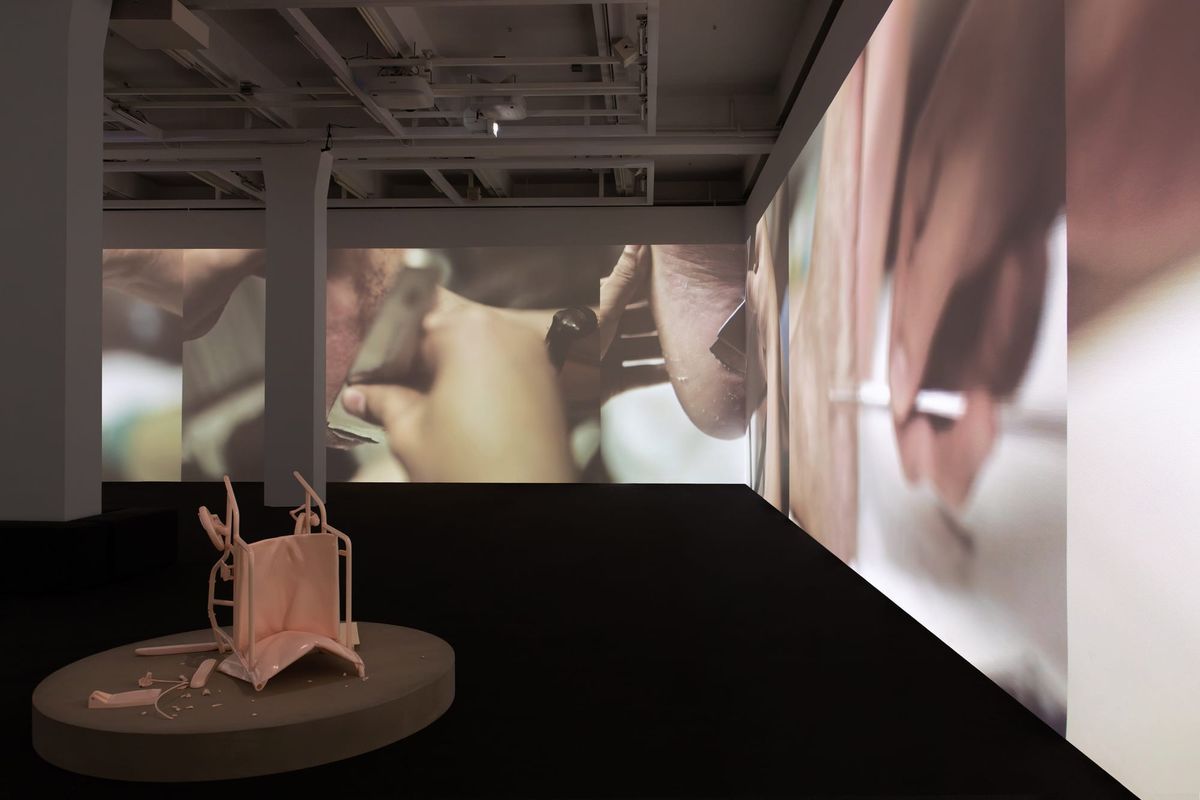
Once, mid faint, my vision jerked, the world convulsed, and I reached wildly as the ground gave way. The body failed first, sight lagging by two ragged heartbeats. I never recalled the instant everything went dark, only a final inhale—brief and clipped, over before panic could form. Zhang Peili’s A Day (2026)—a 12-minute, eight-channel video installation commissioned for Tai Kwun’s F Hall Studio—unfolds from a similarly unstable first-person perspective: a wheelchair jolts and sways its way through an unseen protagonist’s day, rumbling through domestic interiors, parks, courtyards, spectral infirmaries, hospital corridors, and waiting rooms. What ought to register as ominous, however, felt oddly buoyant: the camera lurches ever onward, unsteady yet persistent, with the tips of sneakers peeking up from the bottom edge of the frame to underline the POV. The wheelchair’s journey is accompanied by a jaunty, mechanically cheerful tune—the closing notes of Xinwen Lianbo, China’s nightly state-news broadcast.
Disability and illness have long lurked in Zhang’s repertoire, but less as subject than procedure. In a series of projects based on his own CT and MRI scans, bones, organs, and bodily fluids are converted into 3D, realized as meticulously carved objects in marble, onyx, crystal, and resin. Flesh becomes inventory—segregated, sanitized, rendered pristine—and laid out with fastidious froideur. Latex gloves, his earliest recurring motif, standardize and sterilize touch, first looming larger than life in his painting series X? (1986–89). Gloved hands go on to repeatedly smash and reassemble a mirror in the grueling three-hour video 30x30 (1988)—a landmark piece often cited as China’s first work of video art—and, three years later, obsessively wash and disinfect a live chicken in Document on Hygiene No. 3 (1991). In these works, the viewer occupies a distant vantage, watching clinical routines unfold from a measured distance.