Issue
Gala Porras-Kim: An Alternative Proposal for the Life of Objects
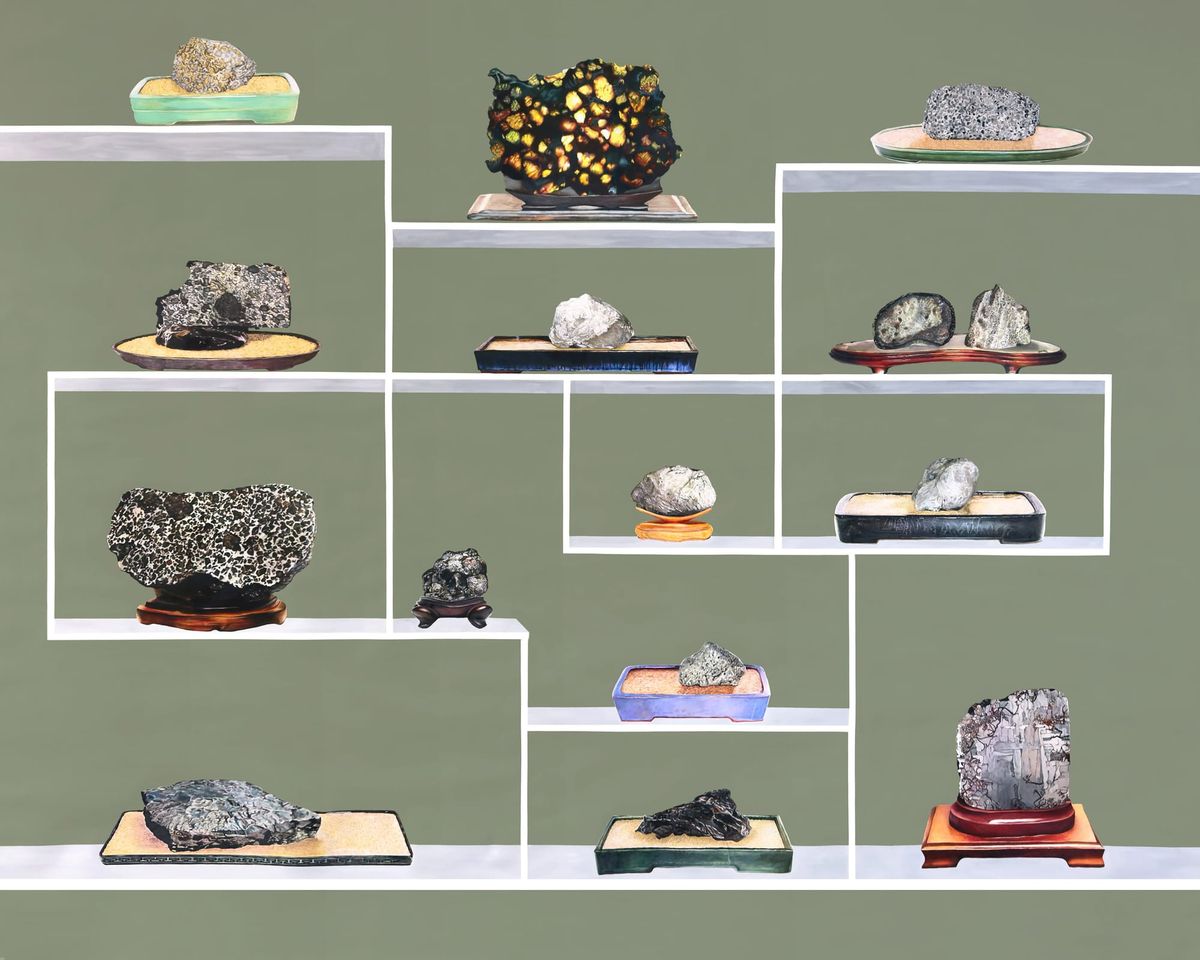
Museums often present themselves as stable guardians of history—places where objects are carefully maintained and classified so that the past may remain intact. In Gala Porras-Kim’s work, this stability crumbles. Through drawings, letters, sculptural propositions, immersive installations, and research-based projects in which objects seem to resist clinical codification, the Los Angeles-based artist poses a deceptively simple query: what happens when an item is preserved according to a logic that does not align with its original function? The question lies at the core of museal practice, even if institutions prefer to phrase it in more technical terms: categorization, accessioning, conservation, stewardship, and display. Porras-Kim approaches those same procedures from another angle. Her work attends to the immaterial remnants of an object after it has been taxonomized: the spiritual life that survives historical labeling, the ritual obligation that exceeds display, the environmental condition that clashes with climate control, the legal status that resists seamless museological translation. In doing so, she peels back the layers of contemporary signification to reveal the inherited structures, uncertainty, and daily labor of the people who decide what an object is allowed to be.
Porras-Kim traces her fascination with these inquiries to an early attraction to history. As a child, she loved visiting museums and reading labels, trying to learn how people had lived before. Over time, however, she became increasingly attentive to the fact that the past is always “presented” (to borrow a technical term from museum and heritage studies). “I realized how much of what I was seeing was being constructed,” Porras-Kim told me in conversation earlier this year. “It depends so much on the personality of who is presenting that information.” That awareness sharpened during her years at CalArts in California, where she undertook conceptual training centering on the structures that produce meaning. The combination proved decisive, as for Porras-Kim, history ceased to appear as a stable field of recovered facts, becoming instead a set of frameworks through which objects, narratives, and values are organized. This is one of the reasons her practice feels so resonant with the concerns of new museology, which has long argued that museums are never neutral repositories but cultural technologies that fabricate interpretation.
Her early experiences with the Fowler Museum at UCLA were formative in this regard. One of the first collections she worked closely with contained artifacts that had lost their catalog numbers and, with them, their institutional identities. They sat on a shelf in the curatorial office, accompanied by notes accumulated over time: one person proposed an identification, another crossed it out, someone else suggested a new origin or use. The scene gave Porras-Kim an unusually concentrated view of museum knowledge in motion, whereby uncertainty was productive, revealing a chain of interpretive labor usually concealed by the polished authority of the label. “It was really interesting to see how the same object could be something different across generations of people,” she recalled. The research was rendered formally through an assembly of drawings, sculptures, and display mechanisms presented in the 2016 edition of “Made in L.A.” at the Hammer Museum, which submitted a hypothetical new configuration for these fragments. The exhibition text noted that “her proposal, in the form of new objects, are singular suggestions for objects whose possibilities for interpretation are infinite.” Here, one can see the shape of her later practice already emerging, as the museum itself becomes the medium of her work—a place where ancient materials are continuously made and remade.