Shows
Everyday Engines: Iftikhar Dadi and Elizabeth Dadi’s “Cosmos”
Iftikhar Dadi & Elizabeth Dadi
Cosmos
Jhaveri Contemporary
Mumbai
Jul 9–Aug 22, 2026
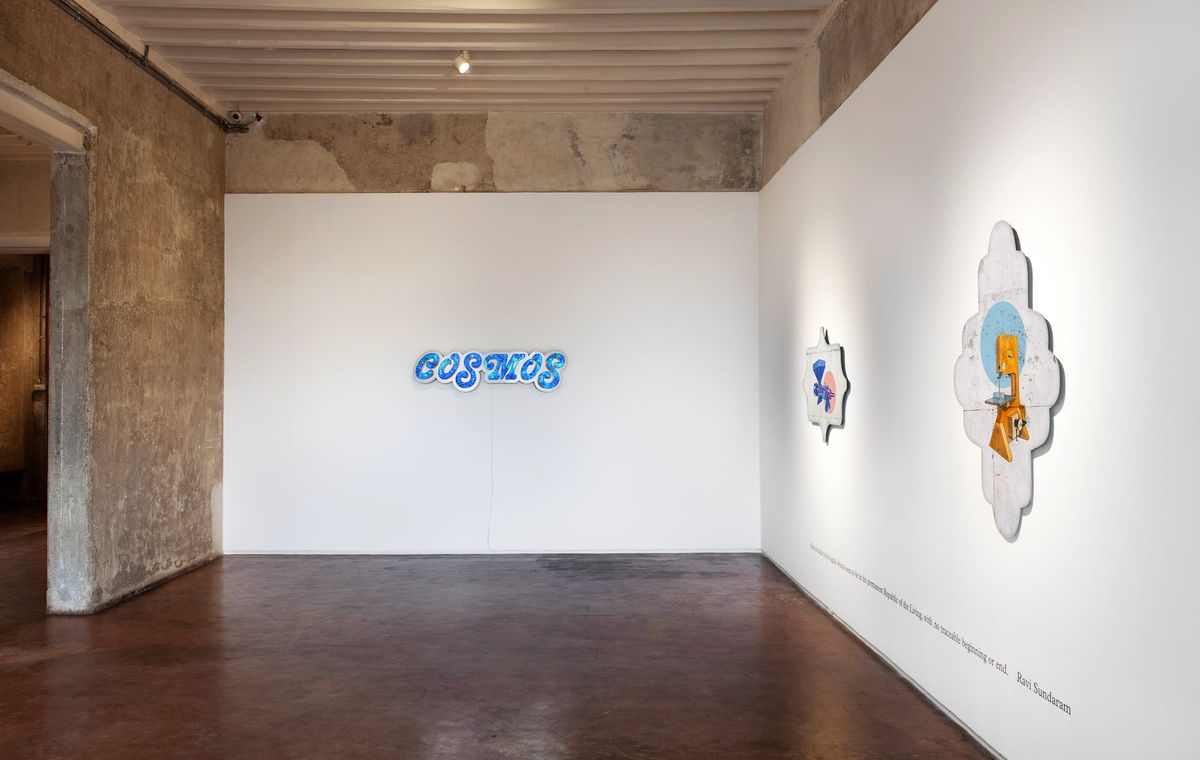
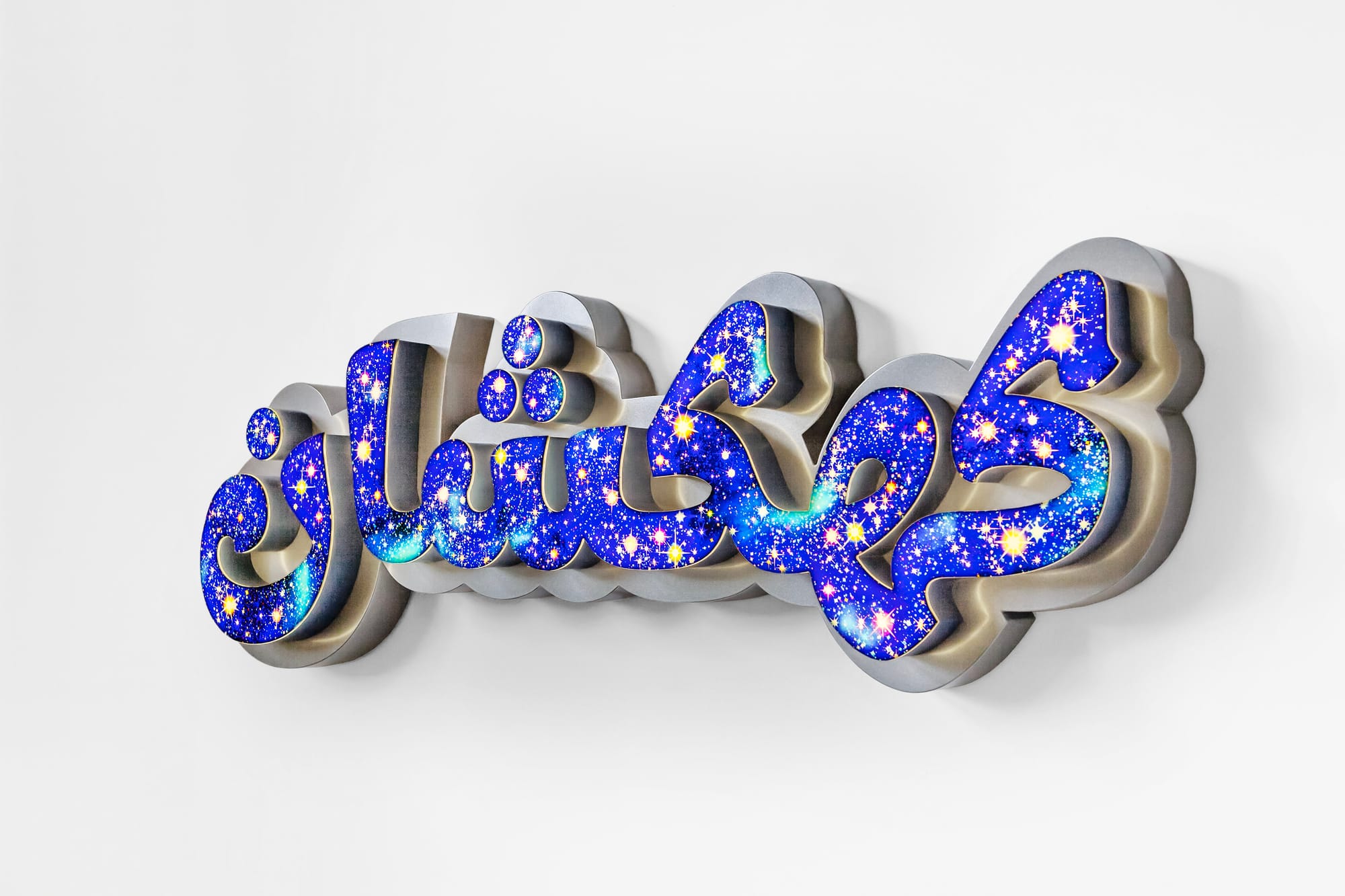
The word “COSMOS” sparkles in blue across a white wall, an image of the night sky stretched across its curled letterforms, lit by a thin, visible electrical cable running down to the floor. Instead of concealing the wire to preserve an illusion of enchantment, the piece lets mechanism and infrastructure sit openly alongside wonder.
Its Urdu counterpart, Kehkashan, hangs in the adjacent room. Together, these illuminated English and Urdu signs string the cosmic to the familiar, pop-inflected street culture of South Asia, where glowing shop signage transforms streets with typography and color at dusk. Their cloudlike frames were borrowed from illustrated Persian and Urdu manuscripts.
In the work of Iftikhar Dadi and Elizabeth Dadi, the universe is not distant or abstract. It is translated, coded in local or vernacular design, and cut on everyday machines.
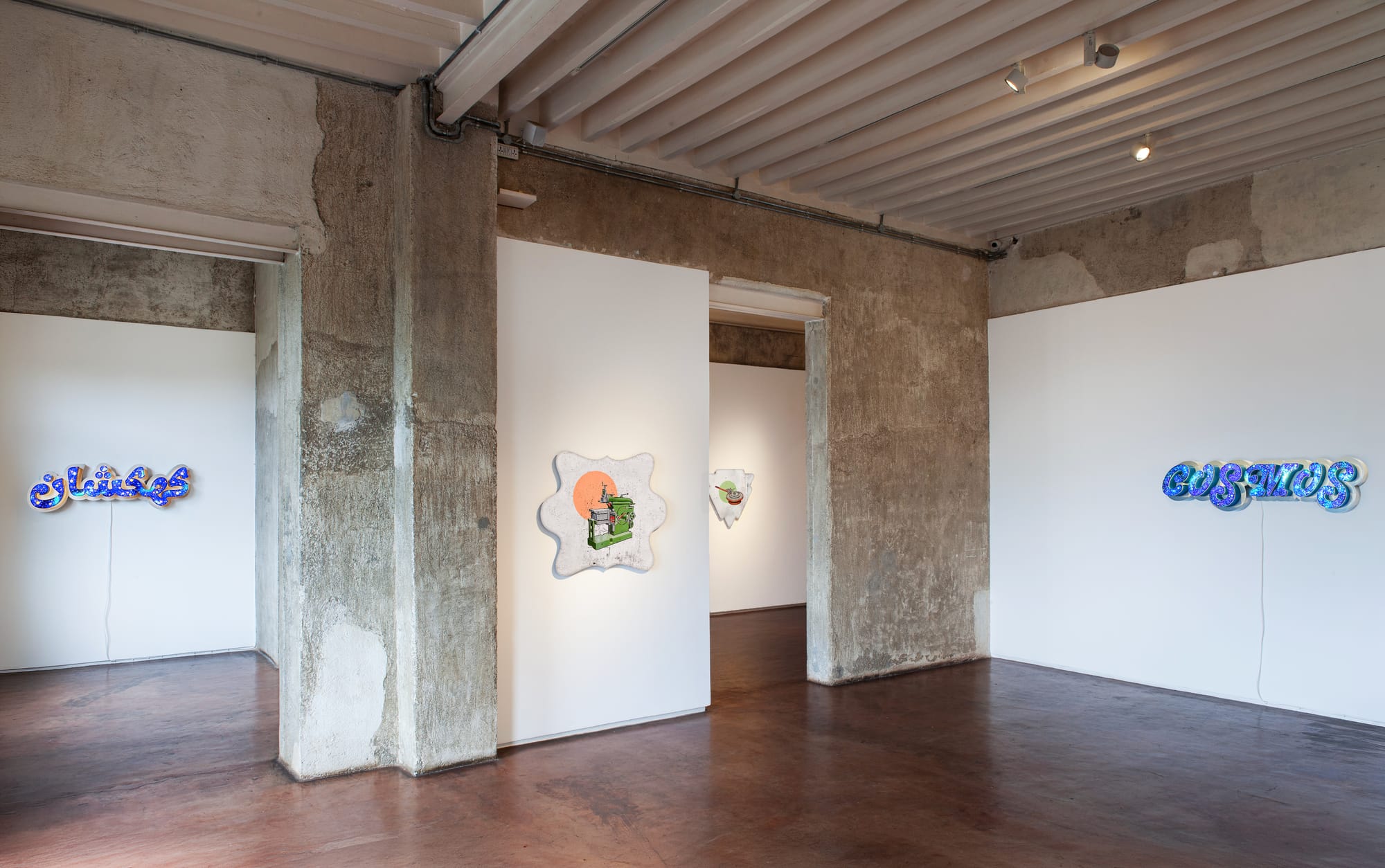
Within the gallery’s infrastructure of exposed concrete, aged plaster, large wooden windows, coppery-oxide floors, and provisional white walls, the show’s atmosphere hovers between workshop and shrine. Against this pale, weathered backdrop, lit by pop-colored haloes, the machines themselves—compressors, drills, presses, millers, grinders, and other instruments common to small fabrication workshops across South Asia—appear humble, rendered here across nine archival pigment prints on Diasec.
Visible daily at street level and in markets, these machines belong to an industrial era that persists even as it remains largely absent from contemporary and futuristic narratives of technological history. Each is set within an irregular, nostalgic cutout reminiscent of Art Deco façades, manuscript cartouches, trophies, plaques, and architectural elements. Their borders swerve, swell, taper, and dip. Acubens, Cosmos takes the form of a soft six-pointed emblem; Rukbat, Cosmos rises like a stepped finial; and Tureis, Cosmos (all 2026) tapers into an inverted geometric mountain.
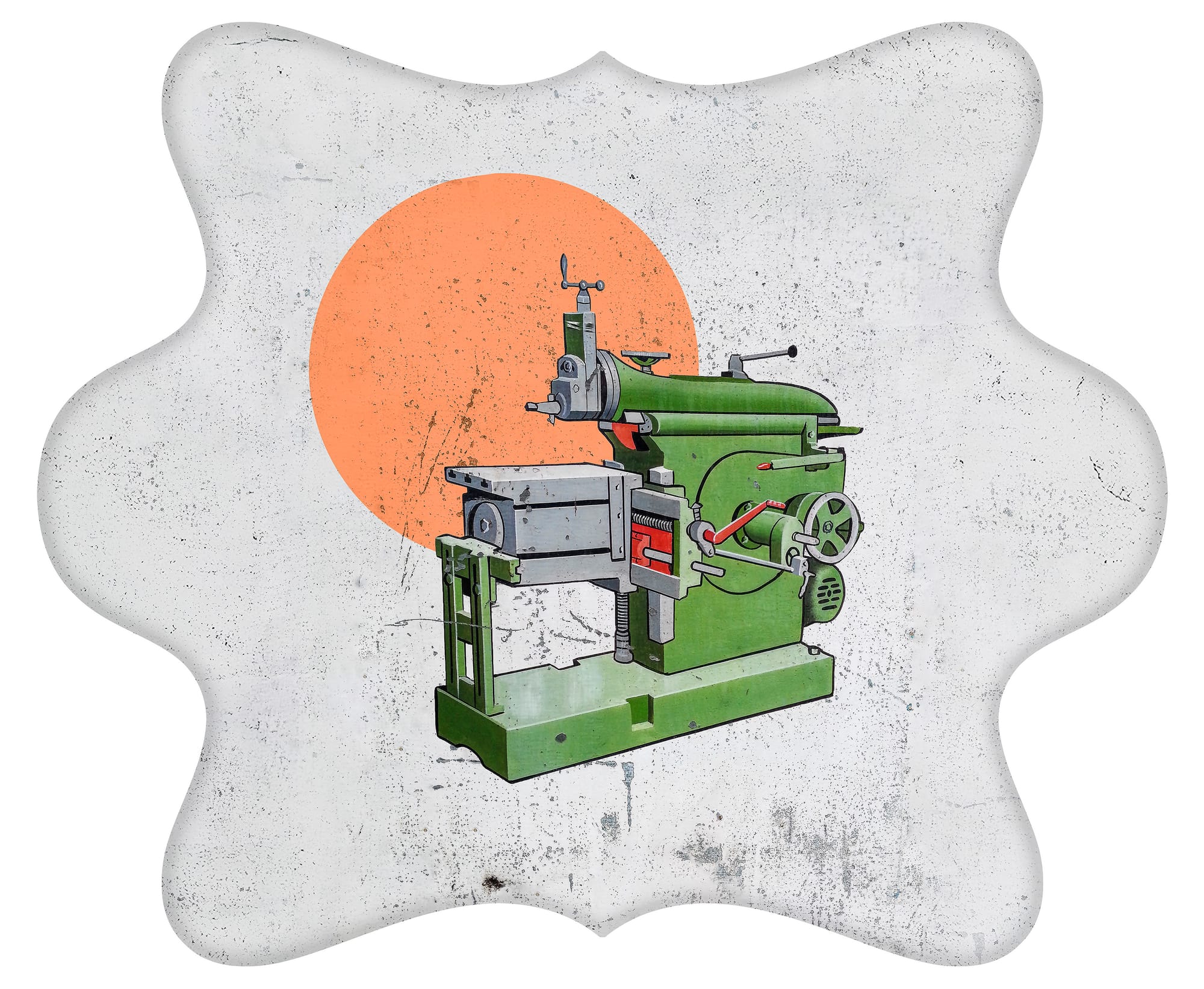
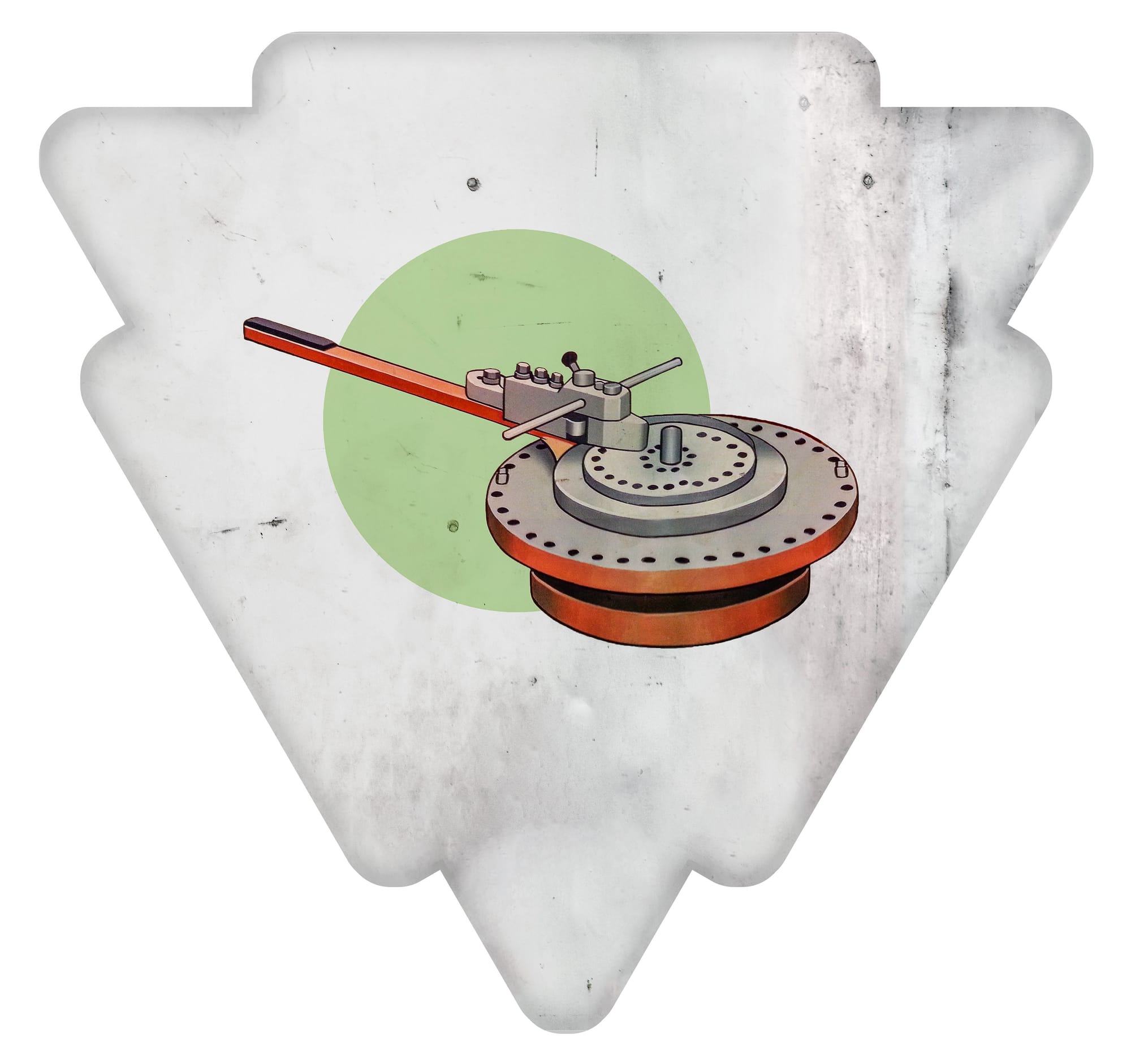
IFTIKHAR DADI and ELIZABETH DADI, Acubens, Cosmos, 2026, archival pigment print on Diasec, 82.3 × 98.6 cm (left); and Tureis, Cosmos, 2026, archival pigment print on Diasec, 75.3 × 79.2 cm (right). Courtesy the artists and Jhaveri Contemporary, Mumbai.
These images, derived from hand-painted commercial signage, are treated with reverence. Even though their backgrounds bear the scratches, stains, and marks of age and fatigue, they are sealed and immortalized under the glossy layer of Diasec. They remind us that refinement can never fully erase time nor the conditions through which an image was formed. The machines they depict have been used, repainted, repaired, and perhaps rendered obsolete in some economies while surviving in others.
Rejecting the popular divide between the industrial and the decorative, or function against aesthetics, the Dadis argue that machines occupy the threshold between usefulness and beauty, and participate in the creation of both. The life of either depends on tools, techniques, labor, and ultimately the transformation of material.
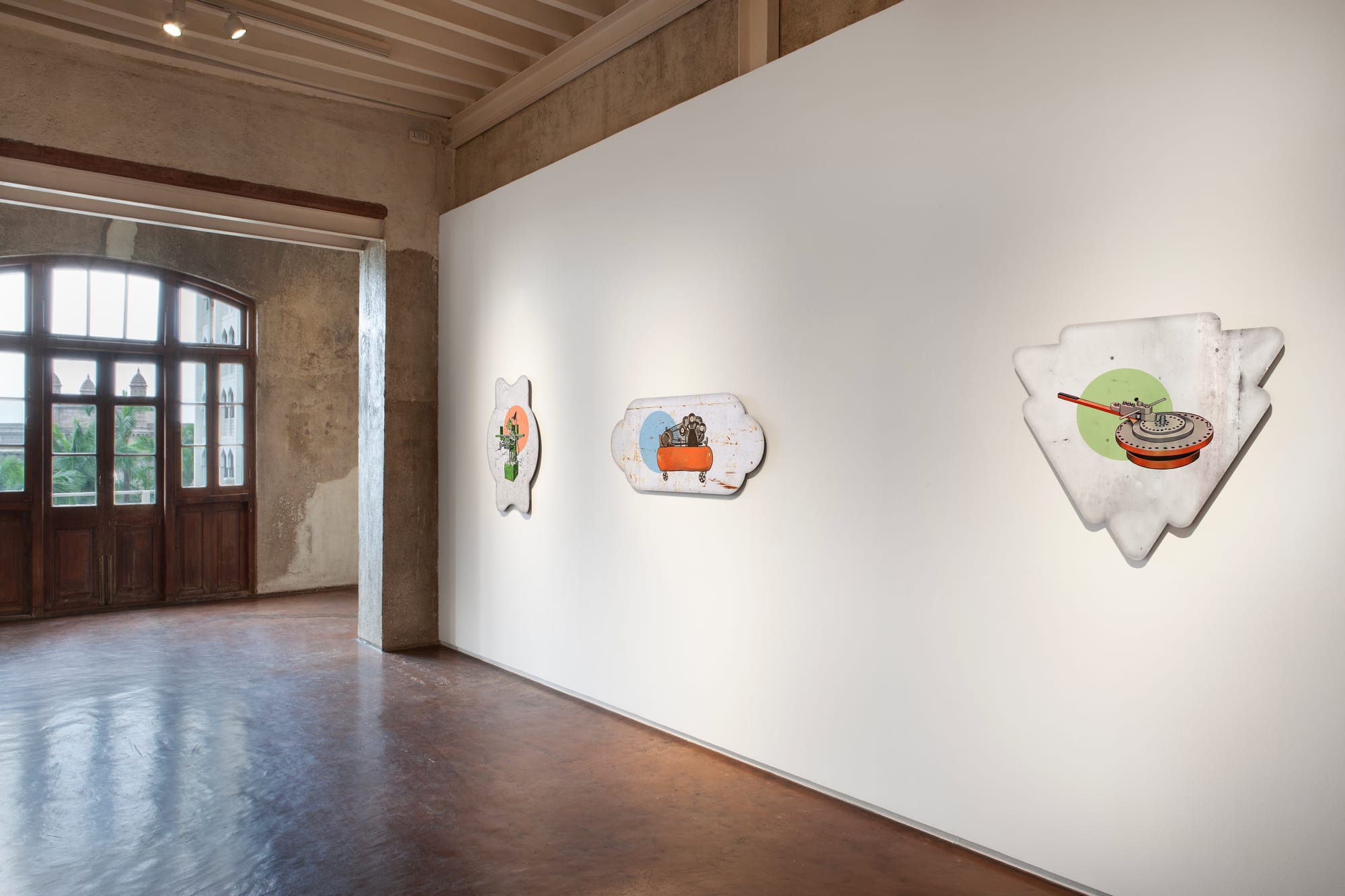
Sometimes these machines take on human or animal postures. Rukbat, Cosmos opens its mouth wide, while Talitha, Cosmos (both 2026) balances a three-eyed orange air compressor on four small, delicate wheels. The pop sensibility in the work of the Dadis is forged from the human touch of hand painting, as opposed to Pop art’s fixation on standardization and mass reproduction. A small shiver in a line, a botched proportion or perspective, a gross simplification of form—each reveals an empathetic, manual interpretation of an otherwise rigid, mechanical object.
When seen in isolation, stripped of their operators, their products, and their workshop settings, the machines take on a strange autonomy. No longer medium or subordinate, they become portraits of production and capacity itself. Catching natural light from the gallery’s windows alongside the sign’s blue glow, fabrication becomes a mode of world-building. We are left to wonder what it might mean to treat the modest, everyday machine that sweats in workshops with the same fascination reserved for emerging technologies and things not of this world.
Mario D’Souza is a curator and writer based between Goa and Kochi, India. He is director of programs at the Kochi Biennale Foundation and a member of Goa’s HH Art Spaces.