Shows
Unfinished Skies: “Prayers to Fornax” at Hyundai Motorstudio Beijing
Prayers to Fornax: Science, Technology, and Spirituality
Hyundai Motorstudio Beijing
Beijing
Jul 18–Dec 13, 2026
For an exhibition whose subtitle invokes “science, technology, and spirituality,” “Prayers to Fornax,” curated by Hyundai Blue Prize+ 2025 winners Yifeng Wei and Penny Dan Xu, is guided less by futurity than by epistemic humility. Few shows attempt to hold science and mysticism in the same breath; this one does, engaging both not as claims to truth but as provisional, often overlapping apparatuses for living with opacity—for navigating a world that contains us, exceeds us, and eludes us. This insistence on orientation rather than mastery—a delicate balance—gives the exhibition its grounded register, even as it traverses otherworldly terrain.
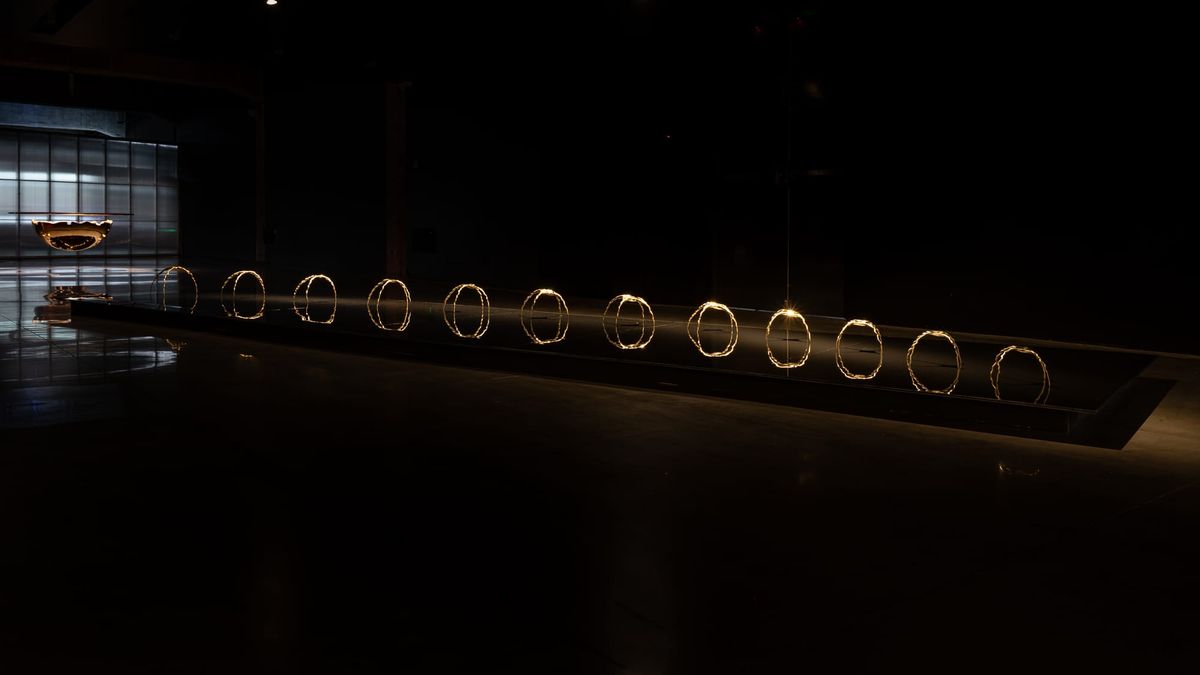
That register is set at the threshold, with a sense of estranged arrival. In Chen Zhe’s Celestial-cranial Instrument: Sutural Zodiac (2022–23), 12 spindly brass forms rest precariously on a dark mirrored platform, their reflections completing their hemisphere-like profiles into ethereal, glimmering orbs. The sculptures trace the gradual development of cranial sutures: in earlier stages, their spidery limbs arc progressively downward but hover just above the ground; later, they touch down, like alien life-forms tentatively establishing a foothold. Chen brings zodiac’s twelvefold order into proximity with the vulnerable materiality of the human skull—stardust meeting sinew, cosmos meeting flesh.
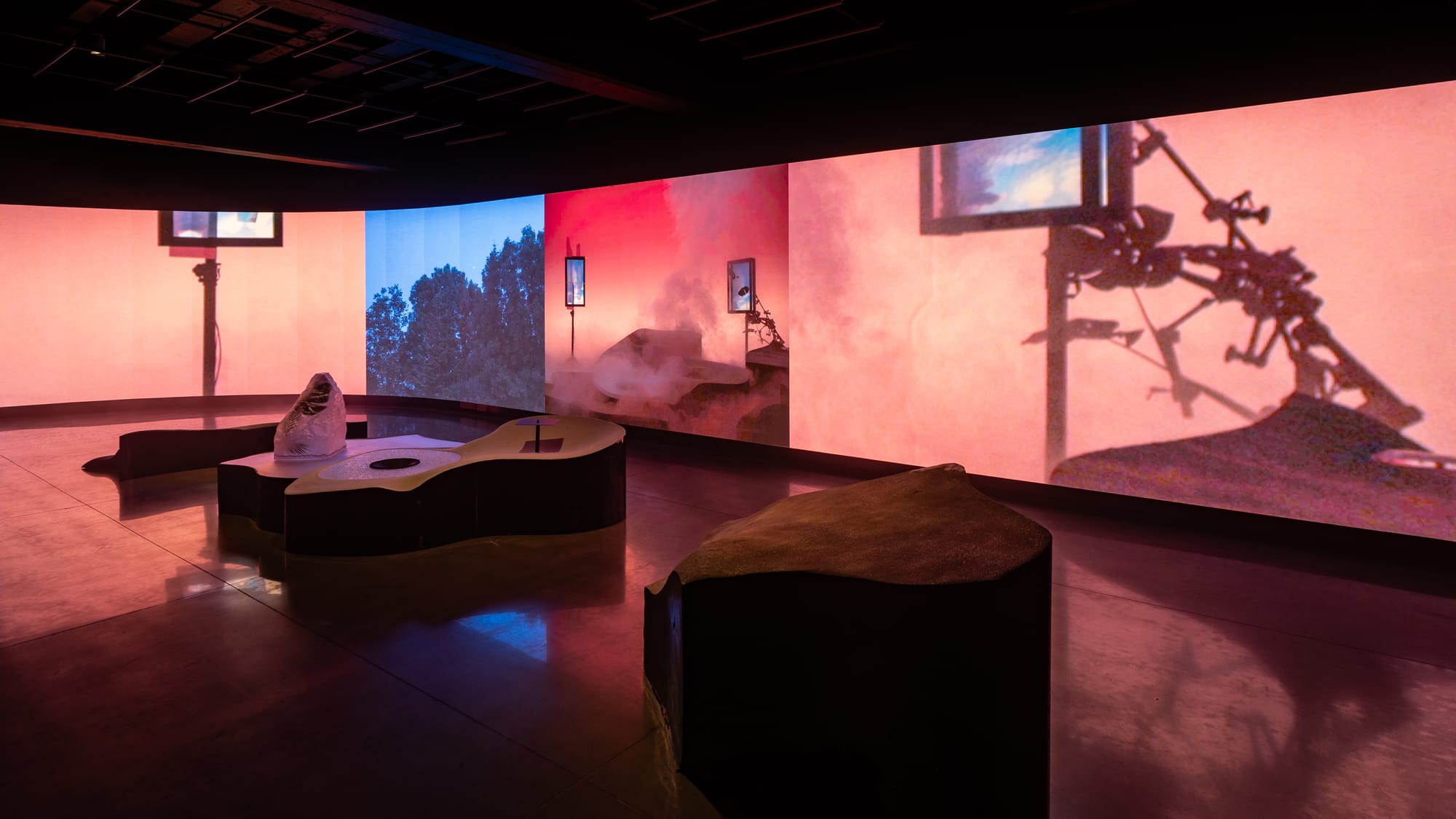
The show then turns to the limits of science. June Balthazard and Pierre Pauze’s video installation Mass (2020) casts two physicists as themselves—2019 Nobel Prize laureate Michel Mayor and Chiara Mariotti, director of research at CERN, the European Organization for Nuclear Research. The two meet in a post-catastrophic world, moving between labs, study rooms, and caves to debate the theoretical models that govern existence, from the long-abandoned Æther to the Higgs boson, discovered at CERN in 2012. The work’s force lies less in the pursuit of any determinate conclusion than in its juxtaposition of everyday minutiae with the mesmerizing unknown: offscreen, spectral sculptures evoke glaciers and desert topographies, while the camera’s attention to desks, research binders, and billowing curtains renders scientific inquiry as lived, almost devotional, labor.
Further video installations each summon a guide—spirit, sage, performer—through Indigenous cosmologies and resonant landscapes. In Natasha Tontey’s Of Other Tomorrows Never Known (2023), a cyborg-vampire, at once theatrical and deadpan, traipses through unruly temporalities in which Minahasan cosmology reframes technology and care as reciprocal relations among humans and the more-than-human. Riar Rizaldi’s Tellurian Drama (2020) roams the ruins of Radio Malabar, the Dutch colonial radio transmitter built in West Java in 1923. A shaman’s haunting zither performance unsettles the mountain’s reduction to extractable resource, restoring it as sentient interlocutor and conduit for ancestral presence. In Haroon Mirza’s Cymatic Ceremony (2024), collaborating filmmaker Helga Dóróthea Fannon carries poppy seeds through a forest before scattering them across a Chladni plate. Activated by soprano Juliette Fraser’s voice, the trembling seeds settle into successive geometric configurations, transforming vibration into oracular surface.
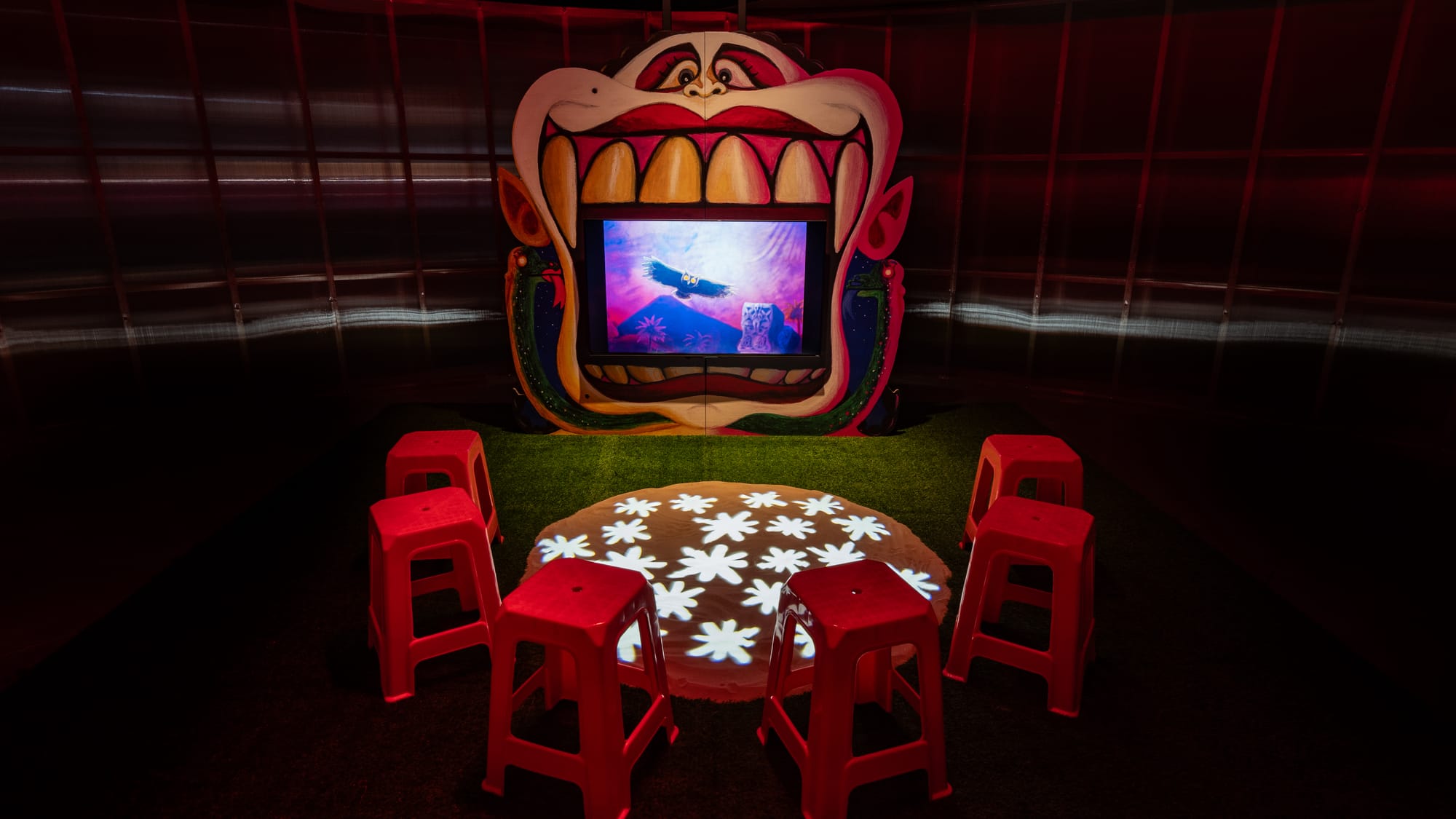
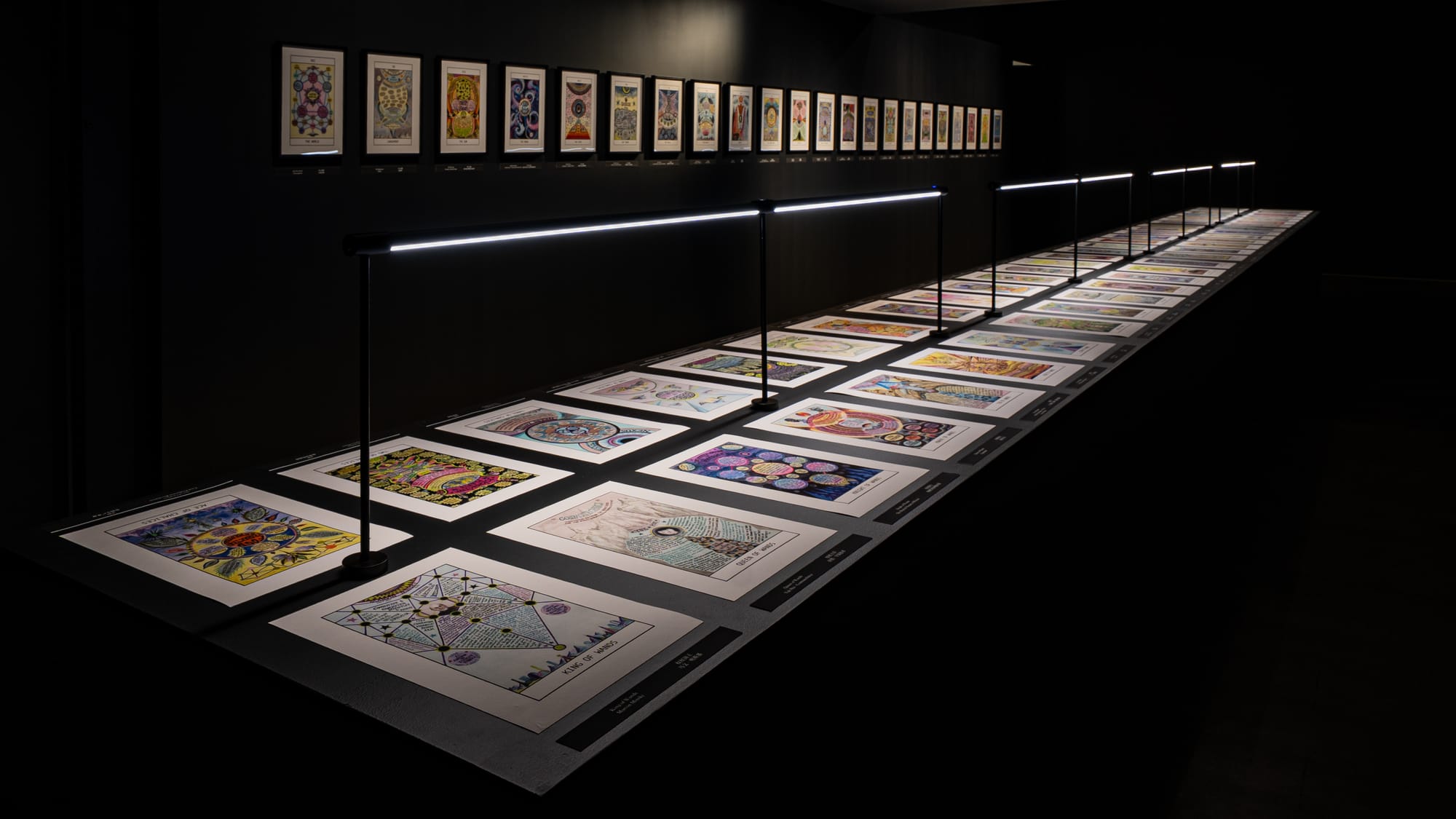
Installation views of NATASHA TONTEY’s Of Other Tomorrows Never Known, 2023, single-channel HD video, color, stereo sound, dimensions variable: 15 min 55 sec, originally commissioned by the Akademie der Künste, Berlin, for the Human Machine Fellowship Programme, 2021–23 (left); and SUZANNE TREISTER’s HEXEN 5.0, 2023–25, giclée print on fine art paper, 78 prints, 29.7 x 42 cm each (right), at “Prayers to Fornax: Science, Technology, and Spirituality,” Hyundai Motorstudio Beijing, 2026. Courtesy the artists; Annely Juda Fine Art, London; P.P.O.W. Gallery, New York; and Hyundai Motorstudio Beijing.
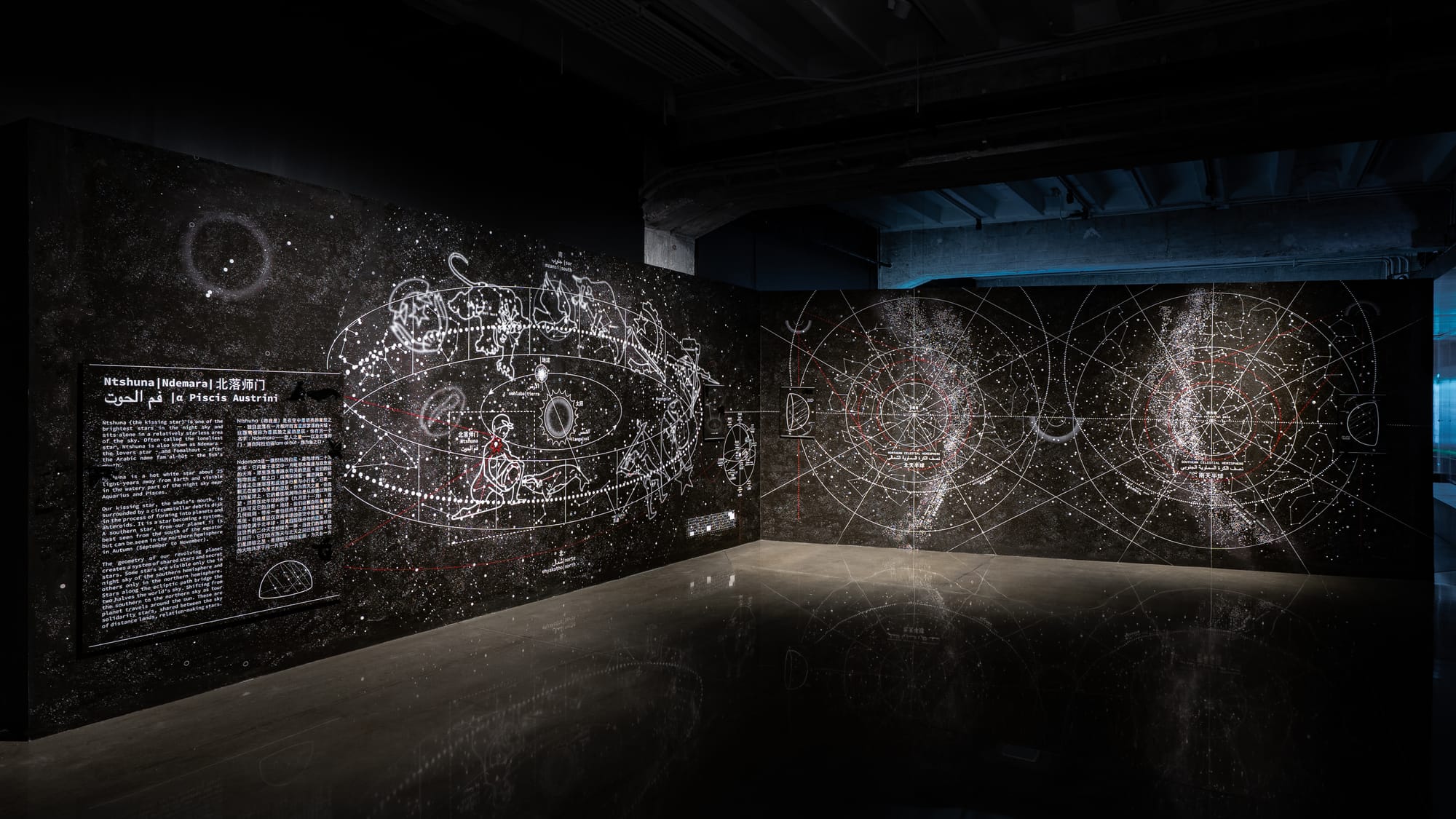
Darkness pervades the low-lit galleries as a condition of wayfinding: when the horizon disappears, one attends more closely to earthly pulses, ancient echoes, and the faint light of distant stars. But Zach Blas’s three-channel video Metric Mysticism: A Troll’s Tale (2022) warns against false glows; borrowing from the language of magic and fantasy, its philosophizing troll exposes how algorithmic systems mythologize data as transcendent and all-seeing. Adjacent, Nolan Oswald Dennis’s wallpaper installation Black Liberation Zodiac: Whale-mouth Solidarities (2026) charts a counter-celestial map of emancipatory histories across the heavens. The sky emerges as neither universal nor fixed, but contingent on vantage, visibility, and the possibility of collective recalibration.
It is in the exhibition’s non-moving-image works that its propositions become most affecting. Dennis’s sprawling, analog mural is cinematic in scale and sweep; eye and body must plot their own paths across its dense cartography. Suzanne Treister’s HEXEN 5.0 (2023–25) similarly compels self-directed discovery: its 78 tarot cards fold planetary and terrestrial technologies, climate crisis, corporate and state power, spiritual ecology, and systems theory into an alchemical visual field. For curator Wei, a practicing tarot master, the deck’s invitation to be read—indeed, pored over—carries particular charge: rather than promising access to settled futures, Treister’s cards make the present newly legible as unstable realms of entanglements.
The show’s titular Fornax is a faint southern hemisphere constellation named in the 18th century by French astronomer Nicolas-Louis de Lacaille after a chemical furnace—an Enlightenment instrument projected onto the sky, evoking transformation and purification. “Prayers to Fornax” offers neither technology as destiny nor transcendence as deliverance, instead proposing art as a site for rehearsing relation: a space in which systems too vast to grasp whole can nonetheless be encountered, interpreted, and contested from within. The sky remains unfinished, its lines still open to revision.
Michele Chan is managing editor at ArtAsiaPacific.