Shows
Up Close: Li Donglu’s “Reborn”
New Voices in Paris Now: Between Memory and Matter
Alisan Atelier
Hong Kong
May 29–Aug 29, 2026
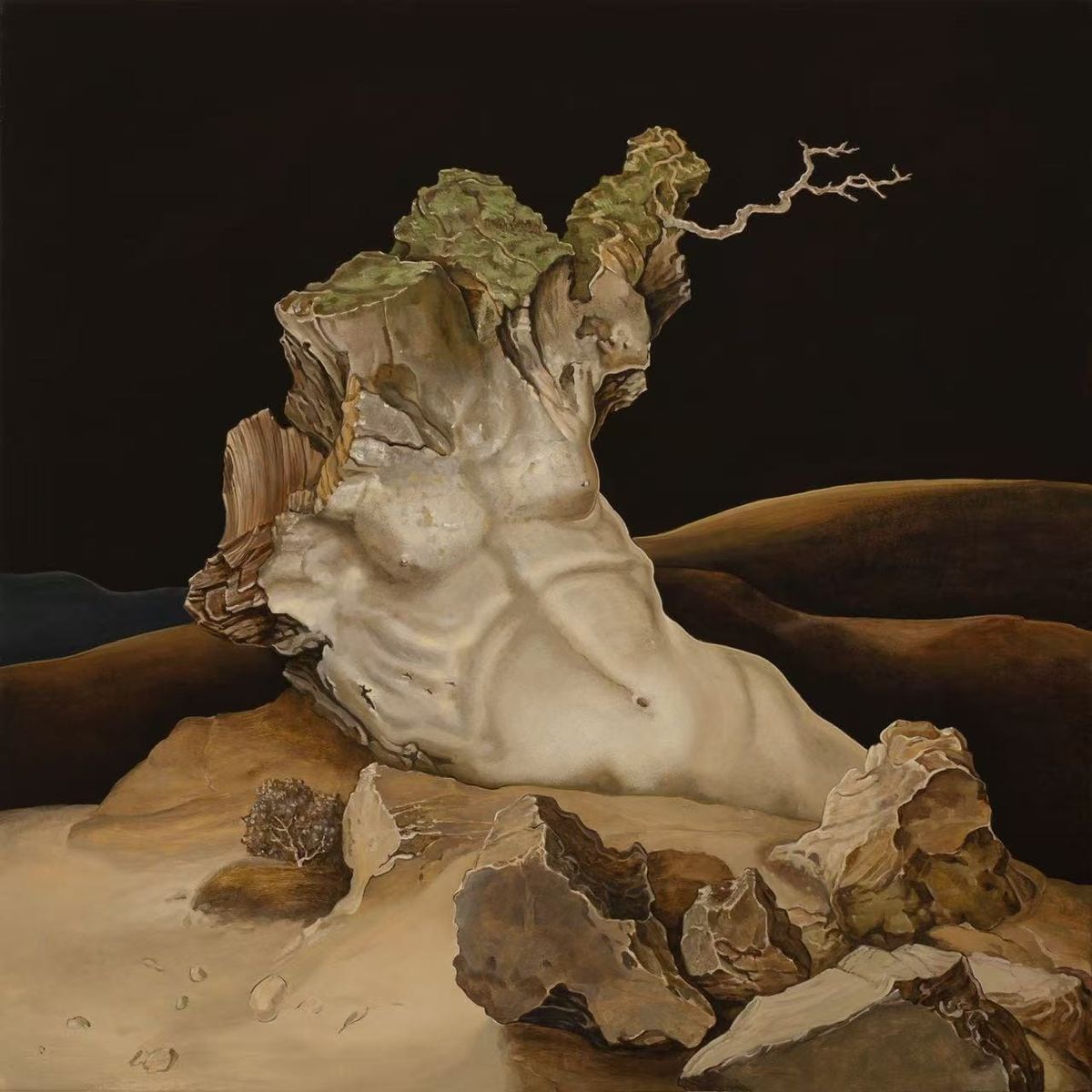
Paris-based painter Li Donglu draws on Sino-Francophone visual language, fusing the expressive economy of xieyi (寫意, “conveying intent”)—the gestural mode of Chinese literati landscape painting—with the exacting realism of classical Western oil technique. His recent oil-on-canvas Reborn (2026), featured in the group exhibition “New Voices in Paris Now: Between Memory and Matter” at Alisan Atelier, Hong Kong, sets a solitary, fissured sculptural torso against a desert landscape, staging the aftermath of civilizational collapse as a surreal dreamscape.
Li has described his depictions of the natural world as existing “alive in the way of death,” framing life and its eventual end not as opposites, but as phases within one continuous cycle. To render decay spreading across terrain, Li juxtaposes the texture of exposed wood grain with its polished surface, and pairs the roughness of fractured stone with the smooth curve of surrounding dunes. Hope emerges in small gestures: patches of green along the figure’s neck and a single branch, a possible proxy for a limb, reaching out toward the abyss, quietly signaling rebirth. Li builds a counter-narrative alongside the ruin—one where the cracks suggest healing instead of further splintering. The painting holds both readings simultaneously, asking us to view vitality and atrophy not as sequential, but as coexisting conditions.
Where Greco-Roman marble idealizes the body, Li’s subject carries visible imperfections—a jutting ribcage, divots of the hip—that leave it starved rather than divine. Even as the sculptural form borrows from Western statuary, the overall composition mirrors that of penjing (盆景, “tray scenery”), the ancient Chinese art of condensing a landscape into miniature form. Li adapts this device by substituting the traditional tree with a broken body, trading a purely natural backdrop for one that captures human vulnerability. His subdued palette of muted browns, greens, and blacks reflects penjing’s restrained tonal range, yet in oil, it sharpens into stark contrasts between subject and background, giving the painting both balance and drama. Amid the seemingly tranquil setting, a fragile faith rises, persisting within an otherwise desecrated civilization.
Sabrina Hau is an editorial intern at ArtAsiaPacific.