Shows
Deceitful Narratives: Ai Weiwei’s “Button Up!” at Factory International
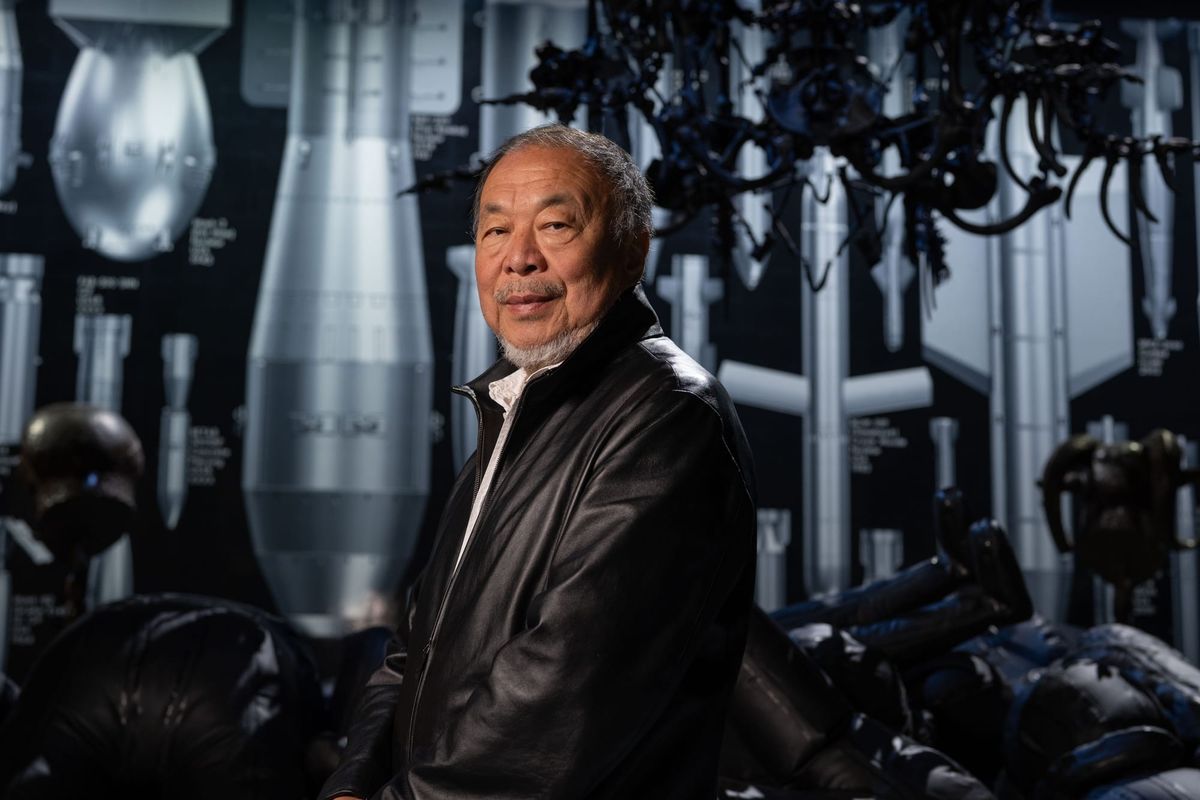
Ai Weiwei
Button Up!
Factory International
Manchester
Jul 2–Sep 6, 2026
There is one key contradiction that mires Ai Weiwei’s practice: he decries propaganda while using many of its mechanisms, earnestly tugging at heartstrings, dazzling with monumentality, oversimplifying with binaries of good and evil, and asserting questionable accounts of history. This was wholly evident in “Button Up!,” his solo exhibition at Manchester’s Aviva Studios. And yet, I walked away with more admiration for Ai than before.
Speaking to Manchester as the former epicenter of the First Industrial Revolution, “Button Up!” located industrialization at the roots of broad phenomena, including colonization, China’s modernization, modern warfare, and the destruction of craft.
Adjacent to the entrance is History of Bombs (2019/25), a nine-meter-tall, 25-meter-wide mosaic made of Chinese-manufactured Woma toy bricks that brings viewers straight into Ai’s deconstruction of the military-industrial complex. The mural renders 50 of the world’s most destructive bombs at one-to-one scale, labeling each with its country of manufacture and arranging them chronologically from left to right and by deadliness from top to bottom; the explosives used in Russia’s war on Ukraine, for example, are located near the bottom right. Ai describes History of Bombs as a presentation of “technical facts,” but in a separate didactic label advances a more hot-blooded argument: “It’s simple: ceasefire and stop the wars. Do not bully.” Indeed, his supposedly analytical approach quickly gives way to a vehement, humanist stance. The mosaic’s sheer size, the cold, steely sheen of the depicted devices, and the participation of 308 volunteers who assembled it over 11 months emphasize the weapons as the output of industrial processes involving many logical minds and deliberate hands. This is the hypocrisy of war: that reasoned thinking is orchestrated for the unreasonable taking of life. In this topsy-turvy context, Ai might be excused for cloaking fervency in objective fact.
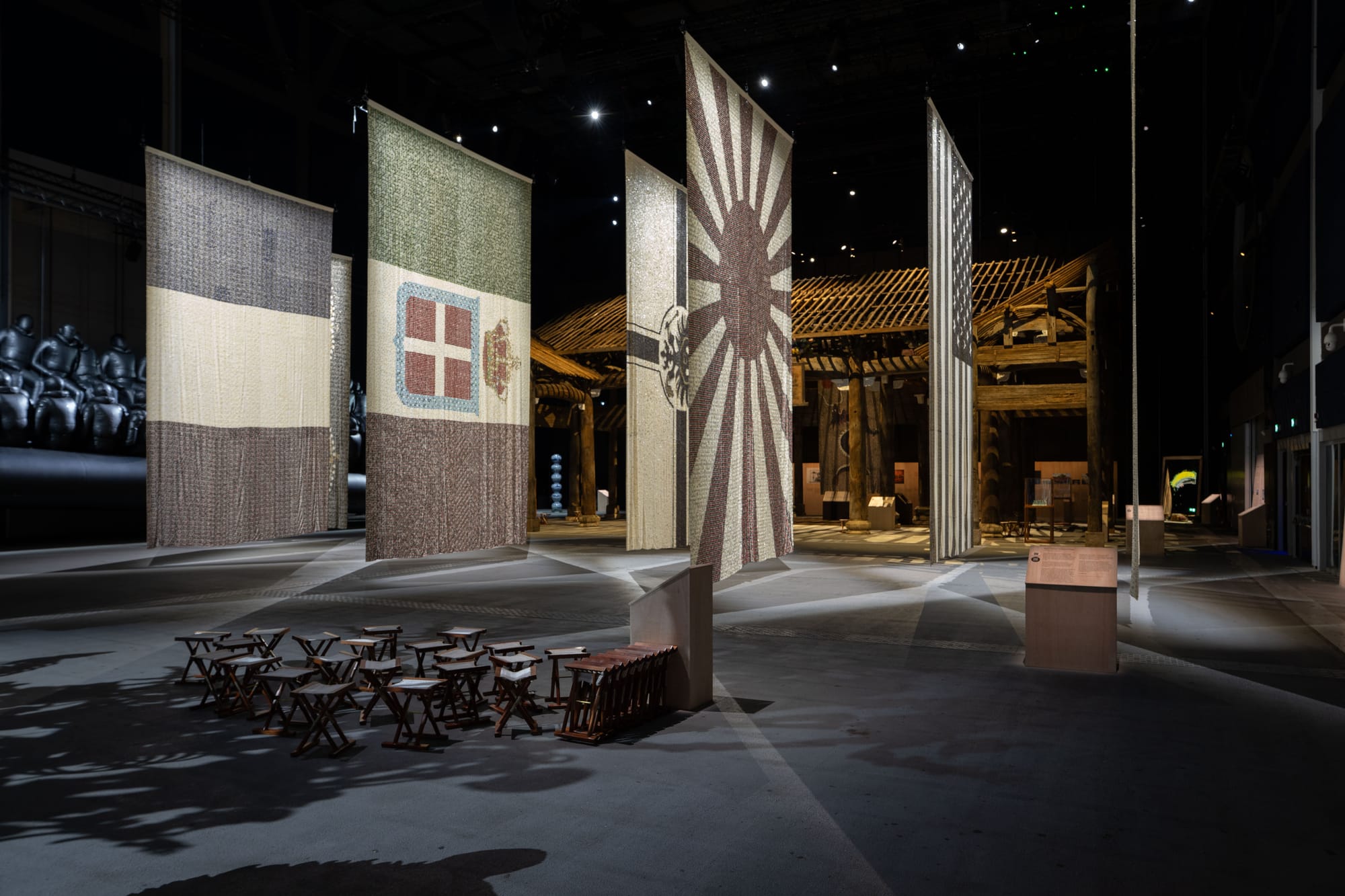
Suspended at the center of the exhibition, the equally gargantuan Eight-Nation Alliance Flags (2024) tenuously link the trade of industrialized goods with the Eight-Nation Alliance’s invasion of China in 1900–01. Thousands of buttons of all colors and sizes are sewn into fabric to form the flags of the Alliance’s constituent nations: Germany, Japan, Russia, Britain, France, the US, Italy, and Austria-Hungary. But while the object label states that the Alliance’s invasion was “aimed at opening trade ports,” trade was, at best, contextually connected with the campaign’s motivation. The more commonly cited target of the Alliance’s attack is the anti-colonialist, anti-imperial Boxer Rebellion, which, granted, arose in the wake of the Qing empire’s defeat in the Opium Wars and China’s concession of economic rights to foreign powers under unequal treaties. Historical misattribution aside, an extraordinary amount of work went into the making of Flags: 33 artisans from Shandong dedicated 281 days to their production. Ai’s employment of craft here thoughtfully redresses an effect of the unequal treaties—the devaluation of Chinese handmade goods against the mass-produced commodities that China was forced to accept from the West as trading currency, alongside opium. Why this labor was channeled into what appears to be a glimmering, monumental homage to the invading countries, though, is less clear.
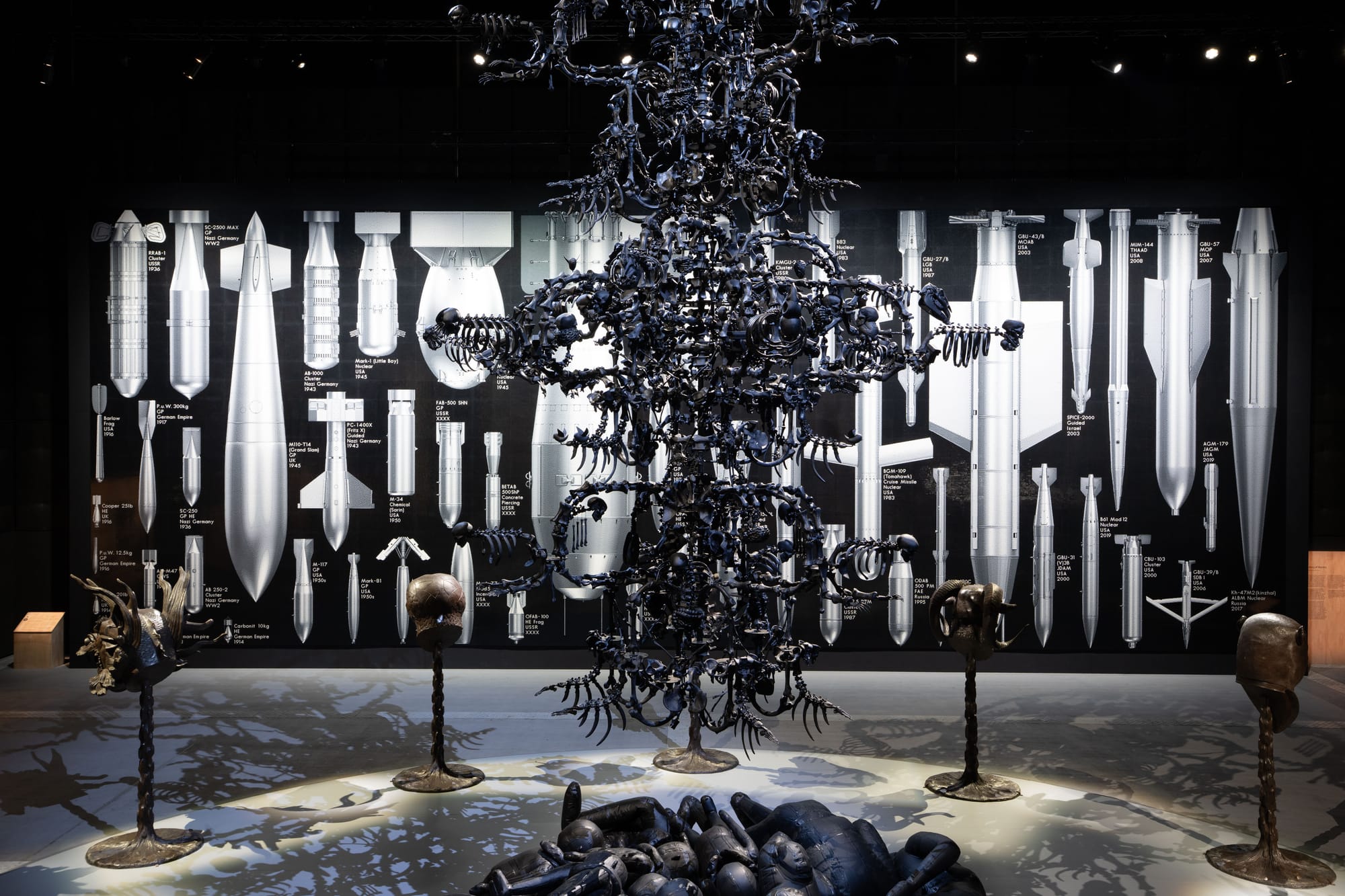
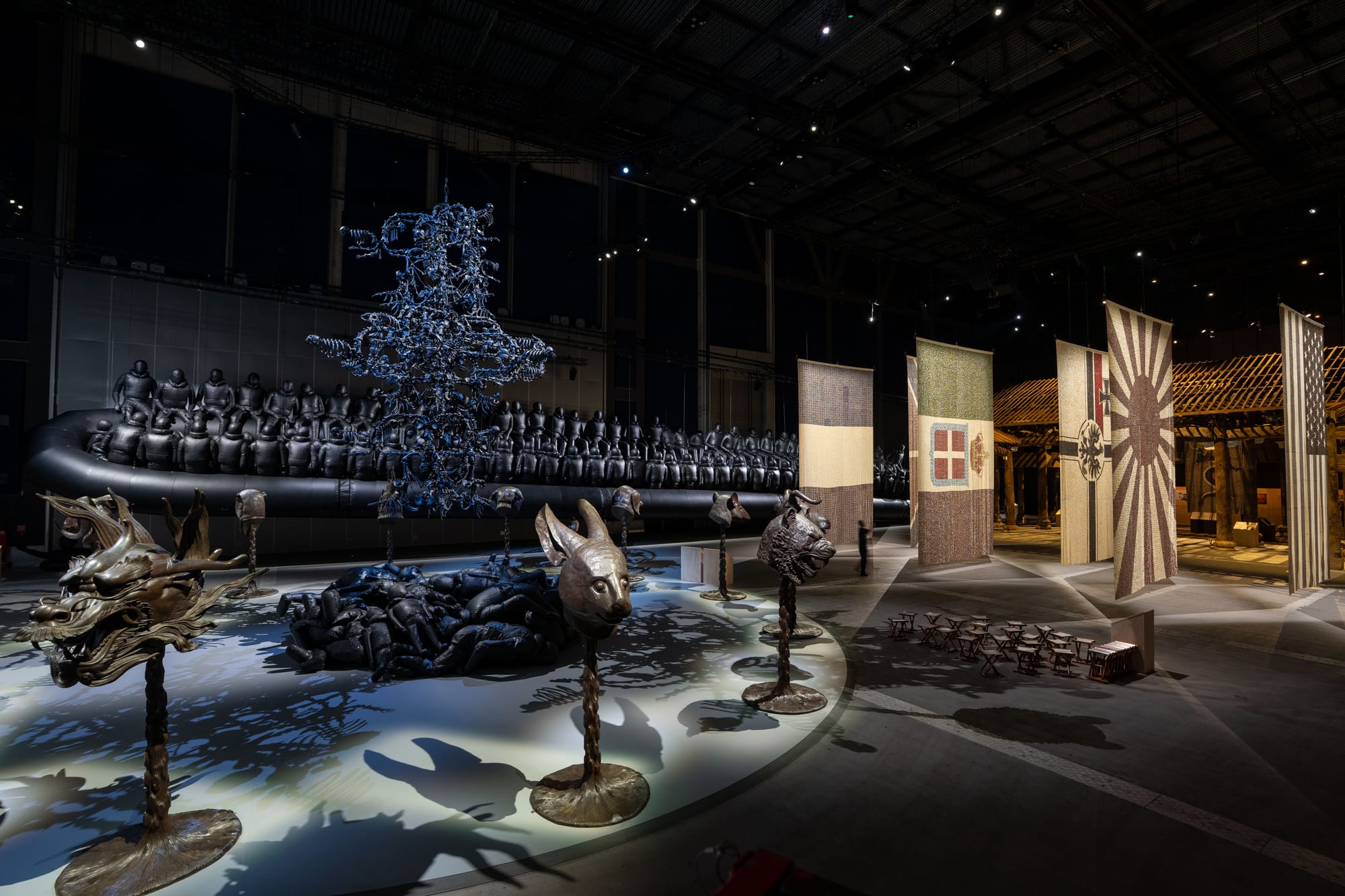
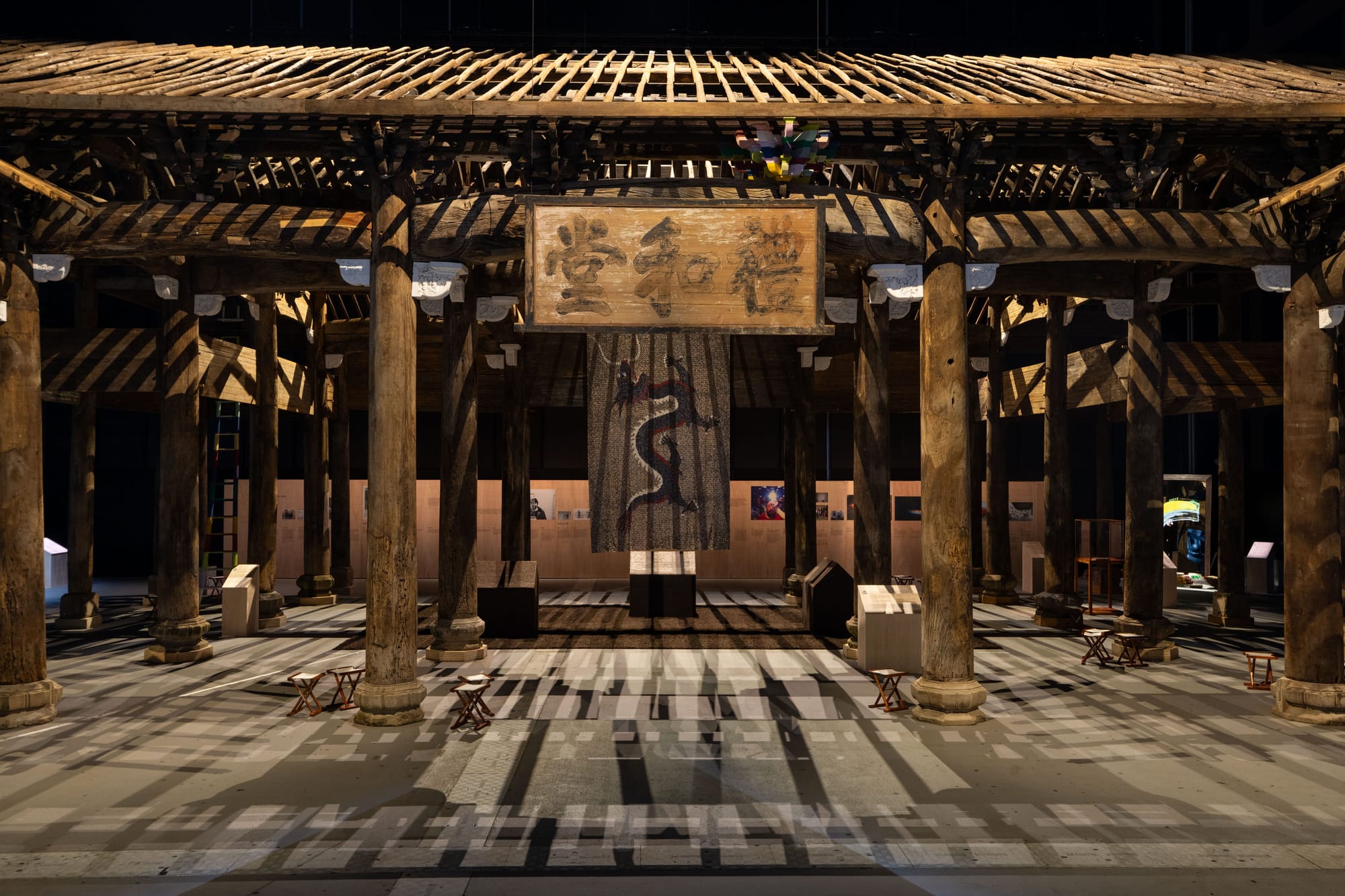
Installation views of AI WEIWEI’s “Button Up!” at Factory International, Manchester, 2026. Photo by Hugo Glendinning. Courtesy Factory International.
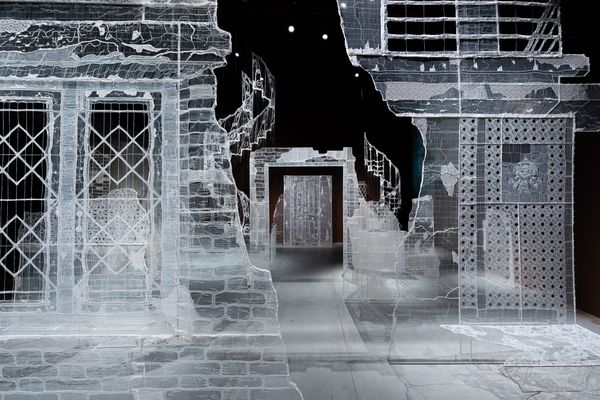
China’s “Century of Humiliation” is the subject of several other works. Circle of Animals/Zodiac Heads (2010) recreates the 12 bronze animal sculptures that French and British troops looted from a fountain in Beijing’s Yuanmingyuan palace in 1860. Less straightforward is Wang Family Ancestral Hall (2015), which presents the wooden bones of a temple that once belonged to a prominent family in Jiangxi province. Laid out on the floor is a bed of pu-erh tea leaves, which the clan traded with Britain, earning handsome profits. The installation was intended as “a symbol of British-Chinese history and China’s declining fortunes by the end of the 1800s.” Here again, historical accuracy was shunted to shoehorn the work into a contrived narrative. How, exactly, do the family’s temple and tea reflect China’s 19th-century decline? Did the Wangs lose their fortune after the British stole tea manufacturing secrets and transplanted cultivation to India? Ai’s explanation leaves this unclear. On the contrary, in his essay for the 2015 presentation of Ancestral Hall at Tang Contemporary in Beijing, curator Cui Cancan writes that the family and temple remained prosperous throughout the 19th century; it was not until the Chinese Communist Party’s (CCP) land reforms of 1950 that the property was seized.
What is undeniable is that China’s “Century of Humiliation” cast a long shadow that lingers beneath the CCP’s relentless drive to propel China as a global superpower. Ai himself has suffered under the party’s strongman approach, having been imprisoned for 81 days in 2011. What put him on the party’s radar, according to the exhibition, was his involvement in a citizens’ investigation probing the collapse of school buildings that killed 5,197 students during the 2008 Sichuan earthquake. Audible throughout the show is Nian Nian (Commemoration) (2021), a series of recordings in which volunteers recite the names of the victims in Mandarin and other Chinese dialects. Between almost mechanical incantations are stutters and brief moments of hesitation as readers grapple with the articulation of certain characters. This struggle aptly encapsulates “Button Up!,” where what the works express do not necessarily match their purported intent. More broadly, the show reflects an artist attempting to remake a rhetorical inheritance of grand, sweeping narratives and polemics in the service of freedom and justice. The results are at times strained, but perhaps the struggle is all that we have. If Ai demonstrates anything, it is the necessity of confronting the limits of the status quo again and again, regardless of failure, guided by vast ambition and an unflagging moral compass.
Chloe Chu is an art writer and editor based in London.