People
The Image World: Interview with Simon Fujiwara
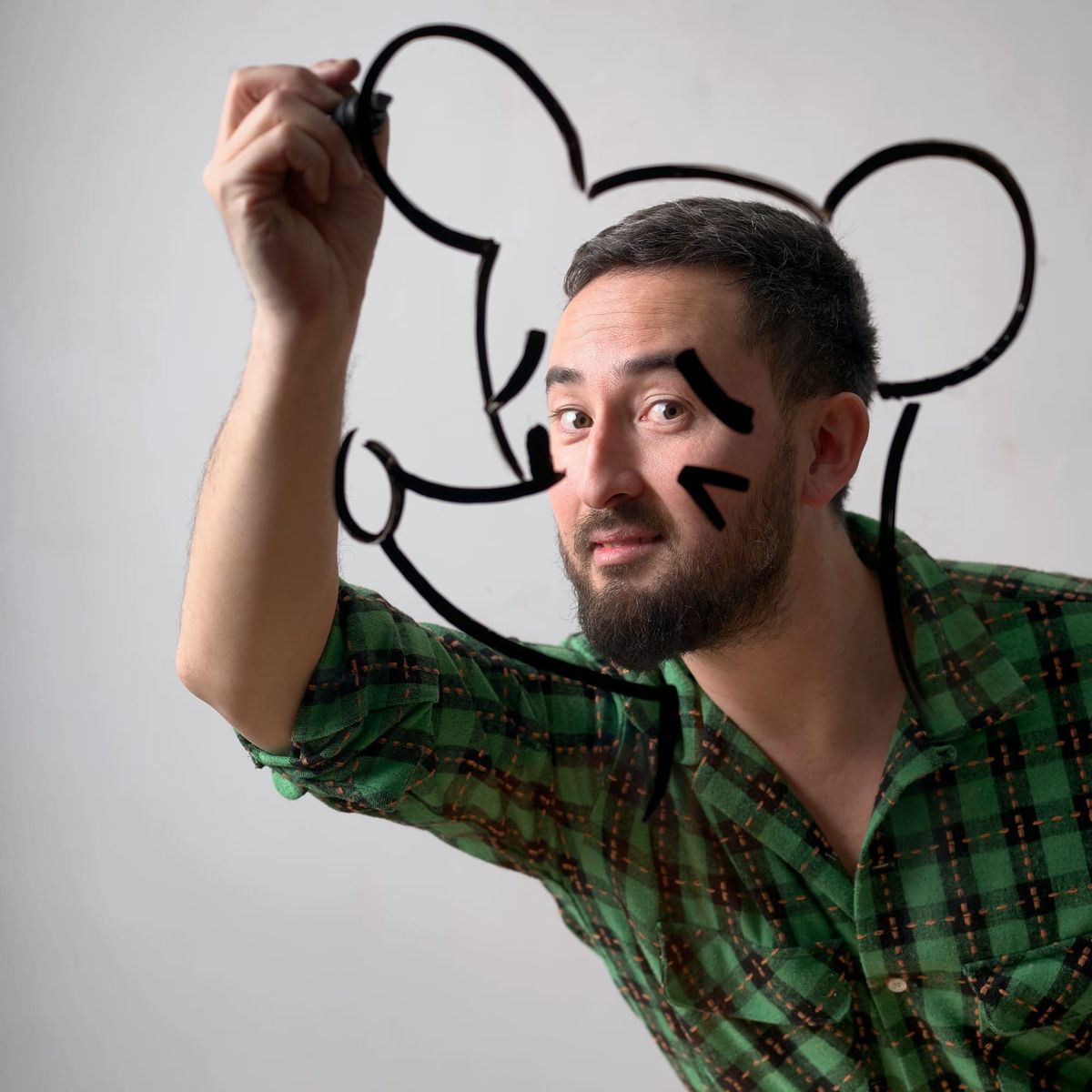
For nearly two decades, Simon Fujiwara has interrogated the unstable relation between authenticity and selfhood in contemporary image culture. Through playful, immersive installations that often begin with intimate or autobiographical premises, he examines how public representations shape the ways we perceive both ourselves and others. Given the theme of identity-formation underpinning much of his work, I have long had it in mind to speak to Fujiwara, not least because we happen to have attended the same secondary school. We met during his career survey at Mudam Luxembourg—Musée d’Art Moderne Grand-Duc Jean.
Your career survey at Mudam takes the form of an amusement park, with pastel-colored signs pointing us to themed rooms. What made you come up with this format?
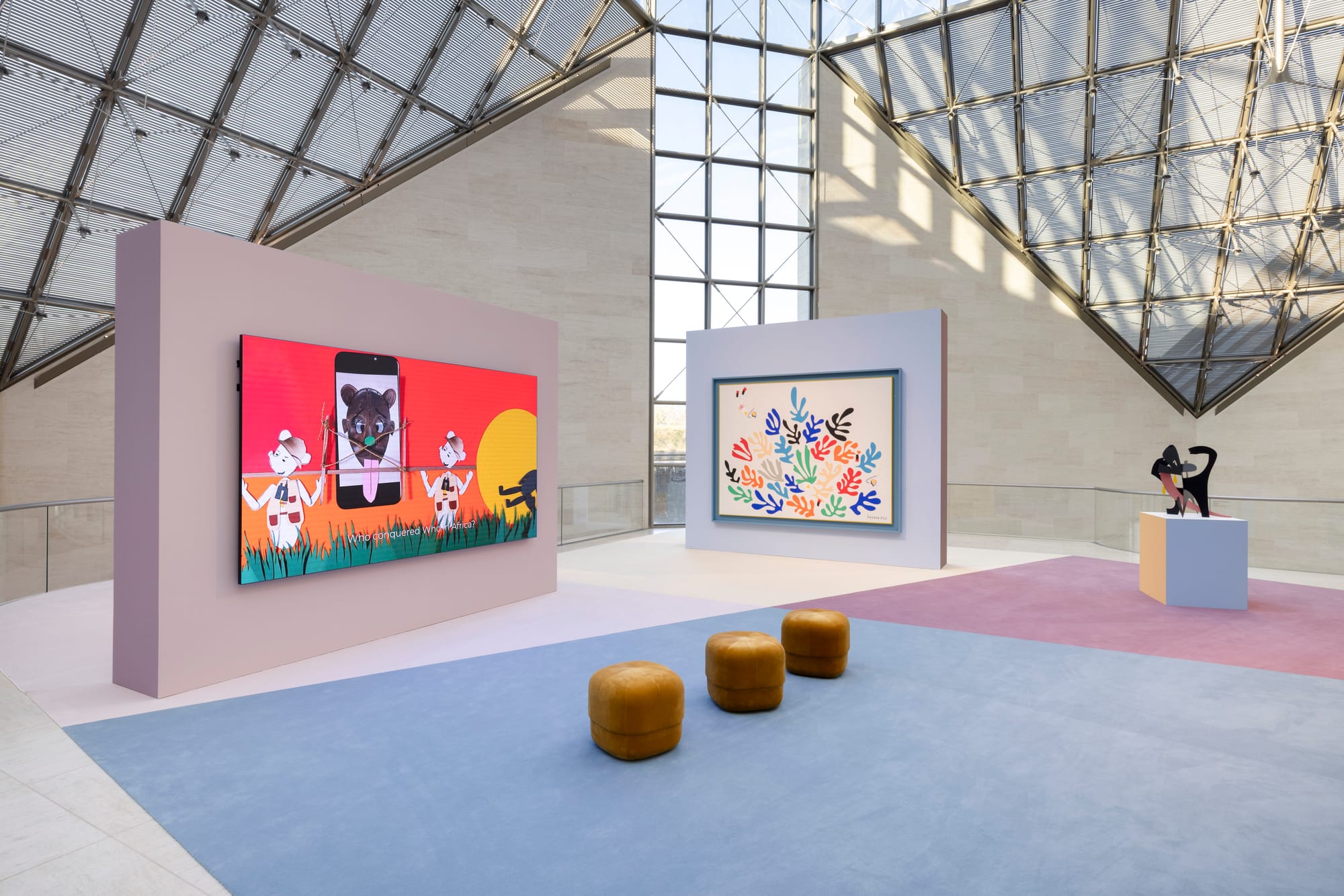
When I was given the floor plan of the museum, I realized that the building’s form looked very similar to the map of Disneyland, which made me think about the similarities between museums and theme parks. For 20 years or so I’ve had a growing sense that the world is turning more and more into a theme park. Every part of life is now in service to the logic of entertainment in order to be seen, and so to exist within this hyper-attention economy. Within that kind of performative world, people become caricatures and ideas become IP. Cities, too, need to perform for this marketing logic as they compete to be the better social media backdrop. It’s a world in which everything is becoming a simplified image of itself, like Main Street, U.S.A. in Disneyland or Sleeping Beauty’s castle.
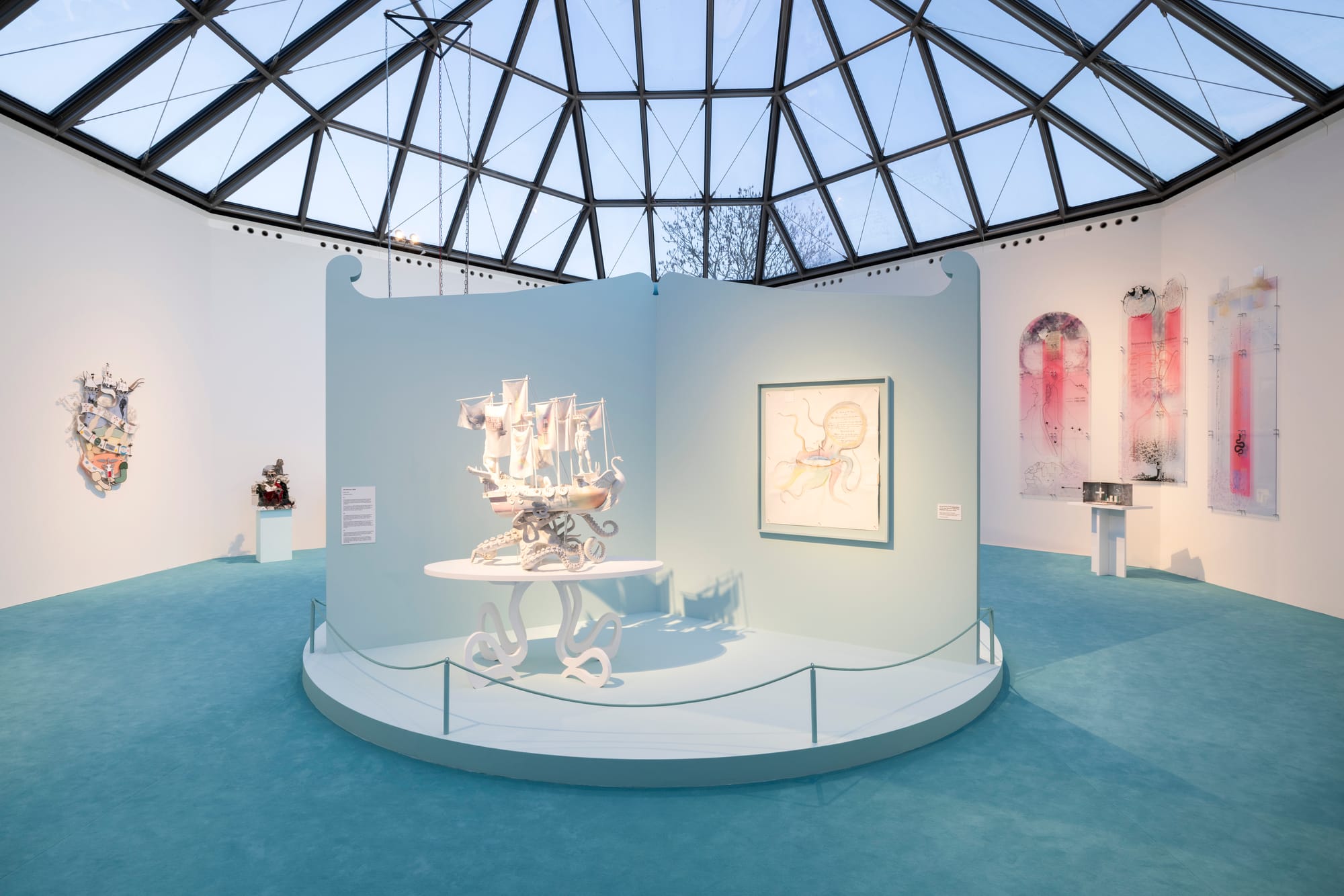
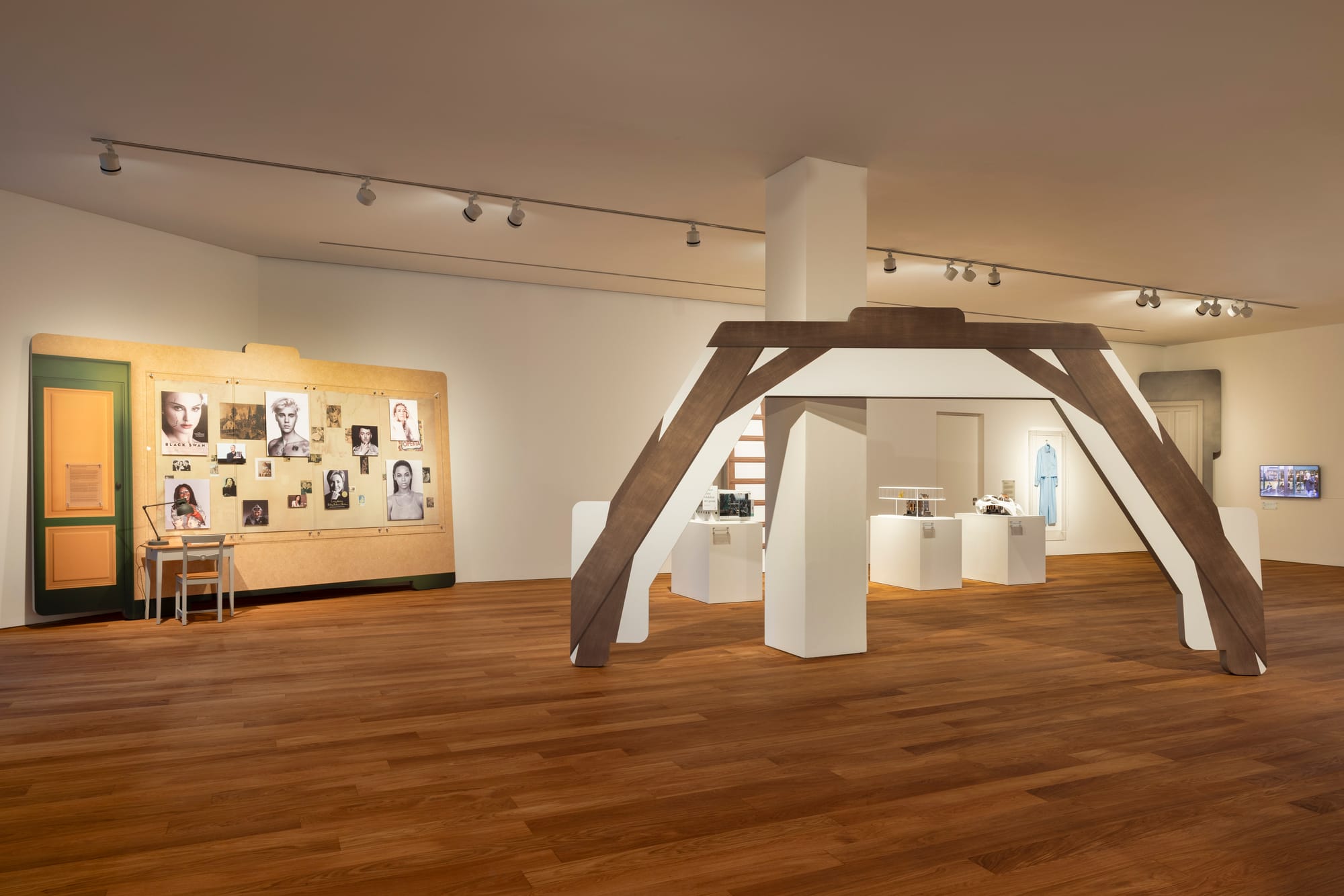
Some of the installations, like Syphilis: A Conquest (2020–23)—with its cutesy blues and pinks and fantastical galleons—or your work exploring the touristic legacy of Anne Frank, Hope House (2017–20), have a theme park feel to them.
At first they seem to be polar opposites, but for me, both works deal with the world of spectacle and how our most intimate lives are caught in a web of profit making and human storytelling. In my work with the history and legacy of Anne Frank I was investigating the surreal ascent of a normal person—just a teenage girl—to her status as global icon. All of her fame came after her death, and however important the message of hope and the memory of the Holocaust that is ascribed to her might be, she had very little agency in becoming the literal poster child of this. At that level of fame there is an inevitable flattening of her complexity, on some level she has been cartoonified by popular culture. At the opposite extreme, syphilis is a sexually transmitted disease that has millions of victims throughout history, has effected significant changes in how we view sex, monogamy, shame, and the medical system, but is one we almost never speak about. Like most things we don’t want to see, we banish it from our lives, so much so that when I contracted syphilis I thought it was a joke—I didn’t know it still existed today. So there is a connection in that Anne Frank is hypervisible to the point of invisibility, while syphilis is something that is ever-present in our society but unseen. I try to make both visible.
I find it interesting how the sense of play in your work always rubs up against some very serious matters.
I think that’s just how I am as a person—I always see a mixture of humor, lightness, and darkness in anything. I also attribute it in part to my experience of growing up gay—from childhood, I had a feeling that everything around me was some kind of construct that I didn’t fit into and yet was presented as real. I also grew up in the predominantly white cultural context of St. Ives in Cornwall. I felt like I was observing everything as though it were theater, or a game with its own rules that I had to learn in order to play. All societies have these codes, but beneath them lurks a yearning for the “real.” It’s a sort of human tragedy that we can never look at the truth head-on. Much of my work is about all the masks we employ to avoid bare life. It’s comical, like farce often is, so that’s where you might detect the humor.
Your work concerns how images shape who we feel we are—not only how we present ourselves, but what we look at.
At the core of many of my works is “what is an image?” It may sound simple, but I don’t understand what pictures actually mean for us as humans, only that they are extremely powerful, almost magical. Nor do I know how much of me has been informed by looking at images of other people, or whether it’s even a useful project to think about, as if there were some truth or “real person” at the bottom of all that digging.
I grew up at the end of the world, pre-internet. I would order magazines like i-D, and found those pictures far more real than my surroundings. All teenagers back then fantasized about life through media, but I think that it was heightened for those of us in isolated places. I spent my youth in an image world, believing pictures were real. I thought “when I grow up” I would have to accept reality, but it has turned out more surreal than I could have imagined.
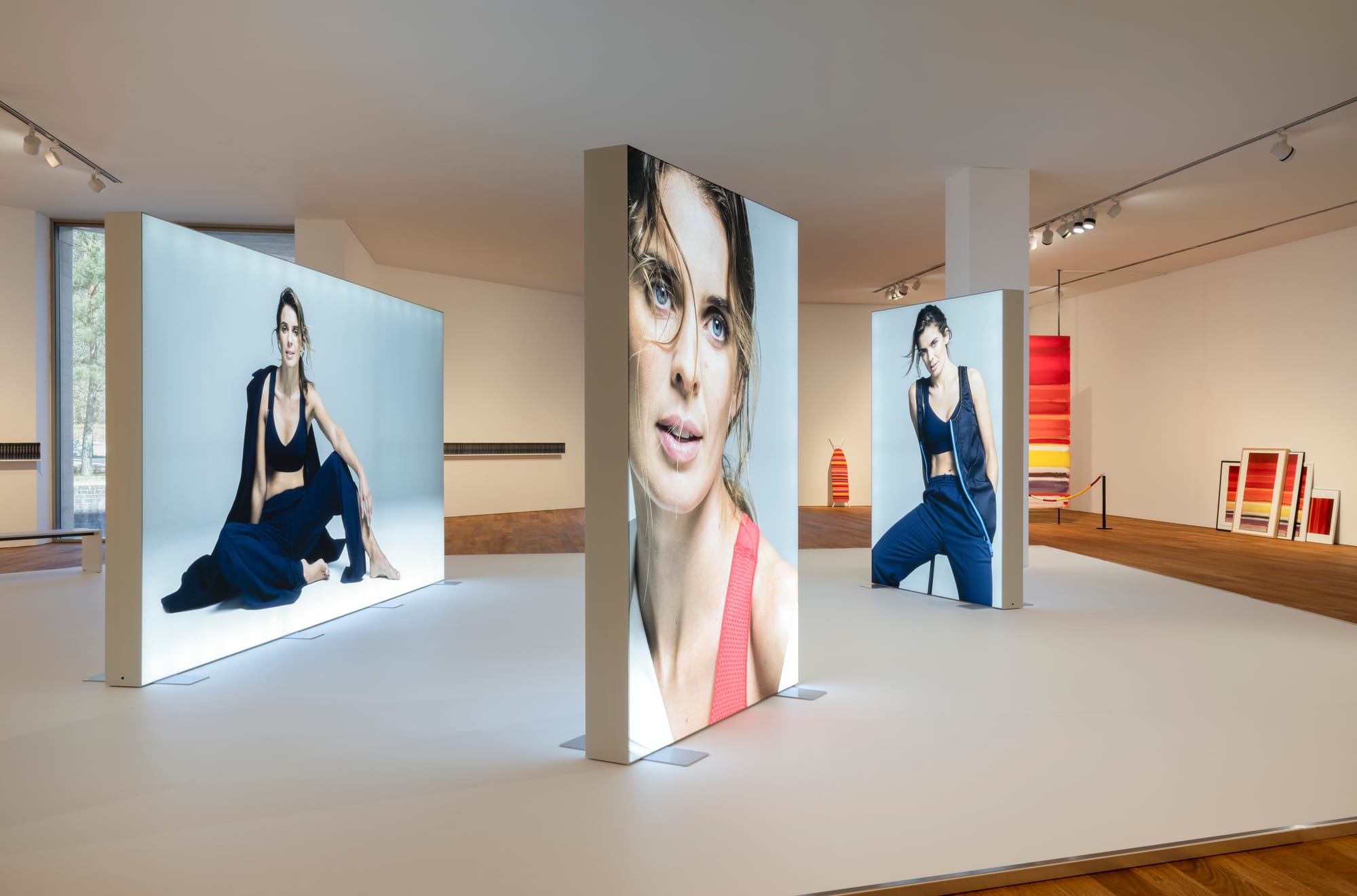
Personally, I’m very interested in Joanne (2016/18), which revolves around your secondary school art teacher, especially as I attended the same school and remember her very well. Does her role as your teacher play into the work at all?
As background, definitely. I mean, you probably remember Joanne arriving at the school.
Of course.
It was a big event! Imagine, a former beauty queen arriving at an all-boys’ boarding school. She was such a relatable, charming, kind person. People were in love with her. For me, she was like a breath of fresh air, because she was making work about image and beauty, about what is and isn’t real. She was young and drawn to the same things I was—she introduced me to feminist artists like Cindy Sherman and ideas of masquerade and play and being someone else—things she herself carried in her own body politic. So, when we started working on the piece, it was like slipping back into an old conversation.
One of the things that I found particularly moving about the work’s video component was when she reflects on what happened to her at the school, when she was forced to leave after nude photographs of her were circulated on its intranet. While recounting the story, she uses the word “family” to describe the school.
It’s interesting you point to that, because that’s when you realize the work is not so much about Joanne losing her image but about losing a whole life and community. Primarily, though, it’s about Joanne as a symbol. That was very clear from our first conversation. She wanted her story mythologized, made into an archetypal story, and as an artist herself she understood what that meant—she could play with this notion of objectification. She knows the language of it. It would have been much harder to attempt something like this with someone I didn’t know. We had a basic trust, as students and teachers often do.
It’s funny to think how your work is so rooted in the ways we identify, because one of the reasons I remember you is that I’m part Japanese myself.
Are you?
Yes, although sometimes I’m not sure I perform very well as a Japanese person. I don’t know Japan particularly well and I don’t speak the language.
It’s interesting to hear you speak about it as a performance you are failing at. I hear that often from children of mixed “white plus other” heritage, who grow up mostly in the West and have forgotten or never learned their other parents’ language. It’s as if there is an obligation to be as “both” as possible; maybe it’s about “unifying” the two selves. I imagine that people of single heritage don’t have that pressure or that particular struggle. They simply are from where they are from.
When I think about the image world you describe, I find it hard not to recall the onset of Pictorial Realism in Western art—the moment when images became hard to distinguish from the life they depicted.
Funny you say that because, for my architecture degree—before I went to art school—I wrote a thesis on Caravaggio. I looked at how he foregrounded the figure and dissolved all spatial context and background. He was essentially creating the first fashion shoot, with that neutralized backdrop we are now so used to, pulling us out of illusory perspective. I think there is a link between this dissolution of space and our screen cultures of today.
Do you think the survey is a turning point for you in your practice?
It has been important to take stock of what I’ve done. I feel less judgmental about myself, I suppose. It’s not all that bad, is it? But I’m ready now to ask: What’s next?
Tom Denman is a London-based writer.