People
The Cosmos in a Drop: Interview with Wallace Chan
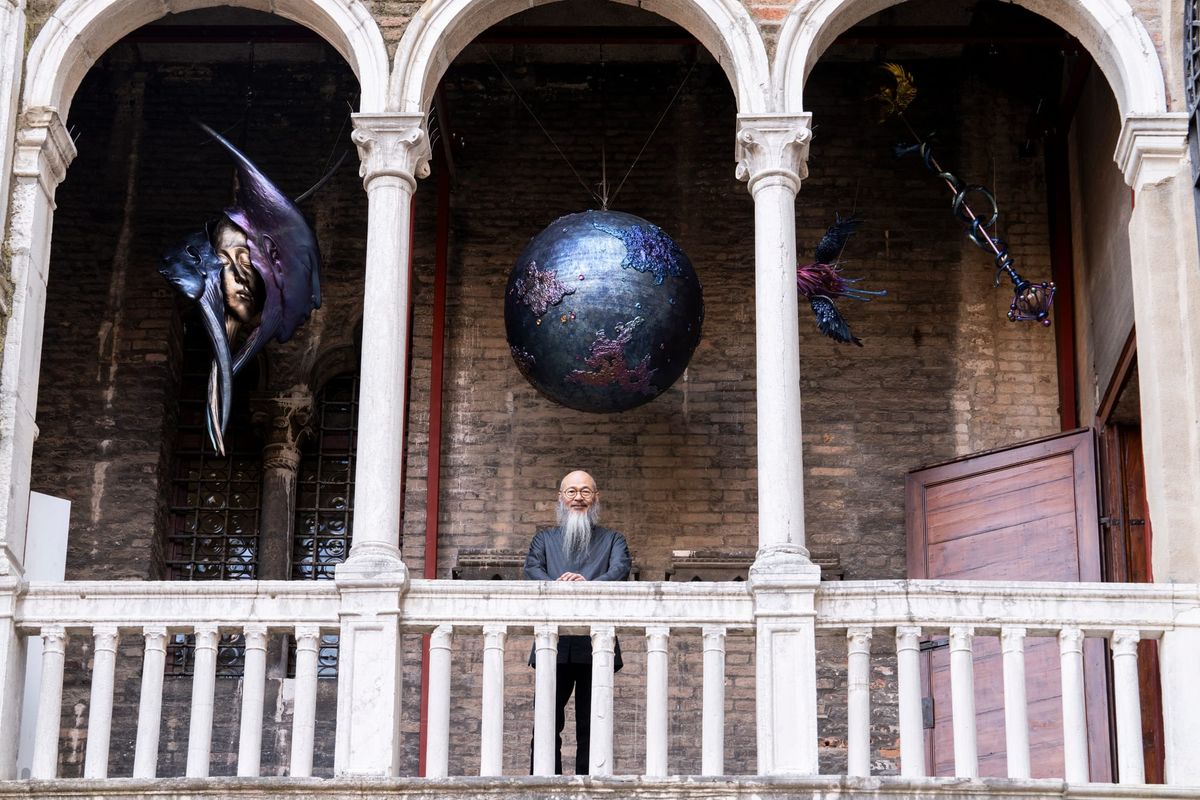
For decades, Wallace Chan has worked across a range of mediums and scales, from microscopic optics in carved gemstones and technically refined jewelry to titanium sculpture at architectural proportions. This year, he is holding two concurrent shows in Venice, “Vessels of Other Worlds” at the Pietà Chapel, and “Mythos” at Scala Contarini del Bovolo. On the occasion of the 61st Venice Biennale and the opening of Chan’s Venice presentations, ArtAsiaPacific spoke with the artist about his development, the thinking behind these exhibitions, and what it means to move between Buddhist thought and Western iconography.
When someone walks into the Pietà Chapel and sees the works for the first time, what do you want them to feel?
The chapel is small, almost shockingly so, given the history it carries. Vivaldi spent much of his career here, composing for the girls of the Ospedale della Pietà; The Four Seasons was born within this building. That accumulated time saturates the room. When I first stood inside it, I felt what I can only call reverence.
Audiences will notice immediately that a Chinese artist, who works within Eastern philosophical traditions, has brought work into this specifically Christian space. I would prefer that observation to function as an opening. In Buddhist thinking, a mind that enters a space already filled with its own fixed categories cannot receive anything new. But if it pauses, empties itself, then it becomes capable of receiving almost anything. East or West, sacred or secular, ancient or contemporary—for me, these distinctions are provisional. What remains is a shared question about the cosmos and the self.
I’ve thought about this through the Buddhist image of crossing between shores. This shore (此岸) and the other (彼岸) in perpetual exchange, neither fully distinct from nor fully continuous with each other. The works here are about finding what both traditions already hold in common: a longing for what cannot be seen.
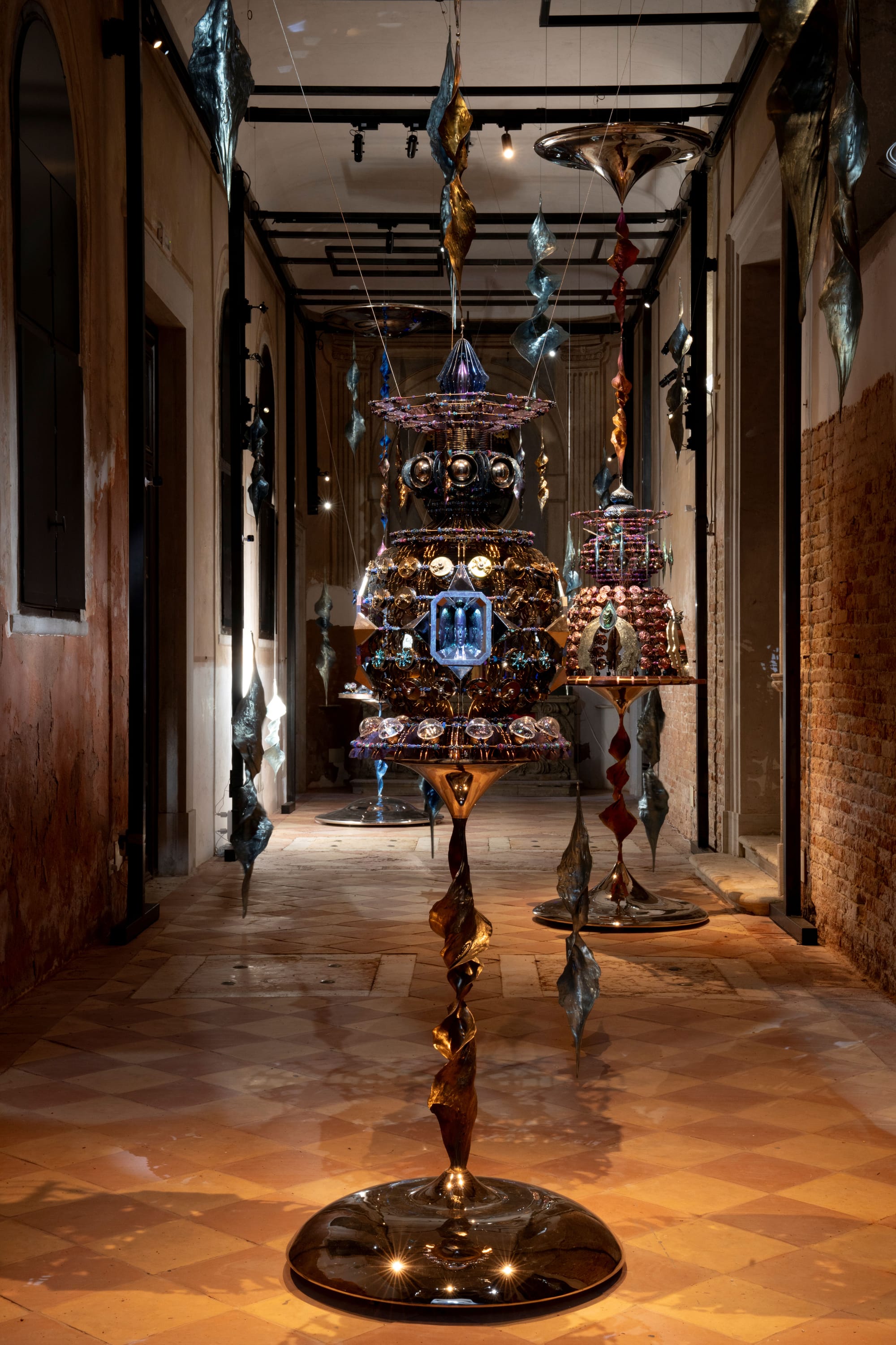
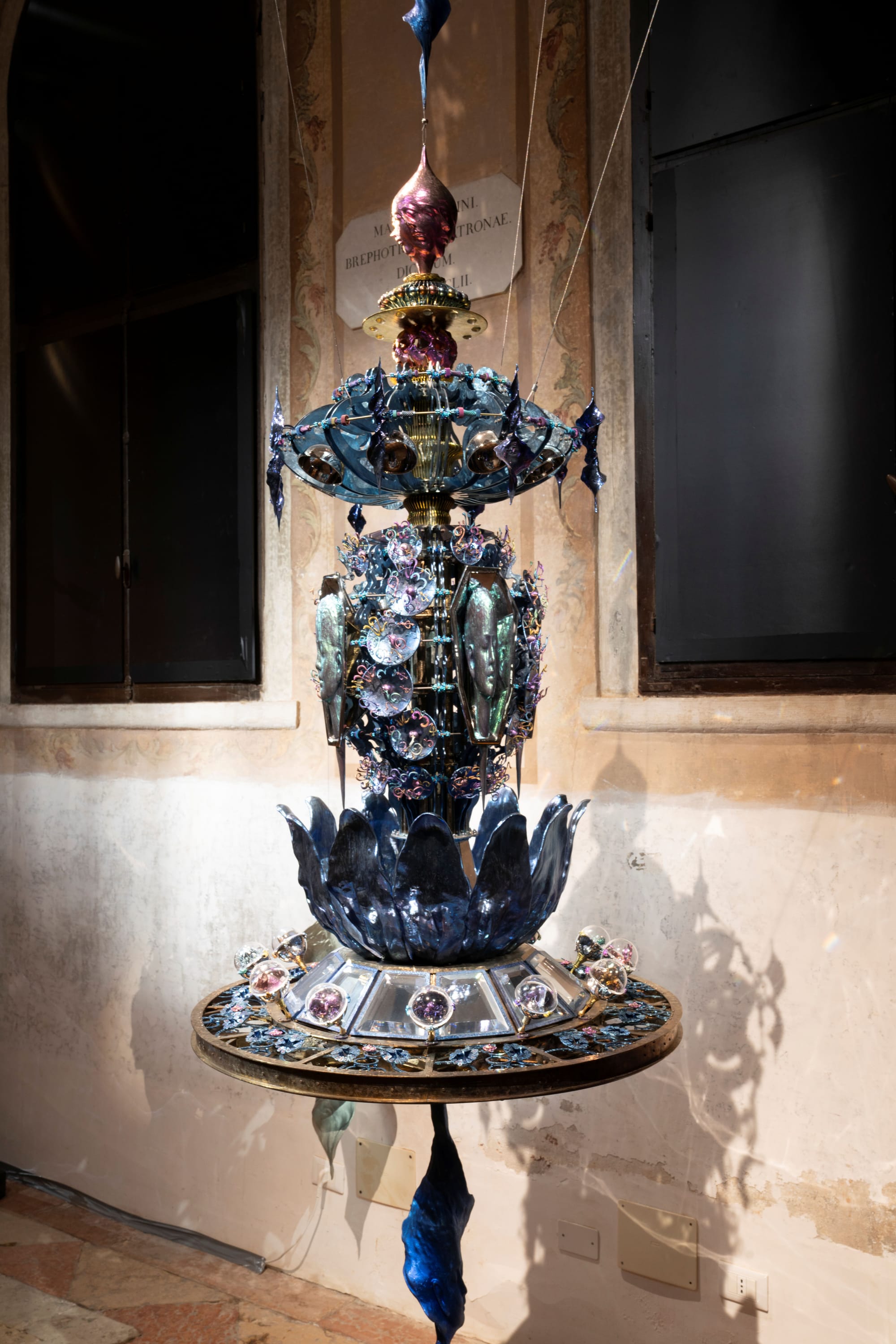
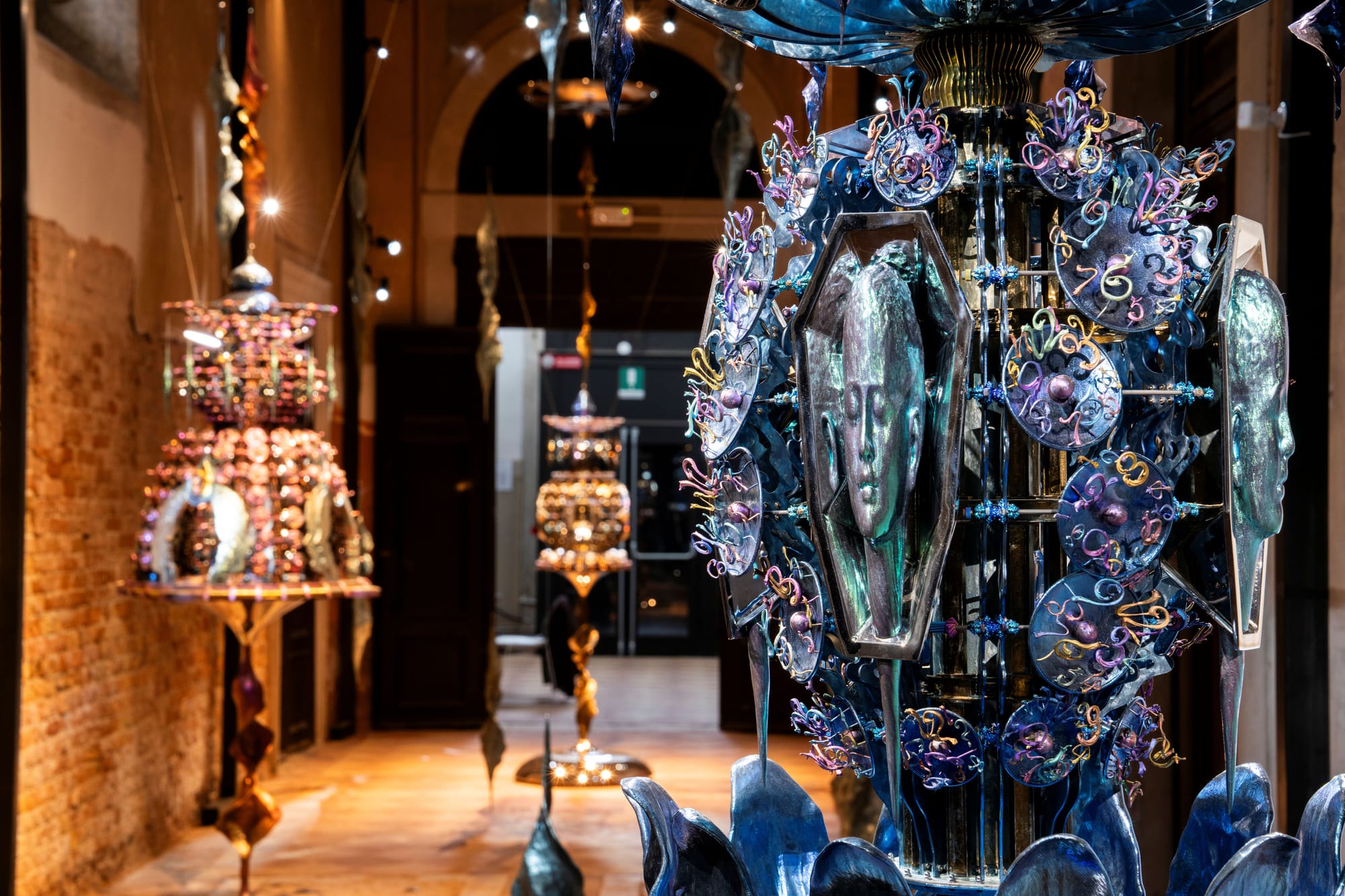
Installation views of WALLACE CHAN’s “Vessels of Other Worlds” at the Pietà Chapel, Venice, 2026. Courtesy the artist.
Your early training was in traditional Chinese carving, Buddhist deities, and Guanyin figures. What led you to the work that you are making now?
I began carving in 1973 within the classical Chinese tradition, learning the formal canon of devotional sculpture. Then, by chance, I came across reproductions of Michelangelo. Europe was entirely unreachable for me at the time. I spoke no English and had no access to that world except through images.
When I was 33, my grandfather passed away and was buried in a Christian cemetery. Walking among the graves, past mourning figures and angels, I felt grief but also an overwhelming sense of hope. I began returning to cemeteries regularly, sketching and studying funerary sculpture. From there I moved into Greek mythology, Western philosophy, and early Christian iconography.
Some of the works here are inspired by the Olea Sancta, the sacred oils used in Catholic liturgy for baptism and anointing. What drew you to this specific ritual object? And what do you find in it that connects to your thinking?
Oil is among the most ancient substances of transformation. It passes through matter and, in these liturgical contexts, renders matter sacred. What interested me most was the process of transformation: the reduction of a physical substance to its most concentrated essence. There is a kind of birth in that passage.
Three works in this exhibition enact three movements: birth, growth, and rebirth. I thought of them as a score for a human life, three notes that together constitute the full range of existence. And existence, it seemed to me, demanded color. Those familiar with my earlier work will notice how much more colorful this exhibition is. The previous ones were more restrained. But human life is not monochrome. From birth to death, we move through an extraordinary range of sensation, emotion, loss, and joy. The image I kept returning to was the body immersed in oil. The richness of the palette is about the nature of experience.
What I found, gradually, was that the difference between Chinese and Western sculptural traditions was smaller than it appeared. If you step back far enough and look at the whole of human civilization, you will find the same pursuit, just in different forms. Every culture reaches toward truth. That recognition became the foundation of everything I make.
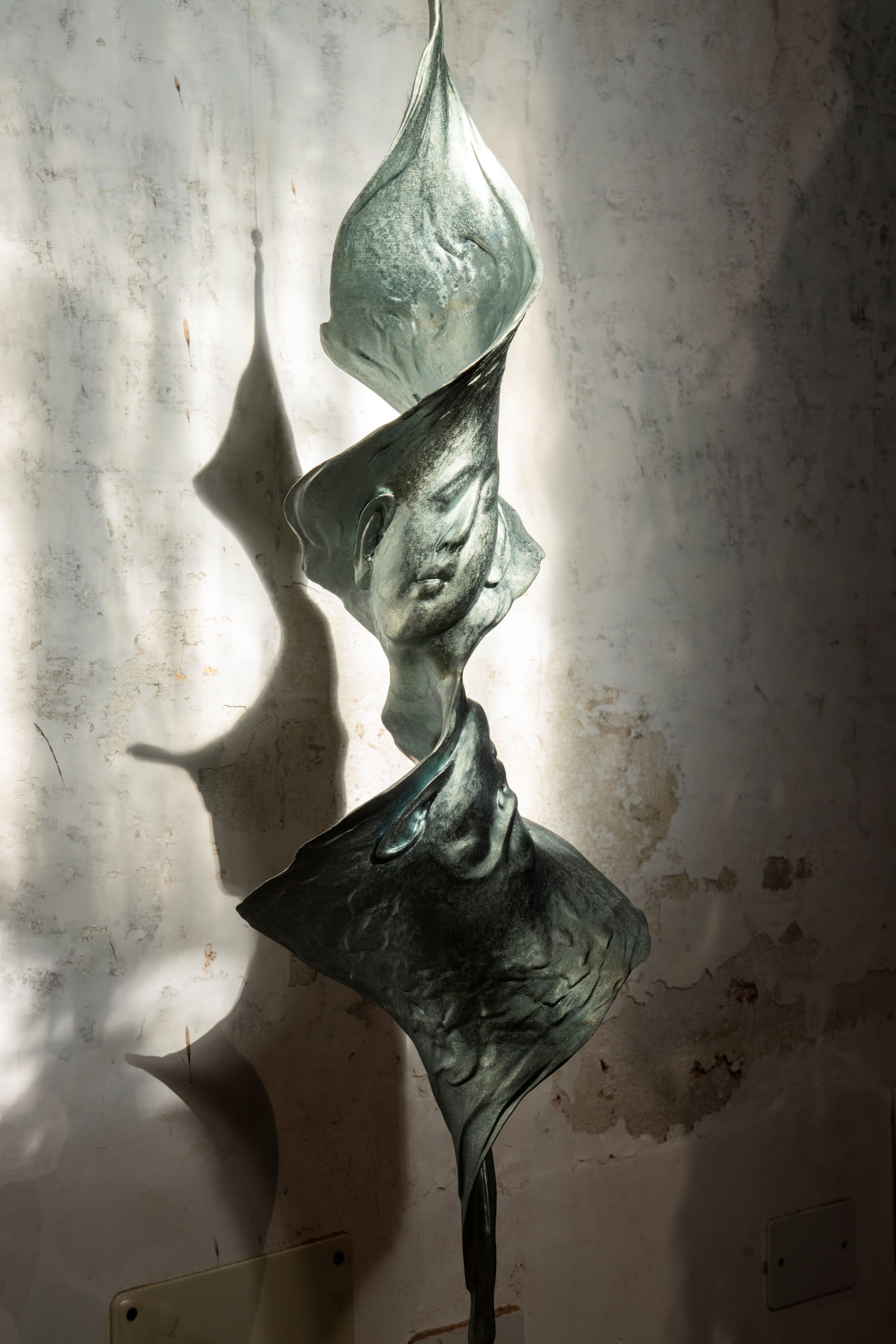
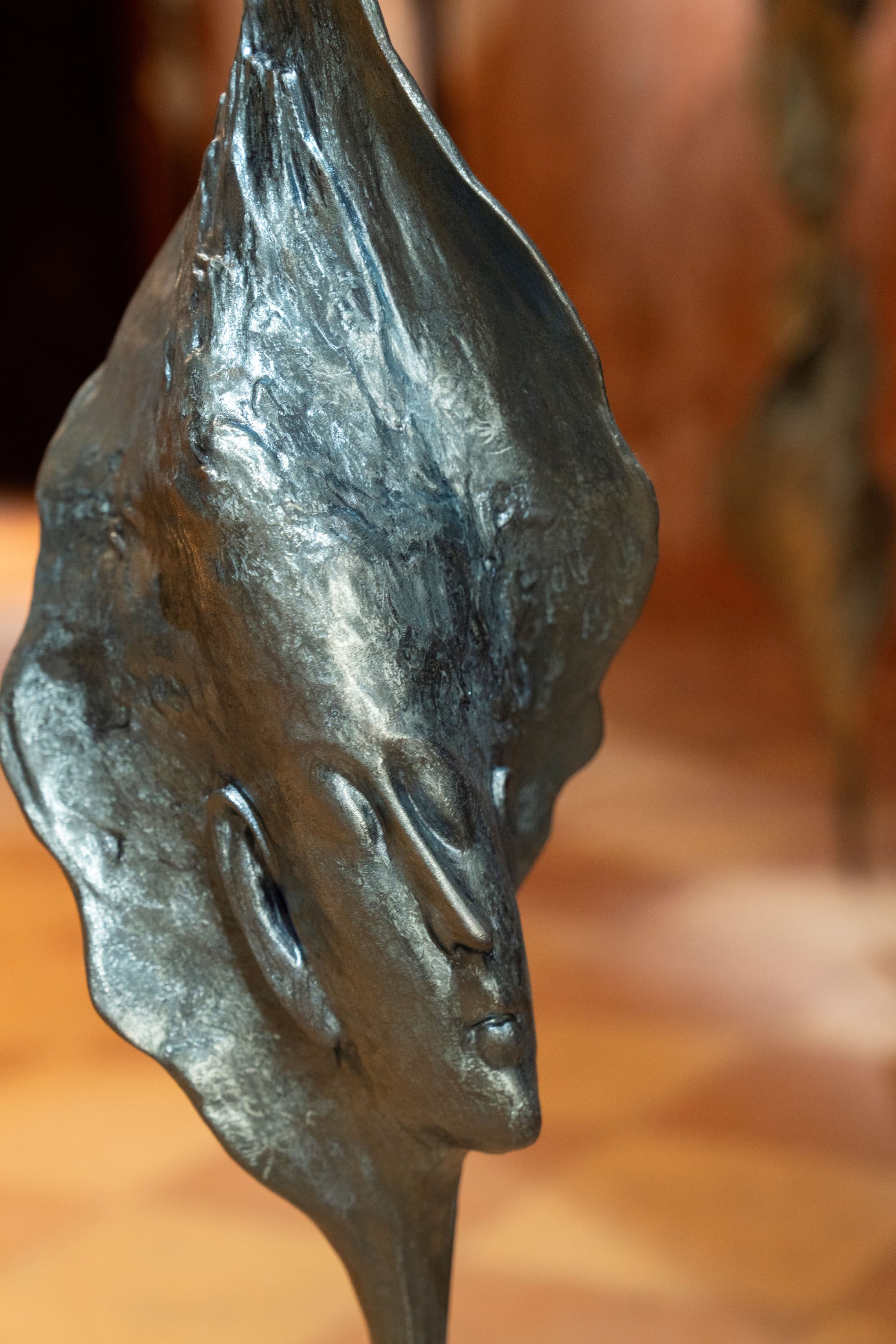
Installation views of WALLACE CHAN’s “Vessels of Other Worlds” at the Pietà Chapel, Venice, 2026. Courtesy the artist.
Looking at the work in Venice, human faces keep reappearing, submerged, half-emerged, enclosed within flowing forms, wings, and shells. Who are these figures? And why do you keep returning to the motif of the face?
The face sculpture at the entrance was made using a technique I developed in 1987, which I call the Wallace Cut. The fundamental principle is an inversion. You carve away everything you want the viewer to see and preserve the rest. The image appears suspended within the material through refraction. The result is that the image is reversed, held inside the substance rather than displayed on its surface. For this particular work, I used stainless steel fitted with triangular facets, so that as you look into the face, your own reflection enters it.
The figures here are deliberately androgynous, neither male nor female, neither child nor elder. There is something sacred in the androgyne. You will also notice that the eyes are only one-third open. That visible third surveys the human world, matter and surface, all the activity of the visible. The remaining two-thirds are turned inward, toward what cannot be seen. It is a portrait of interior consciousness.
The forms themselves are modeled on falling water. A droplet, as it falls, is distorted by gravity and air resistance. For me, that distorted droplet contains everything. Slow down a camera long enough and you will find an entire landscape refracted within a single drop—the surrounding environment, even the sky above, compressed and held inside. I am fascinated by the idea that the cosmos fits within a drop.
Your practice spans an extraordinary range of scale, from a gemstone held in the palm to a titanium sculpture 10 meters high. How do you understand scale as a conceptual problem?
Every morning, from the moment we open our eyes, we begin calculating. What to eat, how much it costs, how to develop a business, where to travel, what to earn. We live almost entirely inside a computational relationship with the world. Large-scale sculpture is, for me, a challenge to that reflex, a way of testing whether my capacities can exceed what the arithmetic of daily life demands.
I am interested in the continuity between large and small. A one-carat diamond and a 10-meter-tall structure are governed by the same questions: the light, the relationship between surface and interior, and the way a material holds and transforms energy. When I carve a gemstone, I am thinking about how light enters and refracts inside it, how color is generated at the boundary between densities, how the stone sits in relation to the body that wears it. Those concerns simply expand when I work at an architectural scale. The micro and the macro are the same investigation conducted at different magnifications.
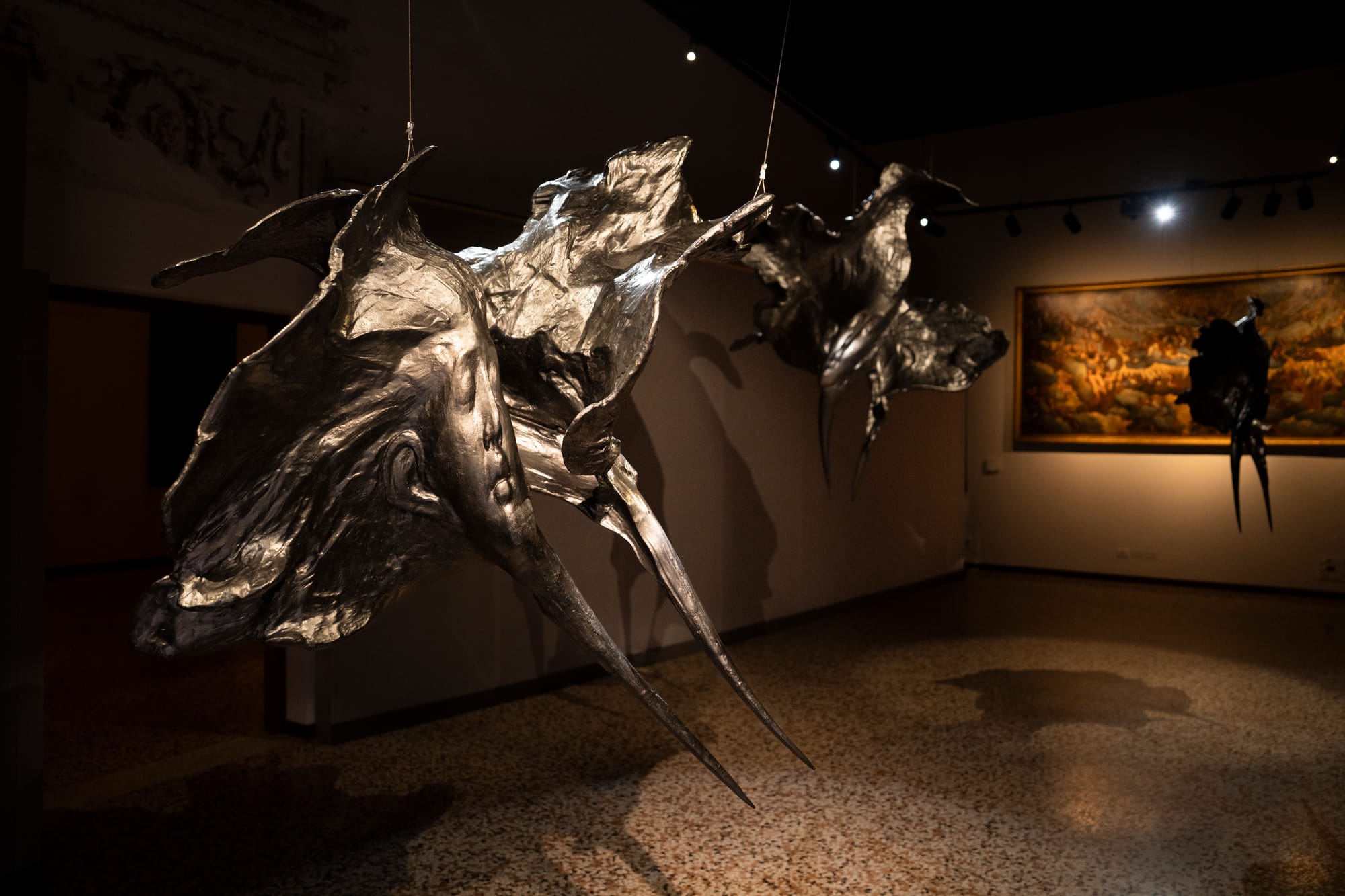
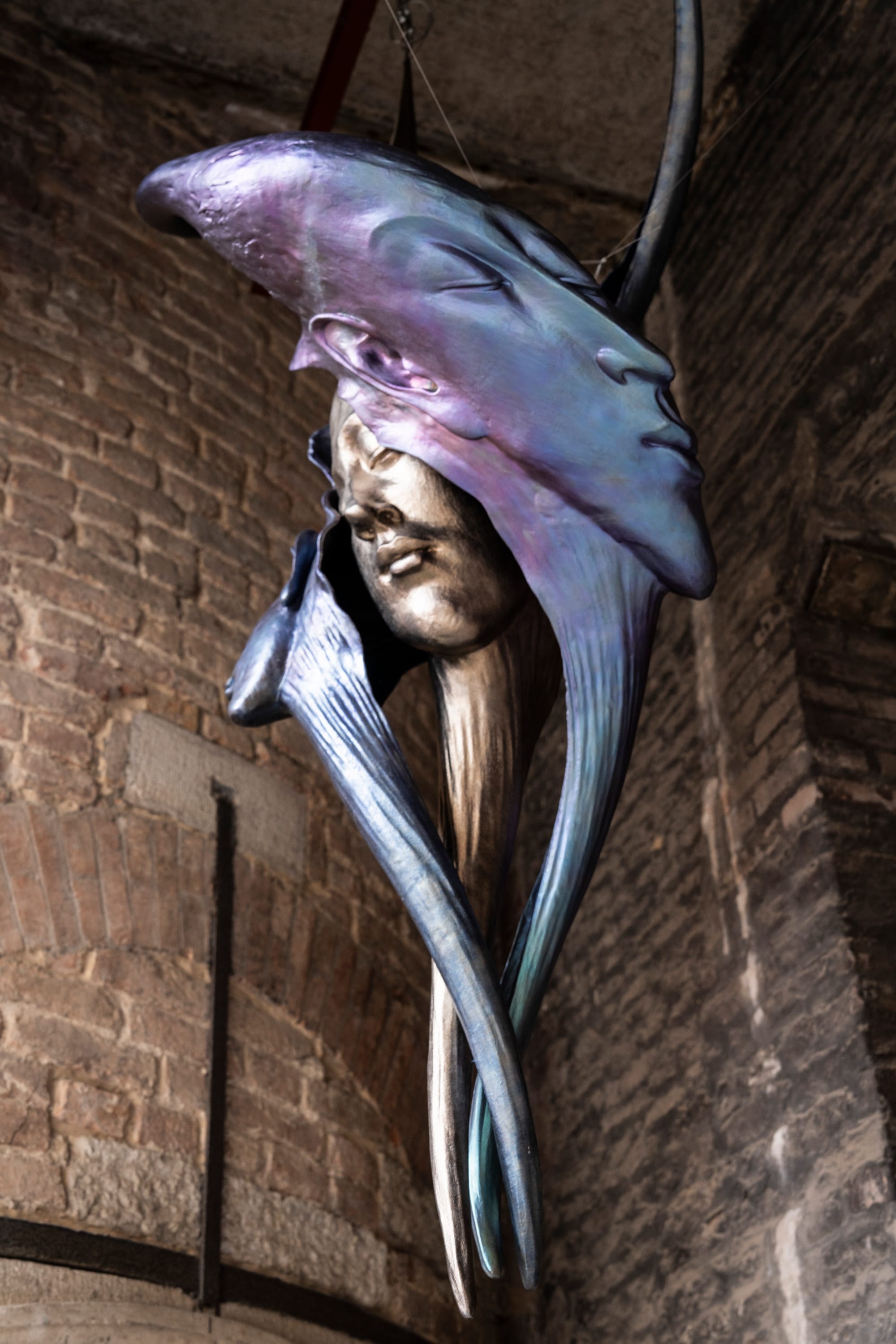
Installation views of WALLACE CHAN’s “Mythos” at Scala Contarini del Bovolo, Venice, 2026. Courtesy the artist.
How does a new work begin for you? What does that earliest stage of the process look like, before the work has taken any concrete form?
As I mentioned earlier, everything holds something inside it. That is the premise I work from. Every material has a history, a set of physical behaviors, a particular way of receiving and transforming light. A grain of sand, for example, contains crystalline structures, sedimentary time, the compressed record of processes that took millennia. I approach every material this way.
Light interests me particularly because it is simultaneously a physical phenomenon and something that feels almost metaphysical. When laser light enters a gemstone and the stone opens under it, you witness energy meeting resistance and then dispersing. In a sense, it is a model for how meaning moves through culture, or how experience moves through a life.
Each of your Venice exhibitions has had a distinct theme. For example, “Titans” felt powerful and confrontational; “Totem” explored the sacred and the religious; while “Transcendence” was almost meditative. How did the title and concept for this exhibition, “Vessels of Other Worlds,” come about?
I kept returning to the word “vessel” because of its multiplicity. A vessel is a container that holds. It is also a ship that travels, carrying something fragile across a vast and uncertain distance. I became interested in what it would mean for a work of art to function that way, as something in perpetual transit, capable of absorbing the culture of wherever it arrives and then returning, altered, to its point of origin. This exhibition is in dialogue with a concurrent presentation at the Long Museum in Shanghai, and the relationship between those two cities partly generated the title. Both Venice and Shanghai are water cities, where commerce, culture, and migration have always moved through liquid channels. Three screens here in the Pietà Chapel transmit live images to Shanghai in real time, and three screens at the Long Museum transmit live images back. In that sense, the vessel is also the structural logic of the exhibition itself.
“Vessels of Other Worlds” and ”Mythos” is on view through October 18.