People
A Degree of Separation: Interview with Başak Doğa Temür
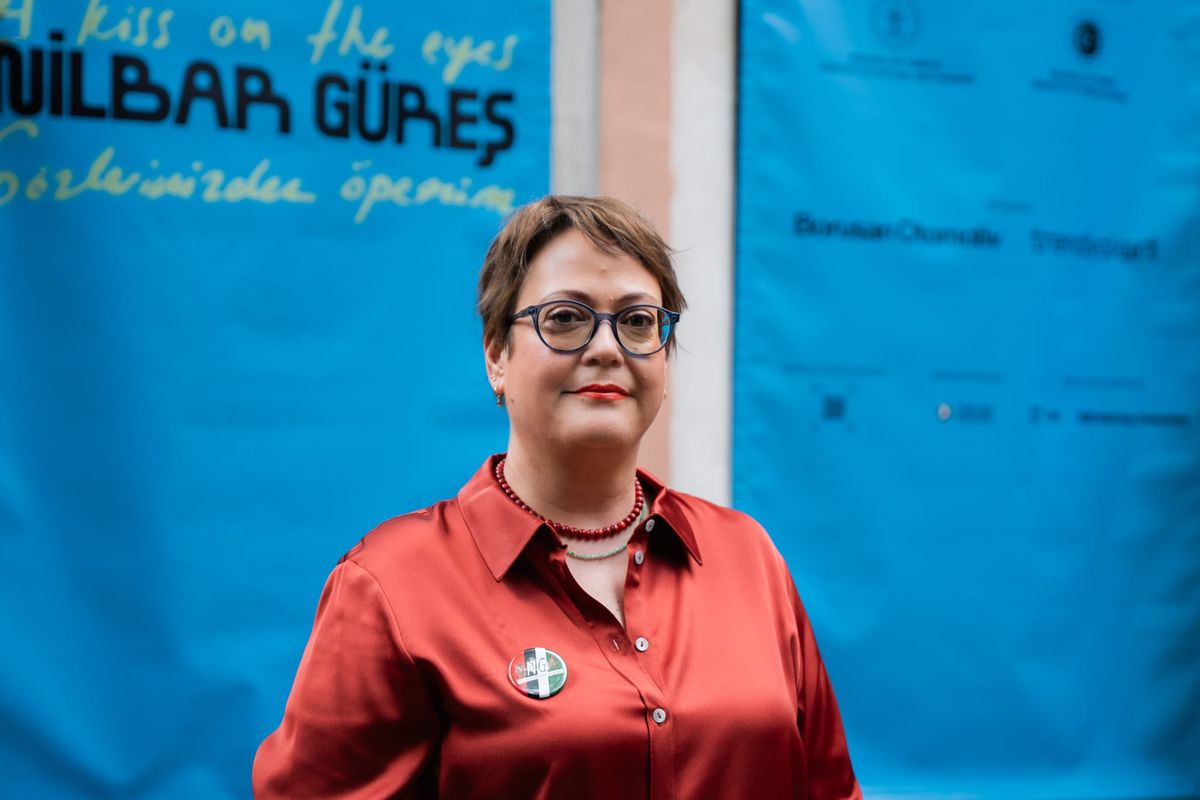
Başak Doğa Temür lives at a remove from the art world in Istanbul, preferring a more reflective, slower-moving locale that is not steeped in elitism. At 48, the curator combines youthful candor with a seasoned grasp of the institutional infrastructure that sustains artists, art workers, and the broader cultural sector. After a decade at Arter (2010–20), Temür is now partial to independent collaborations, her latest project being Nilbar Güreş’s “A Kiss on the Eyes” for the Türkiye Pavilion at the 61st Venice Biennale. ArtAsiaPacific’s Istanbul desk editor Matt A. Hanson spoke with Temür about the exhibition, which offers a glimpse into the plush, feminist imagination of a Turkish woman striving for personal and creative freedoms in Europe through colorful works across textile, sculpture, photography, and painting.
An exhibition in Venice is quite a significant project—could we begin by contextualizing your collaboration with Güreş, and how that was enlightened in “A Kiss on the Eyes”?
There used to be an independent jury comprising art professionals from Türkiye. They would appoint a curator, who would then name an artist for the national pavilion in Venice. In 2015, the system changed so that the committee (which I have also been part of) started choosing the representative artist.
So, the committee actually commissioned Nilbar first before inviting me to curate the pavilion. As such, I play more of a supporting role—the spotlight remains on the artist. I strongly believe it should be like that and appreciate this approach.
For me personally, it was both challenging and rewarding to immerse myself in someone’s entire body of work in such a short period of time. I’m grateful to have had the opportunity to work with Nilbar. She is an artist of remarkable intensity, and her practice is extraordinarily layered, not only conceptually but also formally.
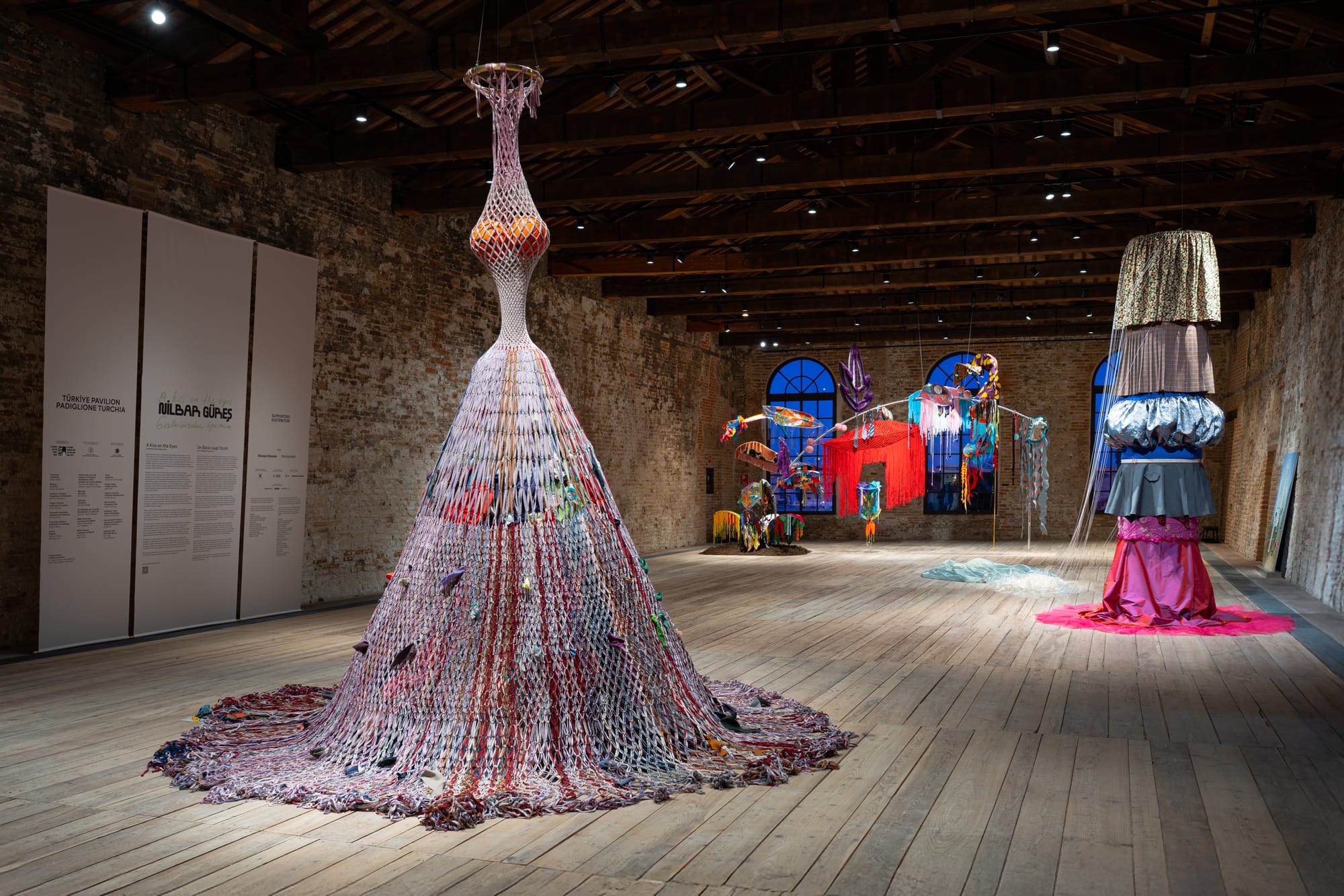
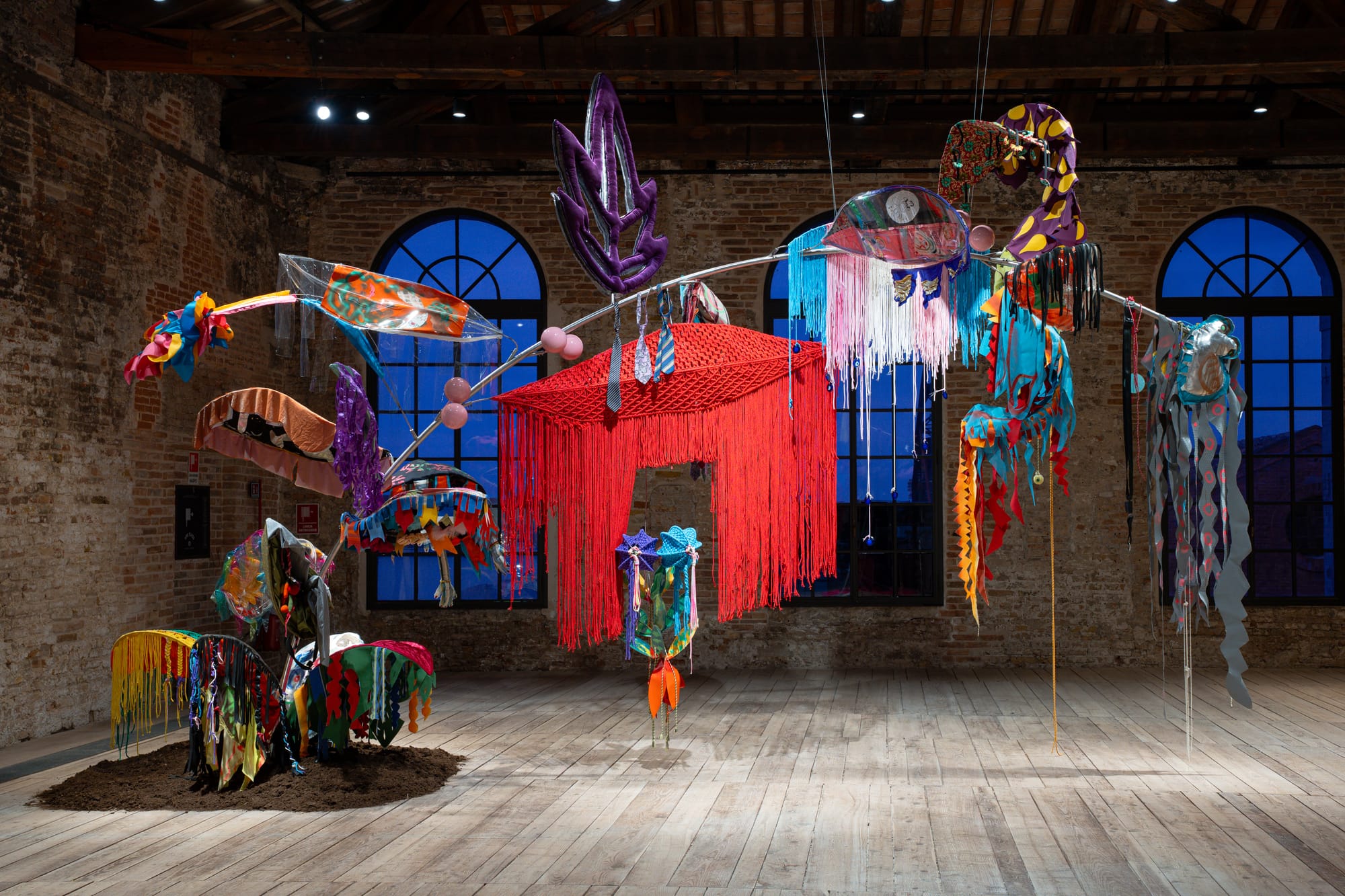
Installation view of NILBAR GÜREŞ’s Land, 2026, mixed media, 350 x 550 x 200 cm, at “A Kiss on the Eyes,” the Türkiye Pavilion, 61st Venice Biennale, 2026. Photo by Fatih Yılmaz. Courtesy the Istanbul Foundation for Culture and Arts.
Nilbar is quite active in Türkiye, having exhibited at numerous galleries as well as important institutions like Istanbul Modern, Cappadox, or, more recently, Arter. She studied in Türkiye and Austria, and currently divides her time between Istanbul, Naples, and Vienna. What are your thoughts on that network of interaction through these specific geographical interrelations?
That’s a great question, because this situation of hers is a core subject in her practice. Nilbar was born in Istanbul and studied painting at Marmara University. She found out that later on that, Turkish citizens could easily apply to study in Austria. Nilbar wanted to get out and learn in a different way, so she did two masters there—one in painting and graphics, and the second one in textile pedagogy. Through that, she slowly started her career in Vienna before returning to Türkiye.
Do you remember Rampa Gallery in Istanbul? They closed in 2017, but they were quite hot back then, supporting and representing many artists, and staging great shows. Nilbar was in their roster and exhibited frequently there. But at the time, she did not receive much institutional attention apart from a few museum group shows. Last year, at Arter, she finally held her first institutional solo presentation in Türkiye, titled “Velvet Stare.”
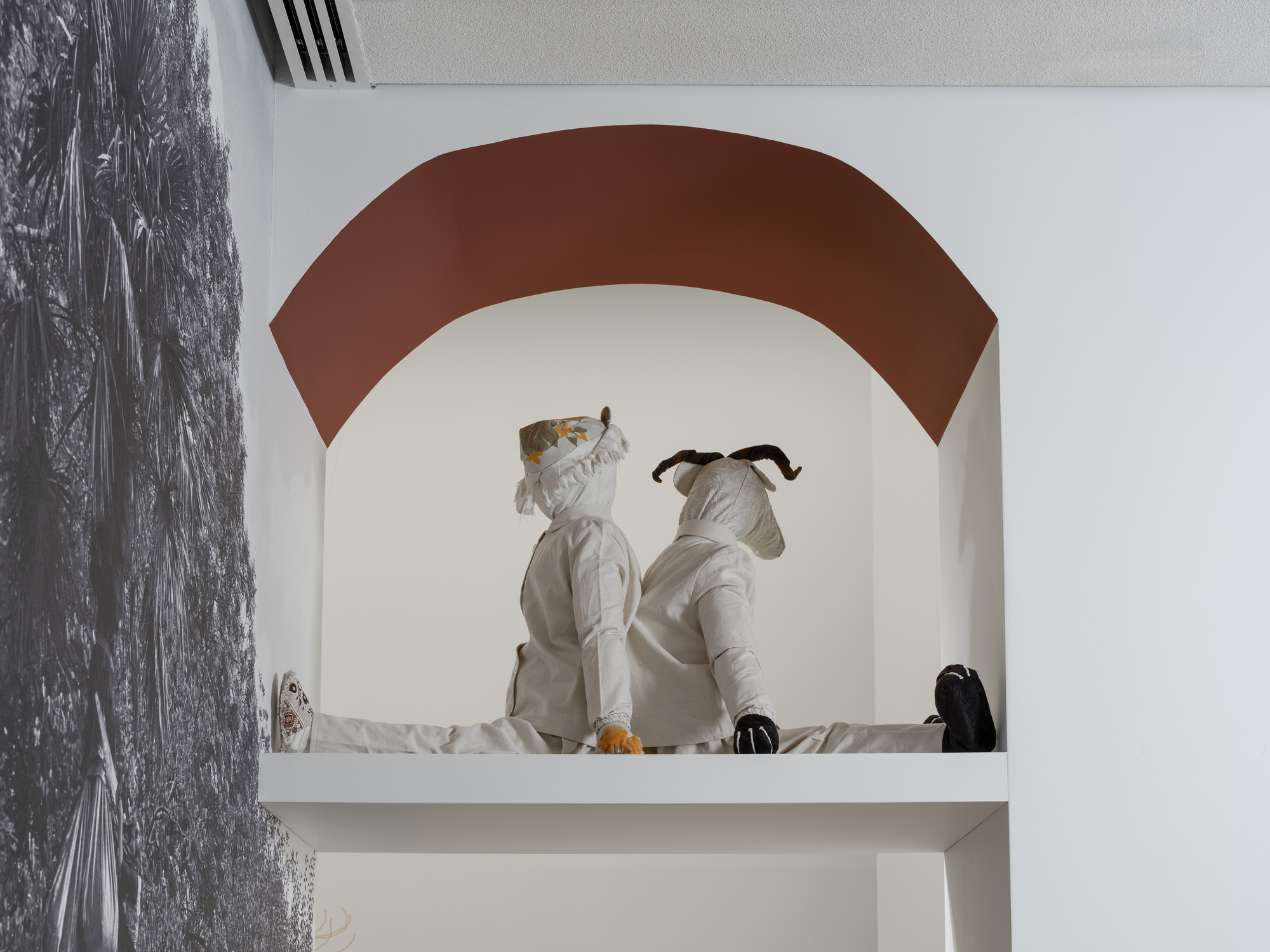
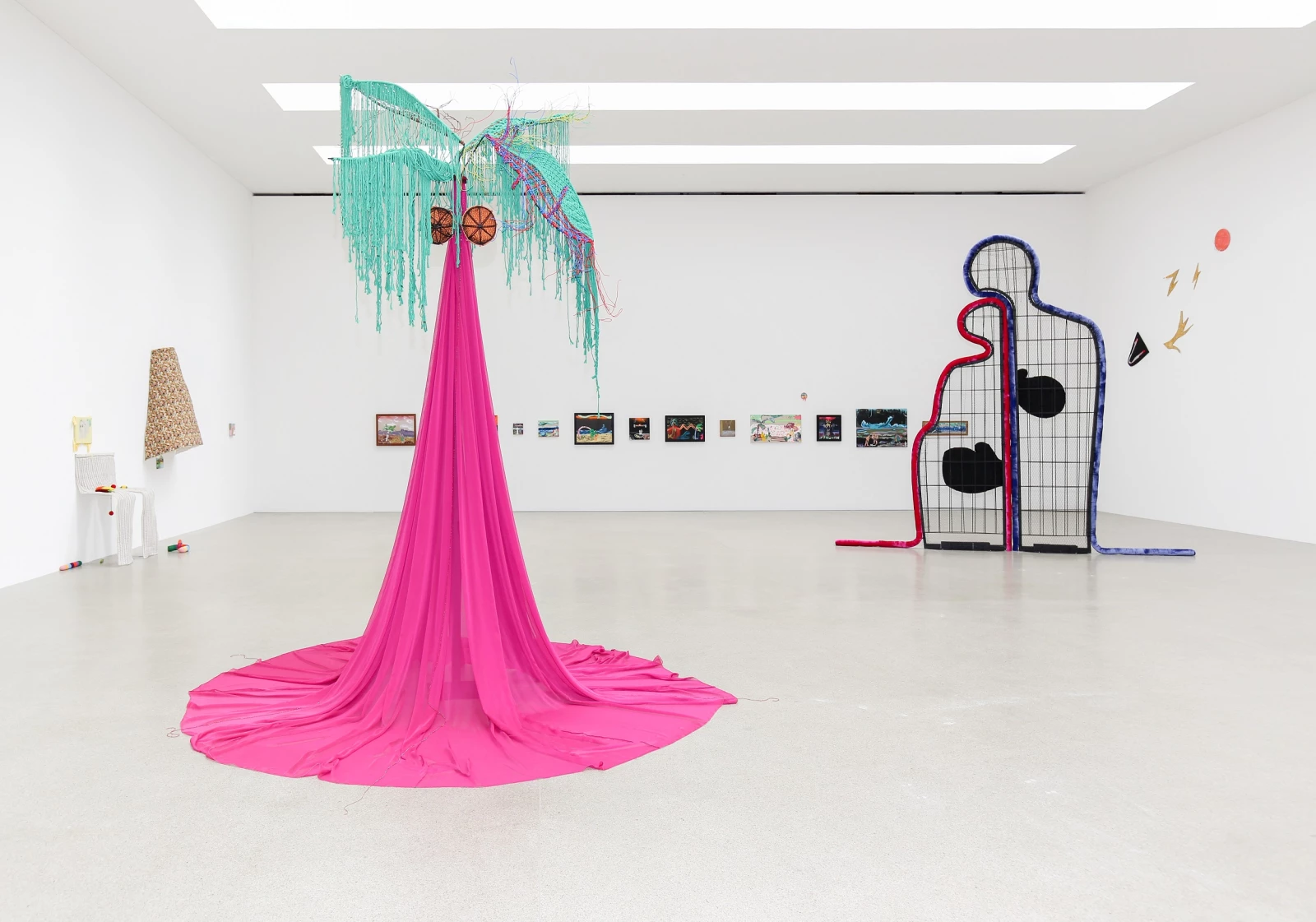
Installation views of NILBAR GÜREŞ’s Back to Back (left) and Gloves – Spears (right), both 2016, mixed media, dimensions variable, at “Velvet Stare,” Arter, Istanbul, 2025–26. Photos by Kayhan Kaygusuz. Courtesy Arter.
Right now, Nilbar is based in Naples—she said she was sick and tired of being discriminated against in Austria for coming from the so-called “East” or “Third World.” She didn’t have an easy life in Vienna; she faced a lot of discrimination there as a Turkish woman who also comes from a Kurdish Alevi family. These aspects have informed her works, including Undressing (2006), which features a woman entirely wrapped in headscarves, sitting at a table. Throughout the video, she takes off the fabrics one by one, reciting in Turkish the name of a woman every time she removes a veil. In the end, when the last scarf is gone, we finally see her face.
Many of her projects comment on Islamophobia and racism in the West, but they also often address LGBTQ+ themes, which is not an easy thing to do in Türkiye. These latter works are more “acceptable” abroad.
Installation view of NILBAR GÜREŞ’s “Sour as a Lemon” at the Kunsthaus Biel, 2021. Photo by Lia Wagner. Courtesy the artist; GALERIST, Istanbul; and Kunsthaus Biel.
In “A Kiss on the Eyes,” was there something particular you found that aligned with the space or brought an exceptional sort of harmony within her works?
Actually, yes. As mentioned before, Nilbar originally trained in painting. Later on in her career, she began to work across photography, video, and collage. She uses lots of different materials. If you look at her collages and paintings, you realize that there’s this search—she’s always looking for the third dimension.
In 2019, she was invited to do an exhibition in Switzerland at the Kunsthaus Biel, titled “Sour as a Lemon,” which opened in 2021. It’s a huge space with high ceilings. She asked the curator, Felicity Lunn, “I’m a painter; why did you invite me here?” Lunn encouraged her to try exploring the third dimension. It was during this time that Nilbar made Velvet Stare (2020), a towering, nearly four-meter-tall palm tree wearing a pink dress, with coconuts hanging underneath the leaves that resemble eyes, but also breasts.
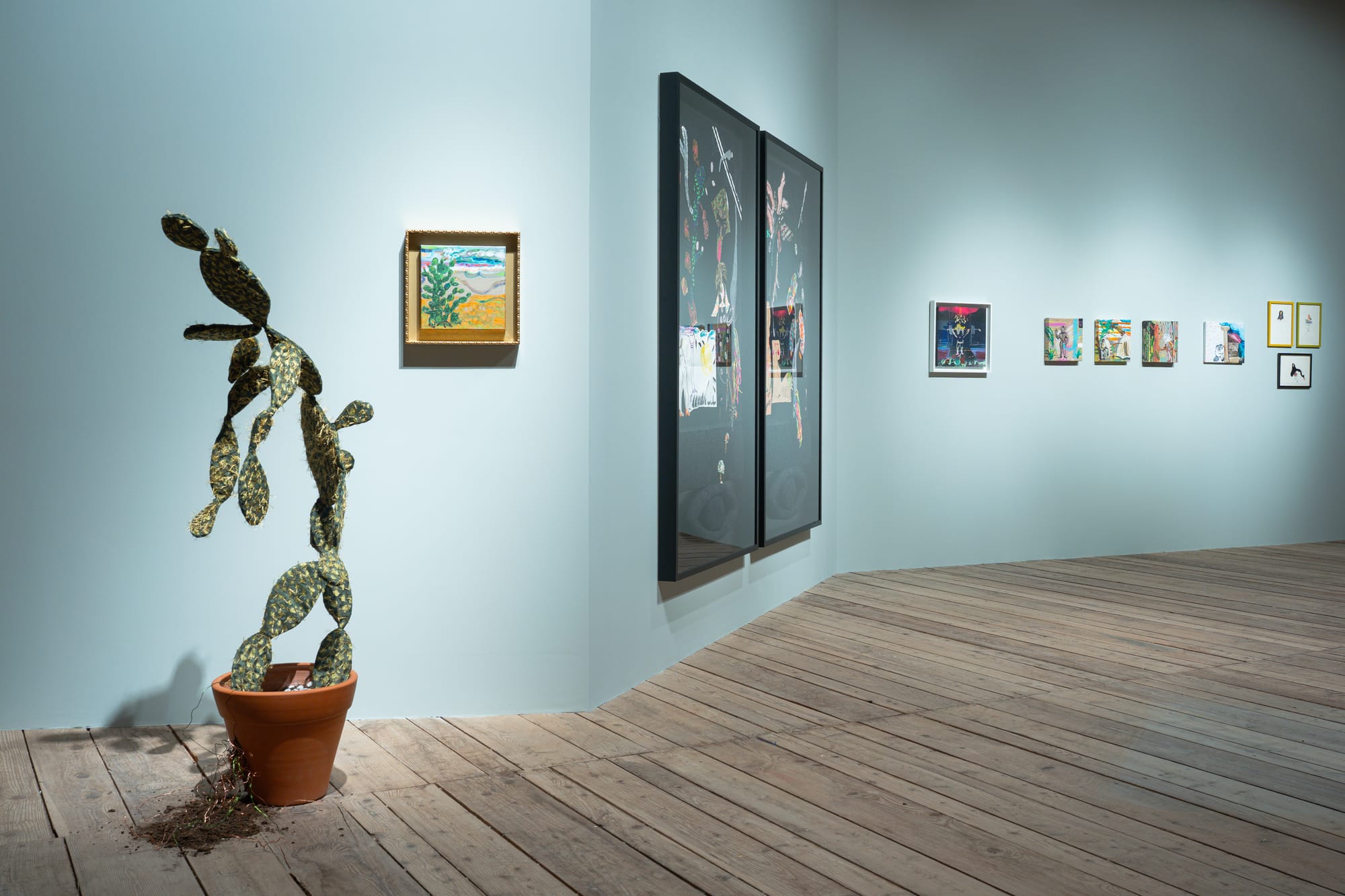
From there, she shifted toward a more three-dimensional vocabulary. Venice presented a new challenge. The pavilion is a large space with ceilings nearly eight meters high, and at first Nilbar wondered how she could possibly inhabit it. But she embraced that challenge. She wrestled with the space until it gradually became part of the work itself. The result is an ambitious body of new works that incorporate knitting, textiles, copper, and other materials she has never worked with before. The exhibition is largely composed of sculptures and installations, featured alongside a selection of paintings. It feels like a significant moment in her practice, marking a new level of spatial and material experimentation.
Between the textiles, staged photographs, paintings, and other media, there seems to be a consistent aesthetic—a color scheme or world-building that runs through the show.
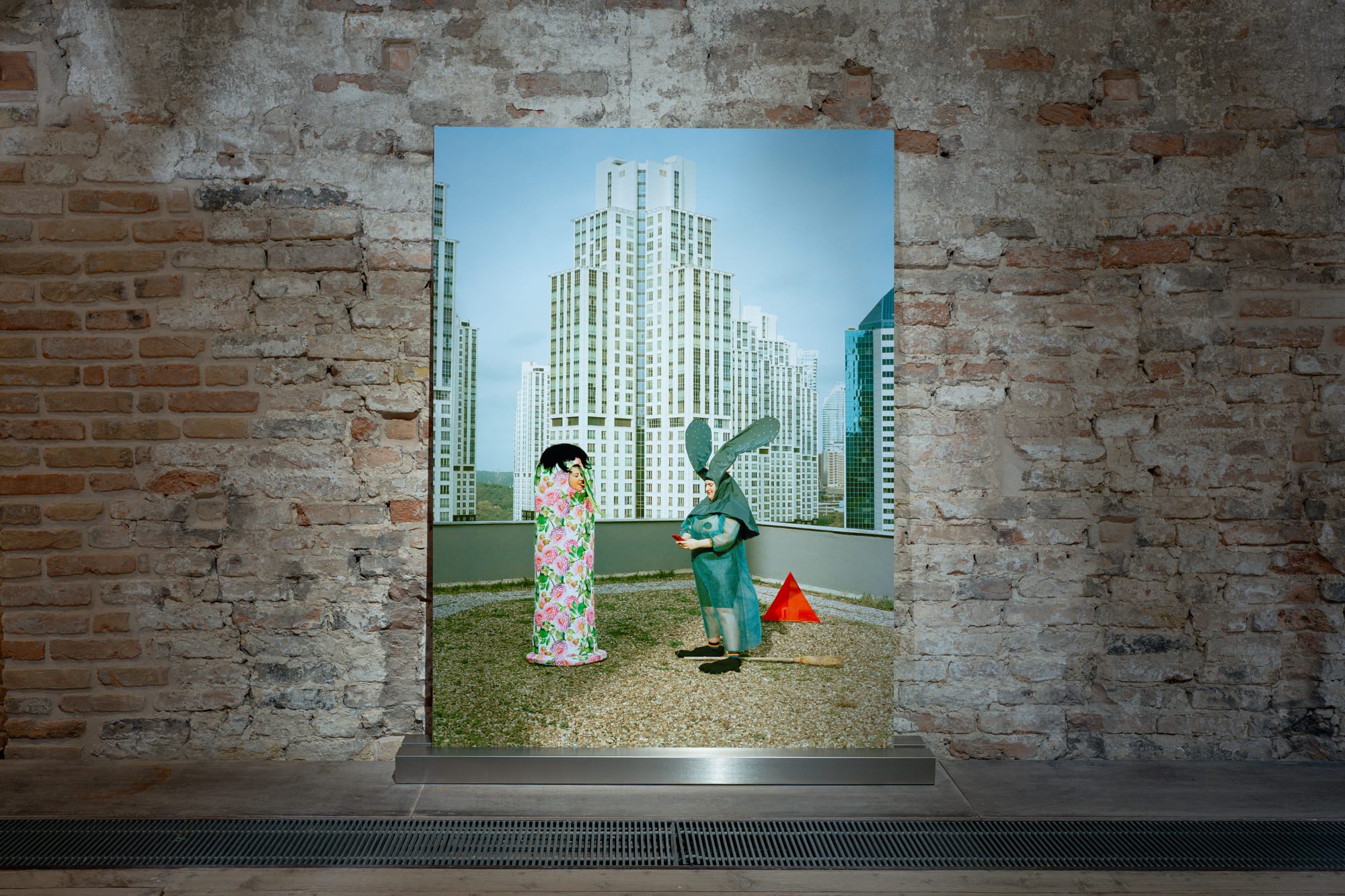
Yes, it all happens intuitively for Nilbar. For example, Amazon Temple (2026) is a rework of a previous sculpture she made for the 31st São Paulo Biennial in 2014. When she first visited the exhibition venue in Brazil, she noticed all these columns in the Ciccillo Matarazzo Pavilion. For her, a feminist, they were too masculine and phallic, so she decided to drape them in skirts. She layered dresses local to São Paulo onto the pillars, with one usually donned by wealthy women placed at the bottom, and others worn more by working-class women on top of it. Here, she’s playing with social hierarchies. She made a column of skirts, whereby the one at the bottom flares out, recalling a parachute. When we installed this work in Venice, we set up a photograph next to it. Just a day before the opening, we realized that one of the subjects in the image was wearing a costume made of the same fabric we used for the “parachute”—it was even the same color.
Nilbar doesn’t plan these things; she does it all freely. This instinct is her alphabet, her toolkit.
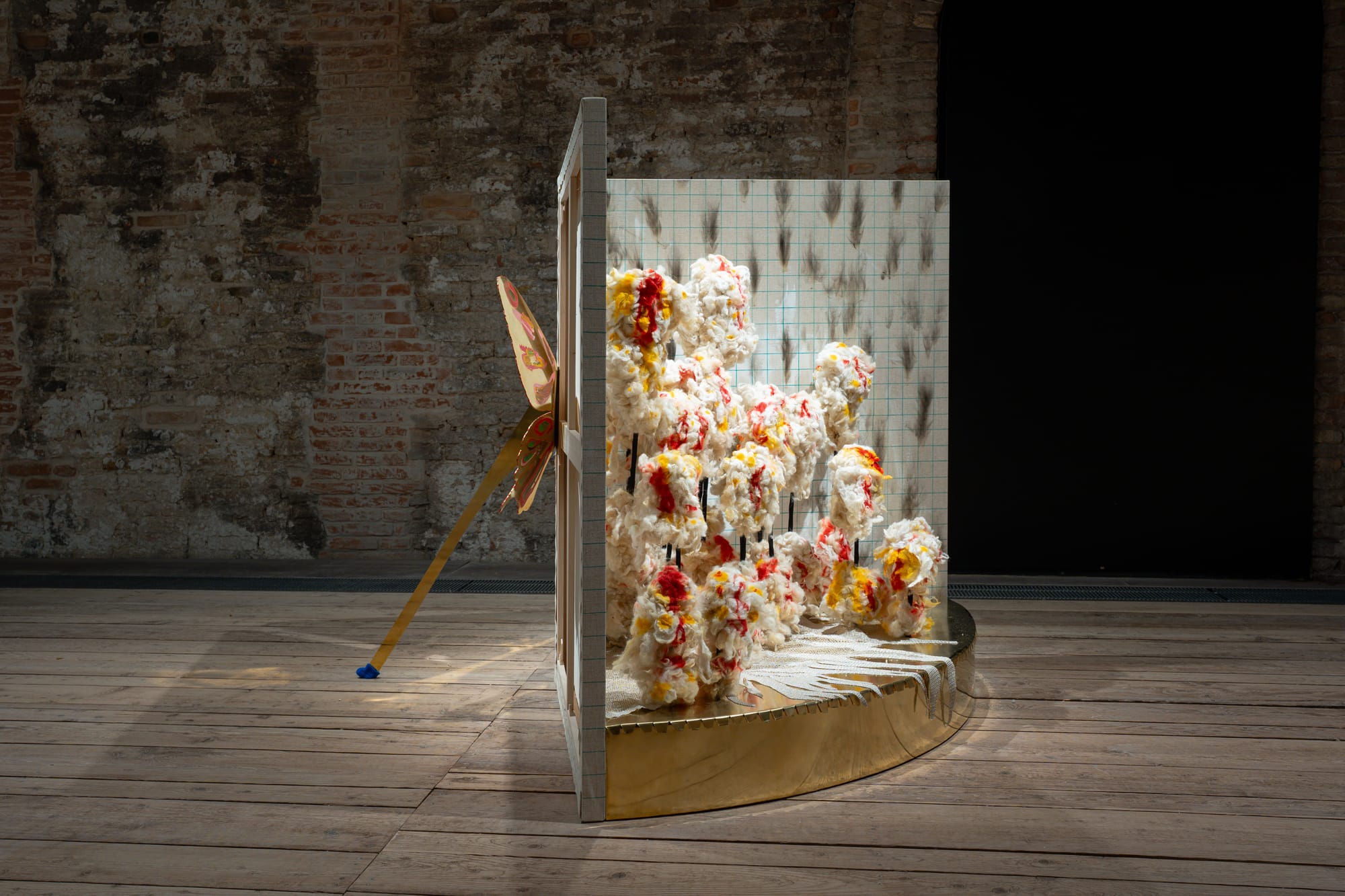
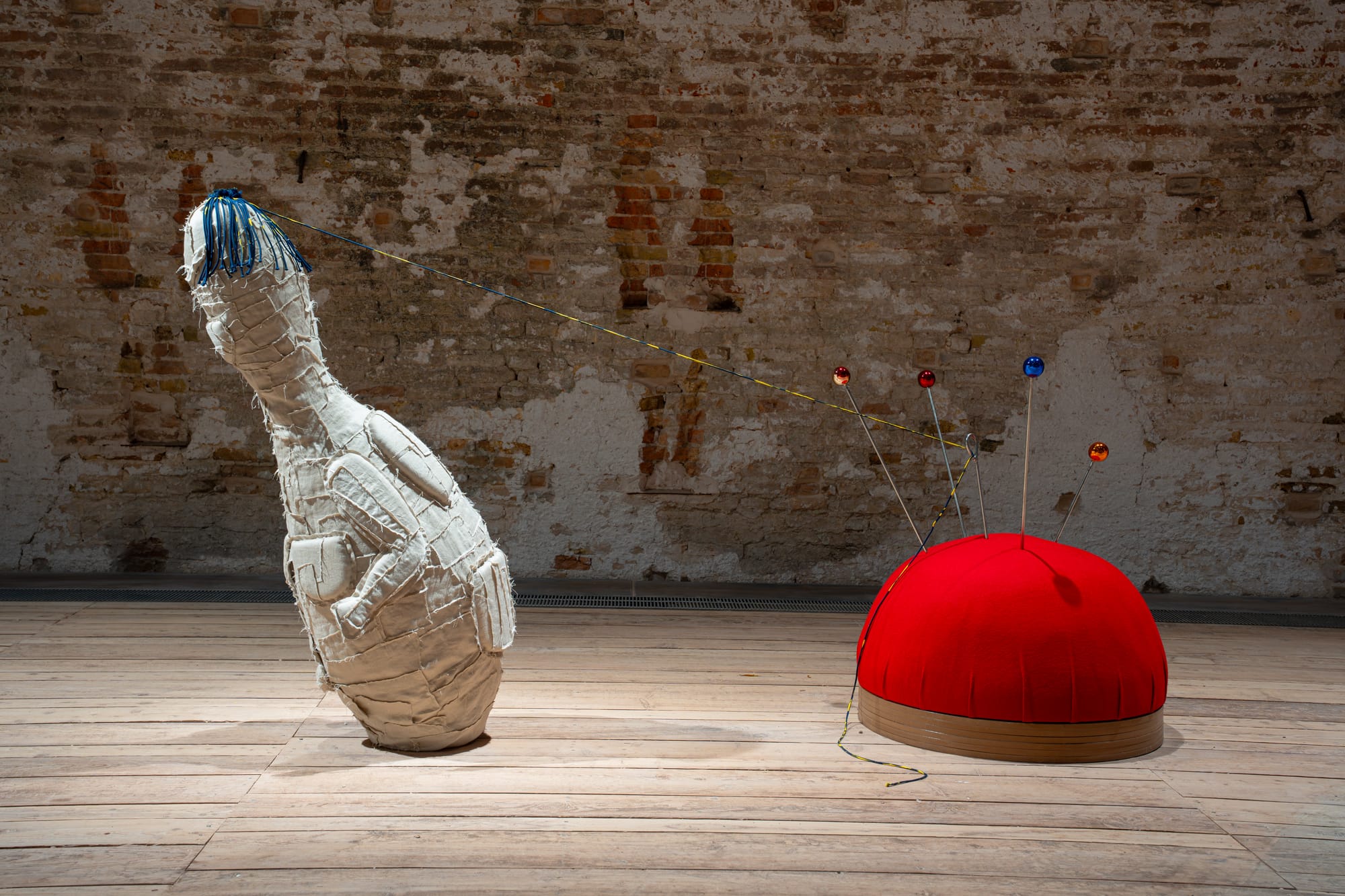
Installation views of NILBAR GÜREŞ’s Hey, Hairy Fire, Don't Fall Asleep!, 2017/26, wool, spray paint, wood, steel, brass, 155 x 180 x 190 cm (left); and Stuck, 2026, fabric, steel, wood, 155 x 90 x 290 cm (right), at “A Kiss on the Eyes,” the Türkiye Pavilion, 61st Venice Biennale, 2026. Photos by Fatih Yılmaz. Courtesy the Istanbul Foundation for Culture and Arts.
The Venice Biennale is an opportunity for art to reach the global public. What kinds of conversations arise between artists and curators when preparing for this international event?
It’s a very intense, stressful, and short period, so you really need to be fully honest with each other. There’s a lot of pressure. It’s the Olympics of the art world, as the cliché goes. This whole national representation framework at these events is very troubling.
Amid the political turmoil surrounding this year’s Biennale, was the Türkiye Pavilion a site of activism?
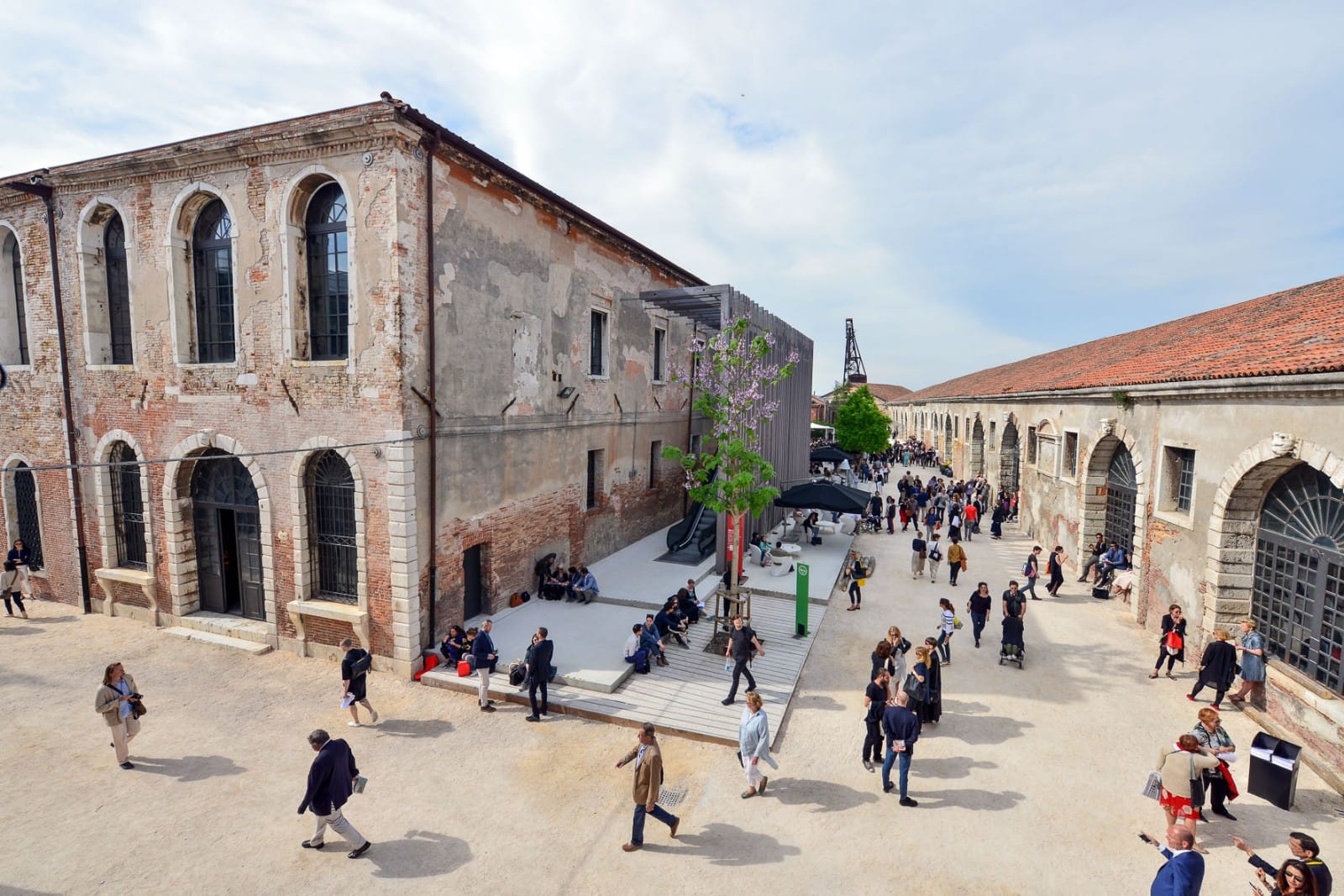
It was, yes. I was wearing a pin of the Palestinian flag. We participated in the artist-led Art Not Genocide Alliance (ANGA) protests, which also took place during the opening week of the 60th Venice Biennale in 2024. That year, ANGA managed to shut down the Israel Pavilion. This year, there was a rally at the latter’s new location. Originally, Israel had a pavilion in the Giardini—which represents the “First World”—where the US, France, Japan, and Korea have their permanent spaces. But this time, for some reason, Israel relocated to the Arsenale, where it was adjacent to the pavilions of Saudi Arabia, the UAE, and Türkiye. It’s weird that they came here so close to us—it almost felt intentional.
We were very much involved in the protests. For Nilbar, that was a given. She thought, “How can we care so much about the arts right now?” There were many shows and subjects and things in Venice that were so indifferent, as if nothing was happening in the world. It was disheartening.
There was a 24-hour strike. We closed our pavilion and hung some flags and posters that ANGA had produced. That was fine and peaceful. People still came by and asked us, “Can you turn the lights on? Can you tell us a bit about the show?”
A mixture of interests and possibilities emerges when you question the role of culture in our current condition through activism and exhibitions, particularly under such global attention.
It’s a powerful position. When you’re in Venice, it’s a very temporary power. We decided to make use of it. When the world is burning down, it’s insane to just go around drinking your prosecco, eating your clams and pasta. That’s impossible for me. I’m really grateful that I met someone like Nilbar, who felt the same.
We were neighbors with the Luxembourg Pavilion, which wanted to join the protests, though with some distance. Many other Western countries faced problems with closing down their pavilions for the strike, including the UK. In most cases, the artist wanted to shut down the pavilion, but the commissioners didn’t. After all, this is the mission of states.
For Türkiye, the system is unique in that the pavilion is commissioned by the private Istanbul Foundation for Culture and Arts, and realized under the auspices of the Ministry of Foreign Affairs and the Ministry of Culture and Tourism.
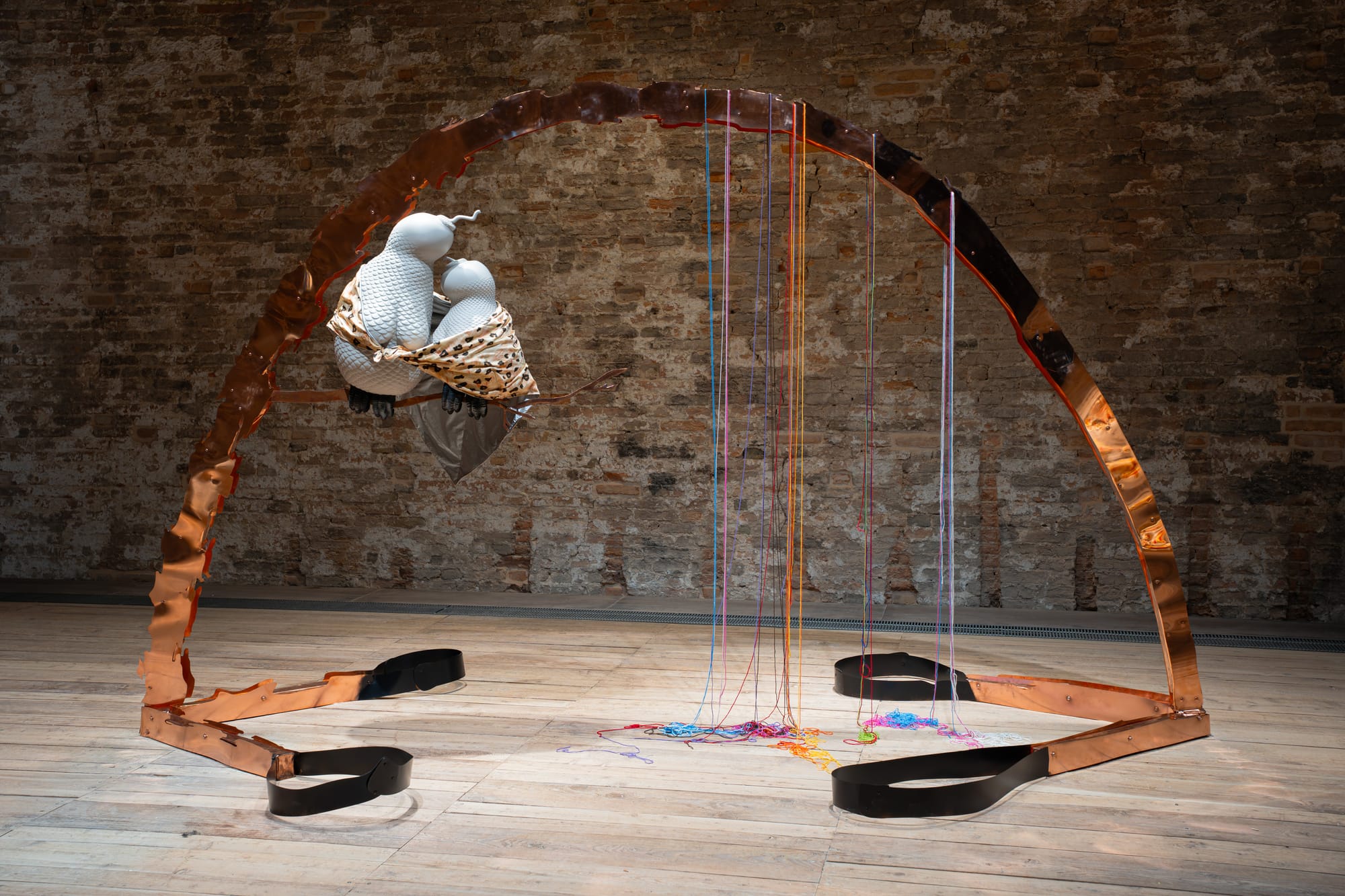
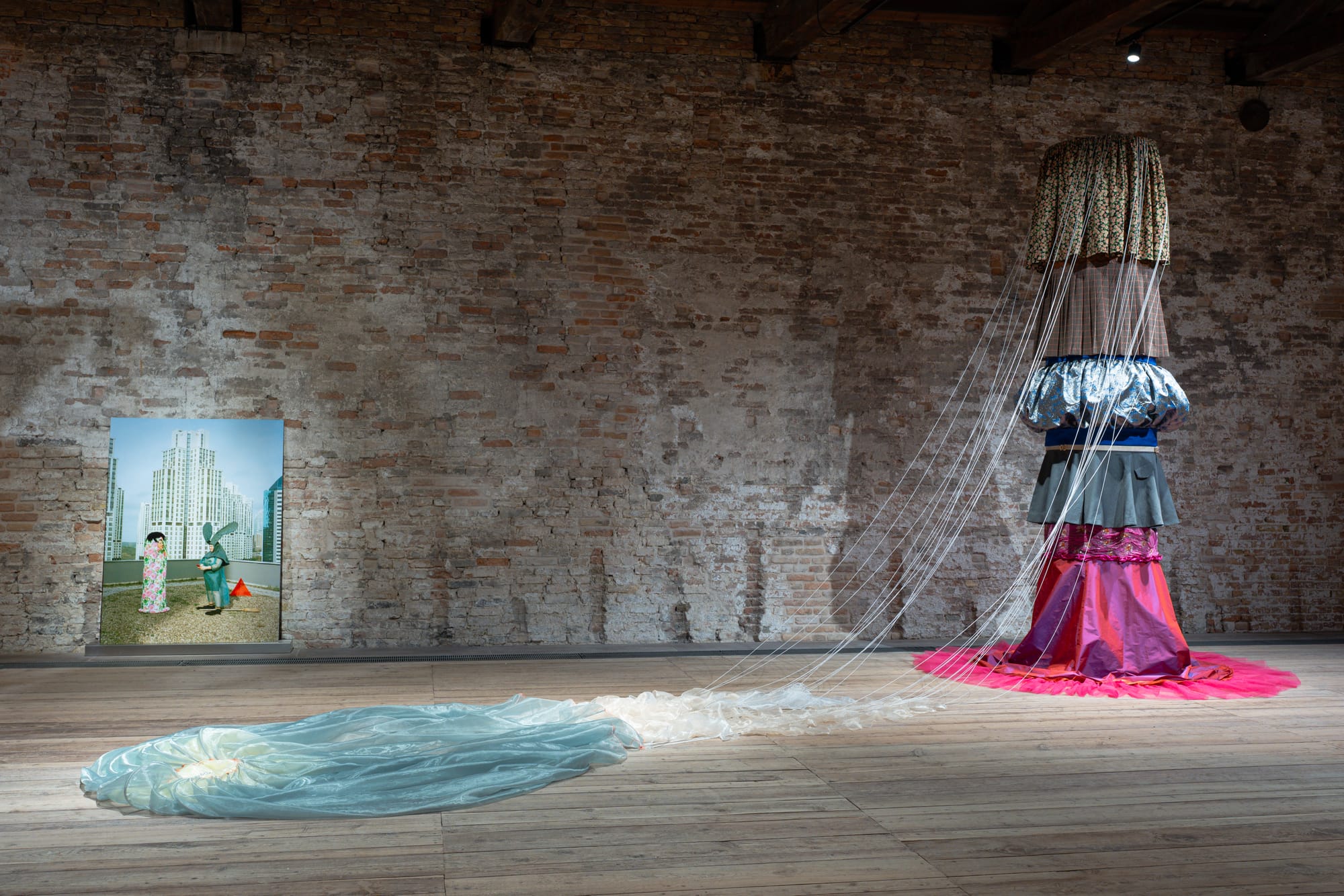
Installation views of NILBAR GÜREŞ’s Birds, 2026, mixed media, 240 x 390 x 220 cm (left); and Amazon Temple, 2026, fabric, belts, rope, steel, 400 x 230 x 780 cm (right), at “A Kiss on the Eyes,” the Türkiye Pavilion, 61st Venice Biennale, 2026. Photos by Fatih Yılmaz. Courtesy the Istanbul Foundation for Culture and Arts.
The theme, “A Kiss on the Eyes,” emphasizes human affection and intimacy—including symbolic acts of intimacy in personal life. It draws on the Turkish line Gözlerinizden öperim, which is often written at the end of a letter. Is that a historical idiom?
It’s a very traditional phrase that is well-known and loved, often said by elderly people to younger people as an expression of affection and respect. It is typically used at the end of a conversation or a letter, creating closeness while preserving a certain distance, and without claiming ownership of the other person.
For Nilbar, however, the title also addresses another experience. Having lived and worked internationally for many years, she found that she was often expected to explain where she comes from, or what her references, colors, and even visual language mean. The title gently reverses that expectation, instead inviting us to look differently.
In that sense, “A Kiss on the Eyes” is not ironic or sarcastic. It is both generous and selective, extending tenderness to those who approach with curiosity and openness, while quietly refusing the unequal expectation that some artists must endlessly translate themselves in order to be understood.
Within the context of a national pavilion, this also feels significant. Although the exhibition is presented in the Türkiye Pavilion, it does not propose a fixed image of national identity. Instead, it questions how identities are produced, perceived, and negotiated across borders. The title therefore becomes an ethical proposition as much as a warm greeting: perhaps what matters is not where we come from, but how we choose to look at one another.
Matt A. Hanson is an art writer based in Istanbul and ArtAsiaPacific’s Istanbul desk editor.