News
Kazakhstani Art Community Demands Reinstatement of Censored Venice Work
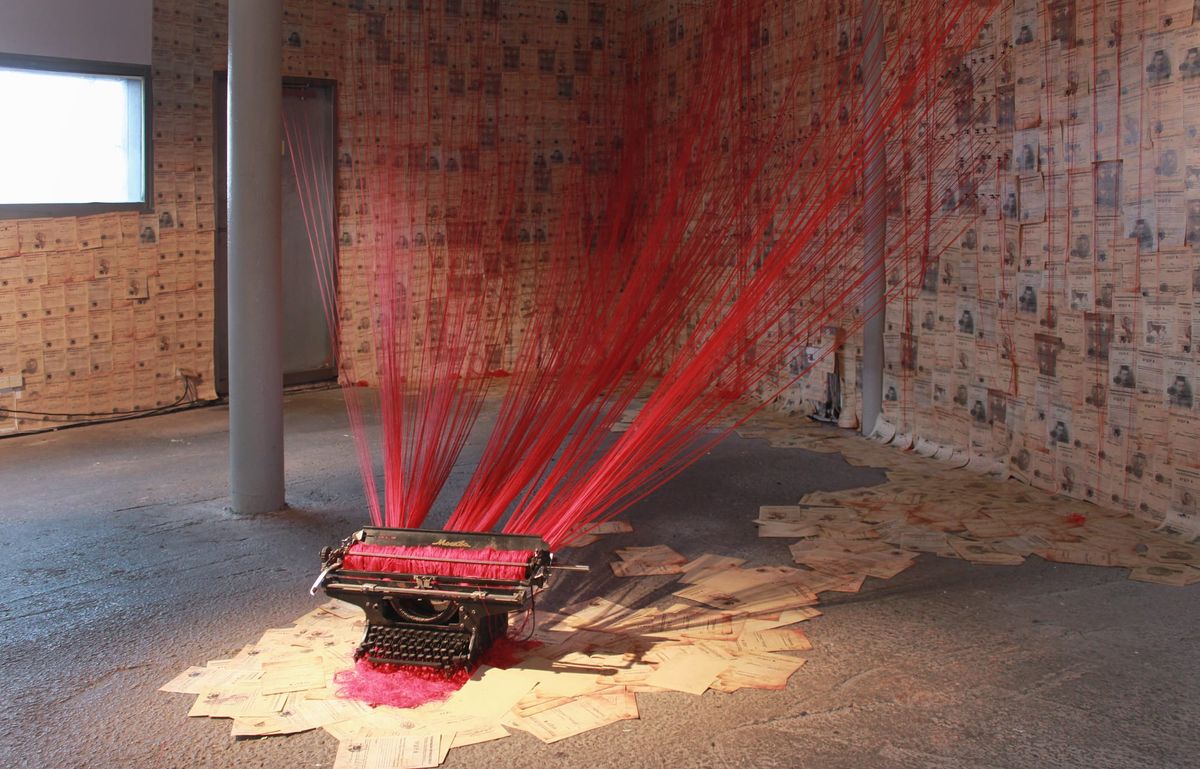
On May 21, more than 100 Kazakhstani artists, curators, arts professionals, and art community members signed an open letter on e-flux. The signatories demand the restoration of Äsel Kadyrkhanova’s installation Machine (2013) to the Kazakhstan Pavilion at the 61st Venice Biennale, as well as an apology from Kazakhstan’s Ministry of Culture and Information to the artist and the art public by May 31—the national memorial day for victims of Soviet political repression and famine.
The work was dismantled on May 5, days before the Biennale’s public opening on May 9. Comprising archival copies of Soviet-era arrest warrants connected by red threads to a vintage typewriter, Machine evokes Kazakhstan’s historical trauma of Stalinist-era forced collectivization, manmade famine, and labor camps. It was among nine works selected through an open call for curator Syrlybek Bekbota’s exhibition “Qoñyr: The Archive of Silence.”
In its initial explanation for the work’s removal, Kazakhstan’s Ministry of Culture and Information—the pavilion’s commissioner—cited a clause in its hosting contract with the Museo Storico Navale di Venezia prohibiting works of a “political, ideological, or other” nature, according to a report by the media outlet Vlast. D’Uva, the company that manages the museum, rejected this account in a statement published on May 11, with CEO Ilaria D’Uva affirming that the company had neither imposed restrictions on the work nor requested its removal. She described the decision as one made autonomously by the pavilion organizers.
Bekbota subsequently took personal responsibility in an extensive Facebook statement, explaining that after discussions with Kadyrkhanova about alternative presentation options—including substituting Machine with more recent works—and receiving no agreement, he unilaterally decided to remove the installation. “I personally made the decision to dismantle [Machine] in its original form. And I take full responsibility for this decision,” he wrote.
Describing Machine as “an artistic study of historical memory,” the open letter condemned its removal as an act of political censorship that had harmed “the feelings of Kazakhstani people who lost family members during the time of Stalin’s terror” and “caused great reputational damage to the pavilion of Kazakhstan at the largest international art forum.”
Pavilion co-commissioner Danagul Tolepbay responded to the letter by telling ARTnews that “it presents only one side of the situation without requesting comment or clarification from the organizers.” As of the time of writing, the Ministry has not publicly responded to the signatories’ demands.
Kalani Ko is an editorial intern at ArtAsiaPacific.