News
Song Burnsoo, 1943–2026

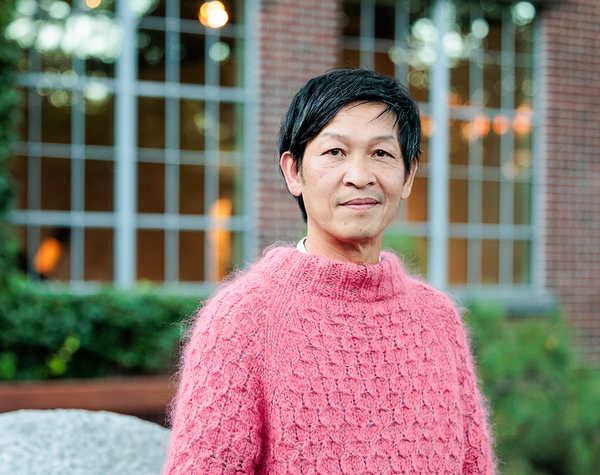
Song Burnsoo, a pioneering fiber artist whose 50-year career left a formative mark on Korean contemporary art, died on June 15 at the age of 83. Gallery Baton, which represented him, announced his passing on June 18.
Born in 1943 in Gongju, South Korea, Song attended Hongik University in Seoul, where he received both his BFA and MFA. His early work comprised pop-art-inspired prints centered around sociopolitical issues, among them Consultation of General Rule about Unification of Korea (1972/2001), a commentary on the division of the peninsula. Song temporarily moved to Paris in 1977, turning to textiles while studying lithography. The works that followed carried strong religious undercurrents, threading motifs of thorns and shadows through an iconography of suffering and redemption, as seen in Self of Wrath (1996) and From That Day On (1997). These themes became central to Song’s artistic identity, finding expression in the tension between pain and hope. It culminated in a Catholic commission: Unfinished Diadem (2002–03), a monochromatic blue plain-woven fabric depicting a crown of thorns and its contorted shadow, now permanently displayed at Gwangju’s Neungpyeong Catholic Church—the only tapestry adorning an altar in South Korea.
Song returned to Hongik University from 1980 to 2008 as a professor in the College of Fine Arts, and was later named Professor Emeritus. He served as director of both the Daejeon Museum of Art and the Maga Art Museum, the latter of which he founded in 1998 to advance the study of fiber art. Among his many accolades, Song received the Korean Presidential Award of the Order of National Service Merit in 2000 and the First Golden Fleece Prize at the 2001 “KÁRPIT” Exhibition of Contemporary Tapestry in Budapest, which celebrated the millennium of the foundation of the Hungarian State. His works have been exhibited at major institutions locally and internationally, including the Seoul Museum of Art, the Tokyo Metropolitan Art Museum, and the Museum of Fine Arts Budapest.
Gallery Baton, which had worked closely with Song since 2019, commemorated his legacy in a statement: “Rooted in the trajectories of lived experience and the sensibilities of his time, his work left an enduring mark on the identity and horizons of Korean contemporary art.”
Emily Ng is an editorial intern at ArtAsiaPacific.