People
“Vaguely Asian”: Interview with CFGNY
To speak of the New York-based collective CFGNY is to enter a slippery game of recursion. The unidentifiable acronym “CFGNY” is a container for “Concept Foreign Garments New York,” as much as “Cute Fucking Gay New York,” or “Cult Freaks Galore New York,”—each instance of naming a semiotic performance that orbits the group’s metonym, “vaguely Asian.”
In the context of Asia’s relatively recent consolidation into nation-states, which produced an idealized modern concept of “the people,” the notion of “refashioning” oneself suggested to the philosopher Alex Gwang-Taek Lee a series of questions such as: How can Asia inhabit its new political form? If a name that condenses multiplicity into unity is a strategic abstraction, might Asia instead become the name of a new political subjectivation? And what would be required, at the level of “the people,” as necessary subjects of any contingent pedagogical and political project, to do so?
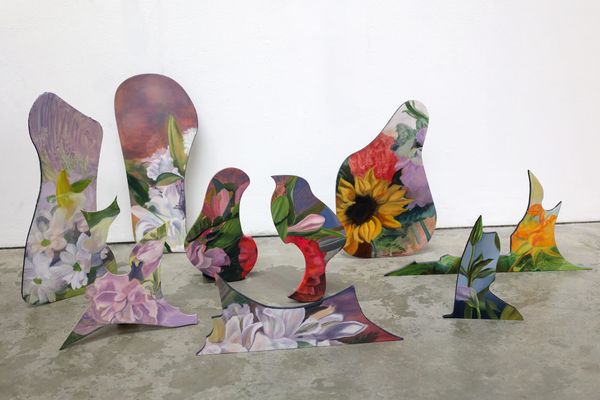
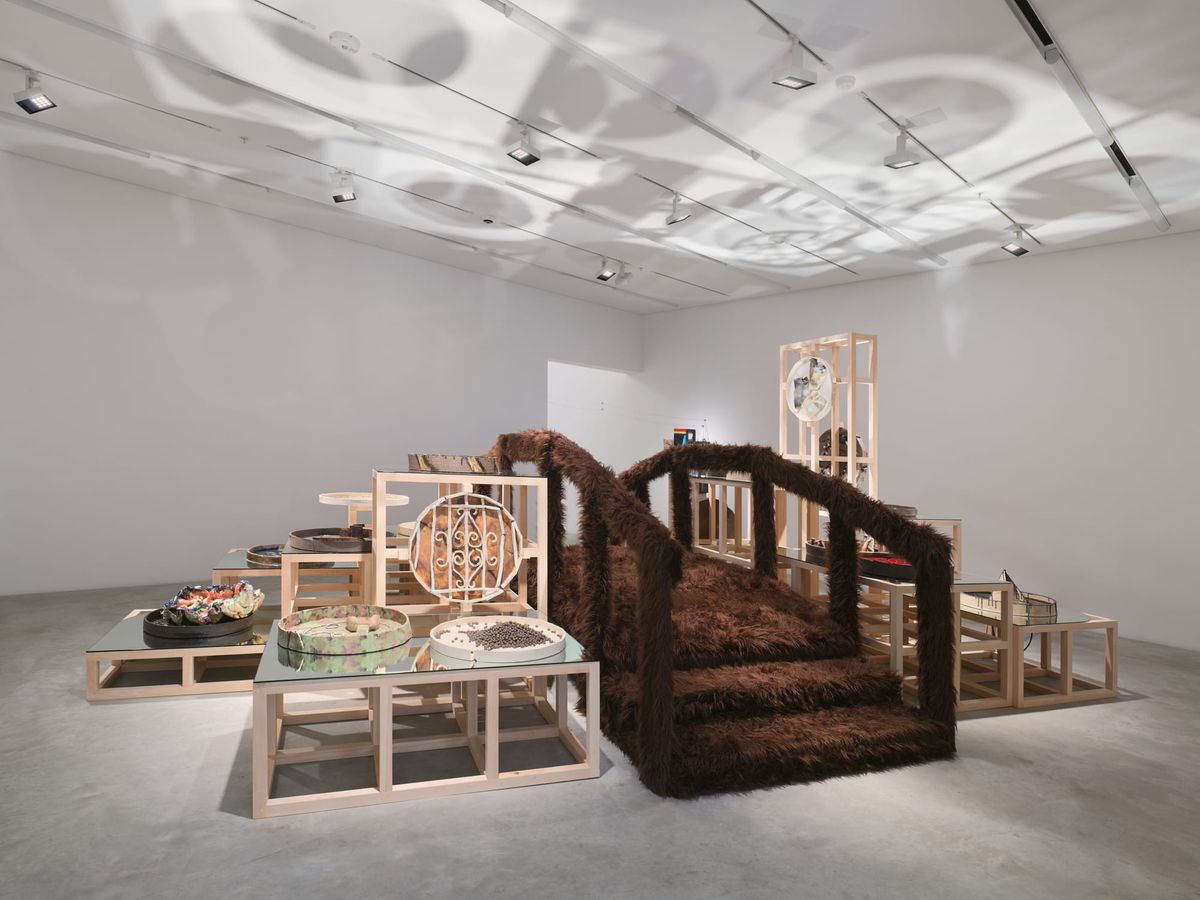
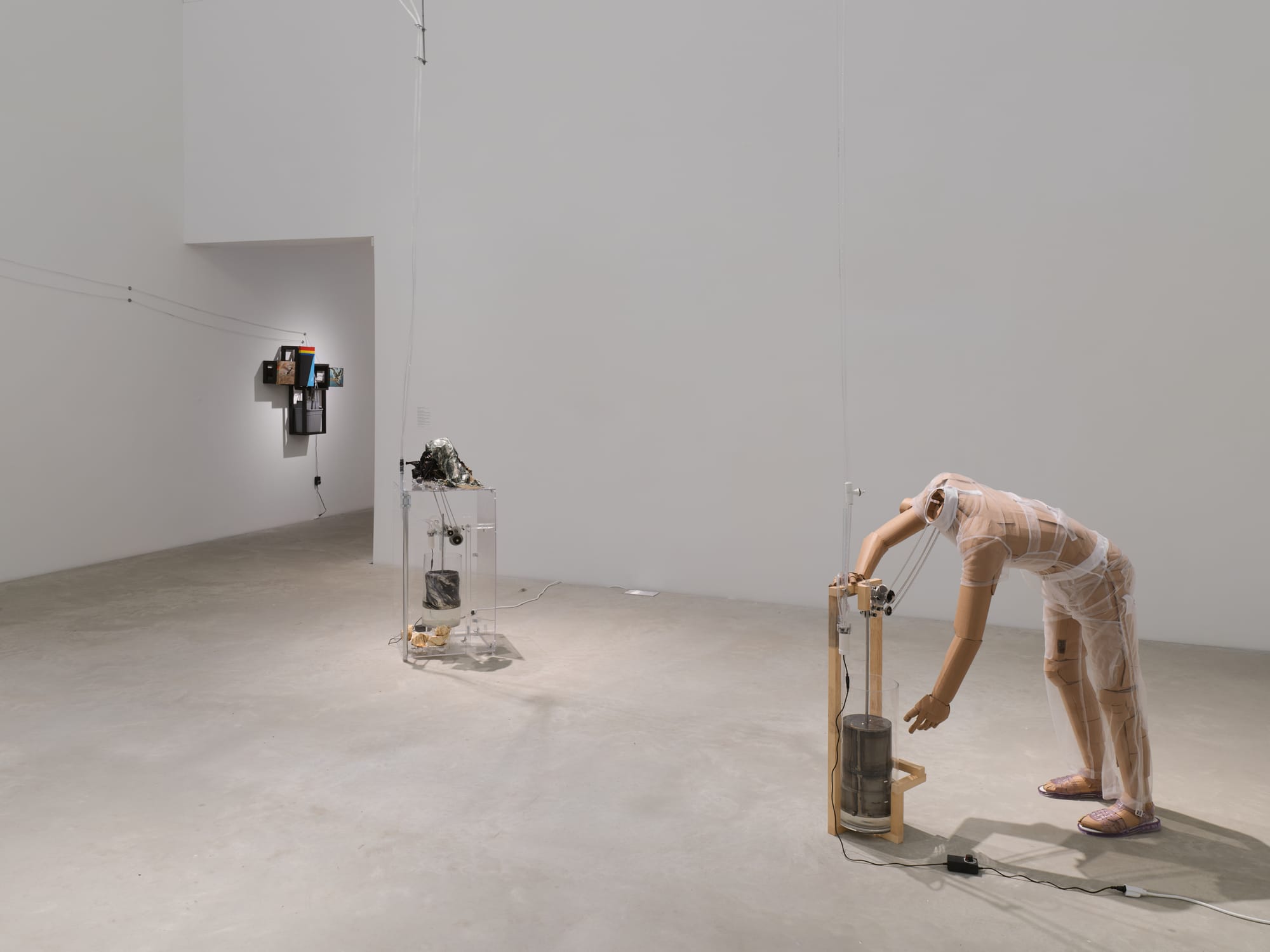
Since 2016, CFGNY’s “vaguely Asian” sensibility has nurtured its ability to absorb and confuse projected identities, aesthetics, and affiliations. Their recent exhibition in the East Williamsburg nonprofit Amant, “Puddles into Pond,” departs from a group of Beijing plein air painters active during the Cultural Revolution, self-named “No Name Painting Association” (alternatively “Wuming Painting Collective” and “Anonymous Painting Group”). Treating this history as an affective field, the show presents 18 stylizations of a ceramic template made by friends and peers—including artists Ami Lien, Arlette Quỳnh-Anh Trần, and Cole Lu—assembled like lily pads around a life-size, brown, and furry bridge that encapsulates the “cute, zany, and interesting,” concepts coined by Sianne Ngai, all at once. Visitors enter through a pop-up store run by Amant staff—a form of social practice—before reaching an installation of provisional water clocks composed by a plastic vinyl bag sewn with alien bookworm plush patches, a hunched cardboard figure, and a kitsch monument that renders the global supply chain in terms of nature, time, cosmology, and material flow.
Yet, as the three current core members—Daniel Chew, Ten Izu, and Tin Nguyen—told me backstage at Amant, “Much of our practice is what goes on behind the scenes.” While intervening in economies of production, circulation, and value, the collective moves like a slow missile between form and formlessness. They disperse identity while solidifying authority, inhabit genres like landscape art, performance, and social practice only to subvert expectations, and embody the Asian or the merely “vaguely Asian.” Yet CFGNY is ultimately in pursuit of alternative socialities. Following a cult fashion show co-produced by Amant and The Kitchen, the vitalic New York multidisciplinary institution founded in the 1970s, we spoke about fashion and music influences from the late 2010s, technologies of self-imaging, and love formed through art.
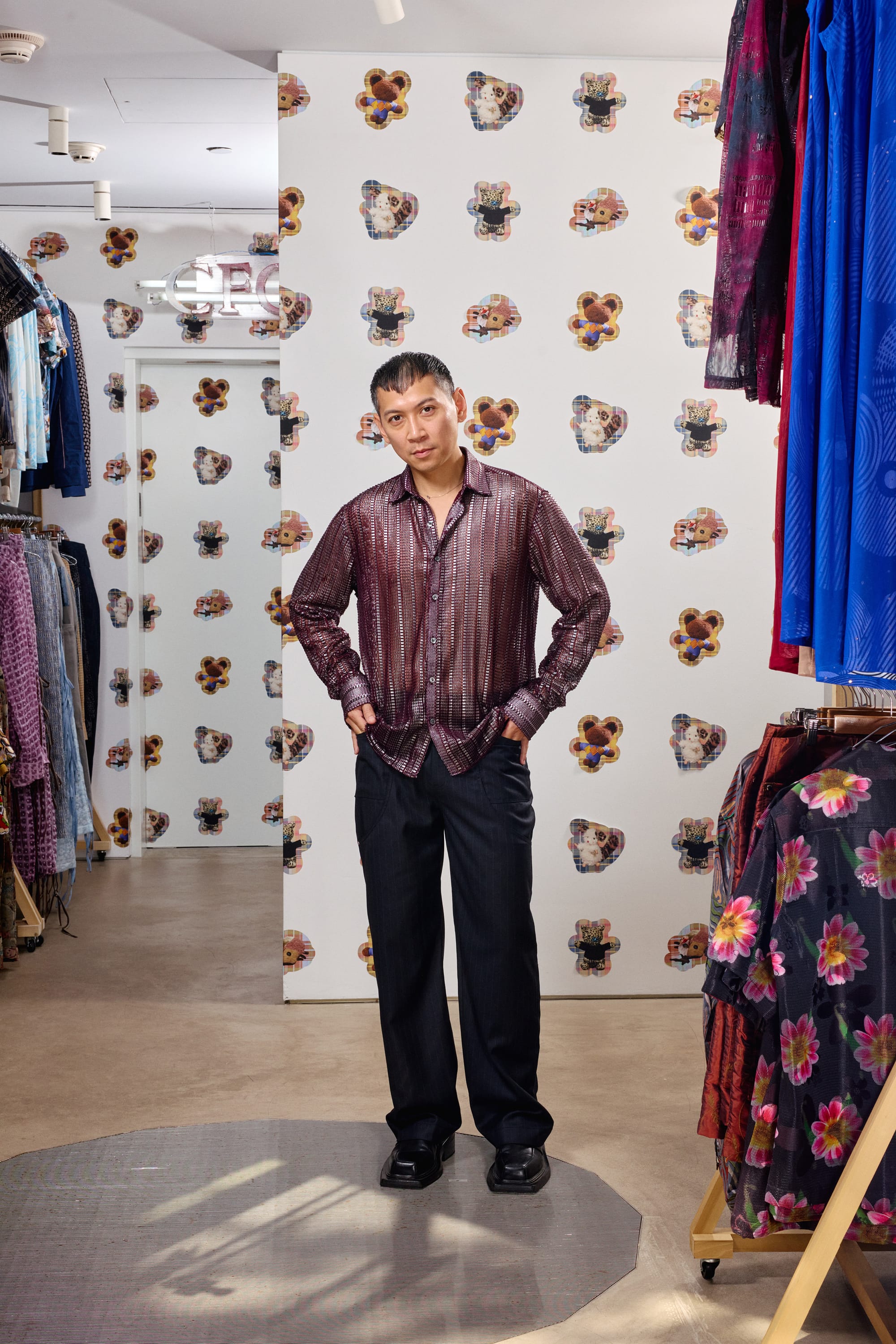
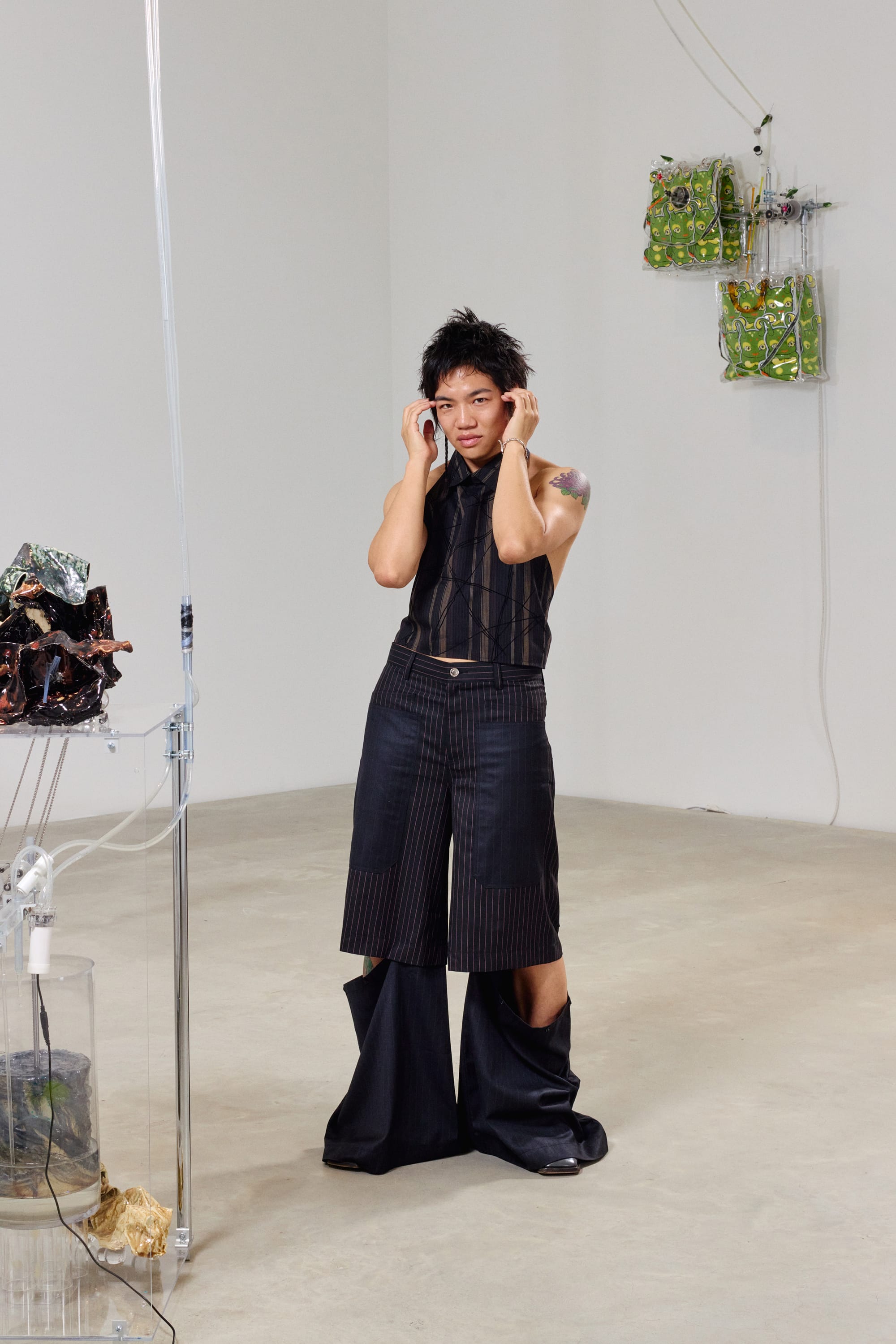
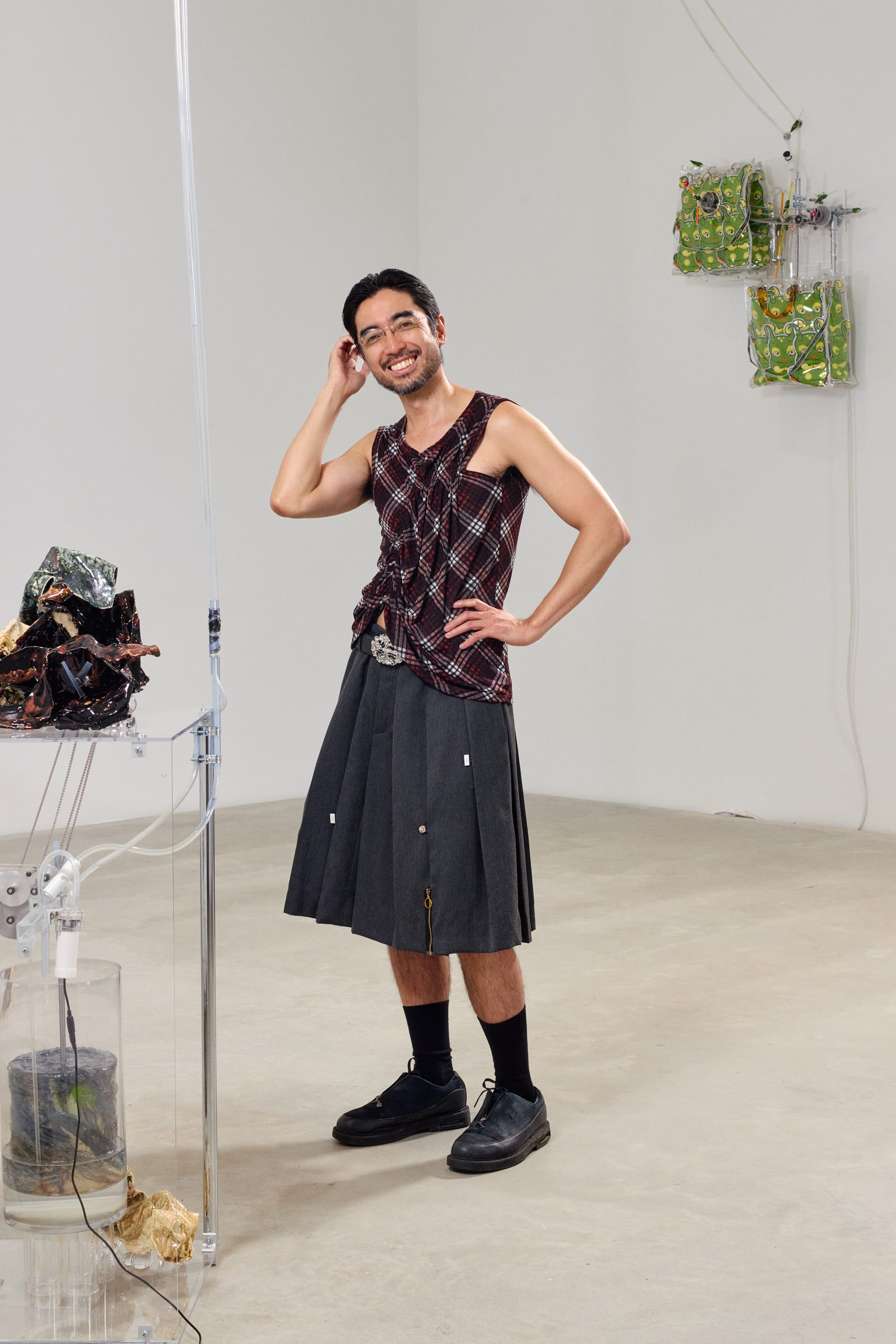
Looks 01, 03, and 04, modeled by TIN NGUYEN, TEN IZU, and DANIEL CHEW (left to right), for “CFG-20260717,” 2026. Courtesy the artists and Amant, New York.
You met in New York. When you first started working together, was there a group of mentors, or a semblance of a network through which you felt aligned? And do you feel that now with peers?
Daniel Chew: When we were young, we hung out a lot around 47 Canal. We were the assistants of the people behind the gallery, who were maybe one generation older than us. We definitely learned the ropes of and about the art world being in life with these people who mentored us. There was so much drama around that group—drama CFGNY was both inspired by and reactive to. They were all friends, but were also competitive. We started collaborating because we felt like we needed to do something different.
Did the idea for CFGNY emerge through artist projects, friendships, or something more formless? I’m curious about the decade over which you’ve now collaborated together, whether there was an initial vision, and how the collaborative process has shaped the collective.
Tin Nguyen: It started as friendship, but over time we formalized ourselves since we realized that CFGNY could be a project where multiple people could share a practice. When you allow the practice to lead, it takes on its own shape through time and space. We had a sense of what we wanted to do in the beginning, but it was our experiences in the early years that led us to where we are today. Some aspects are still the same because we will always be ourselves, but we also have expanded through each of our exhibitions, which present opportunities for new research into individual institutions. For example, “CFG-20260717” was inspired by the advent of video art in the ’70s, which was around the time that The Kitchen was founded. Someone had asked us, “Have you made video work?” We’re like, “Not really.” But now, clearly, it’s on our mind.
DC: Oh, that’s funny.
TN: But there are parts of the project that remain consistent. For instance, Sung Tieu was present for our show, and she said, “You guys are doing the same thing, but it’s grown a lot.” As we continue to use fashion as a medium, our relationship to garment-making expands through the ongoing conversations within our community. Each year, more information is folded in.
Ten Izu: So much of our project is about researching and exploring life, and presenting our findings through performance and art.
DC: I’d also say much of our practice is what goes on behind the scenes. What powers and nurtures it is the process of making something and the experiences we have in the making, which is then presented as either an object or a performance.
TI: The real meat of the event was not the hour-long performance itself, but the entire day. All the work we had done was manifested from the first call time—hair, makeup, and styling arriving, each wave of models, months of intense and meticulous planning coming to life, through everyone we invited to come and participate and make the day happen together. Of course the performance meant a lot, but at some point it almost felt secondary to bringing people together and interacting with them.
TN: That goes for the entire project. There are parts that are visible to a wide audience as well as parts that a much smaller group of people get to experience. It’s a lens whose framing is constantly shifting. Even now, right after a major performance we are in constant communication with our models and other friends in exchange for their help. Everyone is like, “Oh my God, you need a break.” But part of our work is the relationships we’re building, and maintaining our word. “You did this for us, therefore we’re going to do it for you.” Some of the practice is perceivable and some of it is not.
Even within the collective, my role and my relationship to the performance are different from Daniel and Ten’s.
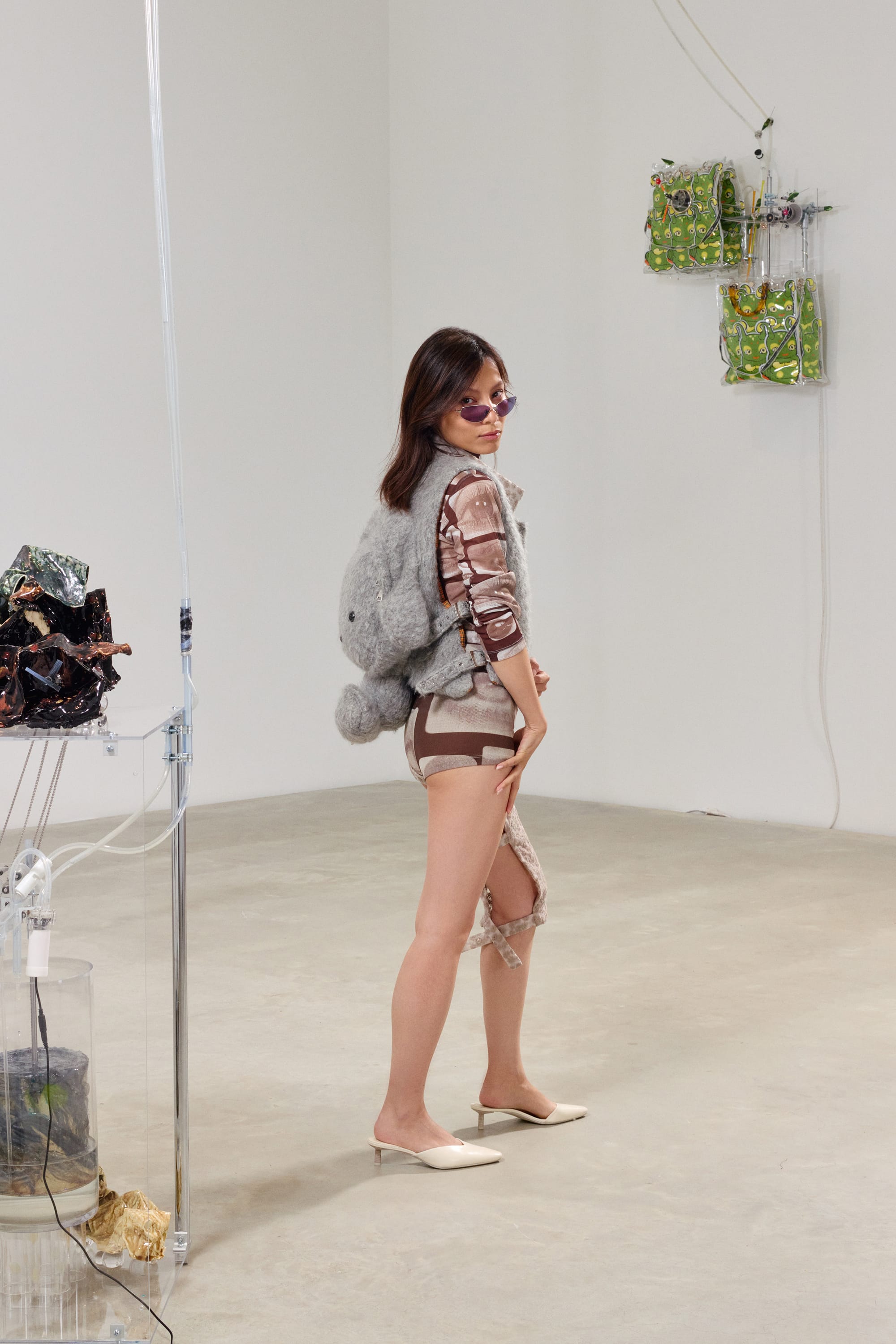
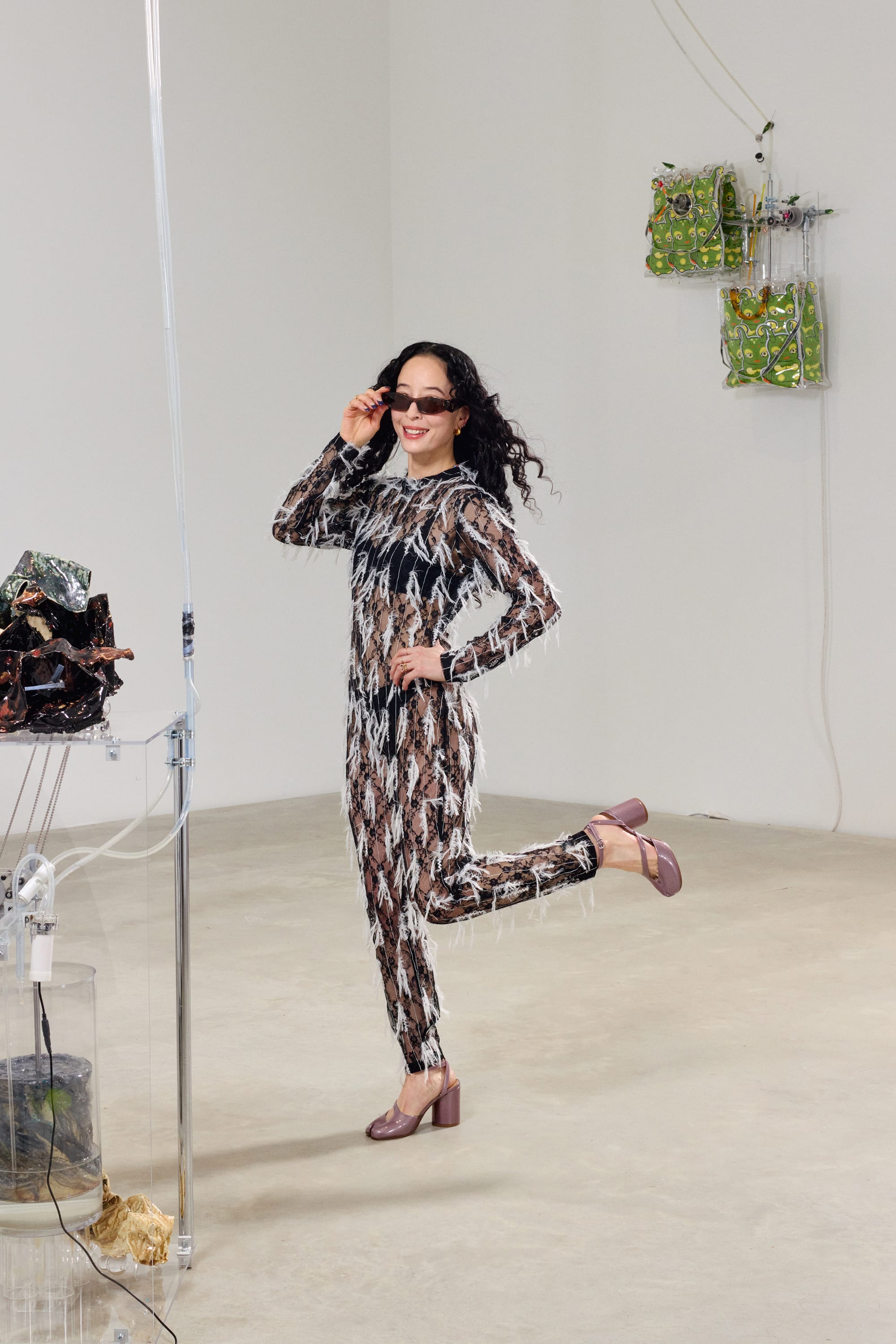
Looks 23 and 39, modeled by SUNG TIEU and LOTUS L. KANG (left to right), for “CFG-20260717,” 2026. Photo by David Brandon Geeting. Courtesy the artists and Amant, New York.
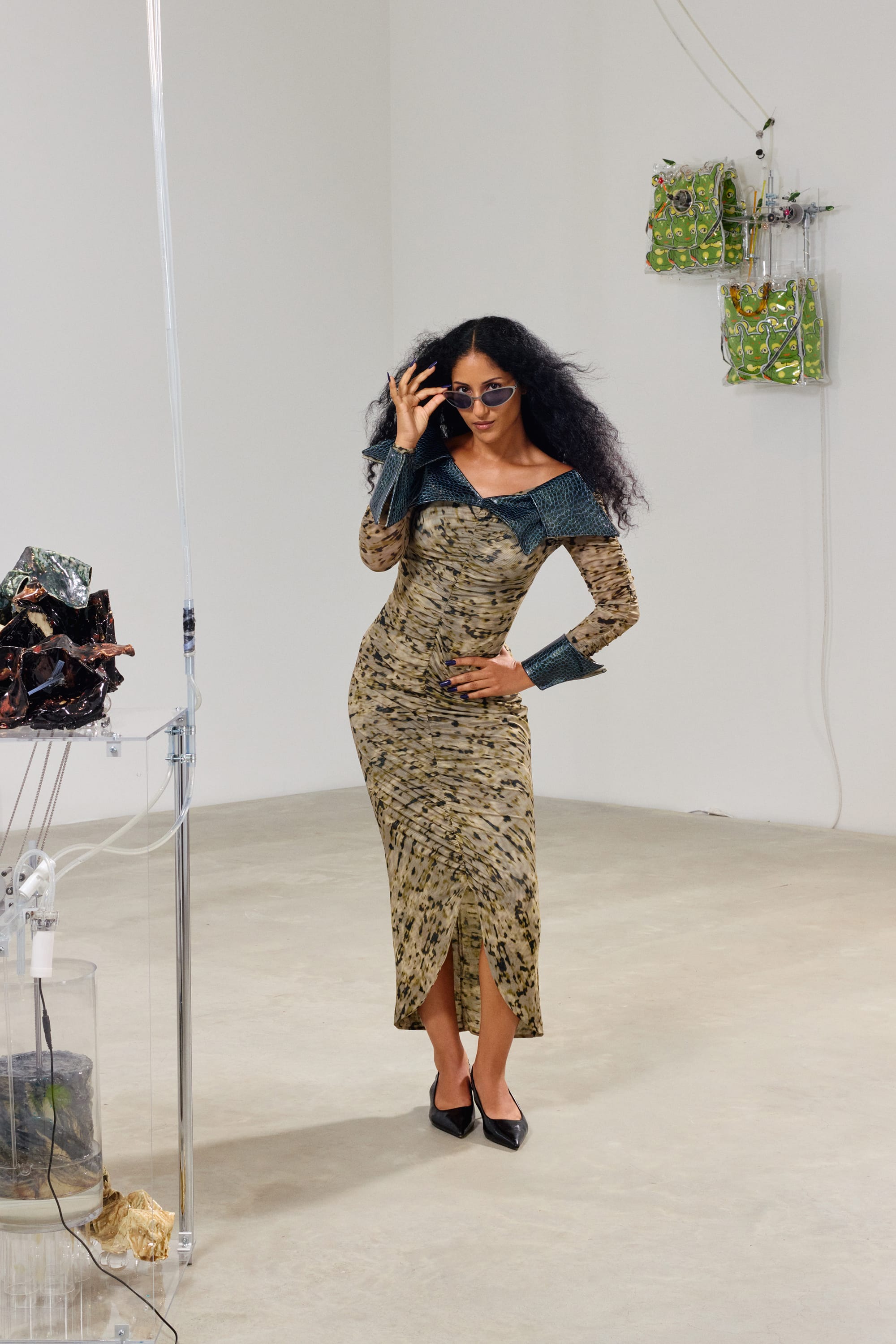
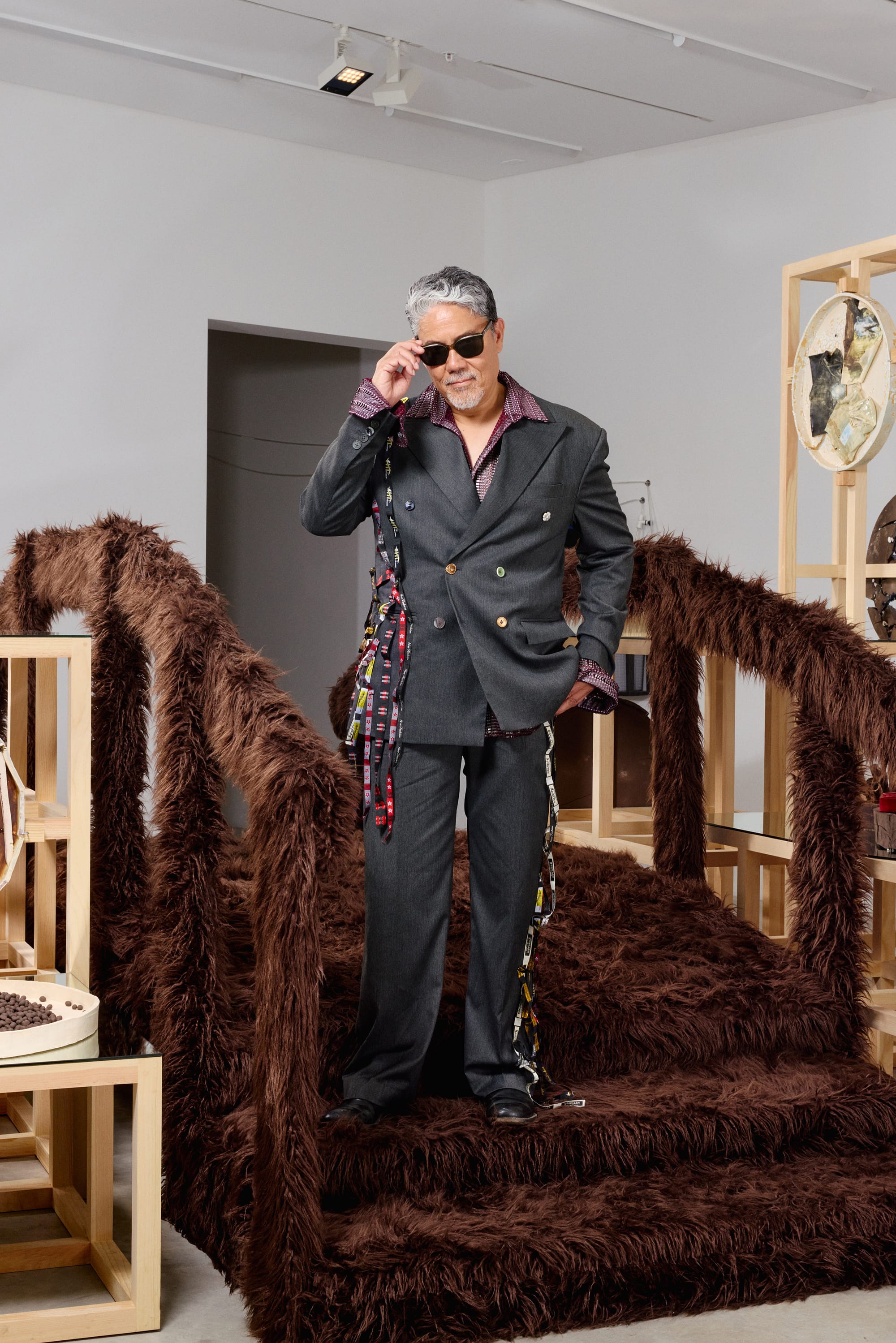
Looks 28 and 37, modeled by FARAH AL QASIMI and PAUL PFEIFFER (left to right), for “CFG-20260717,” 2026. Photo by David Brandon Geeting. Courtesy the artists and Amant, New York.
Where does your impulse to research come from? This particular presentation with Amant and The Kitchen references the No Name Painting Association as well as a history of video art in New York.
DC: When you start researching anything, reality often appears as the result of a series of coincidences, but the point is to try and make sense of it. Our reality is dictated by historical machinations. Figuring out the logic of how things work now by tracing where they came from—that’s what I’m interested in.
TI: To zoom out, as Americans, we’re raised to have the sense that we’re history-less because the US is not very old. But then you go somewhere and hear, “This fountain was built 1000 years ago and people still drink from it every day.” It’s that idea that Americans have no idea why things are the way they are. Even as a diasporic person, you wonder, “How the heck did we end up here?” and want to tease apart everything that happened concretely, and we can see the phenomena. There are these really funny, corny shirts that say “phenomenal Asian” on them. But I think it’s more like phenomenologically Asian. Everything is phenomenological rather than phenomenal.
How did you encounter the No Name Painting Association, and what drew you in? How did they relate to your practice and possibly redirect it toward new directions?
DC: There’s a museum in the West of Beijing called the Inside-Out Art Museum, which is run by Carol Yinghua Lu. They have a partnership with the estate of two of the main members of the Wuming Painting Collective, Yang Yushu and Zhao Wenliang. I went to Beijing in 2024, and we all went together again last year. Both times, there was an exhibition around the No Name Painting Association. We were really drawn to the artworks themselves initially, which then led us to research their collaboration. The paintings were weird.
TI: Before I saw the paintings, someone described to me how two members of the group were lovers, platonic but lovers through art, because they had dedicated themselves to pursuing something together that was forbidden. They had become soulmates bound by shared conviction, and I found that very compelling.
TN: Yes, they were queer, but it wasn’t sexual. There was love.
DC: The thinking of a wider relationship to their dynamic within the collective was interesting for us, because that’s how we also think through CFGNY. So much of our work is about collectivity and collaboration. We saw them as a nice counterpoint to think through how we operate, seeing similarities in a totally different context and history.
TN: A lot of what I read was in relation to how they had experienced something so immense together. With the use of a fashion show we create a structure that is both exhausting and exhilarating. It’s a space where we present ourselves to the public collectively, and after each show everyone walks away closer in conversation. That’s another parallel we were thinking about with the No Name Painting Association: this mode of sociality through a practice. While making exhibitions and performances, we experience our lives collectively alongside the same pressures. Whether it be a personal or economical goal, or our current administration. Of course, what’s going on in the US now is different from what they experienced in China during the Cultural Revolution, but we’re inspired by their will to work with one another and feel related to it.
DC: It was political in the praxis of the group. CFGNY’s politics lies in us being together and creating different registers of relations.
TI: For example, we didn’t realize until things were finalized a few weeks ago that almost a third of our cast and design team was trans. That wasn’t something we necessarily sought out or planned, but it just happened because of who we wanted to work with. It was an apolitical decision that now, in the context of the US, feels like a very political one—not intentionally so, but it’s a lived experience politicized by the forces at play, when all you want is to make art with people.
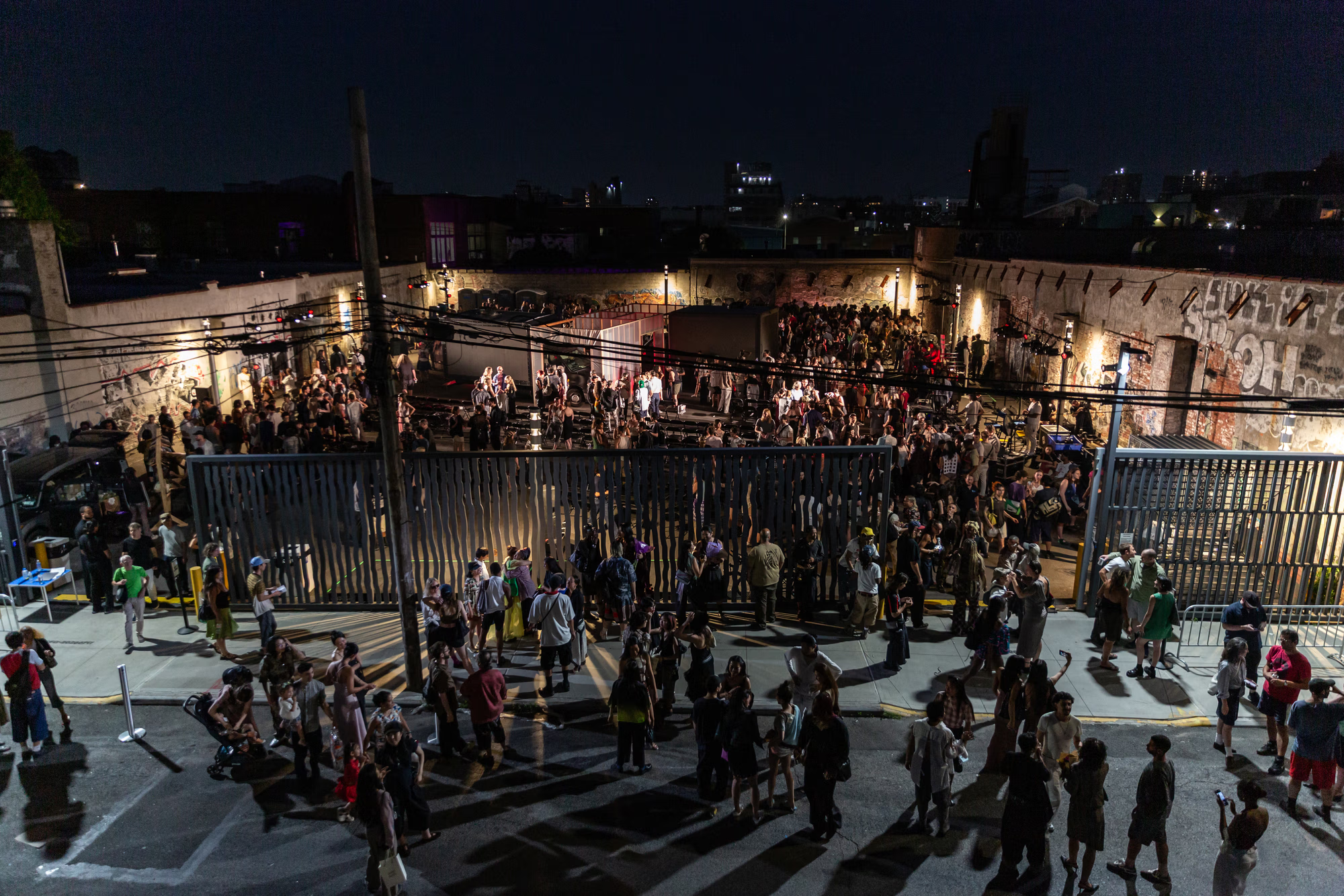
What was the process of planning and staging this fashion show in Amant’s parking lot like? How did it feel after the performance?
TN: It’s very intense.
DC: We had a lot of really talented people, like Joseph Euoi Lee, the Production and Public Programs Associate at Amant, who comes from theater. They were the master of spreadsheets.
TI: The Kitchen, whose entire program is performance and video, had this calm attitude toward production. There were so many distinct actions throughout the show that we didn’t realize it was central to the performance. The three of us have worked together for a very long time, and then suddenly it became one billion other people, and the ball just kept rolling—“Where’s the ball going? We made this big ball,” and then, “We got it. You don’t need to see it.” Just running after it.
TN: I’ve always been inspired by the New York fashion scene and how experimental young brands tend to be. I remember watching Hood By Air videos and going to Telfar shows, and thinking, “They really do mean something to society.” It wasn’t until recently that I felt like, “Oh, we do have a voice here in New York and people seem to care about us too.”
TI: People constantly ask about the relationship between our garment practice and our art practice. Through this performance, the two were presented as a cohesive, continuous thing that keeps rolling around each other. The exhibition at Amant involves collaborations with artists through the ceramics, and a handful of those artists also walk in in the performance. We also made an alternate part of a normal fashion show—a lecture-performance where the performers also functioned as models. A lot of things that we’ve been expressing came together in one commission.
When you say you were obsessed with these young brands, was it the garments? The voice, or a sense of collectivity?
TN: I was into the overall culture that they created and that I also felt like I was a part of. I went to a lot of the parties, wore the clothes because I wanted to support the brands, but what interested me most was what wearing the clothes signified. I came up with a POC and internet scene, and I just identified with it. It felt meaningful because what was most relevant at the time in the art world was German Expressionism.
TI: I was exposed to a lot of this through the internet. Our performance is about the importance of fashion, imagery, social media, and alternative forms of self-imaging. There was a music group called Future Brown that I was really into. It wasn’t a visibility thing. It was the aesthetics and the information that surfaced, the actual vibe that was present.
Can you talk about how you were thinking about the parking-lot space, and how screens and images functioned in the lecture-performance and walk? By the end, Tin, we see a video projected on a truck of you FaceTiming someone in Vietnam, dissolving into an image of motorbikes moving through the city.
DC: A lot of our thinking about digitality came from seeing how early video art techniques inform our phone cameras today. We touched on that because, as video art was developing in The Kitchen, the institution also supported a lot of guerilla-type TV. A subtext to the performance touches on citizen journalism on TikTok. We talk about the Vietnam War, and connect it to the way TikTok has turned the tide on opinion regarding Israel and the war on Gaza, the genocide of Palestinians. Tin calling Vietnam was a reference to our production based there; we wanted a portal to that space. We’re trying to connect the Sony Portapak back to the iPhone, the way video or images could be captured by pedestrians. We wanted to show where we are today on that timeline. We were referencing the motorbike and the images on the truck to think about transportation, which is bound up with how we make our clothes. The concept reflects itself exponentially, and so did the images throughout the performance: an early video art technique in which you take a camera and point it toward a screen.
TI: We often distort space for the viewer, producing a fragmented sense of what’s around them. You can’t really see the action, and everything is mediated through live feeds. At one point, one of the models [Jade Guanaro Kuriki-Olivo] came down from the green room, FaceTiming another model [Diane Severin Nguyen] who held her phone in front of the camera.
What did you learn by stepping into the economy of fashion, whether in terms of production, social relations, or the industry’s value systems?
TN: It was interesting to see how our stylist Avena Gallagher or our makeup artist Souhi Lee played a role within this project. When we shared the script they could relate to the performance because the idea of seeing oneself is universal and within fashion—it’s a topic that drives the industry. Their thoughts really shaped what the work became by the end. Everyone had a very distinct perspective. This made the project difficult because there were so many voices, but in the end it’s about the collective voice, so we continued to shift to make space for that.
TI: That’s the ethos behind why we collaborate, though. We know that the more cooks there are, the stranger and more interesting something can become.
TN: It was very amorphous, changing right up to the last second.
TI: The crux of our work is fluidity, nothing is fixed. And yet you can pinpoint a moment of reality among infinite particles. That’s what interests us.
DC: We’re interested in intervening at certain moments to reveal how malleable something is.
TI: We want to have fun. Why are we here? Let’s have fun with it.
Lily Kwak is a writer and curator based in New York.