Issue
Up Close: Hito Steyerl
In recent years, a deluge of AI “slop” has taken over the internet, marking a new, bizarre chapter in our hyperdigital world. This cyber-sludge has overtaken our feeds, excreting everything from low-quality memes to absurd yet alarmingly naturalistic footage of people that, in fact, are not flesh and blood, but an accretion of hundreds of millions of data points. As generative technologies continue to evolve, spewing out lifelike content that upends our discernment, what remains of the truth? Are we still headed toward a virtualized utopia, or plunging into Baudrillard’s “hell of simulation”?
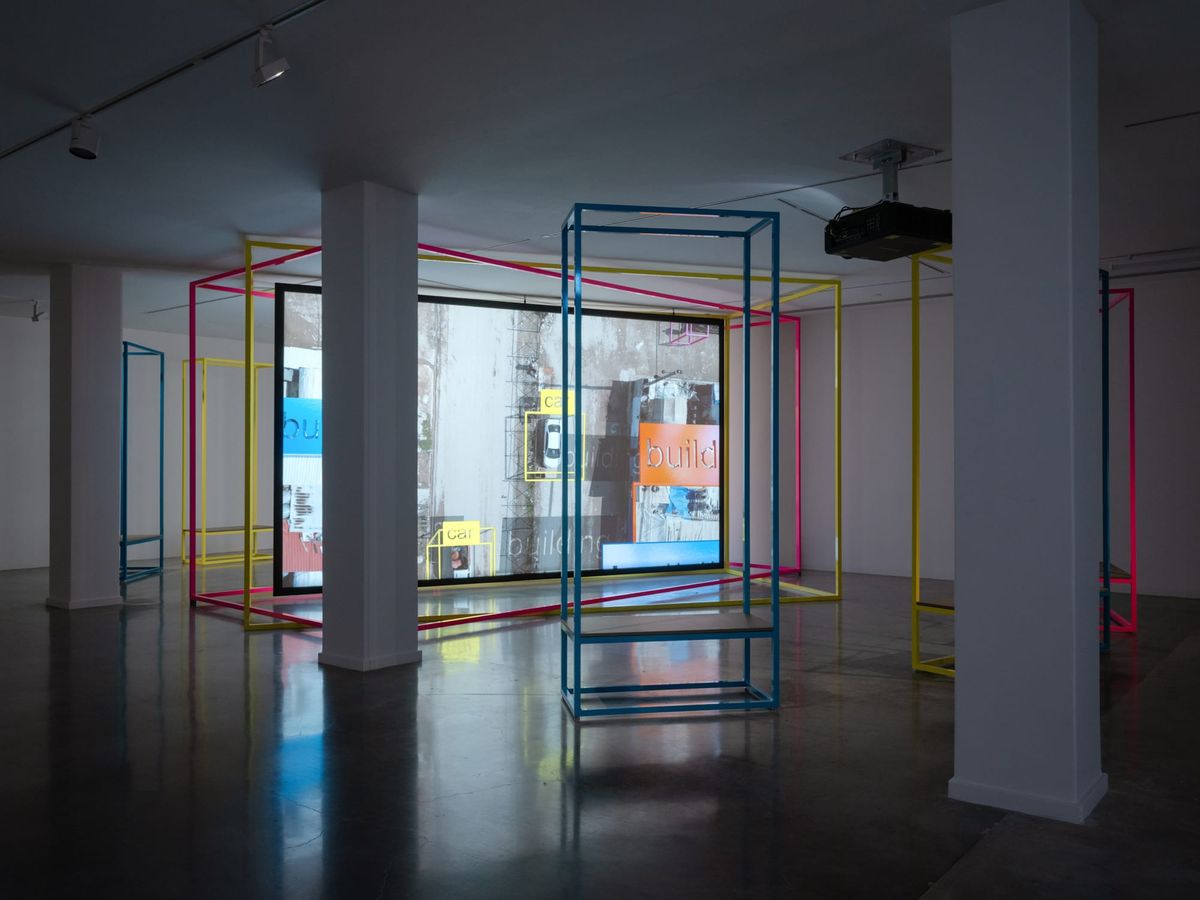
Such questions pervade Hito Steyerl’s practice. The German Japanese artist makes provocative works, often tinged with a mordant sense of humor, that delve into the visual politics of AI and its technofascist underbelly. Her video installation Mechanical Kurds (2025), recently exhibited at Sydney’s Museum of Contemporary Art Australia, explores not only the disturbing potency of supposedly self-running machine-learning programs, but also the human labor that is paradoxically required to sustain them.
The title references the Mechanical Turk, an 18th-century chess-playing automaton that was later revealed to be operated by a person inside it. Steyerl’s work opens with a disembodied female voice singing a haunting melody in Kurdish, as a 3D rendering of the fraudulent contraption floats into the frame. Subsequent documentary-style aerial footage shows a refugee camp in northern Iraq, where displaced Kurds make a living off low-paid data annotation for tech companies that are developing AI-driven military weaponry.