Issue
New York: “Michael Joo: Sweat Models 1991–2026”
Michael Joo
Sweat Models 1991–2026
Space ZeroOne, New York
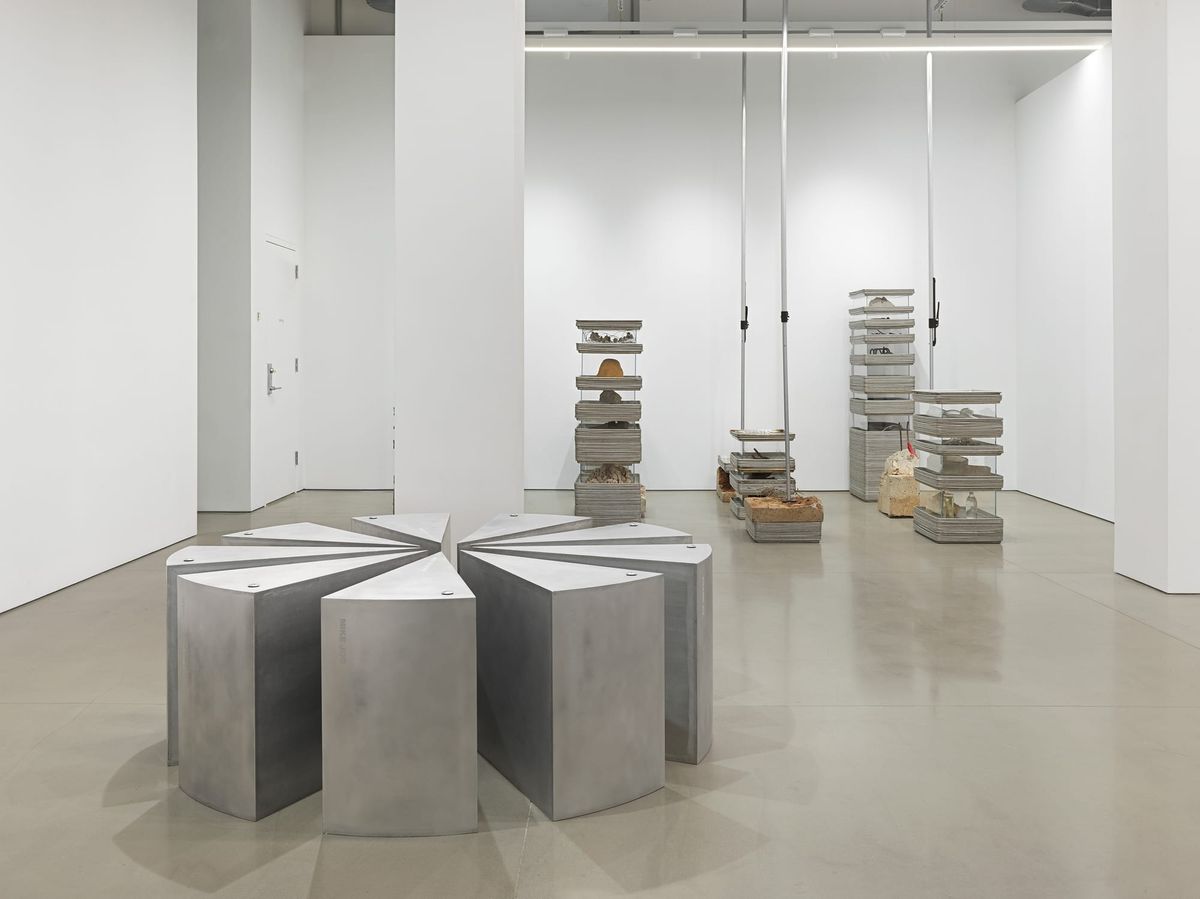
Michael Joo’s early works from the 1990s lure the eye with their shiny aluminum surfaces, while their systemized arrangements suggest the authority of empirical observation. Yet beneath the ascetic nod to Minimalism, these pieces expose the messy reality of indexing the human body.
The impulse to deconstruct, contain, and identify the body—which Joo approaches through processes of collection, distillation, and analysis—emerged amid the AIDS crisis and Culture Wars of the late 1980s and early ’90s, when debates around identity, the body, and morality intensified. The climate spawned now-landmark events like the 1993 Whitney Biennial, a flashpoint for multiculturalism and politics in art. Having just obtained his MFA at the time, Joo entered this landscape with a background in biology and seed science and a keen sensitivity to the possibilities of interdisciplinary practice. His recent exhibition at Space ZeroOne returns to this formative moment, presenting pieces that have not been exhibited for years, alongside others only recently realized and shown for the first time. They take the form of bar graphs, pie charts, and scientific instruments, adopting the austere language of data-driven abstraction.
Yellow, Yellower, Yellowest (1991) presents three beakers of urine lined up on a shelf, each with a label overhead: “Genghis Khan,” “Benedict Arnold,” and “Michael Joo.” “Yellow” functions most plainly as a descriptor of color. Yet the comparative suffixes prompt a hierarchical assessment, while the names racialize the term, turning it into a slur. By grouping himself with a legendary conqueror—known in the popular imagination for his ruthless brutality—and a notorious American traitor, Joo prods his audience to search for a logical relationship among the three figures, while underscoring how systems of classification produce meaning through projection rather than fact.